
Frankfurt, 1848–49: A Constitution Without Command of the Armies
The deputies in St Paul’s Church drafted rights, elections and a German state. The crown they offered to Prussia exposed the distance between writing authority and possessing it.
On 3 April 1849, a deputation from Germany’s National Assembly met King Frederick William IV in Berlin. Its members had elected him Emperor of the Germans. They brought the authority of a constitution drafted in Frankfurt, not an army capable of compelling him to accept it.
The king did not give the visitors the clear acceptance they sought. The Bundesarchiv’s account of that April distinguishes his evasive initial response from his definitive refusal on 28 April. Between those dates, twenty-eight smaller states publicly backed the constitution and urged him to take the crown. The proposal was not a private fantasy shared by a few professors. It had supporters in governments, representative chambers and the wider public. But the largest resources of coercion remained elsewhere.
The encounter makes an unusually sharp starting point for the Frankfurt Parliament’s story. Its failure was not simply that it talked for too long. The deputies were attempting to settle two different questions at once: what rights and institutions a German state should have, and who could make the existing states obey that settlement. Their constitution offered an ambitious answer to the first. It never secured a reliable answer to the second.
A parliament built inside a revolution
There was no unified German state waiting to receive the deputies’ work. The German Confederation linked sovereign states and free cities; Austria and Prussia were its great powers. A national constitution would therefore do more than restrain one ruler. It would redistribute authority among a new centre, existing governments and citizens whose legal positions differed from state to state.
Revolution opened that possibility. In 1848, economic hardship and political opposition combined with the shock of the February revolution in Paris. Demonstrations and barricade fighting forced concessions from German rulers. The Bundestag’s historical overview identifies the lifting of censorship, the appointment of reforming ministries and agreement to a national assembly among those changes. The monarchies had yielded ground; they had not disappeared.
The elected assembly opened on 18 May in Frankfurt. Its electorate was broad by contemporary standards but not universal in the modern sense: women could not vote, and the requirement that adult male voters be independent was administered differently by the individual states. Calling the assembly representative is justified. Calling it the unqualified voice of everyone living within its projected borders is not.
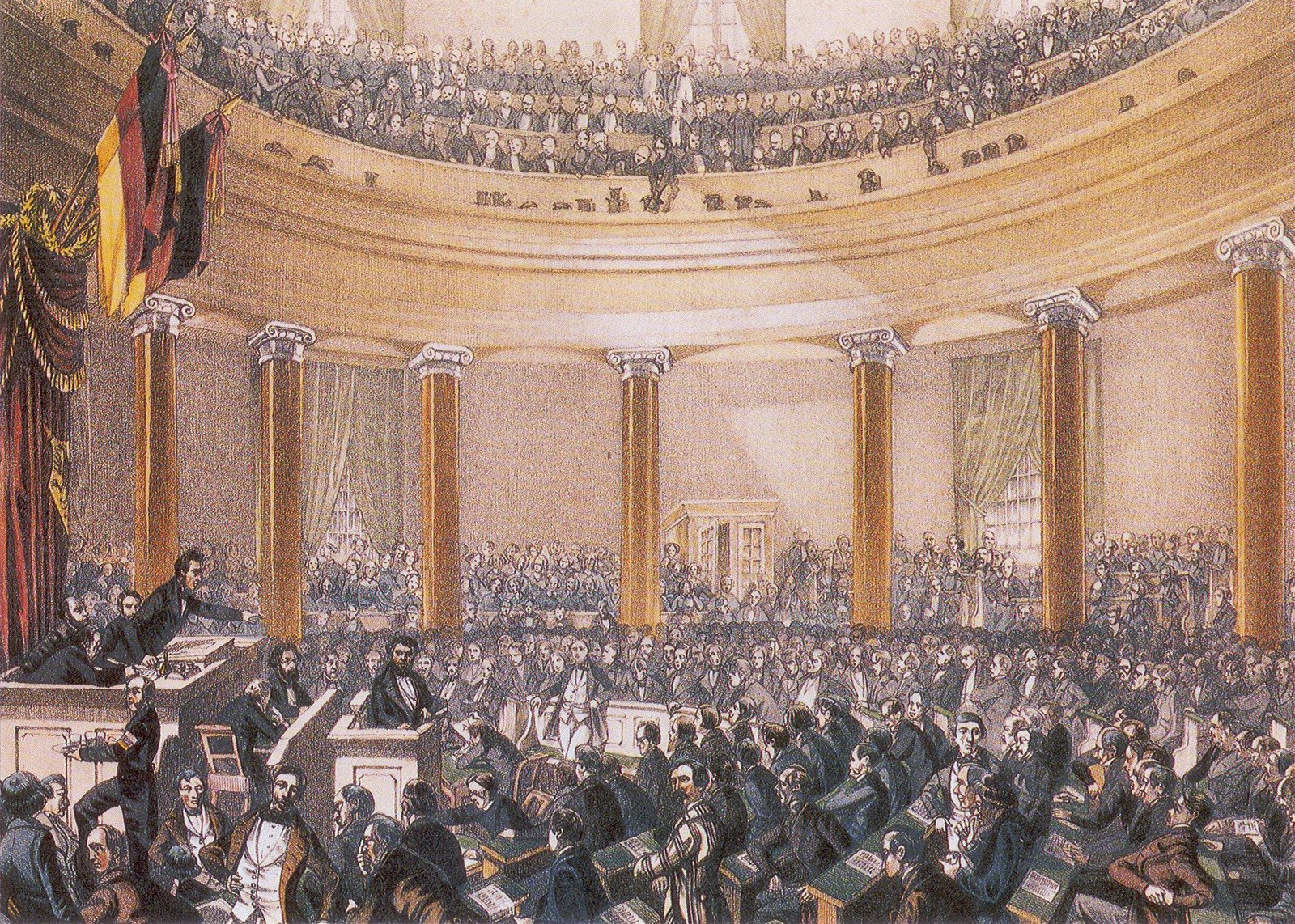
St Paul’s Church became a practical solution to a practical problem. Frankfurt lacked a more suitable large hall. The altar area was converted for parliamentary business, while black, red and gold proclaimed the national movement. The Deutschlandmuseum’s account describes the adaptation of the building. A religious interior became a place in which the nation was publicly represented, even though the nation’s constitutional shape was still under negotiation.

Neither one party nor one programme
The seated assembly in contemporary prints can look like a single body with a single purpose. The debates reveal something less tidy. Deputies had to decide whether the new order should be a republic or a constitutional monarchy, how far the vote should extend, and how executive power should answer to representatives. Agreement on the need for change did not mean agreement on its destination.
There were no modern mass political parties ready to organise all this work. Parliamentary clubs emerged around shared convictions and often took their names from Frankfurt meeting places. The German Historical Institute’s presentation of the assembly explains these early factions. Coalition-building was not an embarrassing distraction from constitution-making. It was how a heterogeneous body could produce decisions at all.
The range of possible revolutions is visible in Gustav von Struve’s March 1848 programme. Before the elected assembly met, he demanded republican government, wider civil liberties, progressive taxation and measures addressing the relationship between labour and capital. He also proposed replacing standing armies with a popular militia. The last demand touched the problem that would eventually overwhelm Frankfurt: a constitutional revolution needed a different relationship between political authority and armed force.
Struve’s programme was a proposal, not the programme adopted by the whole National Assembly. Its importance is precisely that distinction. A hereditary emperor under a written constitution was one contested outcome among others, not a national consensus that the deputies merely transcribed.
What the rights were meant to change
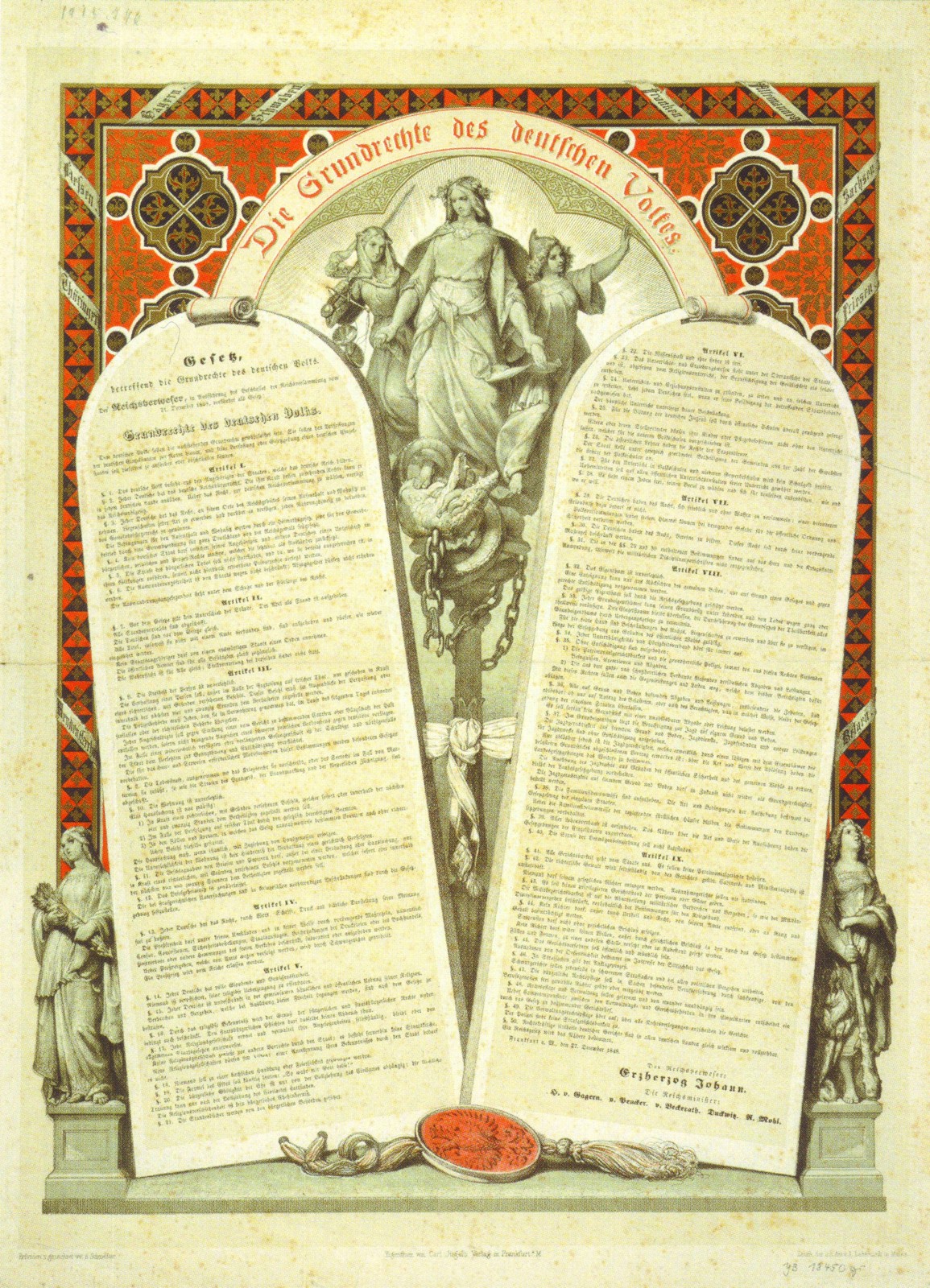
Frankfurt’s lasting achievement was not confined to the title at the top of the state. The fundamental-rights law adopted in December 1848 attempted to make liberties enforceable principles rather than favours granted at a ruler’s discretion. Its guarantees addressed equality before the law, personal freedom, belief, expression, assembly and association. The Bundestag traces this catalogue into the constitution completed the following March.
These provisions connected constitutional language with ordinary encounters with authority. Could an official suppress a newspaper before publication? Could religious affiliation determine access to civil rights? Could birth confer a privileged legal status? Such questions help explain why rights occupied so much time. The deputies were not decorating a state that already existed. They were trying to determine how its power would be experienced.
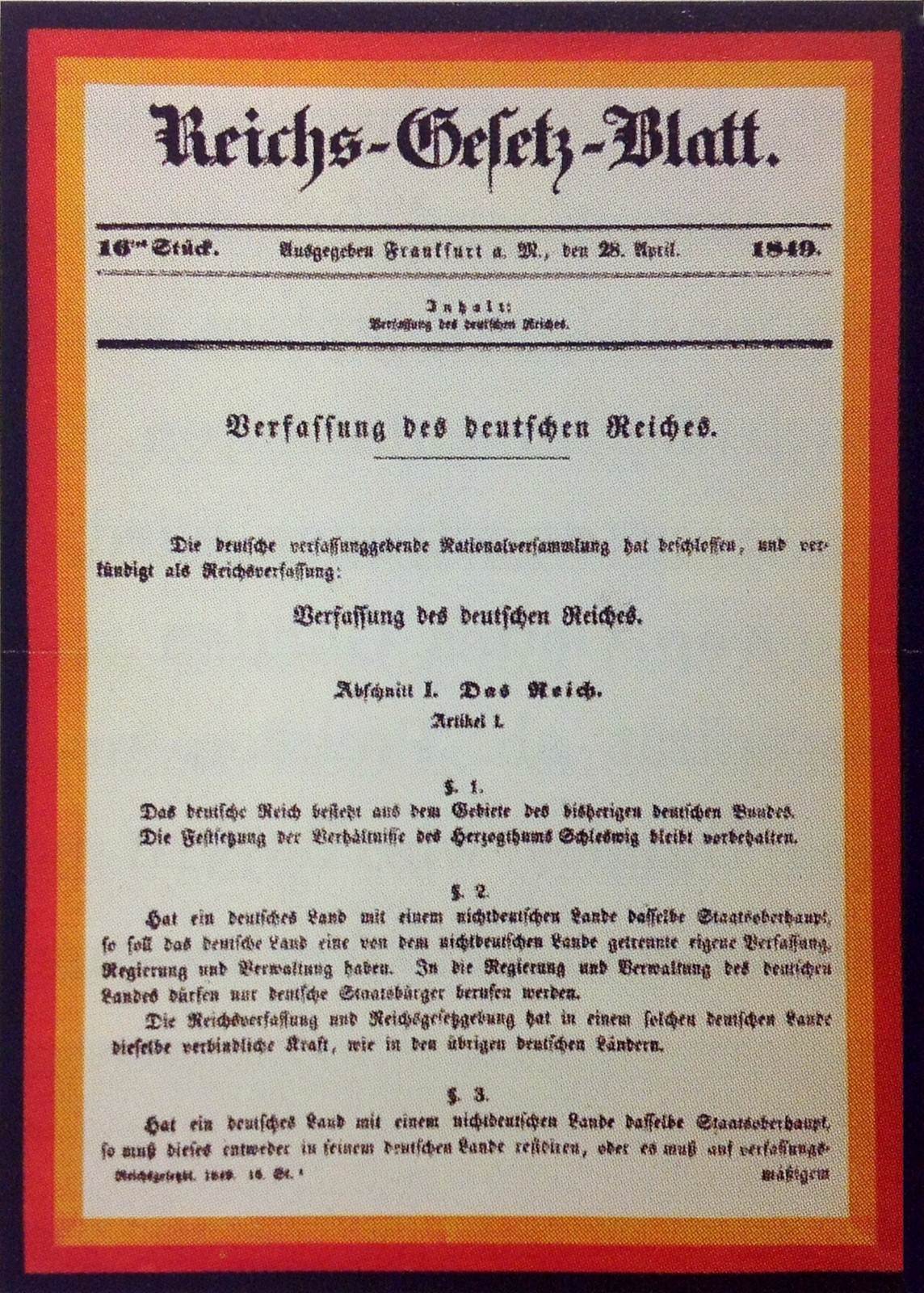
The constitutional text also shows the ambition to bind government through institutions. It projected a national legislature with a chamber of states and an elected popular chamber, as well as a supreme imperial court. A hereditary head of state would coexist with representative lawmaking and budgetary powers. The resulting structure was a negotiated mixture, not a straightforward copy of either a republic or an absolute monarchy.
The limits matter as much as the achievement. The political community remained male at the ballot box. National equality could also collide with the difficulties of drawing a German state across territories inhabited by different linguistic populations. Rights were not a magic device that made those conflicts disappear. They were a framework whose claims still had to be reconciled with borders, sovereignty and actual enforcement.
That is why the distinction between a rights law and its implementation is essential. Declaring a liberty to be law was a substantial act. Making every state authority respect it required courts, officials and governments willing—or compelled—to recognise the national settlement. Frankfurt was strongest in articulating that settlement and weakest in commanding the machinery needed to secure it.
The Austrian question and the Prussian crown
Austria made the map inseparable from the constitution. Including the German-speaking Habsburg lands while excluding the monarchy’s other territories would require breaking apart a state whose rulers insisted on its integrity. Including the whole empire would produce something quite different from the German national state many deputies imagined.
The Deutsches Historisches Museum’s account explains how these pressures strengthened the smaller-German solution, excluding Austria and placing Prussia at the centre. In March 1849, a hereditary imperial office and a strong representative element were joined in the final compromise. The constitution was adopted on 27 March and dated 28 March, the day the assembly elected the Prussian king emperor.
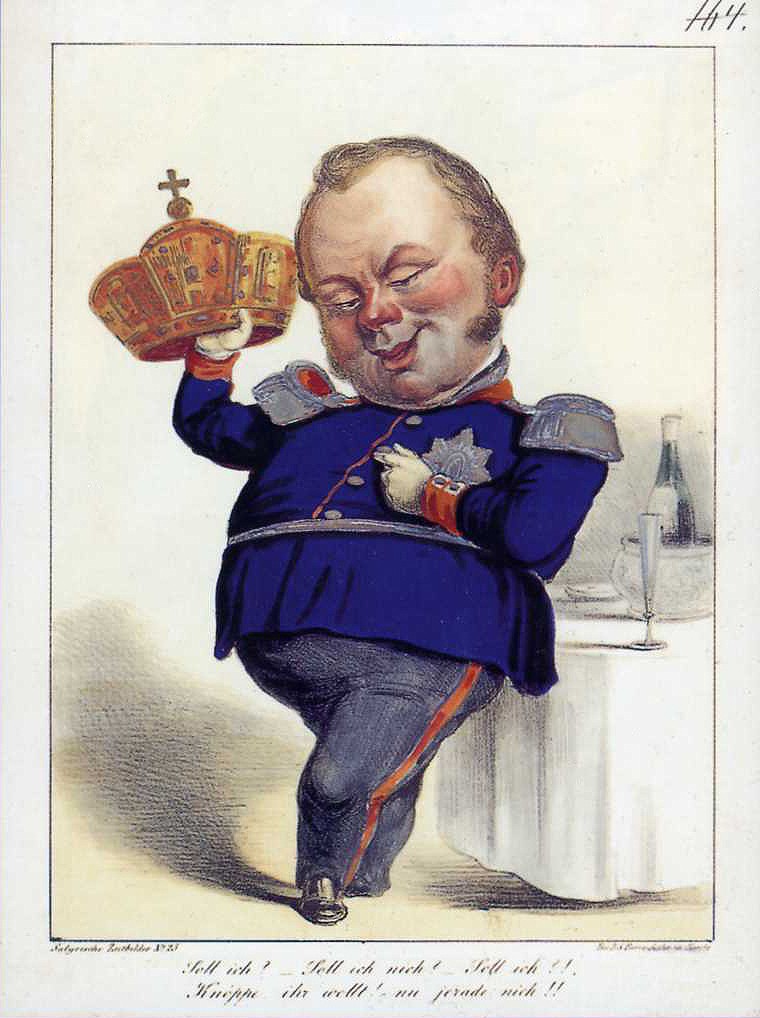
Offering him the office was an attempt to attach the new constitutional order to an existing monarchy with substantial power. It also handed a decisive choice to a ruler who disputed the assembly’s right to confer that authority. Frederick William’s objection concerned the source of the crown: a popularly elected parliament could not, in his understanding of monarchy, simply make him emperor. The same act that liberals saw as national legitimation appeared to him as an unacceptable revolutionary origin.
The famous refusal can therefore mislead if treated as one man’s theatrical insult that suddenly destroyed a healthy parliamentary project. By April, the balance had already shifted. The rights and institutions being finalised in Frankfurt existed alongside governments recovering the ability to reverse the concessions of spring 1848.
The force behind the refusal
Robert Blum’s death had demonstrated the danger months earlier. A democratic deputy, he went to Vienna and participated in the defence of the city during its uprising. Austrian authorities arrested him; his claim to parliamentary immunity did not protect him. He was executed on 9 November 1848. The Bundesarchiv preserves the episode through the sentence and his final letter. Frankfurt could protest, but it could not make the imperial authorities reverse their course.
The same imbalance shaped the final collapse. Some deputies were recalled by their governments, while others withdrew as the constitutional project lost its prospects. A reduced assembly moved to Stuttgart. On 18 June 1849, Württemberg troops dispersed it. Armed efforts to defend the constitution elsewhere were also defeated. The ending was not merely a debating chamber losing interest. Governments used organised force against institutions and movements that challenged their authority.
None of this proves that another parliamentary timetable would necessarily have succeeded, or that armed revolution offered an easy solution. The deputies faced incompatible demands and states with very unequal resources. Their vulnerability lay in depending on consent from governments whose power the constitution would limit. A coalition could be assembled for a vote more readily than for the sustained transfer of sovereignty that the vote required.
The constitution nevertheless outlived its defeat as a document and a political reference. The Bundestag’s study of the surviving original follows its preservation and its later place in German constitutional memory. Subsequent democratic constitution-makers drew on Frankfurt’s rights tradition. That afterlife should not turn 1849 into an inevitable stepping stone toward a predetermined future. The immediate outcome was defeat, and its costs were borne by people who could not know what later generations would recover.
The Berlin deputation had carried a serious constitutional offer. What it lacked was the ability to decide who must accept it. Frankfurt’s story becomes clearer when those two facts are held together: the assembly created more than an eloquent failure, but less than a state capable of defending the order it had written.