
Magna Carta and the Failed Peace That Outlived King John
The charter of 1215 failed to stop a civil war. Its revisions, exclusions, and later reinterpretations explain how that broken agreement became a lasting language of lawful government.
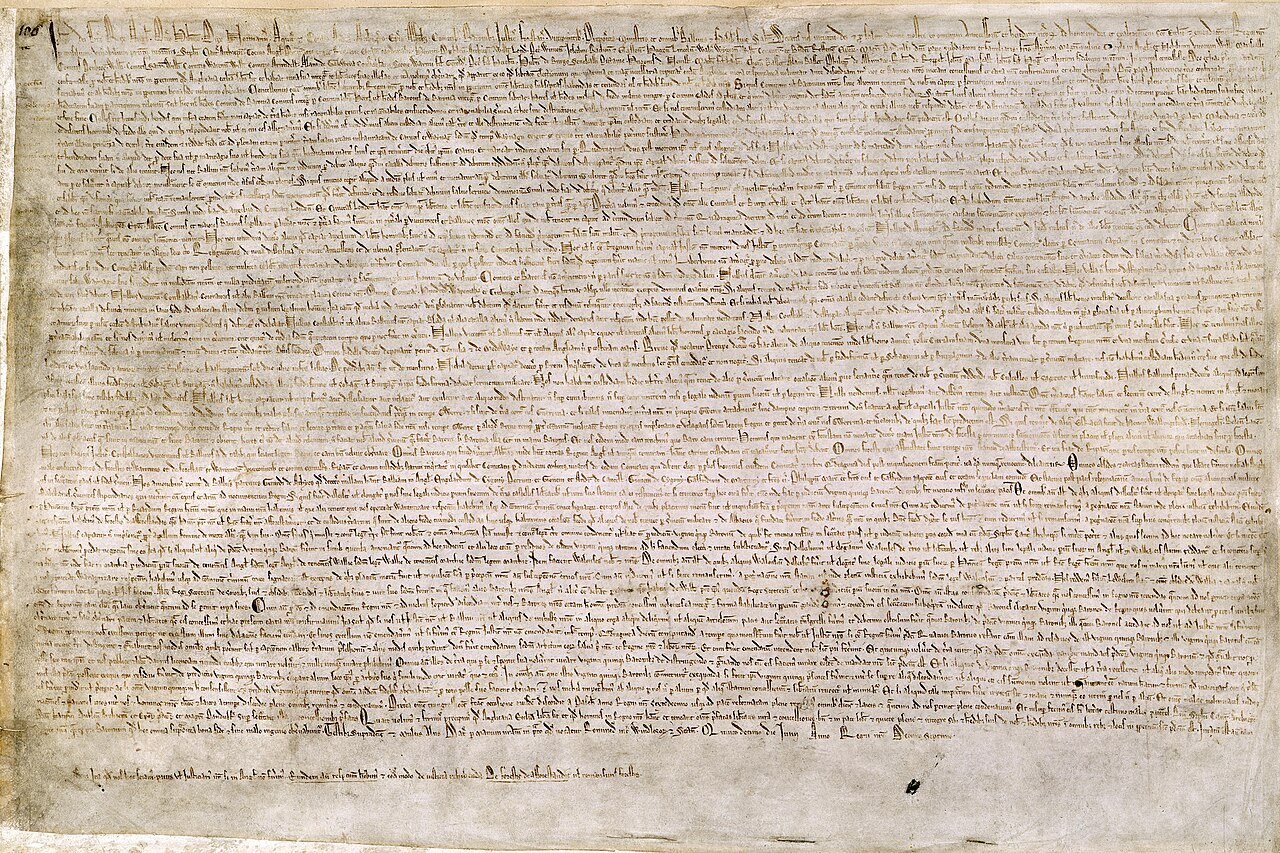
The parchment does not look like a revolution. Dense lines of Latin run across its surface, recording inheritance payments, debts, royal officials, courts, merchants, and grievances with names attached. The famous promises about justice sit among the business of a troubled medieval kingdom. In June 1215, the agreement now called Magna Carta was intended to make peace between King John and opponents who no longer trusted his government.
That peace failed within weeks. The charter was repudiated, the pope annulled it, and war resumed. Yet versions of the document survived the crisis, acquired legal authority, and became resources for arguments their original negotiators could not have anticipated. Magna Carta’s history is most revealing when its immediate failure and its extraordinary afterlives are considered together.
The road to Runnymede
John’s position had weakened after the failure of his French campaign in 1214. The defeat of his allies at Bouvines ended an expensive effort to reverse the expansion of Philip II’s power. Military disappointment sharpened existing anger about royal finance and the exercise of authority. By spring 1215, a group of barons had moved from resistance to rebellion. Their entry into London in May gave them a major advantage and helped force negotiations. the National Archives’ document collection
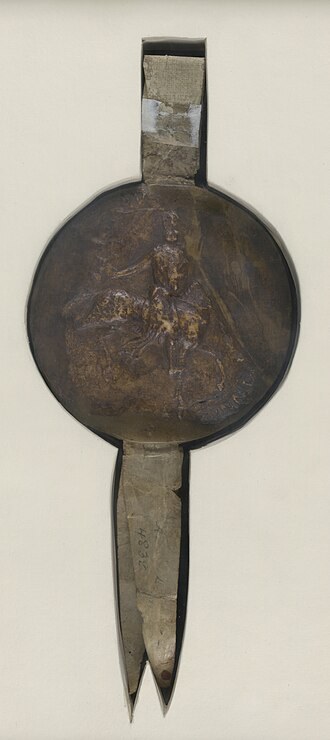
Runnymede, beside the Thames between Windsor and London, became the setting for those negotiations in June. What happened there was a process of bargaining, not a fully recorded ceremonial moment. The surviving Articles of the Barons preserve an important stage in that process: a list of demands and concessions, authenticated with John’s seal. The charter that followed gave the agreement a fuller and more formal expression. the surviving Articles of the Barons
The distinction matters because later illustrations so often show John sitting down to sign one great original document. Medieval royal charters were authenticated by sealing. The Early English Laws project notes that there is no evidence for a single Magna Carta ceremonially written and sealed at the meeting itself. Several engrossments, or formally written copies, were issued. Four from 1215 survive, each an original witness to the document’s distribution rather than a photocopy of one master parchment. the Early English Laws project
The text is dated 15 June. The barons renewed their allegiance several days later. Those dates mark an attempt to restore a working political relationship. They did not erase the distrust that had brought armed opponents to the negotiating table. The practical question was whether written commitments could constrain a ruler who retained the resources and incentives to resist them.
What the negotiators put on parchment
Much of Magna Carta addressed the points at which royal power touched property and livelihood. Its provisions dealt with payments due on inheritance, the management of estates during an heir’s minority, debts, and the conduct of officials. It protected certain urban liberties and regulated matters such as measures used in trade. These details can seem remote beside the charter’s modern reputation, but they were precisely what made an agreement meaningful to people living under John’s rule. the 1215 charter in translation
A royal demand was not merely an entry in a constitutional theory. It might affect whether an heir could take possession of land, whether a household could retain resources, or how quickly a dispute reached judgment. By giving familiar grievances a written form, the charter created standards against which particular acts could be challenged. Its mixture of general promises and narrow remedies reflected the coalition that had produced it.
Widows received specific attention. Clause 7 protected a widow’s access to her marriage portion and inheritance and allowed an initial period of residence in her husband’s house. The following clause addressed pressure to remarry, though the conditions of lordship still qualified her freedom of choice. Such provisions offered real protections within a hierarchical society. They did not establish equal political or legal status for women and men. clause 7’s provision for widows
Nor is it accurate to say that the charter concerned barons alone. Clause 20 limited amercements, monetary penalties imposed by courts, and sought to preserve the means of livelihood of free men, merchants, and villeins. The last group consisted of unfree tenants. Their appearance is significant, but the clause did not abolish unfreedom or make every protection available to everyone. The breadth of a particular provision should not be confused with a declaration of universal citizenship. the Magna Carta Project’s commentary on clause 20
The treatment of Jewish lending provides another necessary qualification. Clauses concerning debts to Jews protected Christian heirs and widows while singling out Jewish creditors in a society already marked by religious discrimination. The document did not promise equal rights across religious communities. Reading those provisions alongside the better-known language of justice reveals both the charter’s reach and the exclusions built into its setting. the commentary on clause 11
The words later readers made famous
Two provisions, conventionally numbered 39 and 40, became especially influential. Clause 39 restricted actions against a free man’s person or property unless justified by lawful judgment of his peers or by the law of the land. This challenged arbitrary coercion, but its terms belonged to contemporary procedures and social distinctions. “Peers” meant equals in status; the wording did not simply introduce the modern jury trial. the scholarly commentary on clause 39
That difference is not a reason to dismiss the clause. It is a reason to understand how legal language can endure while institutions change around it. A promise framed within thirteenth-century law could supply later generations with words for broader claims. Its subsequent power depended partly on the capacity of readers to apply it to circumstances very different from those of the original bargain.
Clause 40 promised that right and justice would not be sold, refused, or delayed. The Magna Carta Project’s commentary places this within a history of payments and royal discretion in the administration of justice. The issue was concrete: access to a remedy could become entangled with a ruler’s financial demands or personal choices. A short formula drew several complaints together in a way that later readers could remember and reuse. the commentary on clause 40
Modern clause numbers make these passages easy to isolate. On the original parchment, however, the text ran continuously. The document’s later fame has partly depended on extracting certain sentences from their surroundings. Those sentences genuinely mattered, but their prominence can hide the political machinery intended to make the entire settlement work.
The enforcement problem
The most confrontational machinery appeared in clause 61. Twenty-five barons were to oversee observance of the agreement. If a grievance was not remedied through the specified process, they could seize royal castles, lands, and possessions to compel compliance, while leaving the persons of the king, queen, and their children unharmed. This amounted to an attempt to organize coercion against the crown within the terms of a peace. the charter’s security clause
The provision captures the difficulty the negotiators could not solve with elegant wording alone. A promise by the king might be worthless without enforcement. Yet enforcement by an armed group of his opponents threatened the authority he understood himself to possess. The arrangement required cooperation between people preparing for the possibility that cooperation would break down.
Clause 60 extended the logic of concessions down the hierarchy, requiring other lords to observe the granted liberties toward their own men. But, as the Magna Carta Project points out, the security mechanism focused on violations by royal government; it did not provide an equivalent machinery to correct the barons themselves. This asymmetry exposes the settlement’s political structure. The king was being constrained by powerful subjects who did not propose to surrender all their own advantages. the Magna Carta Project’s account of clause 60
By August, Pope Innocent III had declared the charter void. John’s relationship with the papacy gave the conflict an international and ecclesiastical dimension, and the pope rejected an agreement imposed on the king under coercion. The National Archives dates the annulment documents to 24–25 August 1215. Civil war resumed that autumn. The text associated with the beginning of liberty had failed in its most immediate purpose: keeping the parties at peace. the National Archives’ charter chronology
Survival through revision
John died in October 1216 while the conflict was still unresolved. His young son became Henry III. The government acting for the new king reissued a revised charter in November, presenting an alternative to continued resistance against the dynasty. A concession that had been intolerable to John could be useful to those trying to secure his son’s throne. Survival depended on political reuse as well as on principle. the National Archives’ account of the reissues
Further revision followed in 1217, when the settlement of the war gave the charter a more durable setting. The Charter of the Forest separated out important matters of forest government. In 1225, Henry issued the version that became the standard later text, in connection with a grant of taxation. The sequence matters: the Magna Carta that acquired lasting authority was not simply the document of June 1215 preserved unchanged. Its force grew through repeated commitments and altered terms. the National Archives’ charter chronology
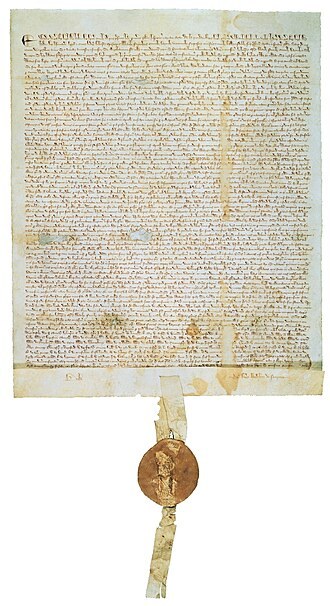
The security clause disappeared from the reissues. That omission helped reconcile the charter with continuing royal government, while many constraints and promises survived. In 1297, under Edward I, the revised charter entered the statute roll. The story therefore moved from an unstable peace agreement toward a recognized part of the kingdom’s law. Later generations inherited both a text and a record of occasions when kings had been pressed to confirm it. Parliament’s historical guide
A charter for arguments still to come
In the seventeenth century, Edward Coke read Magna Carta as a declaration of ancient English liberties. He treated its language as a powerful authority in disputes over the limits of royal action. The Library of Congress’s exhibition on the charter emphasizes the importance of this interpretation. Coke’s Magna Carta was shaped by the political and legal questions of his own age, not merely recovered intact from the intentions of 1215. the Library of Congress exhibition on interpretation

This reinterpretation helped give the charter a place in arguments surrounding the Petition of Right in 1628. The point was no longer only whether John had respected particular feudal customs. Opponents of arbitrary rule sought historical foundations for claims about taxation, imprisonment, and the relationship between king and law. Magna Carta furnished an authoritative vocabulary, although applying that vocabulary still required contest and interpretation.
Across the Atlantic, colonists also invoked the charter in arguments about inherited liberties and fundamental law. Its influence passed through English legal writing, political practice, and colonial disputes. The Library of Congress traces how that tradition contributed to later constitutional understandings of rights and limits on government. The route was neither straight nor automatic: a medieval agreement became useful because new communities invested it with new purposes. the Library of Congress account of the American legacy
The monument at Runnymede makes that long journey visible. Designed by Edward Maufe and erected by the American Bar Association in 1957, it belongs to a twentieth-century language of law and liberty. It is a memorial to the charter’s significance across time, rather than evidence of the exact spot or appearance of the negotiations. Like the paintings of John with a pen, it tells us something about how later societies wanted to remember the event. Historic England’s record of the monument

Magna Carta’s importance does not require making its barons modern democrats or treating its first issue as a success. The charter was narrow in some protections, unexpectedly broad in others, and unable to end the crisis that produced it. Its survival came through revision, confirmation, and political need. Its larger meaning came through argument. That history explains how a failed peace could become one of the most enduring resources for insisting that power must answer to law.
Sources and further reading
- The National Archives, Magna Carta 1214–1225 Military failure, baronial revolt, London, negotiation, and tax grant context. Documents distinguish narrative from contemporary records.
- British Library, Add MS 4838, Articles of the Barons Negotiating document and surviving royal seal. No claim that a single ceremonial master charter was signed.
- Early English Laws, Magna Carta 1215 No evidence for a single document ceremonially sealed at Runnymede; surviving engrossments and legal text.
- Magna Carta of 1215, English translation, BAILII Broad contents: inheritance, guardianship, cities, measures, royal officials. No long quotation used.
- Museum of Australian Democracy, Magna Carta, clause 7 Dower, inheritance, and widow’s initial residence; clause 8 qualifies remarriage rights.
- Magna Carta Project, clause 20, commentary Amercements and protection of livelihood for freemen, merchants, and villeins; social reach with limits.
- Magna Carta Project, clause 11, commentary Debts, widows, heirs, and discriminatory singling out of Jewish lenders; no equal religious citizenship.
- Magna Carta Project, clause 39, academic commentary Lawful judgment of peers or law of land; not an explicit creation of modern jury trial or habeas corpus.
- Magna Carta Project, clause 40, commentary Royal selling/delay of justice; antecedents and significance.
- Museum of Australian Democracy, Magna Carta, clause 61 Twenty-five barons, enforcement by seizure, king and family protected. No claim this establishes modern right to defy law.
- Magna Carta Project, clause 60, commentary Concessions extended down lordship hierarchy; security clause lacks parallel mechanism against barons.
- The National Archives, Magna Carta Failure in 1215, revised reissues and 1225 confirmation.
- The National Archives, Magna Carta 1259–1306, historical timeline Papal annulment 24–25 August 1215; reissues 1216, 1217, 1225; Charter of Forest 1217. Avoid exact disputed day of John’s death.
- UK Parliament, Magna Carta and Parliament 1297 statutory enrollment and early modern political uses, including Petition of Right.
- Library of Congress, Interpreting the Rule of Law Edward Coke’s reading as ancient rights and reinterpretation.
- Nathan Dorn, Celebrating Magna Carta’s Birthday (Library of Congress, 2021) Fundamental law, colonial claims, later constitutional uses; does not claim automatic transmission of universal rights.
- Historic England, Magna Carta Monument, list entry 1430723 1957 American Bar Association memorial by Edward Maufe; modern commemoration.