
Power & Politics
Venice’s Elected Prince: How the Republic Restrained Its Doge
An elaborate election, a binding oath and watchful councils gave Venice a splendid head of state while keeping its doge inside an oligarchic republic.
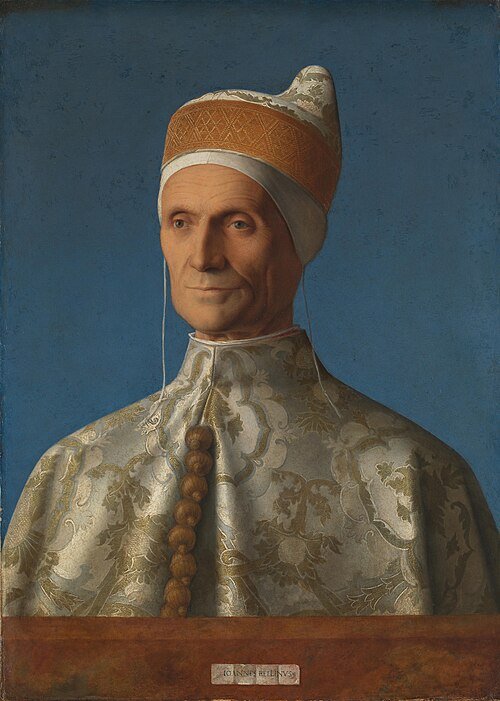
Giovanni Bellini’s portrait of Leonardo Loredan gives the ruler of Venice an almost sculptural stillness. His patterned ceremonial robe catches the light; the distinctive ducal cap rises above an impassive face. Painted about 1501–1502, shortly after Loredan’s election, the picture presents an office clothed in princely dignity. Yet the man who wore those clothes could neither bequeath Venice to a son nor treat its government as his household. The National Gallery’s account of the portrait also supplies a useful caution: this celebrated image was probably a private commission, not one of the official portraits in the palace.
The doge embodied a republic whose governing families had spent centuries narrowing his freedom of action. He served for life, presided over councils, received ambassadors and represented the state in magnificent ceremonies. Around him stood oaths, electoral procedures and overlapping institutions designed to keep a distinguished citizen from turning his office into a dynasty. Their achievement was real, but its beneficiaries were unequal. Venice restrained its chief magistrate while concentrating political membership in a hereditary elite.
An office older than the system that contained it
The title descended from the Latin dux, a military commander, through Venice’s early relationship with the Byzantine world. The office did not begin as the carefully limited magistracy visitors now imagine. Early doges possessed substantial personal authority, and the struggle to prevent familial succession unfolded over generations. A Cambridge history of the doges places their transformation from rulers with monarchical ambitions toward more constrained leadership between the ninth and thirteenth centuries.
This long chronology matters. The republic’s later constitution was an accumulation of responses to particular dangers rather than a single founding design. Mercantile wealth created powerful families whose members needed public institutions to protect trade, conduct diplomacy and organize war. They also wanted protection against one another. A ruler able to use the state entirely for his own lineage would threaten the position of every other lineage.
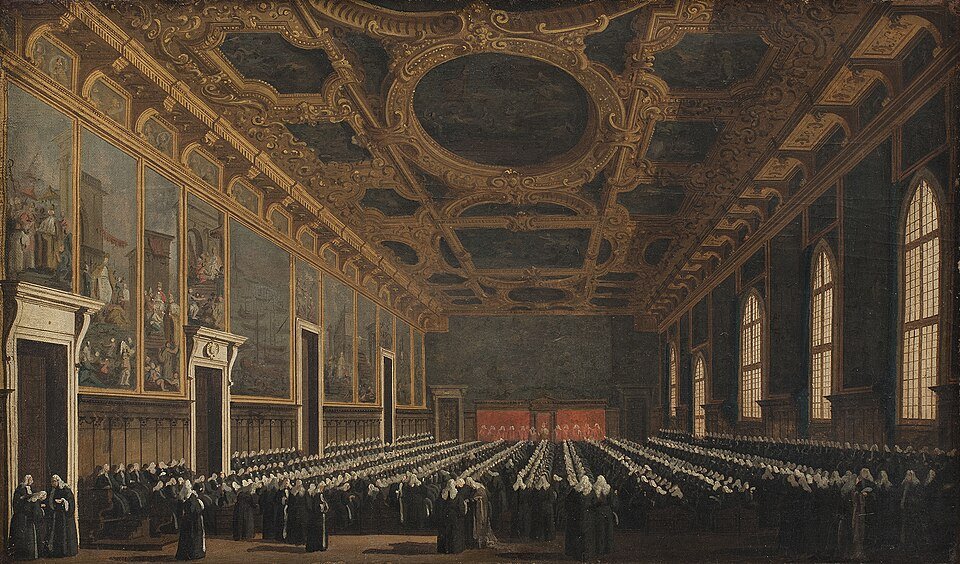
The Doge’s Palace historical account describes the gradual reduction of ducal authority and the growth of councillors and binding commitments. The palace itself eventually gave this collective government a physical form. Its rooms accommodated deliberation, administration and judgment as well as the doge’s residence. A visitor moving through the building encountered an institutional landscape, not simply the apartments of a sovereign.
Commercial expansion and constitutional development were closely connected, although they did not move permanently toward greater openness. Diego Puga and Daniel Trefler’s research on trade and institutional change traces an earlier widening of participation followed by the consolidation of wealthy groups. The men who demanded constraints on a ruler could subsequently erect constraints on admission to their own ranks.
Choosing the man whom nobody should control
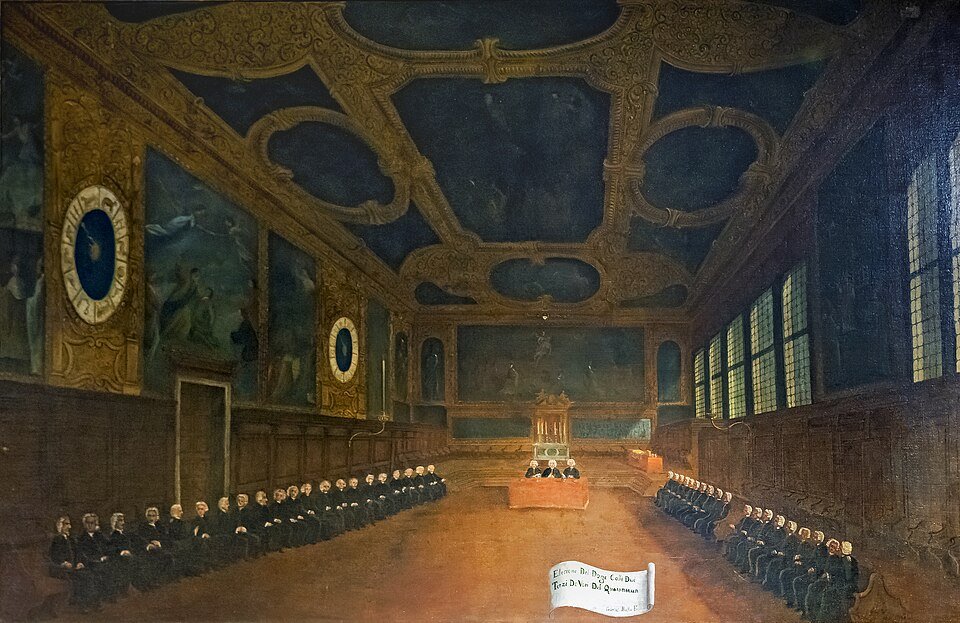
By 1268 Venice had established the celebrated multistage electoral procedure used, with its historical context and practical adjustments, for the rest of the republic’s existence. It combined drawing lots with voting in successive committees. The purpose was to make the final result harder for a ready-made faction or one family to capture.
From the eligible Great Council membership, thirty were selected by lot and reduced by lot to nine. Those nine chose forty, who were reduced by lot to twelve. The twelve chose twenty-five; lot reduced these to nine. Those nine selected forty-five, reduced by lot to eleven. The eleven selected the final forty-one electors. A candidate needed at least twenty-five votes in that last body. Miranda Mowbray and Dieter Gollmann set out this sequence in their academic analysis of the Venetian election protocol, including restrictions intended to limit family concentration within the selecting bodies.
The numbers were cumbersome, but the repeated changes of personnel were the point. A faction could not simply know the decisive electors from the beginning and approach them all in advance. Lot disrupted predictable control; voting restored deliberation after each disruption. The procedure mixed uncertainty with negotiated consent.
It would be a mistake to treat a modern mathematical analysis as proof that historical elections were incorruptible. Models depend on assumptions about alliances, behavior and the information available to participants. Venetian nobles knew one another, negotiated and competed. The system complicated factional management; it could not remove politics from an election. Nor did the use of lot turn the selection of the doge into a vote of the whole population.
The republic’s boundary ran through its citizens
The Great Council was the foundation of the governing order. Its membership supplied the patriciate from which major offices and electoral bodies were drawn. The process commonly called the Serrata, conventionally associated with 1297, progressively made access to that political body hereditary. Scholarship examining its justification follows a sequence extending through 1297–1323, rather than a door slammed shut in one unchanging act.
A family’s place within the ruling body became an exceptionally valuable inheritance. Men outside it could be merchants, skilled administrators, craftsmen or sailors indispensable to Venice without acquiring the same political rights. Women were excluded from the formal offices discussed here. The republic could command the resources of a populous city and a substantial territorial state while reserving decisive deliberation to a much narrower group.
The evidence for that group is unusually rich. Puga’s research dataset on medieval Venetian families brings together council participation, commercial contracts and marriage connections across different periods. Such records help recover the networks behind constitutional labels. A patrician was not merely a name on an electoral list: kinship, capital, partnerships and reputation connected him to other men seeking office.
The doge’s election therefore settled a problem inside an oligarchy. Which member could be elevated above his peers in public dignity without becoming their master? The ritual complexity expressed distrust of concentrated personal control, but it also expressed confidence that government properly belonged to the assembled governing families.
An oath that accompanied the office
Election did not release the winner from institutional supervision. The promissione ducale, the oath of office, enumerated obligations and limits. Its terms could be revised as the republic identified new opportunities for abuse. The State Archive of Venice’s presentation of the ducal oath explains that the earliest surviving example belongs to Enrico Dandolo’s late-twelfth-century dogeship; it also displays Jacopo Tiepolo’s oath of 1229. The doge was required to keep a copy available to remind him of his duties.
The survival of an oath is not evidence that earlier rulers had no obligations. It marks what can be documented, not necessarily the invention of restraint. Equally, the length or severity of a promise cannot by itself establish how faithfully it was observed. Its significance lies in making the ruler answerable to a written definition of his office, which his fellow governors could invoke.
According to the National Gallery’s explanation of the dogeship, even the disposal of state money was restricted. Ceremonial preeminence did not confer a private treasury. Public authority belonged to institutions whose decisions the doge helped articulate and execute.
This did not make every doge equally unimportant. Experience, eloquence, family connections and the prestige of long service could all influence collective decisions. A magistrate who sat at the center of deliberation for many years had opportunities unavailable to someone holding a short appointment. The distinction is between influence within the governing system and a lawful entitlement to govern alone.
The palace’s account of its rooms and collections helps make that distinction visible. Great Council, Senate, Collegio and judicial bodies had their own spaces and functions. The presence of so many institutions under one roof conveyed the republic’s public identity while obliging its officers to encounter one another. Architecture advertised authority and divided its exercise.
Security could restrain a prince and frighten a patrician
The limits on the doge formed only one part of a wider concern with threats to the state. After the conspiracy associated with Bajamonte Tiepolo in 1310, Venice established the Council of Ten. Initially an emergency response, it became a durable institution with formidable powers of investigation and judgment.
The Doge’s Palace museum guide explains an apparent numerical puzzle. The council’s ten members met with the doge and his six ducal councillors, producing a body of seventeen. Its secrecy and security jurisdiction made it a powerful force within the ruling class. Constraints upon one office could coexist with severe coercive authority in another.
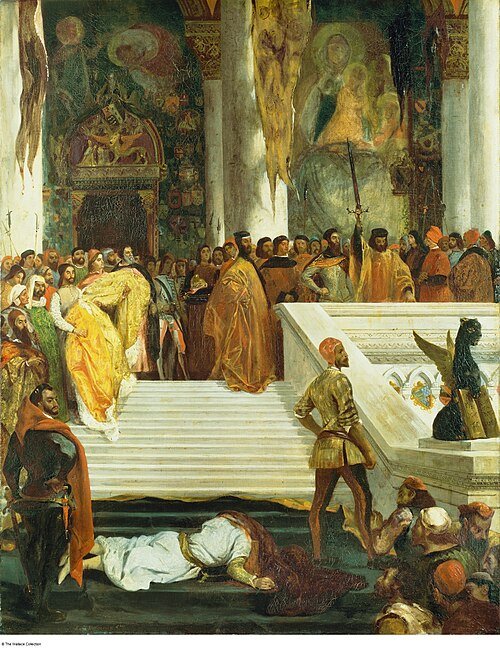
The republic’s commemorative treatment of Marino Faliero made the danger of ducal ambition unmistakable. In 1355 he was executed after a conspiracy against the established order. Among the doges’ portraits in the Great Council chamber, his place was represented by a dark covering rather than an honored likeness, as described in the Venice visitor account of the palace. The republic displayed the continuity of its rulers while marking one as an exception to its memory.
A much later painting by Eugène Delacroix evokes the Faliero story through nineteenth-century historical drama. It should not be mistaken for contemporary evidence of what participants wore, how a confrontation unfolded or what they felt. The distinction between a document and an imaginative reconstruction is especially important in a city whose political past generated so much art.
A less spectacular outcome could also expose the limits of life tenure. Francesco Foscari, doge from 1423, was forced to abdicate in 1457. The Giorgio Cini Foundation’s discussion of ducal commemoration notes the later problem of rehabilitating his memory. Life election created an expectation of permanence, but it did not place the officeholder beyond political pressure. Public honors, private rivalries and institutional action remained entangled.
The prince whom the city put on display
The strength of those restraints helps explain why ceremony mattered so much. Venice needed a recognizable figure through whom to receive foreign envoys and stage its own continuity. The doge could stand for the whole republic because the other governors had worked to prevent him from owning it.
In the eighteenth century, Giovanni Battista Brustolon’s engravings after Canaletto recorded a sequence of ducal ceremonies. The National Gallery of Art’s coronation print, dated 1763–1766, places the investiture on the Giants’ Staircase. A companion print of the Bucintoro departing on Ascension Day shows the ruler aboard the republic’s great ceremonial vessel.
The maritime ritual included the symbolic marriage of Venice to the sea, associated with the casting of a ring into the water. The Metropolitan Museum’s study of eighteenth-century Venetian drawings and prints situates these images within an elaborate public cycle. They document how the late republic represented itself. They cannot establish that every earlier century performed an identical ceremony in an identical way.
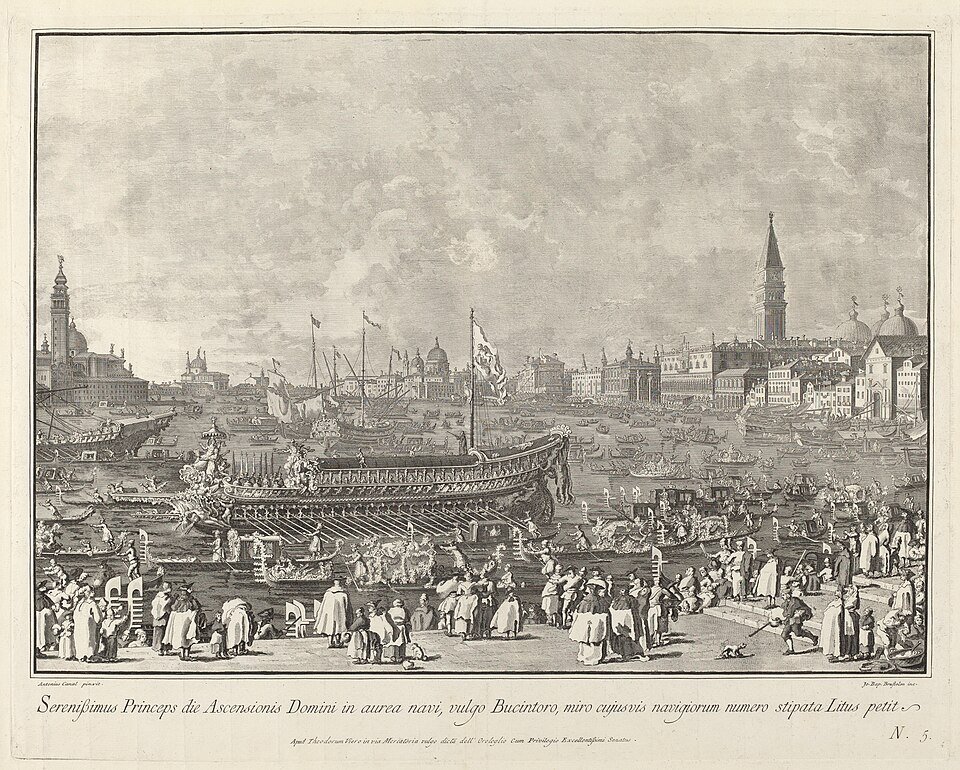
Such displays joined government to a shared visual language: the cap, the palace, the lagoon, the assembled dignitaries and spectators. An elected office could acquire the majesty of a crown while remaining legally embedded in corporate institutions. The pageant made that constitutional arrangement appear enduring.
The limits of endurance
Enduring did not mean invulnerable. On 12 May 1797, under the pressure of the French military advance and political crisis, Ludovico Manin’s dogeship and the old republic came to an end. The Villa Manin historical account connects that moment with the Treaty of Campoformio of 17 October, by which Napoleon’s France and Austria disposed of former Venetian territories. Centuries of procedures for containing internal ambition could not guarantee survival in a transformed European balance of power.
Bellini’s Loredan remains a useful point of return. His office possessed splendor, longevity and international prestige, but these tell only part of its history. Around the figure in the portrait stood men empowered to choose him, bind him, deliberate beside him and, in extraordinary circumstances, remove him.
Venice demonstrated that a state could make its highest representative answerable to a durable governing order. It also demonstrated that constitutional restraint and political exclusion could flourish together. The doge’s carefully bounded authority protected a republic whose ruling families guarded their own place with equal care.
Sources and further reading
- National Gallery’s account of the portrait
- Cambridge history of the doges
- Doge’s Palace historical account
- research on trade and institutional change
- academic analysis of the Venetian election protocol
- 1297–1323
- research dataset on medieval Venetian families
- State Archive of Venice’s presentation of the ducal oath
- National Gallery’s explanation of the dogeship
- palace’s account of its rooms and collections
- Doge’s Palace museum guide
- Venice visitor account of the palace
- Giorgio Cini Foundation’s discussion of ducal commemoration
- National Gallery of Art’s coronation print
- print of the Bucintoro departing on Ascension Day
- Metropolitan Museum’s study of eighteenth-century Venetian drawings and prints
- Villa Manin historical account