
The Meiji Charter Oath: Five Promises and the Making of a Government
In 1868, five broad promises helped a fragile imperial government claim Japan’s future. Turning them into institutions brought reform, resistance, and a struggle over who could speak for the nation.
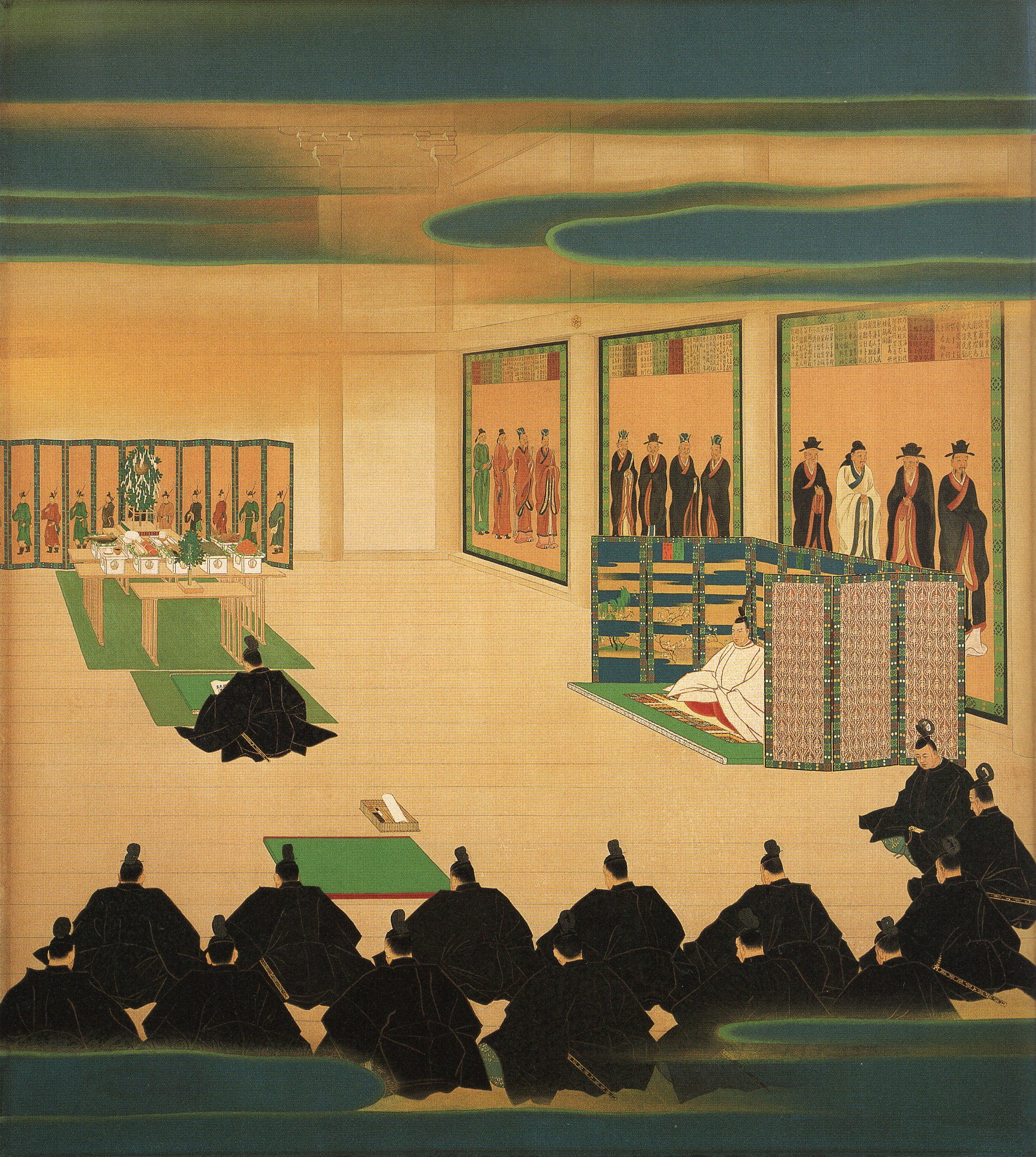
On 6 April 1868, a government still fighting for possession of Japan announced that it would seek knowledge throughout the world. Its enemies had not disappeared; its offices were new; its future boundaries of authority were unsettled. Yet the declaration placed inquiry among the foundations of imperial rule. The Charter Oath was brief enough to be remembered, and sufficiently open to interpretation that people who disagreed about the country’s future could appeal to it.
The urgency behind it was practical. In February the new authorities had already announced peaceful relations with foreign countries, even while the Boshin civil war continued and attacks on foreigners persisted. Men associated with a movement to expel outsiders now had to explain why they intended to deal with them. The oath offered a language in which a change of policy could become fidelity to a higher purpose: the rebuilding of the state. Kitaoka Shin’ichi’s history of the new government’s foreign relations places the declaration within this precarious diplomatic reversal.

A restoration with no finished government
The victors of 1868 could summon an emperor more readily than they could define an administration. Young samurai had helped destroy the political order in which their own status had meaning. Their slogans invoked loyalty and the recovery of rightful authority. Their subsequent policies would require soldiers, officials, industrial machinery, foreign advisers, and forms of knowledge for which those slogans supplied few instructions.
The resulting government used the imperial institution to connect radical change with historical continuity. The emperor could embody a past older than the shogunate while lending his name to unprecedented measures. As John Dower’s study of Meiji political imagery emphasizes, the pursuit of national wealth and military strength belonged to the same project. Learning from the Western powers included learning how to withstand them, compete with them, and eventually participate in their imperial world. A railroad, an army, and a constitution could all serve that ambition. None, by its mere existence, settled who would command the state or how its people might challenge a command.
The document itself emerged through revision. Yuri Kimimasa prepared an initial proposal; Fukuoka Takachika altered it; Kido Takayoshi helped give the oath its final form. The Japan Center for Asian Historical Records traces this sequence. The formulation that appeared under the emperor’s authority was therefore also the work of politicians trying to hold a coalition together.
This matters because its brevity can deceive. Five articles look like five decisions already made. In a government assembled from different political interests, however, an agreement on principles could precede agreement on institutions. What counted as public deliberation? Who belonged in an assembly? Which inherited practices were harmful, and who would decide? The oath did not close these questions. It placed them inside the new regime’s own account of legitimate government. Its success as an inaugural declaration depended partly on leaving room for the answers to change.
Five promises, several possible futures
Issued in the name of an emperor of fifteen, the oath promised assemblies and public discussion, cooperation between social ranks, and opportunities for people to pursue their callings. It called for abandoning harmful customs and grounding affairs in a more universal standard. Its final article declared: “Knowledge shall be sought throughout the world.” The purpose that followed was the strengthening of imperial government. The English translation published by Columbia University’s Asia for Educators preserves that connection.
The language was expansive, but it supplied no franchise, electoral district, or rule for choosing a ministry. An assembly could mean consultation among privileged participants. Public discussion could be encouraged without making rulers removable by the public. Even the opening toward knowledge was directed toward an imperial end. There was nevertheless something consequential in making deliberation a declared principle. Once a government publicly associated its legitimacy with discussion, critics gained words with which to question the way it governed. The same text could reassure the coalition in 1868 and trouble its successors afterward.
Meanwhile the rulers had offices to create. The first arrangement divided authority among three classes of office, established early in 1868. A further reorganization in June, under the Seitaisho, produced the Council of State, or Dajokan. Its name recalled an older imperial vocabulary, but the body was being built for contemporary requirements. Additional revisions followed in 1869 and 1871. The National Diet Library’s administrative records follow this changing structure to its replacement by a cabinet in 1885.
These alterations give the oath a different setting from the familiar procession of national achievements. Government was a continuing problem of assigning powers, organizing personnel, and deciding where one office’s responsibility ended and another’s began. The imperial name provided a center of allegiance. It did not provide a completed chart of administration. What later appeared to be a single purposeful transformation was experienced through successive institutional experiments, each attempting to make the center more capable of acting.
Making the center reach the country
The distance between an imperial declaration and a village school was political as well as geographical. Immediately after the Restoration, much of the country remained under domain jurisdiction. A directive from the new government consequently had a limited field in which it could operate. The abolition of the domains in 1871 and their replacement by prefectures changed that relationship. Four days later, a national Department of Education was established.
The sequence is recorded in the Education Ministry’s history of its own formation. Prefectural schools were placed under the department’s direct control early in 1872, and work proceeded on a unified educational system. The order of events is revealing. Before the government could organize learning across Japan, it had to acquire the administrative reach to do so. The Charter Oath’s invitation to knowledge became more tangible through offices, jurisdictions, and schools. The state was learning to communicate the same intention to many places, then expect those places to act upon it.
For the samurai, the creation of a national state also dissolved the arrangements that had maintained their class. Stipends were converted into government bonds; hereditary privileges were removed; wearing swords was prohibited in 1876. A national conscript army displaced the separate military establishments of the domains. The government also demanded land taxes in money, giving it revenues that could support a broader program of construction and reform. These changes are summarized in Columbia’s account of the Meiji transformation.
Each measure touched a different relationship: a warrior’s dependence on his lord, a household’s obligation to provide service, a cultivator’s relation to the treasury. People encountered the new order through these demands as much as through proclamations. The Satsuma rebellion of 1877 exposed the depth of the rupture among former warriors and the strength of the government’s new military institutions. The victories of the state cannot stand as evidence that everybody experienced its changes as an improvement. Consolidation described what the government achieved; it did not describe every life brought under its authority.
The world becomes a school
In December 1871, while institutions at home were still being remade, the government sent some of its leading figures overseas. Iwakura Tomomi headed the embassy; Kido Takayoshi, Okubo Toshimichi, and Ito Hirobumi were among its deputy ambassadors. Its journey through the United States and Europe lasted nearly two years. The aims included preparing for treaty revision and investigating foreign institutions and cultures.
The mission’s travels are often made into an illustration of the oath’s final article. The surviving paperwork gives that association substance. Ito’s diary recorded detailed observations of Prussian parliamentary and electoral arrangements in March 1873. This was attention to the working parts of government, beyond admiration for imposing buildings or powerful machines. The National Diet Library’s presentation of the diary shows political learning becoming a practice of comparison. The envoys could examine alternatives abroad while the colleagues they had left behind continued making consequential choices at home. A journey undertaken to strengthen the government also enlarged the range of arguments within it.
The emperor’s letter to President Ulysses S. Grant explained the official purpose with unusual clarity. Japan sought to revise the treaties and improve its international standing. To do that, the letter proposed selecting institutions appropriate to Japanese circumstances and adapting them through gradual reform. The text made neither wholesale imitation nor the preservation of every existing custom a duty. Selection was the essential activity.
Yet selection took place under unequal conditions. American and European governments were unwilling to surrender their treaty privileges simply because Japanese envoys had articulated a program of reform. The letter and its diplomatic context reveal the gap between the sovereignty Japan claimed and the treatment it received. The new government wanted knowledge from abroad and greater freedom from foreign constraint. Those desires could reinforce each other, but they also made national strengthening an insistent test of policy. An imported institution would be judged partly by whether it made Japan more difficult to coerce.
The promise acquires petitioners
By January 1874, public deliberation had acquired organized advocates outside the government. Itagaki Taisuke, Goto Shojiro, Soejima Taneomi, and Eto Shinpei, who had left office during the previous year’s political crisis, joined Furusawa Shigeru in forming the Aikoku Koto. On 17 January they submitted a petition for a popularly elected assembly. It criticized authoritarian rule and sought an institution through which public discussion could act on government.
The petition also entered print in John Reddie Black’s Nisshin Shinjishi. The National Diet Library’s copies and account locate an important change in the political audience: an argument addressed to officials could circulate among readers. The party itself soon dissolved, but the petition helped propel the Freedom and People’s Rights Movement. The coalition that had overthrown the shogunate had ceased to contain all of the ambitions released by that overthrow. An appeal to public discussion now asked for a mechanism that the men in power would not control entirely.
A compromise followed at Osaka in 1875. Kido and Itagaki returned to positions as councilors, and an imperial rescript announced a policy of constitutional government. It also provided for a Chamber of Elders, a supreme court, and a council of prefectural governors. The arrangements created institutions while reserving important choices about popular representation.
The surviving draft of the April 1875 rescript helps explain the oath’s continuing force. Together, the two declarations supplied authority for people demanding a national parliament. Petitioners did not need to invent a wholly foreign language of legitimacy: the government’s own promises were available to them. Broad wording that had made agreement possible in 1868 now sustained pressure for further decisions. A declaration could be invoked by its authors’ opponents because it had been issued as a national commitment, rather than retained as a private understanding among the victors.
From an oath to a constitution
In 1889 the Meiji Constitution gave detailed legal form to arrangements the oath had left unspecified. It vested sovereignty in the emperor, established a two-house Imperial Diet, and required the Diet’s consent for legislation. It also recognized liberties whose exercise remained bounded by law. Ministers advised the emperor; the constitution did not make their position depend upon the confidence of an elected majority. These distinctions are visible in the constitutional text itself.
Twenty-one years separated the five articles from this much longer settlement. In between lay administrative reconstruction, overseas investigation, rebellion, petition, and compromise. The oath had neither prescribed every result nor lost all significance when rulers restricted its possibilities. By 1889, an assembly had a defined place in the state, and imperial sovereignty had acquired explicit constitutional powers. The language of 1868 remained available beyond that settlement: a short declaration whose promises had survived the provisional government that first needed them.
For the urban society inherited by the new government, see how Edo fought fire and organized neighborhood responsibility.
Sources and further reading
This account distinguishes the Charter Oath’s stated principles from the institutions subsequently created. Dates use the Gregorian calendar; contemporary Japanese documents may carry lunisolar dates.
- Kitaoka Shin’ichi, “Inception of a Modern Relationship,” Japan-China Joint History Research Report, Modern and Contemporary History, vol. 1 (2011), hosted by Japan’s Ministry of Foreign Affairs.
- John W. Dower, “Civilization & Enlightenment,” MIT Visualizing Cultures.
- Japan Center for Asian Historical Records, “Five-Article Oath” (Japanese).
- Columbia University, Asia for Educators, The Charter Oath, 1868, translation from Sources of Japanese Tradition.
- National Diet Library, Grand Council of State system.
- Ministry of Education, Culture, Sports, Science and Technology, The Establishment of the Department of Education.
- Columbia University, Asia for Educators, The Meiji Restoration and Modernization.
- National Diet Library, Iwakura Mission, including Ito Hirobumi’s diary.
- Columbia University, Asia for Educators, Letter from Emperor Meiji to President Grant, 1871.
- National Diet Library, Petition for a Popularly Elected Assembly, 1874.
- National Diet Library, Imperial Rescript Establishing a Constitutional Form of Government, 1875.
- National Diet Library, The Constitution of the Empire of Japan, 1889, translated by Ito Miyoji.