
Histovia · World War II · Diplomacy & empire
1941–1943 / A promise contested
The Atlantic Charter: Self-Determination and the Limits of Empire
Roosevelt and Churchill promised a world in which peoples could choose their governments. The argument over who counted began while the war was still being fought.
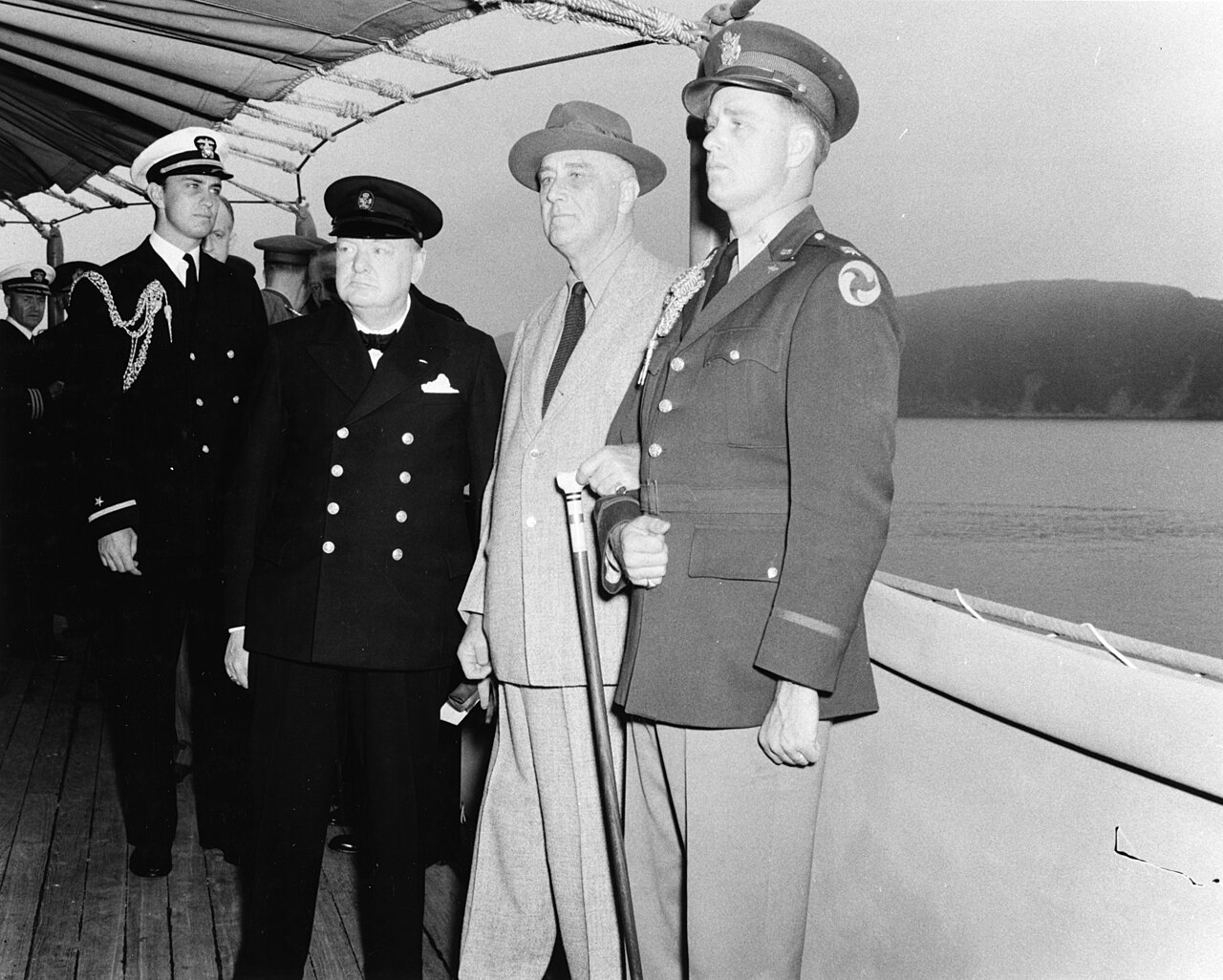
_on_9_August_1941_(NH_67201).jpg)
On 9 September 1941, less than a month after the Atlantic Charter appeared, Winston Churchill had to explain what its promise of political freedom meant for the British Empire. His answer drew a distinction that the declaration itself had left unsettled: restoring European countries conquered by Hitler was one problem; constitutional change in British-ruled territories was another.
That distinction became the Charter’s central political problem. Its language was expansive enough for people under colonial rule to claim it as their own. Its authors had neither agreed a timetable for ending empire nor created a means of compelling one. The document therefore began two histories at once: a history of Allied cooperation and a history of demands that the Allies apply their principles more consistently.
01 / War before the alliance
Why make promises about a peace that was far from won?
Roosevelt and Churchill met from 9 to 12 August 1941 on naval vessels in Placentia Bay, Newfoundland. Britain was fighting Nazi Germany; the United States remained formally outside the war. Germany had invaded the Soviet Union in June, while British leaders also feared further Japanese expansion in Asia. The meeting concerned immediate survival as well as the future peace.
Churchill wanted the Americans drawn more firmly into the struggle. Roosevelt wanted cooperation accompanied by a public account of the kind of international order the two governments supported. As the U.S. Office of the Historian’s overview explains, questions of territory, trade and imperial preference were part of the bargaining. Britain’s need for American assistance did not make the two countries’ interests identical.
The declaration, released on 14 August 1941, gave their partnership a common political vocabulary. It did not bring the United States into the war. Nor was it a binding peace treaty. The Roosevelt Presidential Library’s account identifies it as a joint statement of principles emerging from the conference. Its importance lay partly in making commitments public before victory could determine the terms of settlement.
Public language changes the audience for diplomacy. A private understanding can remain a matter between governments. A published promise can be read by people whom those governments do not intend to consult. Once the Charter entered circulation, its meaning could no longer be settled solely aboard the ships where it had been negotiated.
02 / Reading the eight points
A larger promise than self-government alone
The Charter’s eight principles linked political consent to economic security and the prevention of another war. Read together, they imagined peace as more than the absence of fighting. A stable settlement would require changes in the conditions that made people insecure.
Territory and consent
No territorial enlargement for the two countries; no territorial changes against the wishes of affected peoples; a right to choose government and a wish to restore lost sovereignty and self-government.
Trade and livelihoods
More equal access to trade and raw materials, qualified by existing obligations; international economic cooperation to improve labor standards, prosperity and social security.
Security and peace
A peace after Nazi tyranny’s defeat; freedom from fear and want; open seas; restraint on force, disarmament of aggressor states and a wider system of security.
The third principle carried the most explosive ambiguity. It referred to “all peoples” and their choice of government, then to restoring rights to those forcibly deprived of them. That could describe the occupied states of Europe. It could also invite a question from India or Africa: why should a right lost through earlier conquest count for less than one lost through recent conquest?
The economic clauses posed a related problem. Access to markets and resources could challenge exclusive imperial trading arrangements, yet equal access for states did not automatically give colonial populations control over their own economies. The words could support different projects: freer commerce, stronger welfare protections, or a challenge to foreign domination. Readers had to argue about how those projects fitted together.
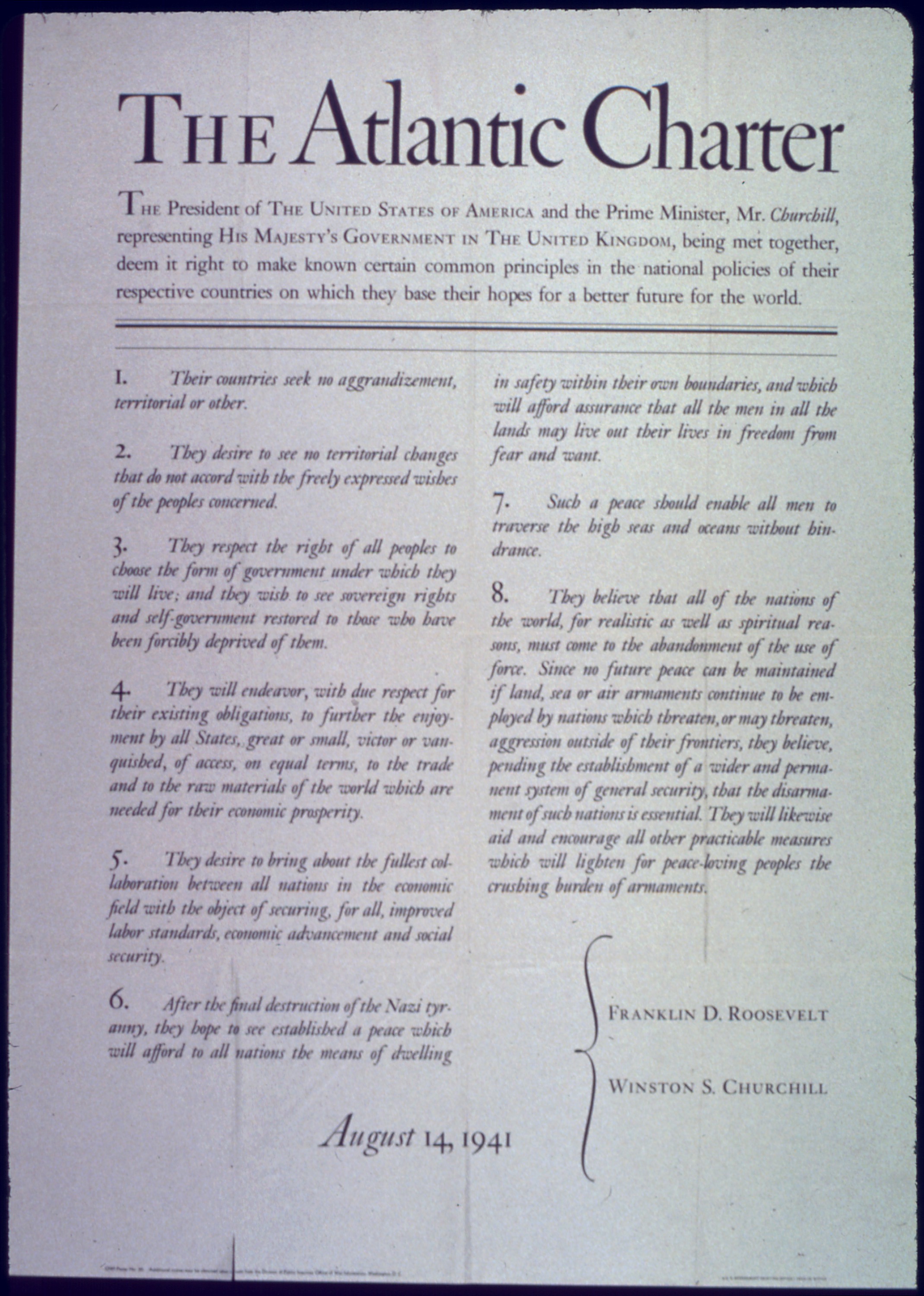

The document as public argument
Who gets to interpret a promise?
A wartime poster could present the Charter as a unified statement of Allied purpose. Political debate exposed the gaps beneath that unity.
Three questions help separate the declaration’s wording from its practical effects:
- What did the text actually promise?
- How did governments say they would apply it?
- What did excluded people demand in its name?
Those questions lead from Newfoundland to the House of Commons, from an exchange of letters about India to a rights program drawn up in South Africa.
03 / The imperial interpretation
Churchill’s distinction between Europe and empire
In his Commons statement of 9 September, Churchill said that the Atlantic meeting had been concerned “primarily” with restoring the sovereignty and national life of European states under Nazi rule. He treated that task separately from the gradual development of self-governing institutions among peoples owing allegiance to the Crown.
He also said the declaration did not alter existing policy on India, Burma or other imperial territories. Britain’s previously stated commitments remained the governing framework. This was not a claim that constitutional development could never occur; it was a refusal to let the new declaration replace the empire’s existing terms and pace of change.
The word “primarily” deserves attention. Summaries that turn it into “only” make Churchill’s statement more categorical than its wording. The practical limitation was still substantial: colonized peoples were not being offered the same immediate political restoration envisioned for occupied Europe.
The consequence was an argument about authority. Was London entitled to decide when another people was ready for the government it wanted? If so, the imperial power retained control of the very choice the Charter appeared to recognize. The dispute concerned who would exercise political judgment, not simply how warmly a leader spoke about freedom.
Burma supplied an early test. As historian Jeremy A. Yellen shows, Premier U Saw visited Britain in the autumn of 1941 seeking a firmer commitment to Dominion status. He left without the assurance he wanted. Britain deferred substantive constitutional discussion until victory. His experience illustrates why the declaration could raise expectations while leaving the structure of imperial decision-making intact.
04 / Two letters, two priorities
Gandhi challenged the sequence: freedom after victory, or freedom now?
On 1 July 1942, Mohandas K. Gandhi wrote to Roosevelt about the contradiction between Allied democratic aims and British rule in India. He also invoked the exploitation of Africa and racial discrimination in the United States. The letter did not name the Atlantic Charter; it challenged the broader declarations of Allied purpose to which the Charter belonged.
Gandhi proposed immediate British withdrawal. He nevertheless allowed for Allied troops to remain, at Allied expense, to resist Japanese aggression and defend China, under a treaty with a free Indian government. His distinction was between military cooperation by consent and the continuation of imperial rule. Independence, in this proposal, need not mean assisting Japan.
Roosevelt’s reply of 1 August emphasized the danger of Axis conquest and the need for common action against it. He enclosed a speech by Secretary of State Cordell Hull. He did not endorse Gandhi’s demand for immediate British withdrawal.
Read together, the letters reveal a disagreement over the order in which freedom and military victory should be pursued. Roosevelt foregrounded the common enemy. Gandhi pressed the Allies to change the political relationship through which they expected cooperation. A shared vocabulary of democracy did not remove that disagreement.
This exchange also complicates a simple contrast between an imperial Churchill and a liberating Roosevelt. American criticism of colonial arrangements did not amount to an unconditional wartime guarantee of independence. The diplomatic record has to be judged by what Washington was prepared to do, as well as by the scope of its public ideals.
05 / Readers become political authors
Africans’ Claims turned broad principles into concrete demands
In South Africa, activists did more than ask what the Charter’s authors had intended. On 16 December 1943, the African National Congress adopted Africans’ Claims in South Africa at Bloemfontein. It combined an interpretation of the Charter with a bill of rights.
The committee, chaired by Z. K. Matthews under A. B. Xuma’s leadership, insisted that the Charter’s references to peoples and men included Africans and other non-Europeans. It distinguished territories needing sovereignty from places such as South Africa, where an entrenched white minority governed an African majority. In the latter, full citizenship and direct participation in the state were central demands.
Its approach to economic freedom was equally pointed. Opening African resources to international commerce could perpetuate exploitation unless African welfare and advancement came first. Political choice, land, work and material security belonged in the same argument.
The significance was not that London or Washington had secretly promised this precise program. African political actors were making their own program from language the Allied leaders had placed before the world. They were claiming a voice in defining the settlement.
Other Africans pursued the issue too. Historian Bonny Ibhawoh describes a 1943 West African press delegation, led by Nnamdi Azikiwe, that asked British officials to clarify the Charter’s colonial application and pressed for representative government. Such episodes help explain why histories of international rights cannot be written entirely as a succession of declarations handed down by powerful states. People excluded from those states’ decision-making were helping to expand the demands attached to their words.
06 / Consequences without inevitability
What did the Atlantic Charter actually change?
The Charter offered the developing Allied coalition a statement of common purpose. The Declaration by United Nations of 1 January 1942 subscribed to its principles while committing the signatory governments to the war effort and to avoiding a separate peace. That wartime use of “United Nations” should be distinguished from the international organization founded in 1945.
Military cooperation subsequently acquired forms very different from a declaration of principles. Histovia’s account of Operation Fortitude and the deception protecting D-Day follows one later example. The alliance could coordinate extraordinary practical efforts while remaining divided over the political future of empires.
The Charter also changed the terms on which imperial policy could be challenged. A government defending colonial control now faced a question grounded in its own publicly endorsed language. Why should political choice belong to some peoples and remain conditional for others? Answering that question required qualifications that could themselves become evidence of unequal treatment.
That was political leverage, not automatic liberation. Nothing in the declaration dissolved an empire, transferred a legislature’s powers or compelled a colonial administration to recognize an independence movement. Nor did it create anticolonial aspirations from nothing. Its impact depended on existing movements, their choices, and the opportunities and violence of war.
The most revealing legacy therefore lies in the distance between intention and use. Churchill sought a closer partnership with the United States while preserving imperial control. Roosevelt sought an international order compatible with American security and economic aims. Gandhi, the ANC and other critics tested the resulting language against the conditions under which their own peoples lived.
The Atlantic Charter mattered because its promises could be taken seriously by people whom its authors had not empowered. It left unresolved who would determine the boundaries of freedom. That unresolved question became part of the struggle over what an Allied victory should mean.
Evidence & further reading
Sources
The argument distinguishes the declaration itself, contemporary political responses and later historical interpretation. Short quotations preserve the sources’ wording; the analysis is Histovia’s.
Primary records
- Atlantic Charter, 14 August 1941, Yale Law School’s Avalon Project transcription
- Churchill, “War Situation,” 9 September 1941, House of Commons, vol. 374, especially cols. 67–69
- Gandhi to Roosevelt, 1 July 1942, Foreign Relations of the United States (FRUS), 1942, vol. I, document 575
- Roosevelt to Gandhi, 1 August 1942, enclosed in the State Department’s 5 August instruction, FRUS, document 592
- ANC, Africans’ Claims in South Africa, 16 December 1943, O’Malley Archives, hosted by the Nelson Mandela Foundation
- Declaration by United Nations, 1 January 1942, FRUS, 1942, vol. I, document 18
Historical interpretation and context
- Jeremy A. Yellen, “Wartime Wilsonianism and the Crisis of Empire, 1941–43”, Modern Asian Studies 53, no. 4 (2019), 1278–1311
- Bonny Ibhawoh, “Testing the Atlantic Charter: linking anticolonialism, self-determination and universal human rights”, The International Journal of Human Rights (2014)
- Office of the Historian, “The Atlantic Conference & Charter, 1941” (retired historical overview)
- Franklin D. Roosevelt Presidential Library and Museum, “Franklin D. Roosevelt Day by Day – August”