
The Letters Left Waiting in the Cairo Geniza
A mother waits for news, a merchant reroutes his flax, and a letter from Aden proves a death. The Cairo Geniza preserves the daily stakes of a connected medieval world.
Summer had passed, and Dosa’s mother still had no letter from him. She was in al-Raqqa, in present-day Syria; her son was in Fustat, the old Egyptian city beside Cairo. Her husband and another son were away too. In the middle of the eleventh century, she sent a message that moved between reproach, practical requests, family news, and an almost unbearable wish to see him. A letter, she explained, could stand in for his face. She wanted antimony, other supplies, and a dark blue head covering embroidered in white. Above everything, she wanted him to write. Her surviving letter allows us to hear the cost of a connected medieval world from the household left waiting.

The papers that stayed behind
The letter survived because written things could acquire a second life after their first purpose had ended. In Jewish practice, a geniza was a place for putting away sacred writings that were worn out or no longer usable. Texts bearing the divine name required respectful treatment rather than casual destruction. At the Ben Ezra Synagogue in Fustat, this practice gathered a much wider company of papers: correspondence, commercial records, scraps of learning, and the written remains of ordinary transactions. The result accumulated through centuries.
The Cairo Geniza collection was therefore formed by habits of preservation very different from those of a royal archive. No official had decided that the irritation of a mother or the account of a trader belonged in a history of civilization. Such things remained beside religious writings because people put them away. Their survival lets us approach the medieval Mediterranean through the business that had to be finished before the day was over.
Fustat was a fitting place for these papers to converge. It had grown from the settlement established during the Muslim conquest of Egypt in the seventh century. When the Fatimids founded Cairo to its north in 969, the older city continued to house substantial Jewish and Christian communities. Its religious boundaries were real, sometimes violently enforced, yet its inhabitants also shared a built environment and a vocabulary of craftsmanship.
The Ben Ezra Synagogue itself bears traces of that setting. Its basilican arrangement resembled neighboring Coptic churches; its carved wooden furnishings participated in decorative traditions familiar in Muslim Egypt. Destroyed during the persecution under the caliph al-Hakim in the early eleventh century, it was rebuilt. The building visible today is largely a nineteenth-century reconstruction, so it should not be treated as an untouched stage set for the letters. The more intimate medieval city survives in pieces: a carved panel, a legal record, an address, a request to send something home.
A bale of flax and a missing son
A letter written around 1060 brings us from the synagogue to the waterfront. Ya’aqov ben Nahum ben Hakhmon, in Tripoli in present-day Libya, wrote to the merchant Nahray ben Nissim in Alexandria. Goods from Fustat had arrived, but unloading them was difficult because other merchandise lay on top. Ya’aqov discussed prices and sales, then gave a practical instruction: if no vessel sailed directly from Alexandria to Tripoli, the flax bought for him should come through Sicily.
Here the commercial map takes shape through an inconvenience. Egypt, Libya, and Sicily were connected by people who had to discover which ship was available and where a consignment lay in its hold. The letter catalogued as T-S 13J25.8 records a workable alternative rather than a grand design. Its route could bend around the absence of a direct sailing. The trader’s problem was immediate, but his proposed solution depended upon a sea crossed often enough for another port to become an ordinary option.
For relatives elsewhere, those same movements could bring an anxious dependence on news and goods. In another early eleventh-century letter, a mother, probably in or near Qayrawan in present-day Tunisia, called on her merchant son in Fustat to return. She reported harassment by collectors of the poll tax and an unsuccessful appeal for charity at a synagogue in Qayrawan. A nephew needed help in the shop. A bill of divorce had arrived for the son’s sister. Bales of flax apparently dispatched by the son had not yet reached them.
The surviving document, T-S 12.533, gathers these pressures without separating commerce from family life. The missing shipment and the absent son belonged to the same predicament. She even compared the distress of his departure for Egypt with an earlier occasion when Byzantines had taken him captive. We have her report, not his reply; neither the arrival of the flax nor a family reunion can be supplied to complete the story.
Her unsuccessful request for aid also opens a door onto the community beyond the trading household. The Geniza preserved appeals made by poor people or on their behalf, together with lists of donors, beneficiaries, and distributions. Studying these papers, the historian Mark R. Cohen found that the apparently unpromising account could be as revealing as the eloquent plea. It recorded the practical organization through which assistance might reach someone in need.
A list can give a historian a different view from a letter. The petitioner presents a particular emergency; the account places help among other payments and recipients. Neither should automatically be taken as the complete story of the person concerned. Read together, they show why a mother’s appeal belonged within a recognizable social practice, even when that practice did not rescue her. The papers of medieval charity widen the picture beyond merchants whose journeys prospered. They preserve people for whom money, family support, and the next journey had become painfully uncertain.
Waiting for the ships
A later letter, probably from the late twelfth or thirteenth century, is more crowded and argumentative. Its writer complained that ships had arrived late and referred again to delays at Rosetta, at the mouth of the Nile. There were travel arrangements to discuss and money to obtain from a silk merchant. Between these matters came greetings to the recipient’s son and a quarrel involving the wife of a man called Abu Sa’d.
The fragment, ENA 1822a.58, does not identify every participant securely. It nevertheless preserves the changing register of an actual message: a shipment, a meeting, a grievance, a greeting. The person receiving it was expected to know the people and the trouble without the introductions a modern reader requires. This is one reason these letters can seem so close and remain so difficult. They were written into existing relationships. Names alone could summon an entire history which the paper had no need to explain, and which has often disappeared.
Beyond the Mediterranean, the journey could become longer and its timetable more exacting. Toward the end of 1103, an unnamed North African trader wrote to a relative in Tripoli while preparing to sail for western India. His letter, now T-S 12.392, described the stages of his travel through Egypt and the Red Sea world. The itinerary included Qus in Upper Egypt and the port of Aydhab. He recorded delays and difficulties with a literary energy that drew on Arabic wordplay and Hebrew biblical allusion.
A recent scholarly reconstruction places the journey against the Nile’s seasonal conditions, the monsoon system, and the Jewish calendar. Its suggestion that religious observance influenced particular pauses remains an interpretation, rather than a motive the historian can simply pronounce certain. The trader’s name and eventual fate are unknown. What survives is the moment before another departure, when a traveler converted the discomforts of his route into a story for someone who knew him. Even its delivery to the intended relative is uncertain.
Long-distance business could leave marriage suspended across the same routes. Around 1200, Solomon ben Yefet composed a personal letter to his wife during an extended absence connected with the India trade. The message combined Judeo-Arabic with Hebrew, and opened amid grief and family attachment. Its surviving form preserves no address. The editors of the Posen Library entry suggest that he may have written it in Aden and caution that it may never have been sent.
That possibility matters. A preserved letter is evidence of words composed, but not necessarily of words received. The family at home might have lacked the reassurance that a modern reader can now find in the document. Commerce generated papers at several stages: someone wrote, someone might carry the message, and someone might finally read it. A break anywhere along that passage would leave the household waiting. Solomon’s surviving draft or letter cannot tell us how his wife answered, or whether she ever had the opportunity.
When a letter had to prove a death
In about 1156, a message from Aden carried news that could end a different kind of uncertainty. Sa’id ibn Marhab wrote to Hillel ibn Nahman, known as the Perfumer, about the drowning of Hillel’s son-in-law, Hiba ibn Abu Sa’d, and another Jewish traveler. The letter’s purpose extended beyond announcing a loss. It was meant to establish the men’s deaths so that their widows could remarry and receive what was owed from their husbands’ estates.
For these families, maritime information had become legal evidence. A voyage that ended at sea left consequences on land, where a woman’s future depended on a fact she could not establish by seeing the body herself. Someone at a distant port had to transmit knowledge in a usable form. The polished greetings and conventions of correspondence did not make the news less urgent. They carried it into the relationships and institutions through which grief, property, and marital status would be dealt with.
We should listen carefully to the women in these records, including the distance between their speech and the surviving ink. A letter could be dictated to a scribe or a male relative. Esther-Miriam Wagner’s study of L-G Arabic 2.129, probably from the twelfth or thirteenth century, identifies Ibrahim as the person who wrote down a female family member’s message to his mother. Its language contains unusually colloquial forms, though Wagner warns against treating those features as conclusive evidence of a distinctively female way of writing.
The letter also exposes inequalities within the household. A pregnant enslaved woman named Sayd wanted to marry another enslaved person, and a dispute over support for her children entered the correspondence. The family’s distress is visible through the owners’ account; Sayd’s own full explanation is not. This is an intimate record of domestic life, but intimacy does not distribute voices equally. Some people dictated their wishes. Others appear because the people who controlled them had something to complain about.
The last journey of the letters
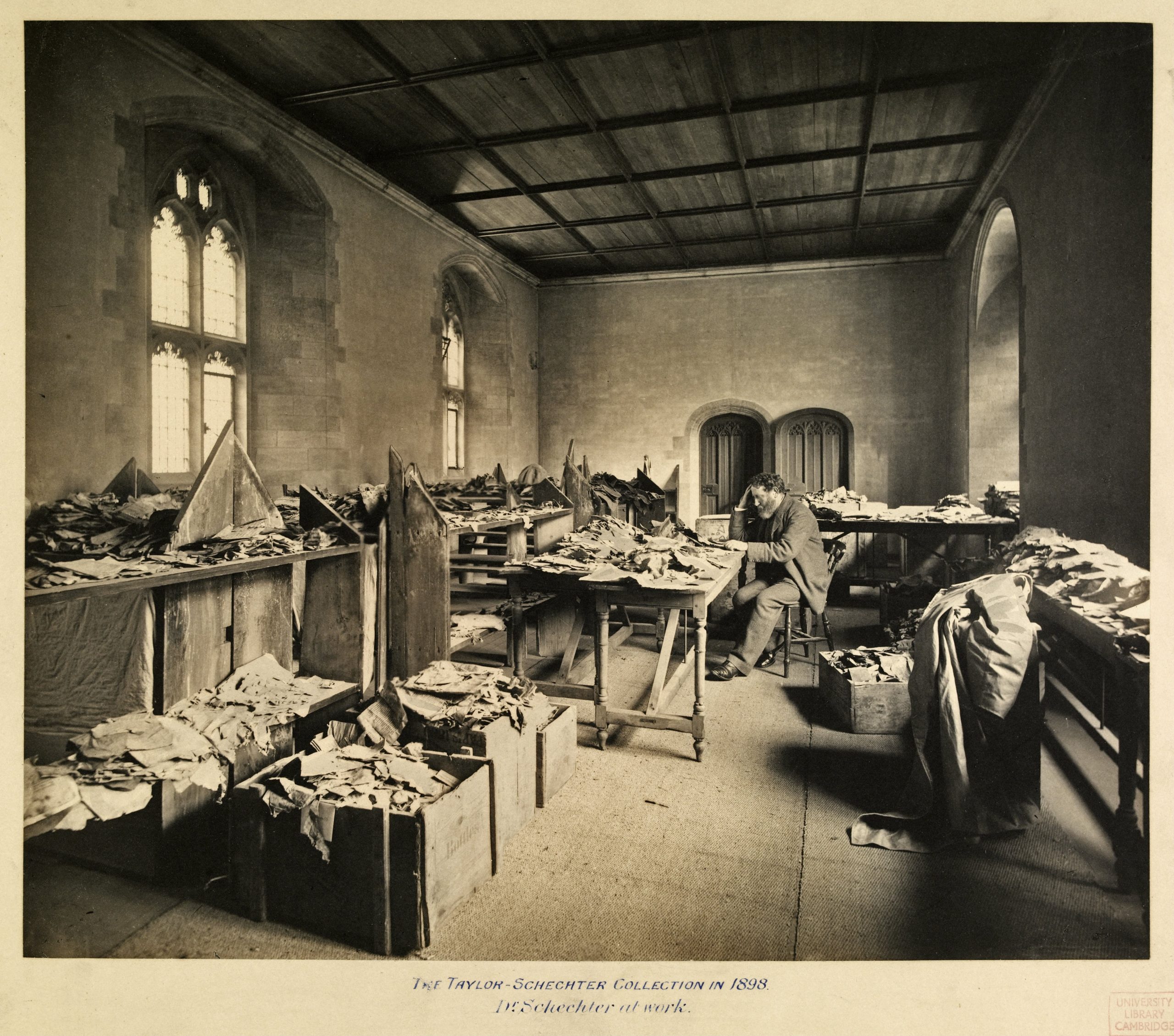
The papers eventually crossed other seas, under very different circumstances. Agnes Smith Lewis and Margaret Dunlop Gibson brought manuscripts bought during their travels to Cambridge; among them Solomon Schechter recognized a fragment of the Hebrew book of Ben Sira. His subsequent journey to Egypt in 1896–97 helped bring a vast collection to Cambridge. Other fragments entered other collections. The archive’s modern dispersal gave the letters another geography.
Their survival remained a physical problem. Conservators working on the Lewis-Gibson collection have documented tears, insect damage, brittle parchment, fading or unstable inks, and old repairs that sometimes hid text. Preserving a letter might mean loosening an unsuitable binding or supporting a fragile edge before anyone could safely read or photograph it. Such work explains why the apparent immediacy of a medieval voice rests on so much patient mediation. The message has passed through a writer, perhaps a scribe, a carrier or a storeroom, a collector, a conservator, and a reader of the old handwriting.
Dosa’s mother had asked for small material things as well as an answer. At the end of her letter she returned to the embroidered head covering: she had been requesting it from his father for two years. That unfinished errand survives with her more urgent plea. We cannot follow Dosa into the room where he may have opened the letter. We can still read what she wanted him to do.
For the inland societies connected to another part of this oceanic world, read Great Zimbabwe and the Roads to the Indian Ocean, a story recovered chiefly from buildings and objects rather than family letters.
Sources and further reading
- Unknown woman, Letter to Her Son, Dosa, mid-eleventh century; translation and commentary, Posen Library
- University of Cambridge, Discarded history: Cairo Genizah treasures
- Ariel Fein, The Ben Ezra Synagogue, Fustat, Egypt, Smarthistory
- Princeton Geniza Project, T-S 13J25.8, PGPID 5900
- Princeton Geniza Project, T-S 12.533, PGPID 5870
- Mark R. Cohen, Poverty and charity in medieval Egypt, Genizah Fragments 38, October 1999
- Princeton Geniza Project, ENA 1822a.58, PGPID 2604
- Caitlin Buckley, Mohammed Salih Cholakkalakath, and Jesse Noily, Travel and Rhetoric in the Letter of an Aspiring Indian Ocean Trader: T-S 12.392, April 2026
- Solomon ben Yefet, Letter to His Wife, ca. 1200; public commentary, Posen Library
- Sa’id ibn Marhab, Letter to Hillel ibn Nahman, ca. 1156; public commentary, Posen Library
- Esther-Miriam Wagner, The language of women: L-G Arabic 2.129, January 2015
- Mary French, Rebecca Goldie, and Emma Nichols, Conservation of the Lewis-Gibson Collection, 2015