
UN Day 2026: Equal Voices and the Great-Power Bargain of 1945
The United Nations celebrates cooperation and sovereign equality. Its founding Charter also gives five states a privileged position. The tension was built into the institution, and it still shapes what reform can achieve.
In his message for United Nations Day on 24 October 2026, the Secretary-General placed an “equal voice” for countries among the organization’s contributions to international life. The message marked eighty-one years since the UN’s creation and called for renewed commitment to cooperation, the Charter and international law.
That phrase opens a historical question. How can the same institution offer sovereign equality while allowing five states to block certain decisions supported by everyone else on its most powerful council? The apparent contradiction becomes easier to understand when the UN is viewed as an agreement negotiated in wartime, rather than as a world government that later fell short of its intended design.
The settlement of 1945 brought two ambitions into one structure: broad participation by states and continued cooperation among the strongest Allied powers. Those ambitions were never identical. Their coexistence explains both the General Assembly’s reach and the Security Council’s limits, and why reform requires more than winning an argument about fairness.
Why the anniversary falls in October
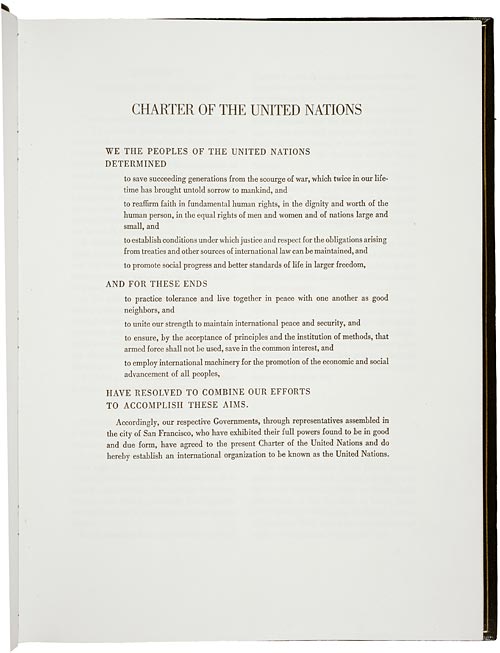
The Charter was signed in San Francisco on 26 June 1945. Its entry into force came on 24 October, after the required ratifications had been deposited. The UN library’s Charter research guide distinguishes the conference, signature and legal commencement: related events, but not one interchangeable founding moment.
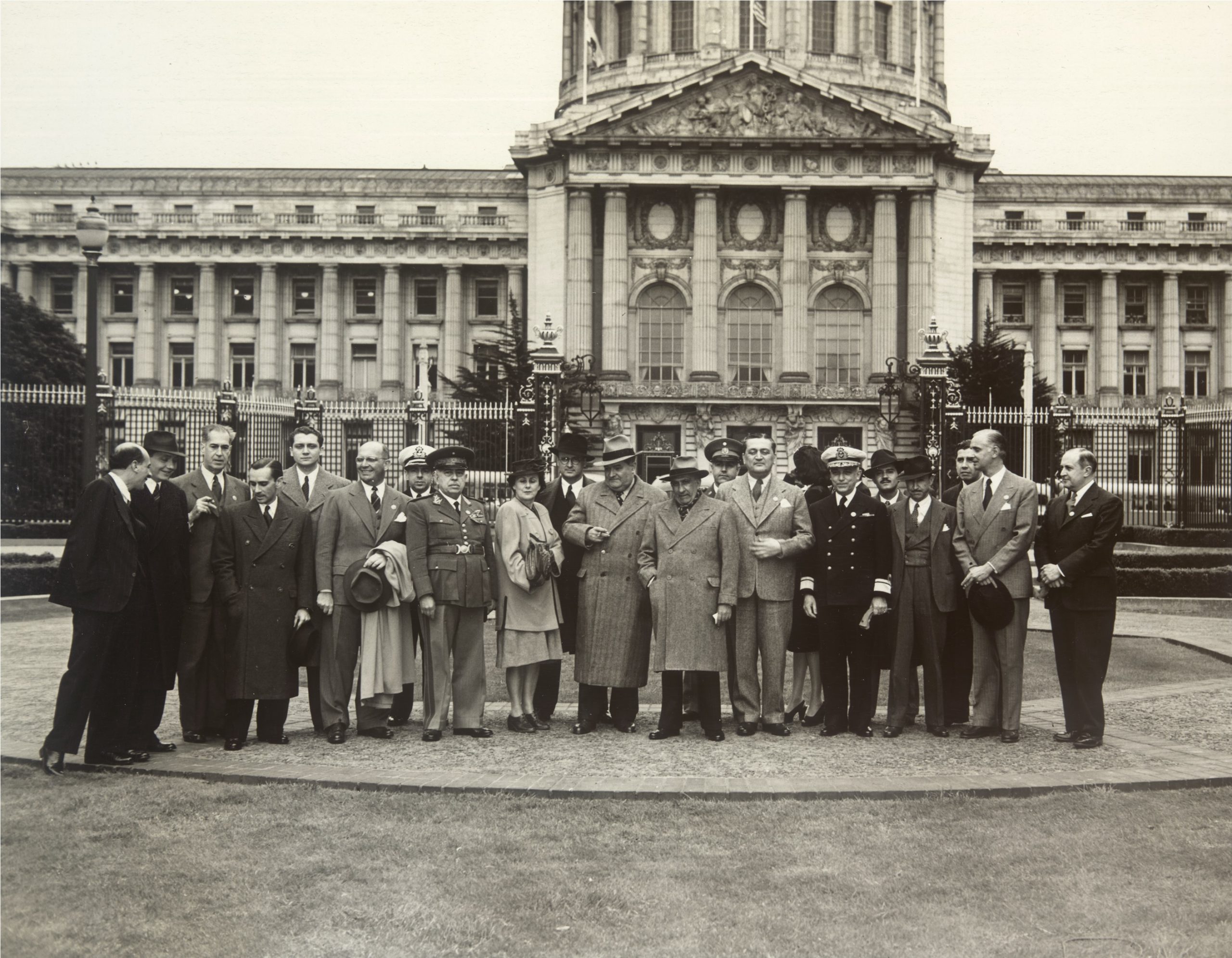
Representatives of fifty countries signed in June; Poland, absent from the conference, signed in October and became one of the fifty-one founding members. The UN’s explanation of founding membership preserves that difference. A photograph of the San Francisco ceremony therefore records a particular stage in the process, not the complete membership story.
Ratification made the document an international commitment. Article 110 required the participation of the five powers assigned permanent Council seats as well as a majority of the other signatories. Great-power agreement was embedded even in the mechanism by which the new organization could begin.
A wartime coalition became an institution
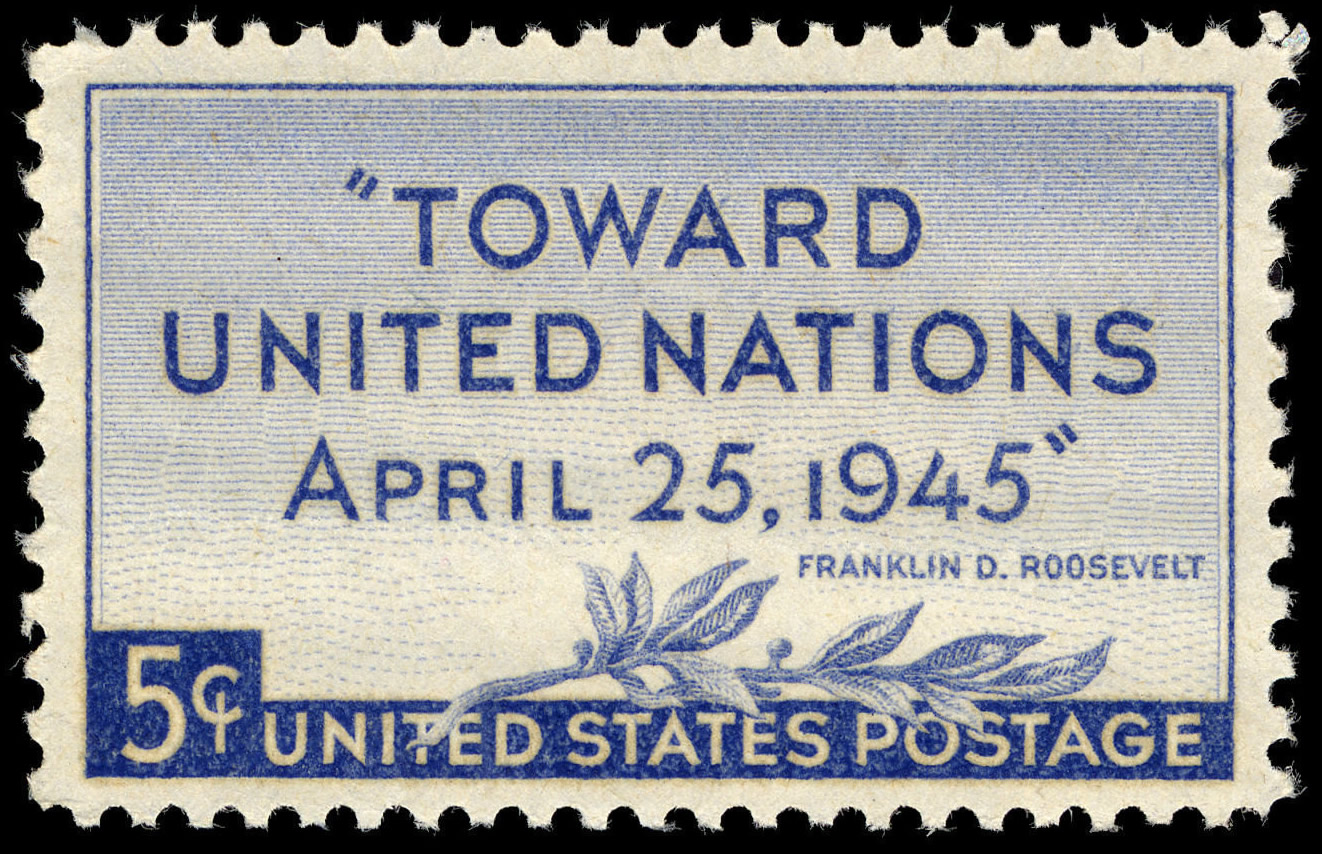
The name “United Nations” had already been used for the Allied declaration of January 1942. During the war, governments worked toward a postwar organization through successive negotiations. The US Office of the Historian’s account traces the movement through Moscow, Dumbarton Oaks and Yalta before the San Francisco conference completed the Charter.
Plans combined an assembly of the membership with a smaller body carrying special responsibility for security. The place of the leading powers and their voting rights were central bargaining questions. In the final 1945 arrangement, the Security Council had eleven seats: five permanent and six elected.
This background changes the historical comparison. The UN was not created by states temporarily forgetting power politics. Its architecture attempted to make cooperation possible in a world where military capacity, influence and willingness to participate were very unevenly distributed. A rule that was politically necessary to secure agreement could also become a source of paralysis.
That is a design problem, not an excuse for every later use of the design. Understanding why a veto was included does not decide whether a particular veto is defensible. Historical explanation and political judgment have different jobs.
The Assembly’s equality is real, but specific
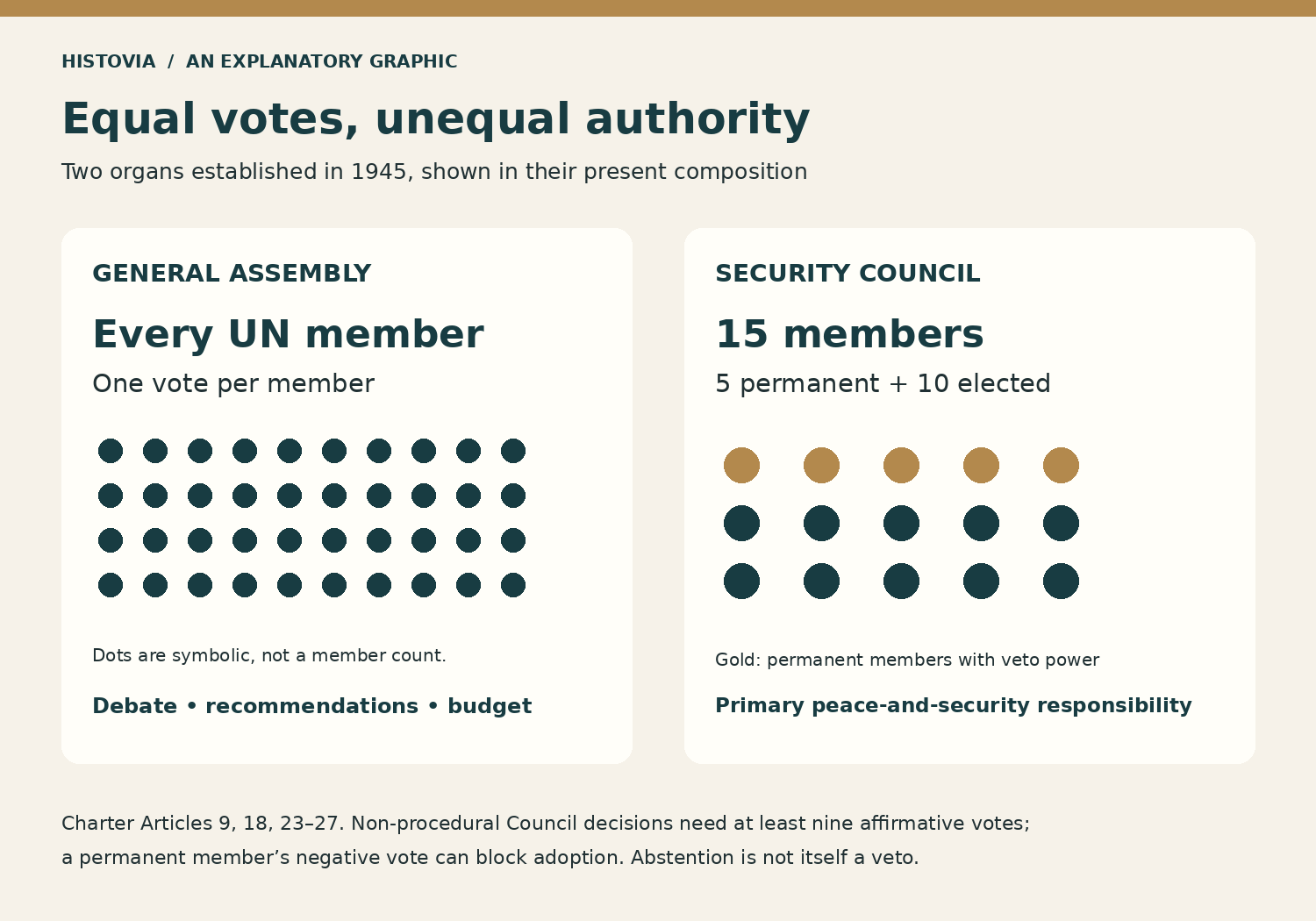
Article 18 gives each General Assembly member one vote. Important questions require a two-thirds majority of members present and voting; other questions generally require a simple majority on that basis. The votes are not weighted by population, economic output, military expenditure or financial contribution.
This is equality among member states. It is not a worldwide popular election. A state’s government speaks through its delegation, while individual citizens do not each cast an Assembly ballot. Equal voting rights also do not make every delegation equally well resourced or every government equally influential outside the chamber.
The Assembly can debate a broad range of questions, make recommendations and exercise institutional powers such as approving the UN budget. Its resolutions must be understood according to their subject and legal basis. Treating every Assembly vote as a universally enforceable command exaggerates its authority; treating every vote as empty symbolism misses important functions.
The Council’s inequality is equally deliberate
The Council today has fifteen members, including ten elected for two-year terms. For non-procedural decisions, the Council’s explanation of its voting system requires at least nine affirmative votes and explains the blocking effect of a negative vote by any permanent member. A permanent member’s abstention does not by itself block adoption. Procedural decisions are not subject to that veto.
These distinctions matter when reading a headline saying “the UN voted.” Which organ acted? Was the matter procedural? Was the result a recommendation or a decision with a different legal effect? The institutional name alone cannot answer those questions.
The permanent members are China, France, Russia, the United Kingdom and the United States. The Charter’s original wording names the Republic of China and the Soviet Union. The surviving institutional privilege and the representation of particular seats have histories of their own; present-day labels should not be projected uncritically onto a 1945 photograph.
The tension is therefore sharper than large countries versus small ones. Some states can participate in a vote whose outcome another member can prevent from becoming a Council decision. That asymmetry is part of the arrangement, visible in its rules.
Who helped write equality into the bargain?
A focus on the leading powers can make the founding appear to have been their work alone. Other participants shaped the terms. Research at SOAS on women and the Charter identifies the importance of Bertha Lutz of Brazil and Minerva Bernardino of the Dominican Republic in securing explicit recognition of women’s equality, including Article 8.
Their efforts reveal negotiation inside the language of principle. Broad references to humanity did not automatically settle whether women would be explicitly recognized. Delegates had to press for particular words and provisions. The resulting Charter prohibited restrictions on the equal participation of men and women in its principal and subsidiary organs.
The historical lesson is that unequal bargaining power does not make every participant powerless. Coalition-building and insistence on wording can leave durable marks in an institution. Equally, a promise in a founding text should not be confused with its complete realization in practice.
Sovereign equality in a world still full of colonies
The UN’s original membership did not represent today’s world of independent states. Colonial systems remained in place, and the Charter included provisions governing non-self-governing territories and trusteeship. Many people invoked in its universal aspirations had no independent government casting a vote on their behalf.
Decolonization changed both membership and political priorities. The UN legal history of the 1960 Declaration on Colonial Independence explains the importance of the growing Afro-Asian membership and the declaration adopted as General Assembly resolution 1514 (XV). New states used the institution’s principles to press claims that went beyond the comfortable assumptions of colonial powers.
This was not merely an expansion of a guest list. Changes in membership could alter the meaning and political force attached to self-determination. An institution formed under one distribution of power became a forum in which that distribution was challenged.
Changing the room without removing its locks
The Council’s membership expanded from eleven to fifteen when Charter amendments entered into force in 1965. The number of elected seats increased, and the affirmative-vote threshold rose from seven to nine. The Charter’s amendment history records the change. Permanent membership and the central veto arrangement survived it.
The example is useful because it avoids two misleading extremes. The constitutional structure has not been wholly unchangeable since 1945. Nor has enlargement automatically redistributed the most consequential privilege. More representation and a different allocation of blocking power are distinct reforms.
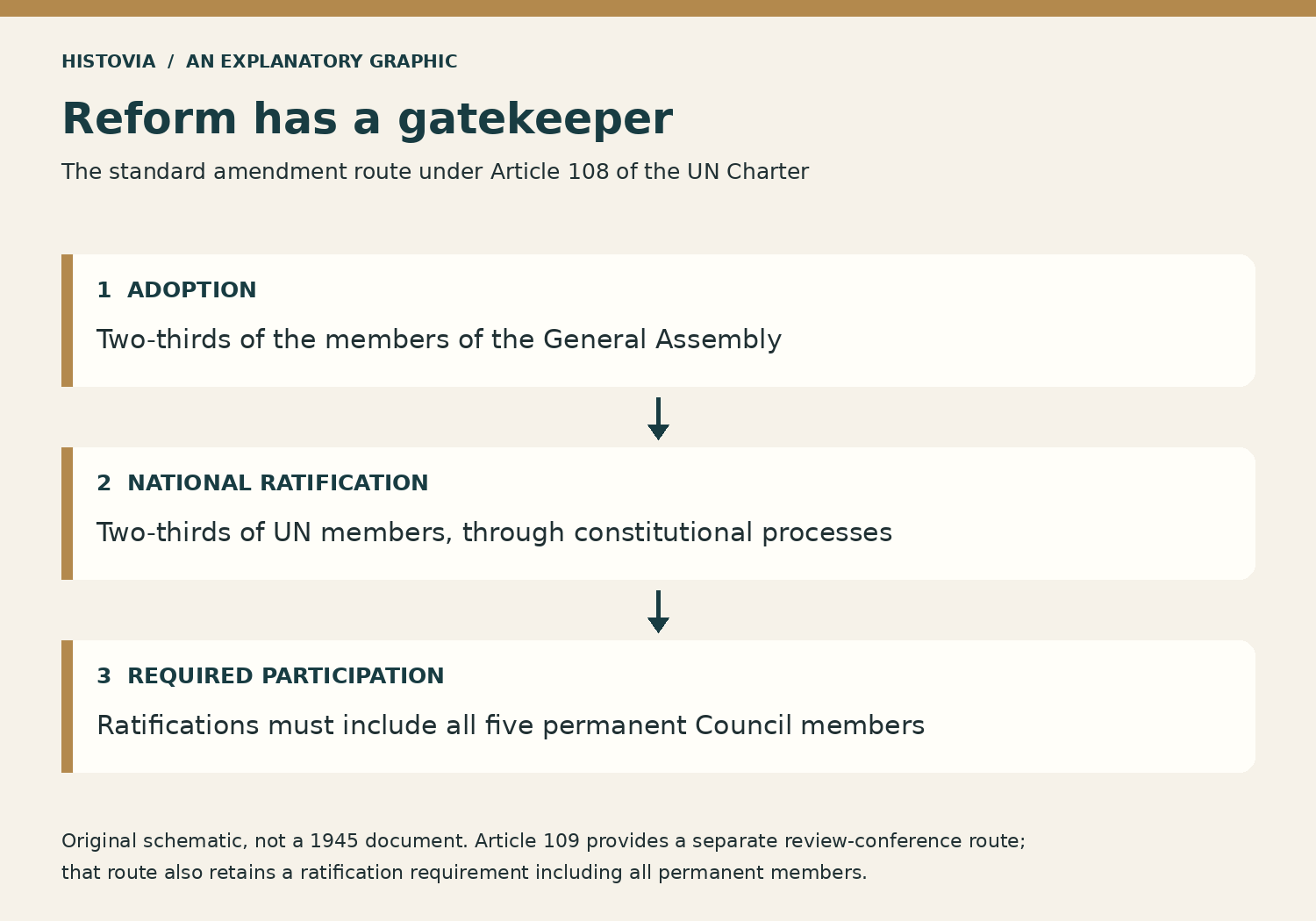
Article 108 makes this distinction politically important. An amendment must be adopted by two-thirds of General Assembly members and ratified by two-thirds of UN members, including every permanent Council member. Article 109 provides for a review conference, but changes through that route also require ratifications including the permanent members.
In practical terms, reform must secure cooperation from the states whose position might be altered. A widely supported proposal can therefore face a bottleneck after an impressive Assembly majority. This explains a structural difficulty without predicting the fate of any particular proposal now under discussion.
Deadlock does not close every avenue
The UN University’s Assembly for Peace handbook describes the General Assembly’s peace-and-security functions and past practice. The 1950 “Uniting for Peace” resolution established a procedure for urgent Assembly consideration when Council unanimity fails in the circumstances it specifies. The Assembly can make recommendations; that procedure does not transform it into an identical substitute for the Council.
A separate initiative, adopted in 2022 as resolution 76/262, calls for an Assembly debate within ten working days of a Council veto, subject to the resolution’s exception for an emergency special session on the same situation. The handbook’s account of the veto initiative explains this procedure and its limits.
Such mechanisms can expose disagreement, require public explanation and keep a matter before the wider membership. They do not erase the original voting rules. It is more informative to ask what a mechanism enables than to describe it simply as either a cure or a failure.
How to read the promise in 2026
The anniversary message’s language of cooperation is an appeal about what members should do. The Charter describes the powers and procedures through which some of that cooperation must operate. Reading one alongside the other reveals an institution that depends on political agreement while trying to give that agreement a durable form.
For a reader following today’s international news, three distinctions are especially useful. First, identify the organ and the rule governing its action. Second, distinguish a statement of principle from the authority to enforce a decision. Third, ask which governments would need to agree for a proposed change to take effect.
These questions resist both easy celebration and easy dismissal. A blocked Council decision does not establish that every UN function has stopped. An overwhelming Assembly majority does not automatically supply the enforcement power needed to implement its recommendation. Specific achievements and failures require specific evidence.
Eighty-one years after the Charter entered into force, the central bargain remains visible. Equal participation has a place in the organization, and so does protected great-power privilege. The history of 1945 helps explain why they coexist. It leaves the present with the harder task of deciding how much cooperation can be built across that unequal structure, and how the structure itself might change.
Sources and further reading
The current hook is the Secretary-General’s official message dated 24 October 2026. Historical comparison is limited to institutional design and its documented development; the article does not infer present voting outcomes or forecast a current crisis. Three historical images are accompanied by two clearly labeled original explanatory graphics.
- Secretary-General, Message for United Nations Day, 24 October 2026. The verified current occasion and the message’s appeal for cooperation and an equal voice.
- UN Dag Hammarskjöld Library, Charter of the United Nations Research Guide. Signature, ratification and entry into force.
- UN Library, Founding Members of the UN. Fifty conference signatories and Poland’s later signature; fifty-one founding members.
- Office of the Historian, The Formation of the United Nations, 1945. The wartime negotiating process and original eleven-seat Security Council.
- United Nations Charter, full text and amendment history. Articles 8–18, 23–27, 108–111 and the 1965 Council enlargement. The treaty is the primary basis for institutional distinctions, not a prediction of political outcomes.
- UN Repertory, Article 18. General Assembly voting and majority requirements.
- UN Security Council, Voting System. Nine-vote threshold, permanent-member veto and abstention; procedural votes distinguished.
- SOAS, Recognising the Women Who Shaped the UN Charter. Archival research into the contribution of Bertha Lutz and Minerva Bernardino.
- UN Audiovisual Library of International Law, Declaration on Colonial Independence. Historical context of General Assembly resolution 1514 (XV), adopted in 1960.
- UNU, Assembly for Peace Handbook. Assembly powers, past practice and the limits of the comparison with Council authority.
- UNU, The Veto Initiative. Resolution 76/262, the ten-working-day debate rule and the emergency-special-session exception; page updated 30 August 2026.
- US National Archives, United Nations Charter (1945). Historical document image and archival identification.