
Histovia · World War II · Justice after war
Putting Aggressive War on Trial: What Nuremberg Actually Decided
The tribunal sought to make the launching of war a matter of individual criminal responsibility. Its judgment also drew boundaries that sweeping accounts of “Nuremberg” often miss.
By Histovia Team
Albert Speer’s verdict at Nuremberg contains a distinction that can surprise a reader encountering the trial for the first time. The former armaments minister was convicted of war crimes and crimes against humanity. He was not convicted on the counts concerning the common plan for aggressive war and the waging of that war.
That was not a declaration that his work was harmless. It was a judgment that different offenses required different findings. The distinction takes us to the heart of the International Military Tribunal’s undertaking: to identify individual responsibility within a dictatorship whose crimes involved entire institutions, without making every form of participation legally identical.
Nuremberg’s central innovation was ambitious, and its limits were consequential. To understand both, we need to separate the charter that created the court, the prosecution’s allegations, the judges’ conclusions and the later proceedings that also took place in the city.

A court created by four powers
Three categories of crime, four counts in the indictment
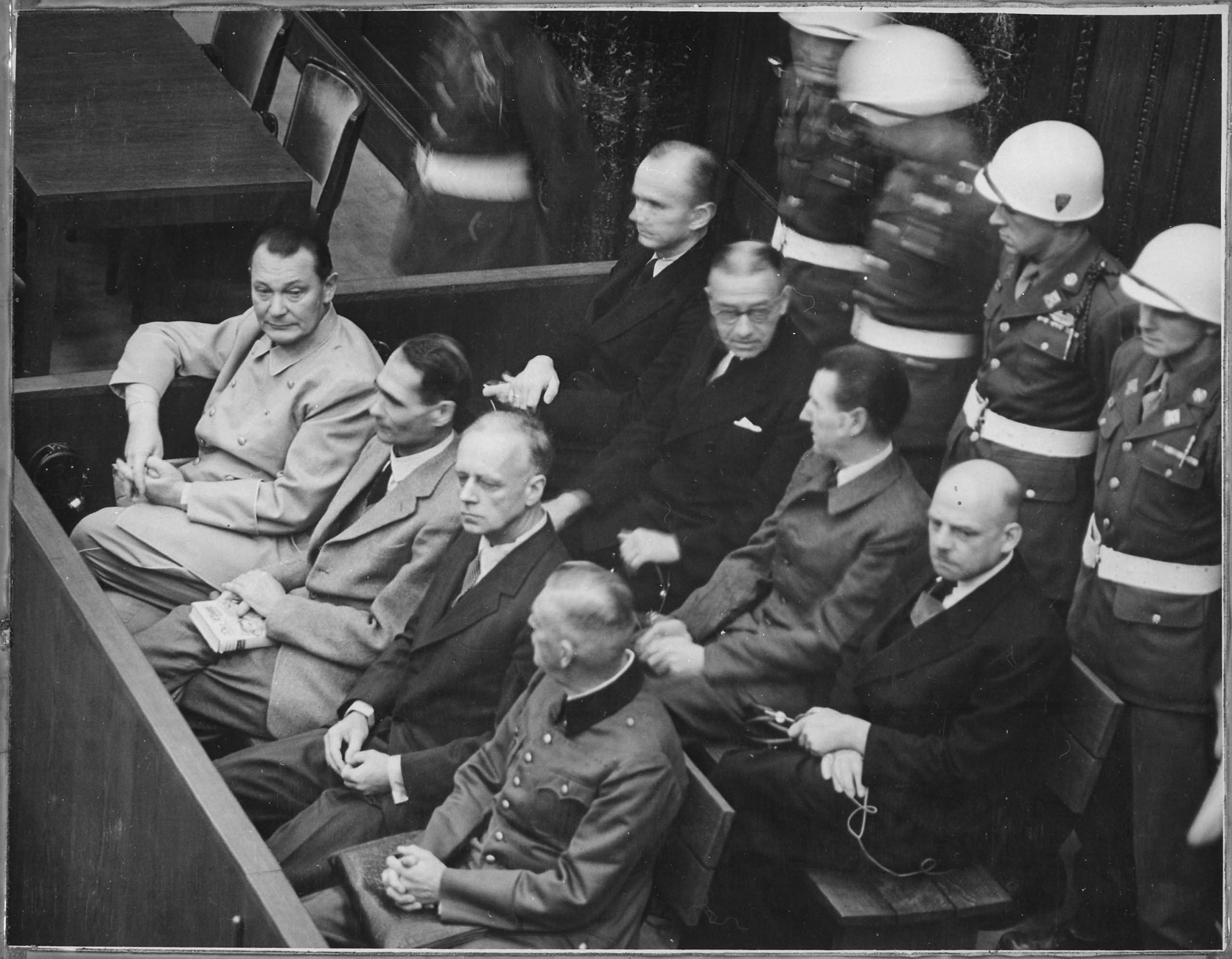
Britain, the United States, France and the Soviet Union established the tribunal through the London Agreement of 8 August 1945. The accompanying Charter specified its powers and procedures. Hearings opened on 20 November 1945; the judgment was delivered on 30 September and 1 October 1946.
Article 6 identified three substantive categories. Crimes against peace concerned the planning, preparation, initiation or waging of aggressive war, or war violating international treaties and assurances. War crimes concerned violations of the laws and customs of war. Crimes against humanity covered murder, persecution, deportation and other specified attacks on civilians, with the connection to other crimes within the tribunal’s jurisdiction required by the Charter.
The indictment organized its accusations into four counts. Count One alleged a common plan or conspiracy. Count Two concerned crimes against peace. Counts Three and Four concerned war crimes and crimes against humanity. The categories and counts were related, but their numbers were not interchangeable.
These distinctions separated the decision to launch a war from crimes committed in its conduct. A leader’s responsibility for one did not automatically settle the evidence for another. Nor did the importance attached to aggressive war make atrocities merely incidental. They remained distinct offenses requiring examination.
Responsibility behind the state
Official power would no longer serve as a complete shield
The Charter directed attention to people exercising authority. Article 7 said that official position, including that of head of state, did not free a defendant from responsibility. Article 8 rejected superior orders as an automatic defense, while allowing them to be considered in mitigation when the tribunal thought justice required it.
The underlying problem was practical as well as legal. A state could wage war only through decisions made and carried out by individuals. If official capacity always protected those individuals, the power to command would become a means of escaping accountability for the very acts it enabled.
But individual responsibility also required an individual inquiry. The proposition did not mean that every soldier, clerk or factory worker had committed the crime of aggression. Which decisions a person helped make, what that person knew and the nature of the participation remained important questions. Later tribunals would make the distinction between policy-making and subordinate activity especially explicit.
Thus Nuremberg challenged two opposite simplifications: that a dictator alone bore all responsibility, and that everyone serving the regime was guilty in the same way. The work of a trial lay between those positions.
Reading the judgment closely
The judges narrowed the prosecution’s conspiracy case
The prosecution presented an expansive narrative linking the Nazi movement’s rise, the seizure of power and successive acts of expansion. The judgment on the common plan or conspiracy accepted that aggressive wars had been planned, but insisted on identifying concrete plans and participants. Distant party programs were not enough by themselves.
The judges did not need to find one perfectly unified conspiracy covering the whole period described by the prosecution. They found continuing planning and multiple plans for aggressive war. Knowing cooperation could make a participant responsible even when Hitler originated the policy.
A further limit is easy to miss. The court treated conspiracy as a separate offense only in relation to aggressive war. It therefore disregarded the portions of Count One that alleged conspiracies to commit war crimes and crimes against humanity as separate offenses. Those underlying crimes remained before the court under the other counts.
An indictment is an allegation; a judgment is a finding. Repeating the prosecution’s broadest account as though the court adopted every part erases one of the most important features of the trial.
The distinction also matters when using Nuremberg as historical evidence. A document introduced in court may illuminate the regime, while the legal conclusion reached about a particular defendant can be narrower than the document’s wider historical significance.
The contested legal foundation
Could individuals be punished under a law clarified after the acts?
The defense raised a serious objection: no earlier criminal statute had precisely established this individual offense, prescribed its punishment and supplied this international court. That was an argument about retroactivity and legality. It was distinct from disputing whether Germany had invaded other countries.
In its discussion of the law of the Charter, the tribunal answered by invoking existing international obligations, especially the 1928 Kellogg–Briand Pact renouncing war as an instrument of national policy. It also drew on customary-law reasoning and the premise that individuals who knowingly violated international restraints could not escape by appealing to the state.
The judges regarded aggressive war as exceptionally grave because it opened the way to the wider destruction that followed. Yet their conclusion did not make the legal controversy disappear. There remained a difference between an international prohibition binding states and a fully specified criminal rule applied to individuals.
A careful history should present the tribunal’s answer as its answer. Saying that the judges developed a reasoned justification is different from claiming that every lawyer accepted it. The achievement and the controversy were connected: the attempt to enforce responsibility exposed how much of the necessary legal machinery had previously been missing.

A verdict with separate parts
Speer’s case shows why the counts mattered
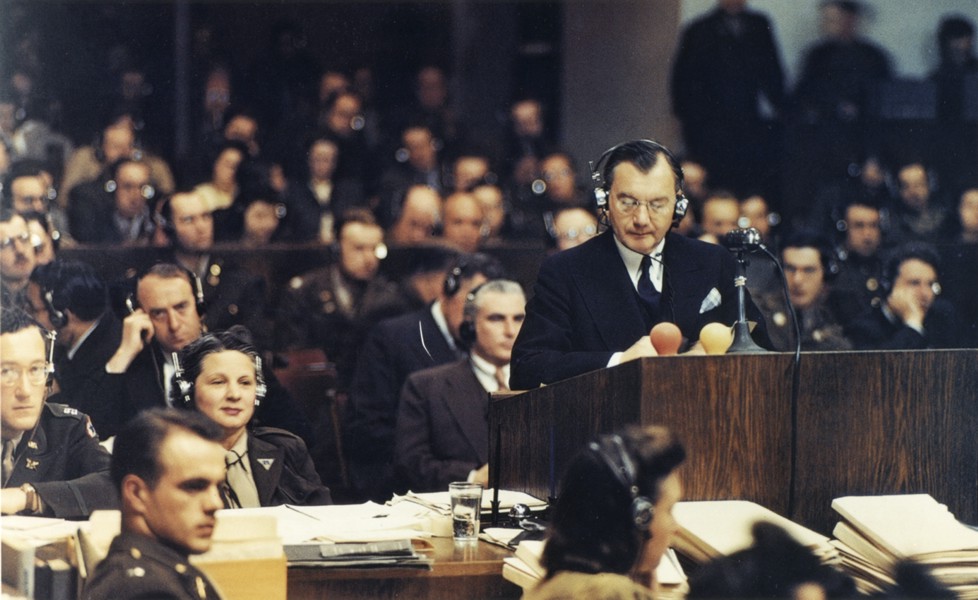
The judgment on Speer found that his armaments role did not establish the aggressive-war participation charged in Counts One and Two. He had taken charge of the armaments industry after the relevant wars were already underway. The court did not regard contribution to war production, by itself, as sufficient for those counts.
Its findings on forced labor were different. The judgment described his demands for workers, his knowledge that foreign laborers were supplied under compulsion and his participation in extending that system. It convicted him under Counts Three and Four. An acquittal on aggression was therefore not an acquittal of exploitation or a general certification of innocence.
Nor should the judgment’s mitigation discussion be treated as the final historical word on Speer’s self-presentation. A trial record answers particular charges on the evidence before it. Later historical inquiry can examine a person’s conduct and claims more widely.
The trial as a whole also produced differentiated results. As the United States Holocaust Memorial Museum explains, the proceedings against the major war criminals must be distinguished from the larger series that followed. Twenty-two defendants were tried at the IMT, including Martin Bormann in absentia. There were twelve death sentences, seven prison sentences and three acquittals. Twelve death sentences did not mean twelve executions: Göring died by suicide before his sentence could be carried out.
One city, different tribunals
The later cases refined the problem of participation
The twelve subsequent Nuremberg trials, held from 1946 to 1949, were conducted by U.S. military tribunals under Control Council Law No. 10. They were not additional sessions of the original four-power court. Their defendants included industrialists, doctors, judges, military leaders and members of Nazi organizations.
The United Nations’ historical review of aggression reproduces and discusses the later judgments. In the IG Farben case, industrial contribution to the war effort was not enough on its own to establish aggression liability. Knowledge, participation in planning and the level of responsibility mattered. The High Command case likewise distinguished those involved in making policy from people below that level.
Those were findings in separate proceedings. They should not be inserted retrospectively into the wording of the IMT Charter as though every detail had already been settled in August 1945. The legal history developed through successive attempts to specify who could be held responsible and for what conduct.
The distinctions also guard against treating an acquittal on one theory as proof that the broader institution was innocent of everything. Aggression, forced labor, plunder and atrocities raised different evidentiary and legal questions.
A lasting precedent within an unequal postwar order
The criticism of victors’ justice identifies a genuine asymmetry. The victorious powers created the court and tried the defeated leadership; their own conduct was outside its remit. Nuremberg was not a universal inquiry into every act committed during the war.
At the same time, the defendants had counsel, could present evidence and could cross-examine witnesses. The acquittals and the narrowing of charges matter. So do procedural limits: the Charter permitted flexible evidentiary rules, and the judgment was final without an appeal. The National WWII Museum’s account of the trial and its legacy places the proceedings within that difficult transition from military victory to an effort at legal accountability.
On 11 December 1946, UN General Assembly Resolution 95(I) affirmed the principles recognized in the Charter and judgment. The International Law Commission formulated principles in 1950. As Antonio Cassese explains in the UN Audiovisual Library’s historical commentary, those later formulations have their own history; they should not be presented as an instantly complete and universally enforced criminal code.
Nuremberg made it harder to argue that a state’s authority erased the responsibility of the people using it. It did not eliminate political selectivity or settle every boundary of aggression. Its importance lies in the effort to make power answer to articulated charges, evidence and reasoned findings, and in the questions that effort left for later courts.
Sources
This article concerns the historical tribunal and its aftermath. It distinguishes the prosecution’s allegations, the IMT’s findings, subsequent U.S. tribunals and later UN interpretation.
- International Military Tribunal, Charter, especially articles 6–8, 16, 19 and 26, Avalon Project, Yale Law School.
- IMT judgment, The Law of the Charter; Common Plan or Conspiracy; and Speer.
- United Nations Secretariat, Historical Review of Developments Relating to Aggression, sections on the IG Farben and High Command trials.
- United States Holocaust Memorial Museum, The Nuremberg Trials.
- The National WWII Museum, The Nuremberg Trial and its Legacy.
- Antonio Cassese, Affirmation of the Principles of International Law recognized by the Charter of the Nürnberg Tribunal, UN Audiovisual Library of International Law.
Photograph provenance and public-domain records appear with each image. Sources checked October 2026.
Explore more World War II history
D-Day’s Invisible Front
For a separate wartime story, Histovia’s illustrated ebook examines the deception campaign behind the Normandy landings and how historians assess its effects.
US$3.90 · PDF + EPUB · By Histovia Team