
Haiti’s Independence and the Price of Recognition
Haiti defeated French rule in 1804. Its struggle for recognition exposed the distance between emancipation, sovereignty, and the indemnity demanded in 1825.
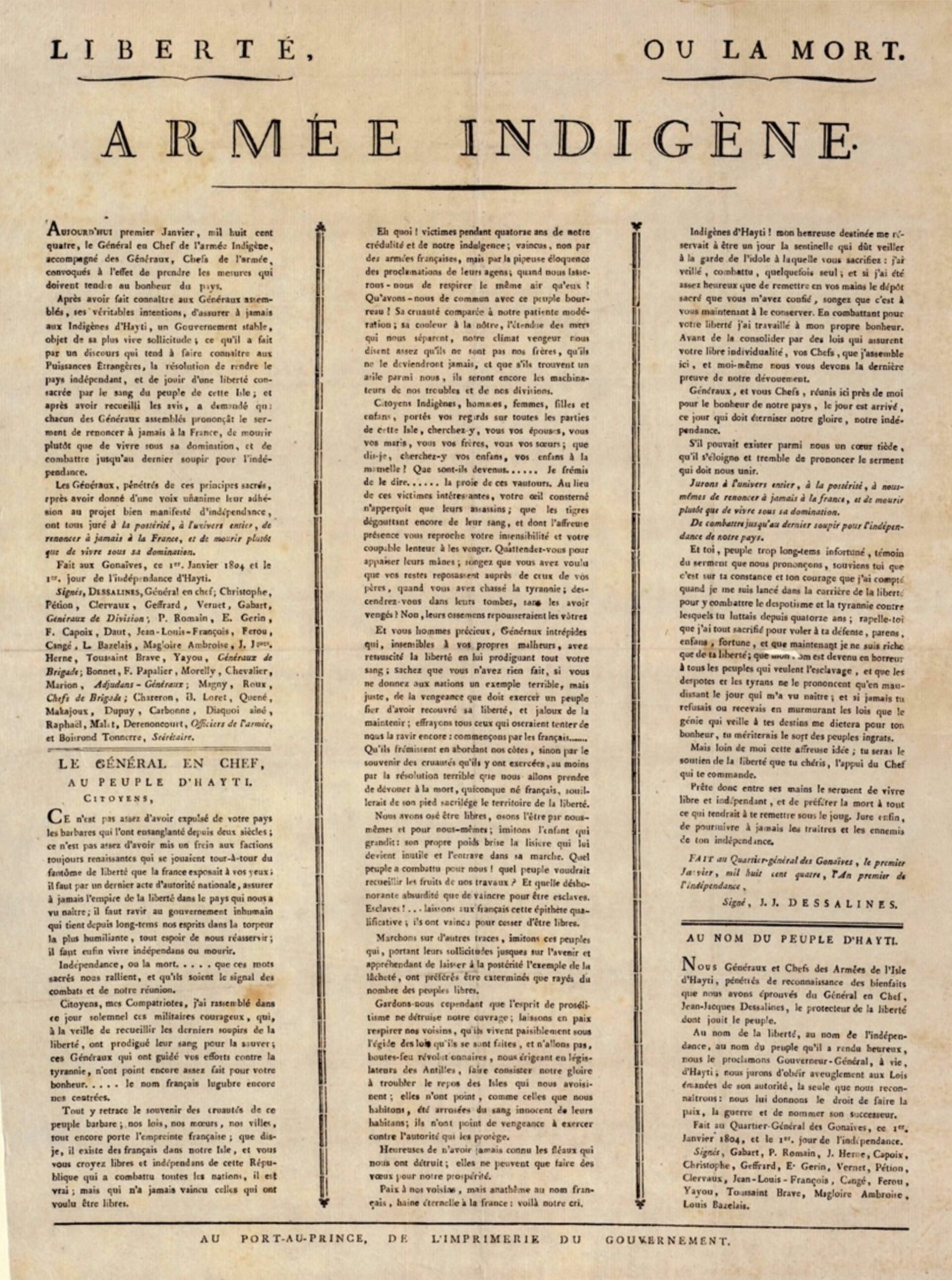
In July 1825, a French envoy arrived off Haiti with warships and an ordinance signed by his king. Independence had been proclaimed at Gonaïves on 1 January 1804, after France’s defeat. Yet French recognition now required an enormous payment to the former colonists. People who had fought enslavement were being asked to finance compensation for the colonial property system they had overthrown.
Between those two moments lay a struggle over the meaning of freedom: who could claim it, how a liberated population would work, and whether military victory entitled a Black state to the diplomatic standing that other governments took for granted. Haiti’s revolution answered the question of French rule. It did not end the contest over the terms of sovereignty.
The revolution that changed the colony
Saint-Domingue, the French colony in western Hispaniola, produced sugar and coffee through the forced labor of an overwhelmingly enslaved population. When a large uprising began in the northern plantation districts in August 1791, the colony was already divided by the French Revolution, disputes among white colonists, and demands for equality from free people of color. The insurgency transformed those struggles. Enslaved people made emancipation an immediate military and political problem rather than a question that colonial legislators could indefinitely postpone. [1]
In 1793, the commissioners Sonthonax and Polverel proclaimed emancipation in the colony. The Convention in Paris followed in February 1794 with abolition across French colonial possessions, although enforcement varied. Toussaint Louverture had fought alongside Spain before entering French service. These changes joined emancipation to an international war without settling who would ultimately rule Saint-Domingue. No single declaration had yet established the independent state that emerged a decade later. [8] [9]
Toussaint’s freedom had boundaries
The constitution issued under Toussaint in 1801 exposes the political arrangement he sought. Its first article retained Saint-Domingue within the French empire while subjecting it to special laws. Article 3 permanently abolished slavery. Other provisions rejected color as a barrier to employment and made Toussaint governor for life. This was a formidable assertion of autonomy, but it was not the declaration of an independent Haiti. [3]
The same constitution reveals a troubling distinction between freedom from ownership and freedom to choose one’s livelihood. Agriculture could suffer no interruption. A plantation was described as a working family headed by its owner or representative, and cultivators were to share in its income. Their movement between workplaces was treated as a danger to production and public order.
These clauses belong together. Toussaint defended emancipation while preserving a disciplined export economy and strong executive power. The constitutional promise that people could never again be slaves did not grant unrestricted freedom to leave plantation labor. The document makes a distinction between emancipation and control over one’s working life that readers should not overlook.
The French return in 1802
Napoleon Bonaparte sent an expedition commanded by his brother-in-law Charles Leclerc to restore effective French control in early 1802. After fighting, Toussaint submitted. French officers then arrested and deported him; he died in captivity at the Fort de Joux in April 1803. He neither commanded the final victory nor proclaimed independence. Those distinctions matter because the political project that followed was more radical than the constitutional arrangement he had defended. [4]
French promises that freedom would survive became increasingly untenable. In Guadeloupe, French forces restored slavery in 1802. The law of 20 May should not be loosely described as a single decree that instantly re-enslaved every French colony: its geographic application and the subsequent measures differed. For Saint-Domingue, secret instructions from naval minister Denis Decrès to Leclerc on 14 June are especially revealing. They envisaged military and agricultural discipline preparing the way for an eventual return to slavery. [5]
Jean-Jacques Dessalines and other commanders who had temporarily accepted French authority renewed the war. Resistance, yellow fever, and the disruption of French reinforcement and supply combined to destroy the expedition’s prospects. The surviving French force surrendered in November 1803. Disease was decisive, but it did not fight the campaigns, hold communities together, or decide what would replace colonial government. [4]
What the declaration demanded
The declaration of 1 January 1804 was organized around a permanent rupture with France. The assembled generals pledged to defend independence rather than return to French domination. Dessalines’s accompanying proclamation presented separation as the means of preventing re-enslavement. Its language was shaped by recent war and by the conviction that another French government could revoke promises of emancipation. [6]
It was also a document of military leadership. The generals constituted the political assembly and vested extensive authority in Dessalines. Reading it as an uncomplicated charter of liberal democracy obscures its priorities: securing an antislavery state and concentrating the power believed necessary to defend it.
Dessalines subsequently ordered massacres of remaining French white residents in 1804. That violence belongs within the history of independence, alongside the French campaign of reconquest; acknowledging one does not erase the other. It also intensified foreign hostility. The United States withheld formal recognition until 1862, even while commercial relationships connected Haiti to the wider Atlantic. Diplomatic nonrecognition did not mean that no ships traded with Haitian ports. [1]
The ordinance carried by the fleet
Charles X’s ordinance, dated 17 April 1825, contained three articles. It opened the former French portion of Saint-Domingue to foreign commerce, but offered French ships and goods preferential customs treatment. It required 150 million francs, payable in five annual installments, to compensate former colonists. Only on those conditions did the king concede independence to the territory’s inhabitants. Even its wording avoided treating Haitian sovereignty as an accomplished fact that France merely acknowledged. [7]
President Jean-Pierre Boyer accepted under naval pressure in July. To meet the first installment, Haiti contracted a French loan with a face value of 30 million francs, receiving less after financial deductions. The indemnity and the borrowing used to pay it were separate obligations. In 1838, the total indemnity was reduced to 90 million francs. That later revision must not be confused with either the original demand or the eventual cost of servicing associated loans. [2]
The two founding documents could hardly have spoken more differently. At Gonaïves, Haitian commanders declared that France’s authority had ended. In Paris, twenty-one years later, a king described independence as something he could grant under conditions. Between them stood a population that had already made the first declaration real, and a treasury now required to make payments under the second.
Sources and further reading
- Office of the Historian, US Department of State, “The United States and the Haitian Revolution, 1791–1804.” Diplomatic overview; the series is now retired.
- Gusti-Klara Gaillard-Pourchet, “La dette de l’indépendance d’Haïti,” Bibliothèque nationale de France. Debt, negotiations, and the distinction between indemnity and loans.
- Constitution of Saint-Domingue, 1801, English translation. Compare the French primary text, especially articles 1–5, 14–17, and 28.
- “L’expédition de Saint-Domingue de 1802 et la vente de la Louisiane,” Bibliothèque nationale de France.
- Fondation pour la mémoire de l’esclavage, primary-source dossier on Napoleon and the restoration of slavery. Includes Decrès’s instructions of 14 June 1802.
- Julia Gaffield, Haitian Declaration of Independence transcription and translation, Haiti and the Atlantic World. Based on surviving official printed copies.
- Royal ordinance of Charles X, 17 April 1825. Primary text, Fondation pour la mémoire de l’esclavage.
- French National Assembly, “1794 : la première abolition.” Legislative history and colonial emancipation.
- T. C. Dawson, memorandum of 16 June 1906, US diplomatic papers. Historical record of Toussaint’s change of allegiance.