
Waitangi, 1840: Two Texts, Many Signings, and a Disputed Transfer of Power
The Treaty of Waitangi travelled far beyond its first signing. Its Māori and English texts, local negotiations and disputed sovereignty reveal what the 1840 agreement did and did not settle.
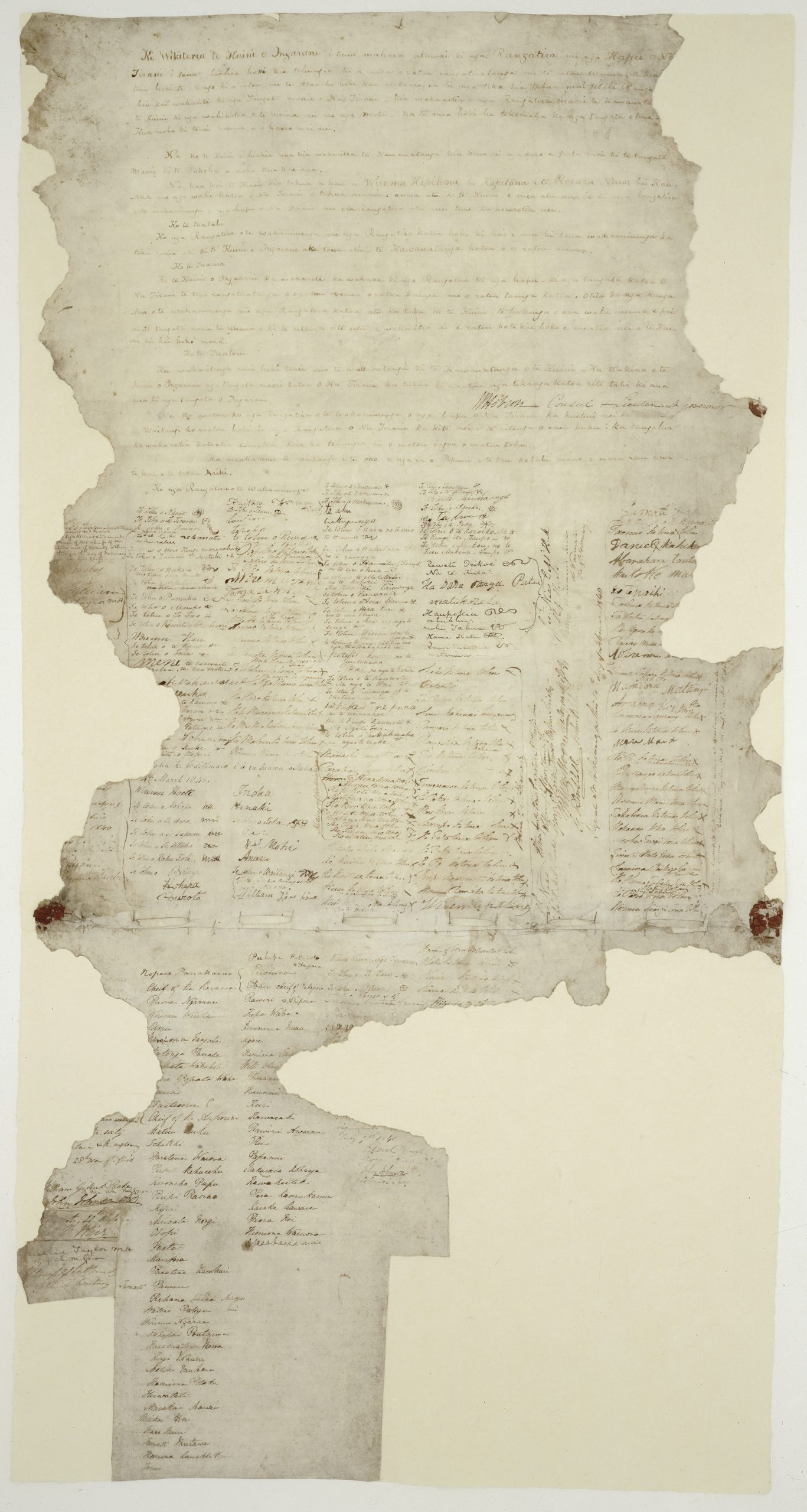
On 6 February 1840, rangatira at Waitangi placed names and personal marks on a Māori-language document that proposed a relationship with the British Crown. That meeting began a much longer process. Copies travelled by ship and overland; other communities debated them, signed them, refused them, or never received a meaningful opportunity to consider them. The surviving record consists of nine sheets, not one universally signed national contract. Their distribution is the first warning against reducing Waitangi to a single ceremony with a single, uncontested meaning. To understand what happened, the language on the sheets has to be read alongside the negotiations around them. [1]
Before the treaty: authority already existed
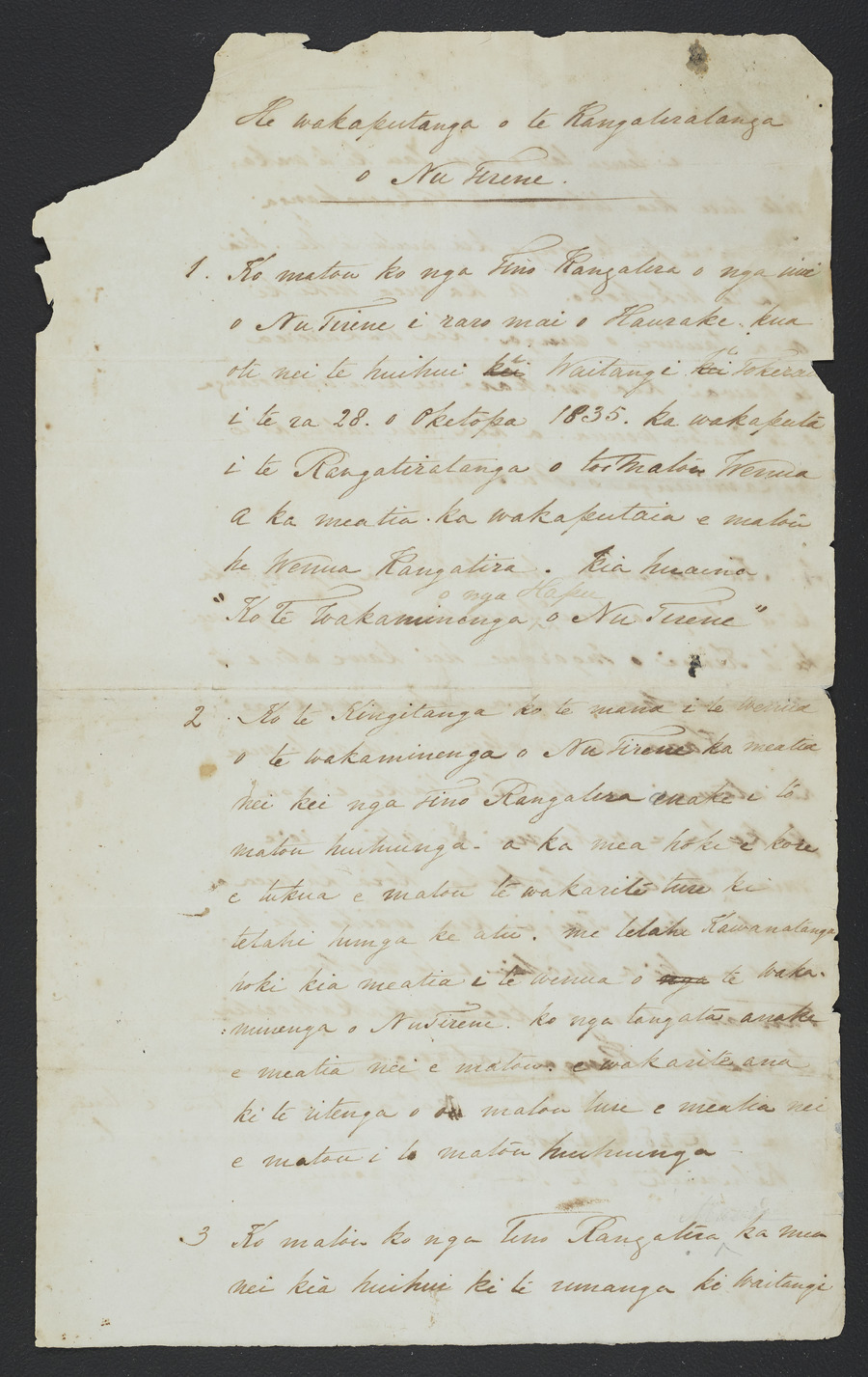
The Crown did not arrive in a political vacuum. In October 1835, northern rangatira had signed He Whakaputanga, the Declaration of Independence. Thirty-four signed at the initial gathering; by 1839 the total had reached 52. The declaration located authority in the rangatira and rejected government exercised independently of them. It also sought British protection. The British government acknowledged the document. These were compatible objectives for its signatories: an external relationship could help defend local authority rather than replace it. About half the men who signed at Waitangi on 6 February had also signed the declaration. The earlier agreement therefore belongs inside the treaty story, especially when interpreting what northern leaders could have expected from another agreement with Britain. [2]
In the late 1830s, communities also faced practical problems that could make a governor useful. Trade and shipping brought opportunities, but British subjects in New Zealand were difficult for British officials to regulate. European land speculators claimed enormous purchases. The New Zealand Company planned organised settlements around Cook Strait and dispatched ships without waiting for an agreed colonial government. Māori communities negotiated with this expanding European presence from their own positions of authority. Their interests varied with geography, trading connections, kinship and existing disputes. A coastal community already dealing with merchants and missionaries faced different pressures from an inland community with fewer settlers nearby. That uneven political landscape would shape the signing process. [3]
A document produced in days
William Hobson arrived in the Bay of Islands on 29 January 1840, instructed to obtain consent to British sovereignty. His instructions also demanded fair dealing over land and protection against transactions harmful to Māori subsistence. The tension was already apparent: acquiring authority and territory for a settler colony was being presented as a protective undertaking. Hobson and his secretary James Freeman prepared notes; James Busby contributed a more developed draft. The emerging English text had three articles, covering sovereignty, property and Crown land purchasing, and the rights of British subjects. On the evening of 4 February, Henry Williams and his son Edward received the document to translate into Māori for the following day. [4]
Richard Taylor prepared a clean parchment copy. On 5 February, the proposed agreement was read and explained to the gathering at Waitangi. Missionaries served as crucial interpreters, and debate continued after Hobson left. Archives New Zealand’s account emphasises that the explanations stressed protection and benefits while minimising the restrictions implicit in Britain’s intended acquisition of supreme authority. That is important evidence about the transaction, not a reason to imagine a silent or credulous Māori audience. Rangatira argued over the proposal and sought assurances. A spoken undertaking could matter as much as a particular written phrase. Religious tolerance also received an oral assurance at the signing, following the intervention of Catholic bishop Jean-Baptiste Pompallier; it was not a fourth written article on the parchment. [5]
What the two texts actually said
The first article contains the central discrepancy. The English text described a cession of sovereignty. The Māori text used kāwanatanga, usually rendered as government or governorship. The term was familiar through missionary language and references to colonial governors, but familiarity did not make it an exact equivalent of an unlimited sovereign power over rangatira and their people. Reading the English claim back into the Māori word assumes the very equivalence that requires investigation. Article Three, by contrast, offered the Queen’s protection and rights associated with British subjects in both texts. Similarity there did not remove the difference over who would exercise political authority. [6]
Article Two made that question sharper. Te Tiriti guaranteed tino rangatiratanga over lands, settlements and treasured possessions. That language concerns the exercise of chiefly authority, not simply permission to occupy property under someone else’s unrestricted rule. The same article addressed land transactions with the Crown. Its clauses must be considered together: a grant of kāwanatanga in Article One stood beside an explicit guarantee of rangatiratanga in Article Two. The historical question is how signatories understood those powers to coexist. Modern translations help English readers approach the Māori text, but they are interpretive aids, not substitute documents that Māori signed in 1840. [7]
Agreement did not mean identical expectations
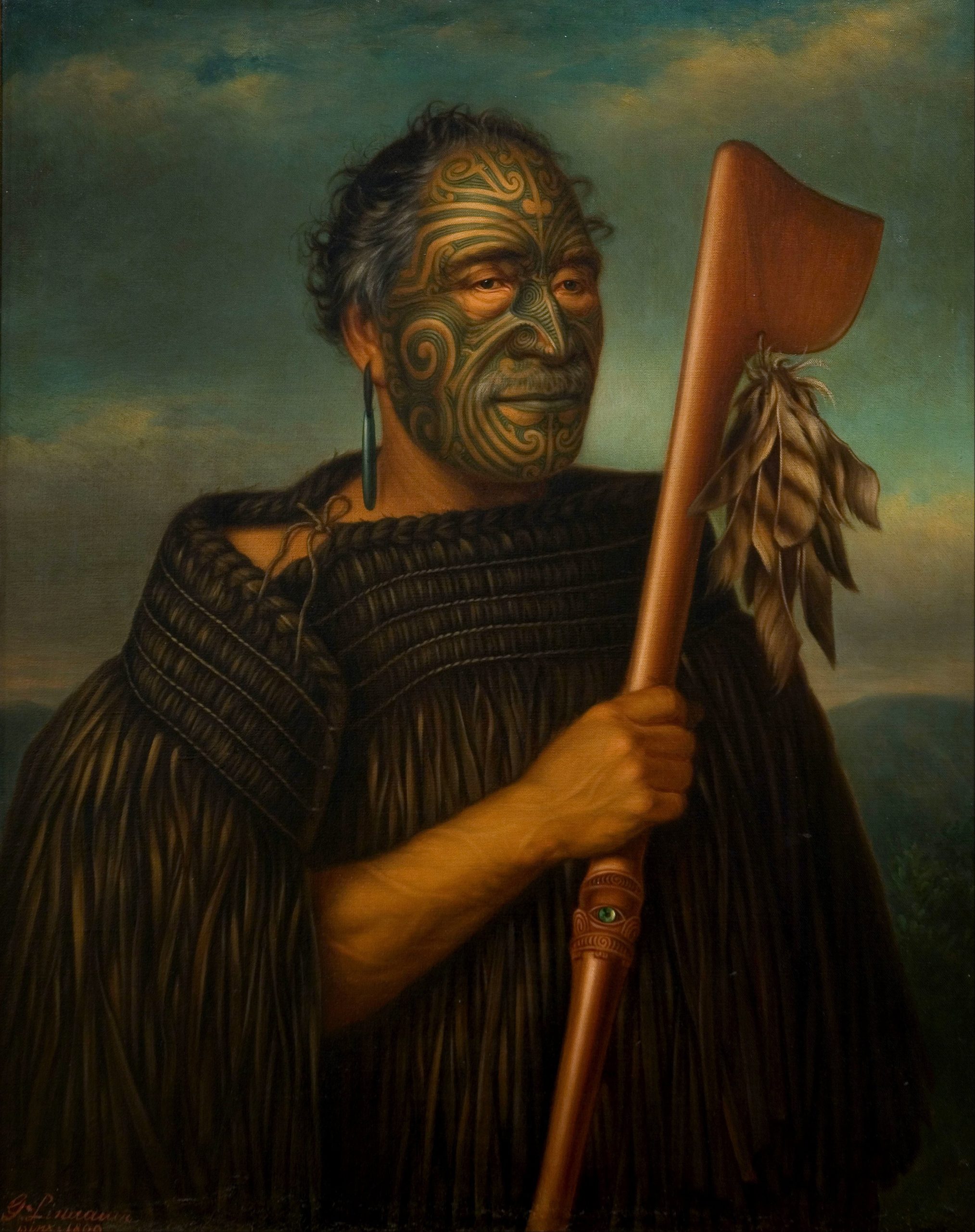
Tāmati Wāka Nene became an influential supporter of the treaty. His political position grew from long experience of European contact, missionary relationships and northern affairs. He regarded that contact as an established reality and favoured a relationship that could regulate it. His later alliance with the government did not make him a passive instrument: he advised governors, criticised British commanders and pursued his own community’s interests. Nene’s career also complicates any account dividing the meeting into a unified Māori side and a unified British side. Māori leaders could share concern for their authority while choosing different strategies for maintaining it. [8]
The first signing occurred on 6 February, earlier than Hobson had expected. Hōne Heke signed first. Around forty rangatira signed that day, although counts vary with the treatment of the surviving record. Subsequent journeys transformed a northern agreement into a much wider collection of engagements. Approximately fifty meetings took place between February and September. By the end of the process, about 540 Māori had signed; all but 39 had signed Māori-language sheets. Some copies were handwritten and one surviving sheet was printed. Hobson’s stroke on 1 March added to the practical difficulties, and Colonial Secretary Willoughby Shortland helped organise further circulation. A signature count alone cannot tell us how carefully each meeting explained the arrangement. [9]
The travelling sheets and the people on them
The Cook Strait sheet makes the journey tangible. Henry Williams took it south, and 34 rangatira signed aboard his schooner Ariel at Port Nicholson on 29 April after an initial period without signatures. Further meetings followed around the northern South Island and the western North Island. He returned with 132 signatures. Its organised columns and border differ visibly from the accumulating marks on the Waitangi parchment. The differences in appearance are useful evidence of administration and travel, while the names locate the treaty within particular communities. The sheet also records women whose political authority can disappear from accounts that picture every signatory as a man. [10]
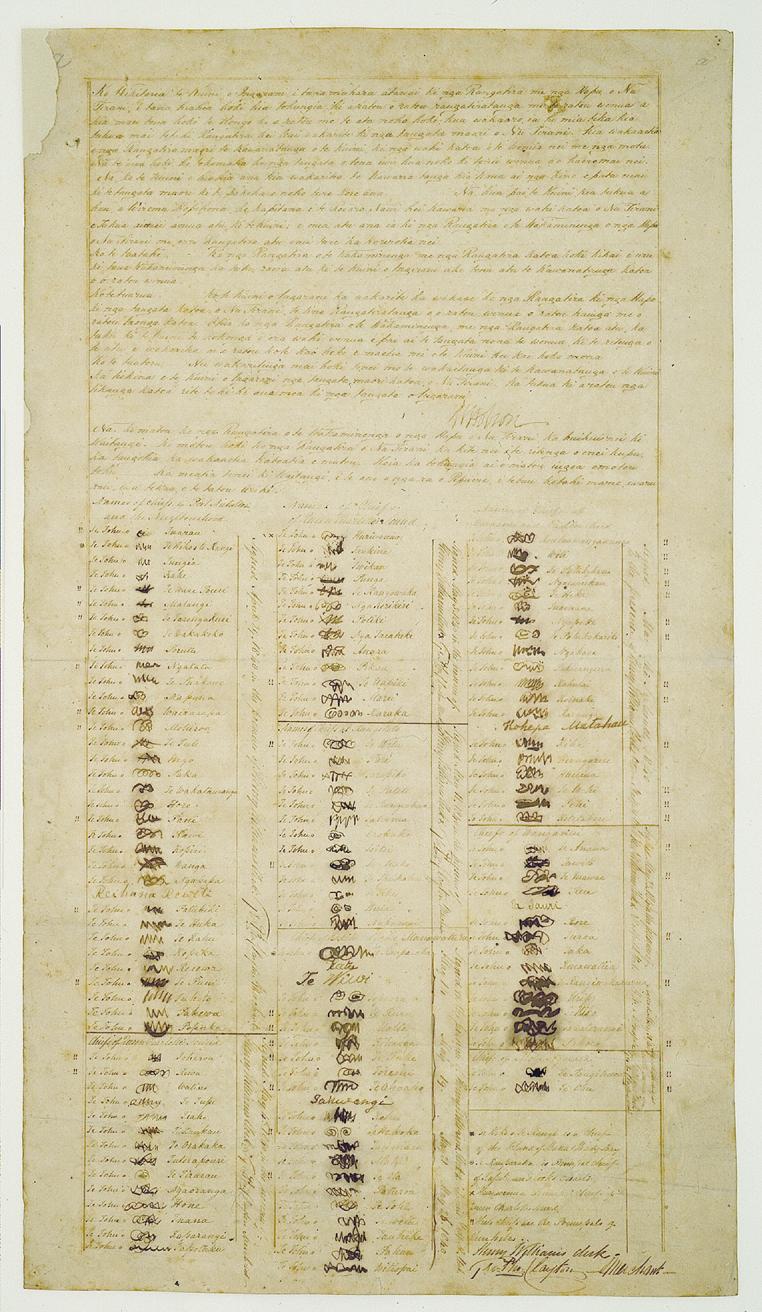
Te Rangitopeora, recorded as Topeora, signed this sheet at Kāpiti on 14 May. She was a Ngāti Toa leader and a composer of waiata, connected through close kinship to Te Rangihaeata and Te Rauparaha. Her later opposition to land sales and resistance to growing settler power show why signing cannot be treated as an advance endorsement of everything the colonial government subsequently did. The treaty was a relationship in which promises could be invoked and conduct challenged. Her documented actions also make a better guide than an invented account of what she privately felt while signing. [11]
Non-signatures require equal care. Some rangatira explicitly refused. Te Wherowhero did not sign; leaders of Te Arawa and Ngāti Tūwharetoa also declined. Their decisions reflected concern for independent authority and different local circumstances. Elsewhere, people lacked an opportunity: no treaty meetings appear to have taken place in some regions, while negotiators sometimes departed before absent leaders returned. It is therefore inaccurate to classify everyone without a signature as a deliberate opponent, just as it is inaccurate to describe the final collection as unanimous consent. Both refusal and exclusion are part of the geographical record of 1840. [12]
A sovereignty proclamation before the journeys ended
On 21 May, with signatures still being collected, Hobson proclaimed British sovereignty over the whole country. He claimed the North Island through cession under the treaty and the South and Stewart Islands through discovery. Those were the Crown’s asserted legal grounds, not neutral descriptions of an empty country or uncontested authority. Māori already lived across these islands. Hobson’s action also responded to the possibility that New Zealand Company settlers would organise their own administration around Cook Strait. Officials carried the proclamation to Port Nicholson and demanded allegiance. The chronology matters: the Crown announced a nationwide result months before the last signatures were obtained in September. [13]
Assertion and effective control nevertheless remained different things. In the 1840s, many hapū retained substantial authority, while settlements relied on Māori food, protection and assistance. Colonial officials increasingly interpreted the agreement through the English text and found chiefly authority inconvenient when it obstructed Crown policy. Land purchasing exposed conflicts within the promised protective system: the official charged with protecting Māori interests also acted as a purchaser. Disputes over settlement and land soon produced violence. These developments cannot be explained by a translation problem alone. They involved decisions about administration, purchasing and the expansion of government power after the signing. [14]

Heke’s later opposition illustrates that widening gap. The movement of the capital to Auckland weakened Bay of Islands commerce; customs duties raised prices, while shipping revenues increasingly went to the government. British legal practices also encroached on chiefly authority. The flagstaff at Kororāreka became a focus of confrontation, culminating in war in 1845. Yet Heke’s challenge did not mean that his earlier signature had been meaningless. His subsequent dealings with Governor George Grey continued to invoke an expectation that the Crown would honour the treaty. Agreement in 1840 and resistance to colonial conduct could belong to the same political position. [15]
What a later inquiry could establish
In 2014, the Waitangi Tribunal’s first-stage Te Paparahi o Te Raki inquiry concluded that the rangatira who signed at Waitangi, Waimate and Mangungu in February 1840 had not ceded their sovereignty. It found that they accepted a governor with authority over British subjects while retaining authority over their own peoples and territories, with overlapping situations requiring further negotiation. That finding arose from an inquiry into particular northern signings and the explanations given there. It should not be inflated into a finding about every later signing or a simple declaration that the Crown has no sovereignty today. The Tribunal expressly did not determine how and when the Crown acquired the sovereignty it now exercises. Its distinction was narrower and historically powerful: Britain’s intention to acquire sovereignty was not the same thing as informed Māori consent to surrender it. [16]
The physical documents survive through careful conservation. The Waitangi sheet’s parchment, now identified by DNA testing as sheep skin, needs controlled conditions and support. Preservation allows its text and marks to be examined, but the sheet cannot speak without its surrounding evidence. Read with the other copies, recorded debates and subsequent actions, it preserves the beginning of a contested relationship whose parties had not agreed on the same distribution of power. [17]
Sources and further reading
- Archives New Zealand, Te Tiriti o Waitangi original documents
- NZHistory, He Whakaputanga: Declaration of Independence, 1835
- Claudia Orange, Creating te Tiriti o Waitangi, Te Ara
- NZHistory, Making the Treaty of Waitangi
- Archives New Zealand, The Treaty of Waitangi and how it happened
- NZHistory, Differences between the texts
- NZHistory, Māori text of Te Tiriti
- Angela Ballara, Nene, Tāmati Wāka, Dictionary of New Zealand Biography
- NZHistory, Signing the treaty
- Archives New Zealand, Cook Strait sheet image and description
- NZHistory, Rangi Topeora
- Claudia Orange, Interpretations of te Tiriti o Waitangi, Te Ara
- NZHistory, Hobson proclaims British sovereignty over New Zealand
- Claudia Orange, The first decades after te tiriti, Te Ara
- Freda Rankin Kawharu, Heke Pōkai, Hōne Wiremu, Dictionary of New Zealand Biography
- Waitangi Tribunal, Stage 1 Te Paparahi o Te Raki report announcement, 2014
- Archives New Zealand, Conservation of the He Tohu documents