
Sutton Hoo: The Ship Burial and the Search for a King
The Sutton Hoo burial reveals extraordinary craftsmanship and far-reaching connections. Its treasures also show why naming the person buried there remains a matter of evidence, not certainty.
The ship appeared first as iron and a change in the sand. In May 1939, working inside a burial mound above the River Deben in Suffolk, Basil Brown encountered rivets still arranged where a vessel’s planks had once joined. The wood itself had largely disappeared. By following the surviving traces rather than digging through them, Brown brought the shape of an enormous boat back into view.
At its centre lay something still more remarkable: an undisturbed burial chamber containing gold ornaments, weapons, silver vessels and other possessions. There was no surviving skeleton to name, measure or examine. The discovery became one of the strongest bodies of evidence for early medieval England, while leaving its most familiar question unanswered. Who had been buried here?
The frequently offered answer is Rædwald, king of the East Angles. He is a plausible candidate. He is not an identification written on an object or established by a body. Sutton Hoo becomes more interesting when the difference is kept in view: extraordinary confidence about some aspects of a vanished world, and carefully bounded uncertainty about others.
Finding a ship in the soil
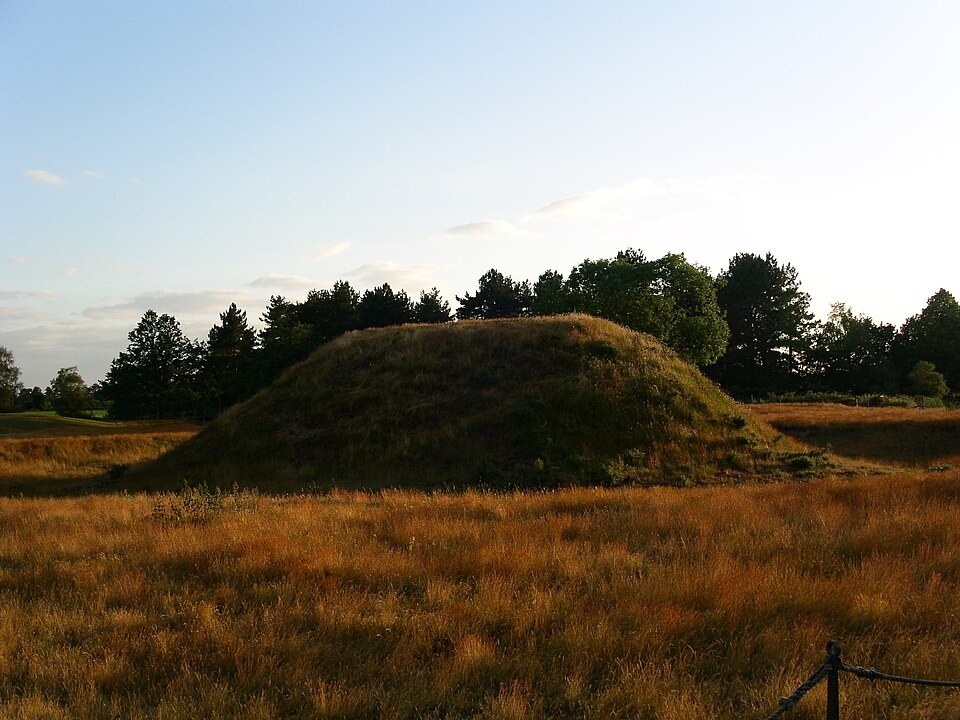
Landowner Edith Pretty had commissioned Brown to investigate the mounds in 1938. That first season uncovered disturbed burials and objects that justified returning. In 1939 he worked on Mound 1, where the rows of rivets required a wider excavation. The impression preserved details of the vessel’s curving structure even though its material substance had gone. The National Trust’s excavation history describes a discovery dependent on recognising fragile evidence as it emerged.
Charles Phillips subsequently directed a specialist team investigating the burial chamber, while Brown continued working at the site. Peggy Piggott uncovered the first gold object on 21 July. The familiar modern story of discovery can become a contest between one overlooked local expert and an establishment. The surviving record is more collaborative. The British Museum’s examination of the excavation notes that Phillips explicitly praised Brown’s skill in his early published account.
The grave’s survival was itself contingent. Other mounds had been robbed. Previous diggers also approached Mound 1 but missed its chamber. What remained was not a representative sample of every East Anglian funeral. It was an exceptionally rich assemblage preserved through an exceptionally fortunate history.
A vessel withdrawn from use
The ship measured about 27 metres long. Its overlapping planks had been fastened with iron rivets, and repairs showed that it had served as a working vessel before its burial. Bringing it inland from the Deben and placing it in a prepared trench required organised effort. Building a chamber inside it, furnishing that chamber and raising an earth mound committed still more labour and wealth to a funeral.
This was a vessel made unavailable to the living. The same was true of the weapons, precious metals and equipment deposited with it. Archaeologically, that expenditure is evidence for a community capable of assembling resources on a large scale. Interpreting it as a statement of authority is reasonable; imagining precisely what every participant believed about the dead person’s voyage is not.
The chamber also altered the ship. Because the central structure was removed or changed to accommodate the burial, surviving evidence cannot settle every question about its earlier rig. A confident modern drawing with mast, sail and crew must therefore be recognised as a reconstruction, rather than treated as an excavation photograph. Scientific and archaeological study of the burial begins with what actually survived: rivets, impressions, altered soil and objects in recorded positions.
Was there a body?
The absence of human remains encouraged an early suggestion that the monument might be a cenotaph, a memorial without a corpse. Later investigation changed the balance of evidence. Chemical work associated with the 1960s and early 1970s excavations found phosphate enrichment consistent with a body having decomposed in the chamber. Acidic soil helps explain why bone and wood could vanish while much of the metalwork remained.
That is a strong reason to understand Mound 1 as a burial. It does not provide the information an intact skeleton might offer. There is no surviving set of teeth from which to investigate childhood origins, no skeleton to examine for injuries, and no body from which a personal name could somehow be read.
The arrangement of the grave and its equipment underpins the usual interpretation of a high-status male burial, very possibly royal. The expenditure strongly indicates social rank; a particular king’s identity requires another argument.
Objects made to be seen
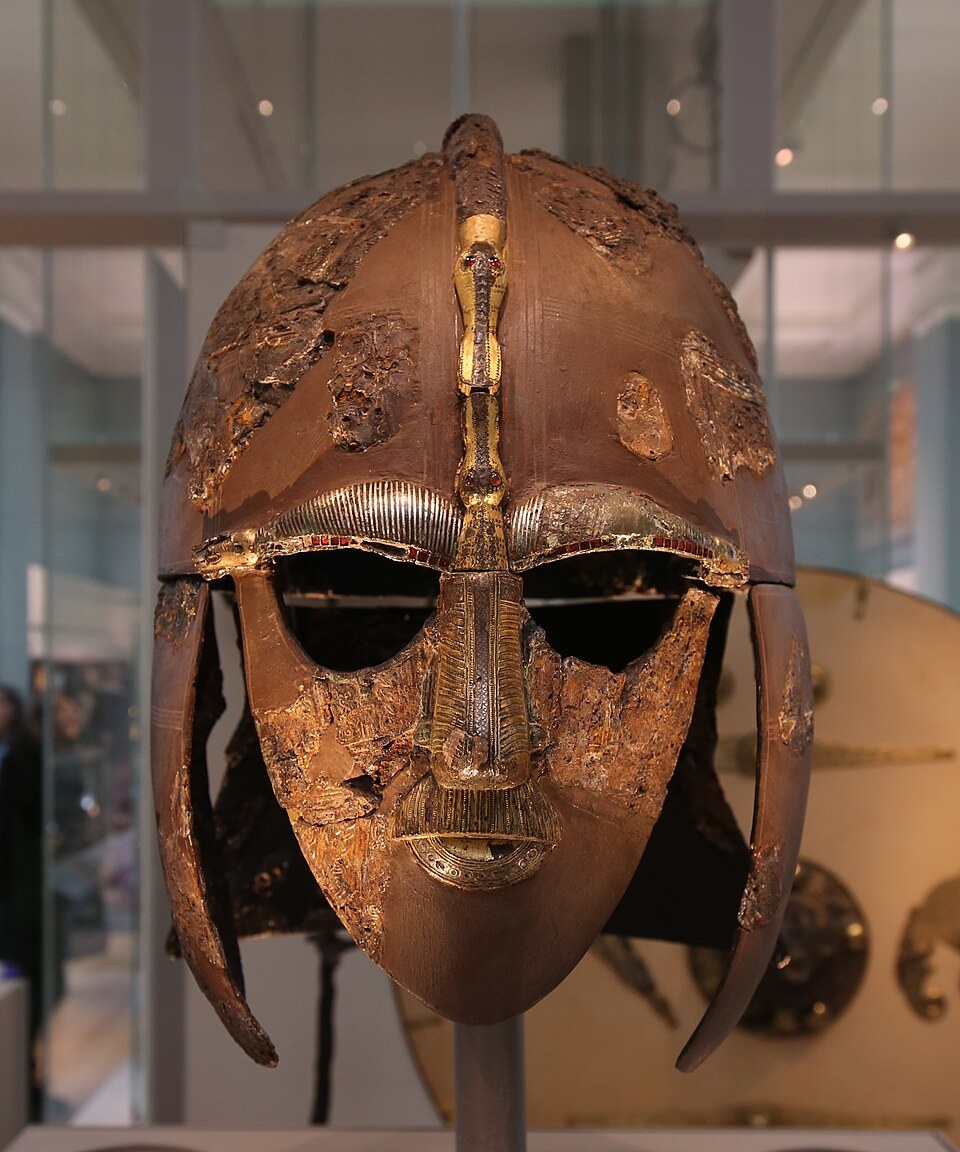
The helmet has become the burial’s face, but the object now on display is also a history of conservation. It emerged in shattered pieces. Its recognisable form depends on the painstaking assembly of surviving fragments, including a major reconstruction completed in 1971. The museum’s object record allows us to distinguish the ancient metalwork from the modern support that makes its structure legible.
Its imagery and construction belong to a wider northern European world. Comparisons with Swedish helmets are important, but resemblance alone does not establish the wearer’s birthplace or a single place of manufacture. Objects, craftsmen and designs could move differently. A helmet could signal connections without functioning as a passport.
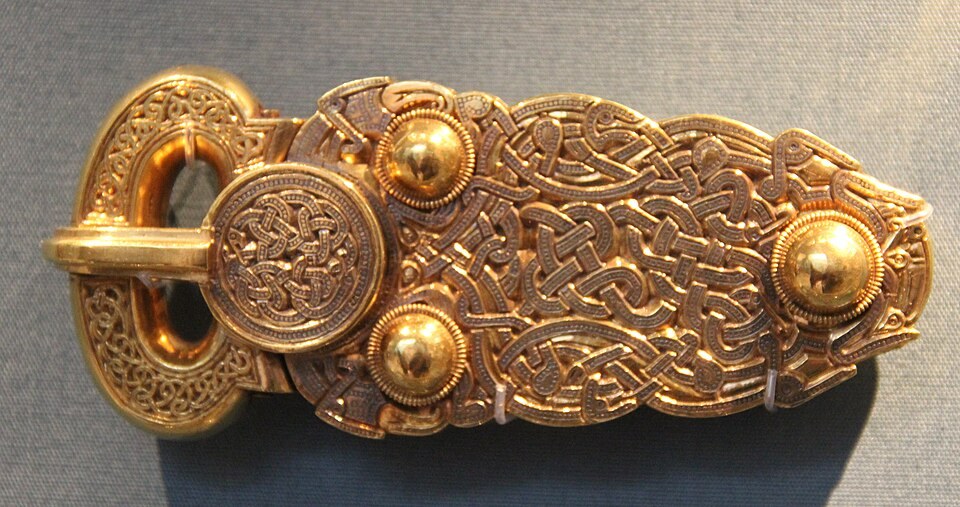
The great gold buckle makes another kind of authority visible. Weighing more than 400 grams, it carries dense animal interlace picked out with dark niello. Its back opens on a hinge and locks with sliding catches. It was both a working fastening and a virtuoso piece of metalwork. The compartment prompts questions about what it held; the surviving object does not answer them. To call it a reliquary without qualification would convert a possible comparison into a known use.
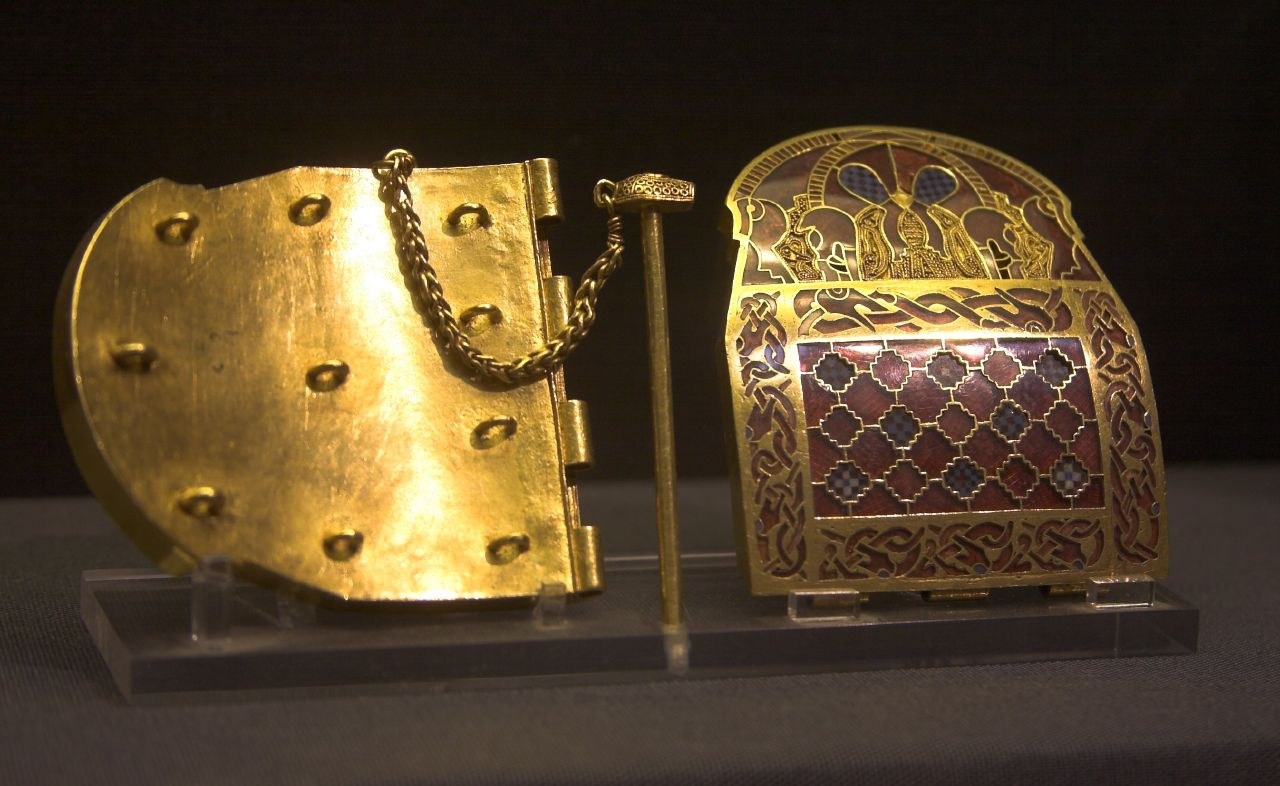
The shoulder clasps similarly join visual magnificence to engineering. Gold, garnet and glass were arranged around mechanisms intended to fasten clothing or equipment. Their surfaces rewarded close inspection, while their materials made wealth visible. The burial preserves the result of highly specialised work by people whose names have disappeared as completely as the name of the person who received it.
Nor was the chamber equipped only for fighting. Drinking vessels, silverware and a lyre placed hospitality, performance and feasting alongside weapons. The museum’s account of the assemblage presents a social setting as well as an individual. A funeral could express the relationships a leader maintained, and the role that others wished to remember or claim for him.
A purse that helps date the grave
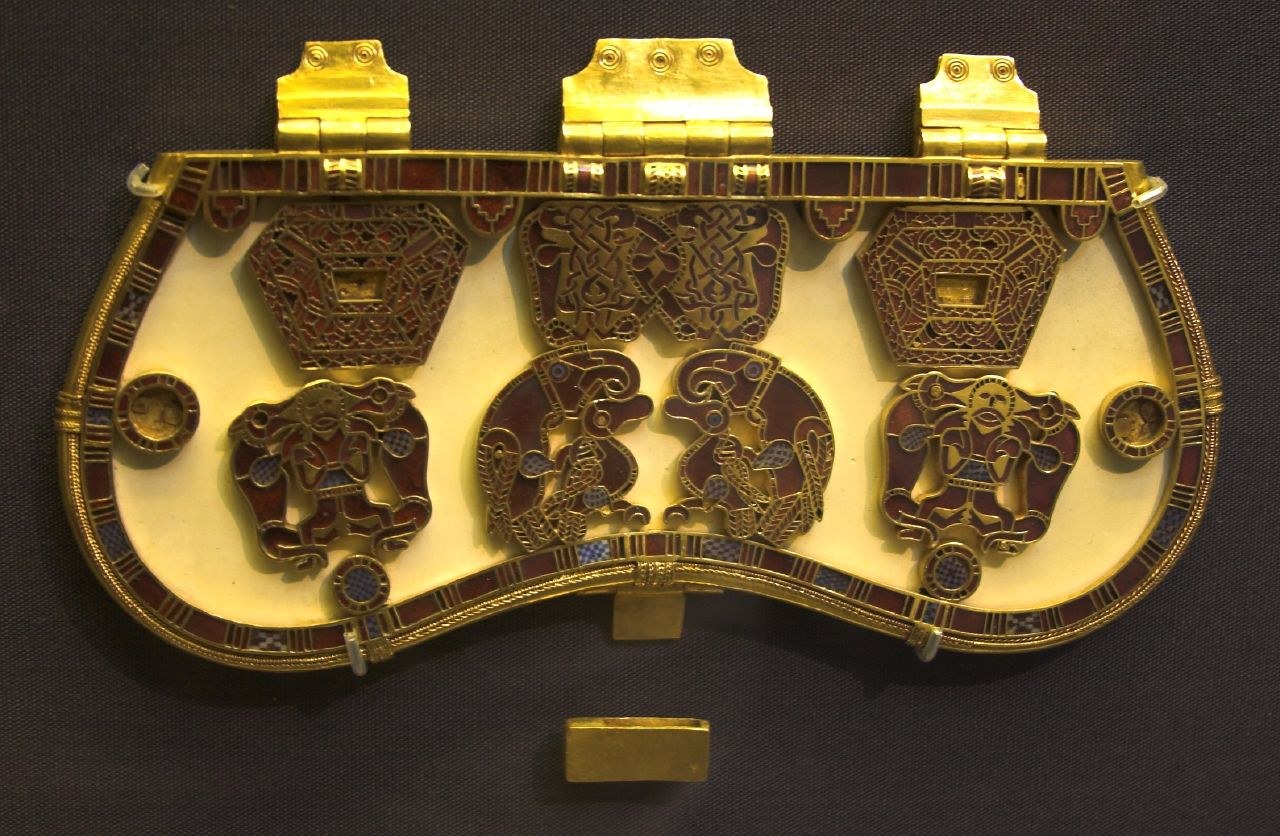
The purse fittings bring craftsmanship and chronology together. Its surviving gold frame and decorated plaques once belonged to an organic container. Garnets and patterned glass formed images that included birds and a human figure between beasts. Their precise meanings remain uncertain. Modern viewers can identify forms without possessing the stories that made those forms immediately meaningful to their first audience.
The purse’s reconstruction is another reminder that a complete-looking museum object can incorporate lost material. Its decorated components survived; its original backing did not. Similarities between the purse fittings and shoulder clasps may point to a shared workshop, but they do not reveal a securely named maker.
Inside were 37 gold coins, three coin-shaped blanks and two small ingots. The coins came from the Merovingian Frankish world across the Channel. They are central to dating the burial, though the museum’s account of the coin group explicitly warns that they cannot be dated precisely. It places their deposition broadly after 610 and before about 635.
A coin supplies chronological evidence, not a death certificate. It could circulate or be kept before entering a grave. Dating the latest pieces helps constrain when burial could have taken place; it does not independently select one year or one ruler. The coins narrow the historical possibilities while leaving more than one person within them.
Why Rædwald remains a candidate
Rædwald fits because he was an exceptionally powerful East Anglian ruler in the relevant period. Bede’s Ecclesiastical History describes his protection of Edwin, an exiled Northumbrian prince, and his victory over Edwin’s enemy Æthelfrith. In that account, Rædwald could intervene decisively beyond his own kingdom. Such a ruler is a credible subject for a funeral of exceptional scale.
Bede also gives Rædwald a memorable religious history. He had received Christian teaching in Kent, but, after returning home, maintained an altar for Christian worship alongside one for sacrifices to older gods. Bede judged this harshly. He was an eighth-century Christian historian explaining the uneven conversion of English kingdoms, not a witness writing down the arrangements at Sutton Hoo.
Bede’s account supplies valuable political and religious context. It supplies no statement that Rædwald was buried in Mound 1. The argument connecting king and grave joins separate bodies of evidence: the burial’s broad date, its East Anglian setting, its wealth, and what later written history says about rulers of the period.
Those connections make a case, but they cannot eliminate every alternative. The early seventh-century dynasty included other rulers whose lives and deaths are only imperfectly documented. More fundamentally, grave goods do not translate directly into personal religious conviction. Objects could be inherited, exchanged, repurposed or selected by mourners. A funeral reflects decisions made by survivors as well as the life of the dead.
Rædwald should therefore remain a leading interpretation with a question attached. Naming him confidently on the basis of the grave and then using the grave to reconstruct his character would make the argument circular.
Connections beyond the North Sea
The burial’s geographical reach is clearer than its occupant’s identity. Frankish coins and Mediterranean silver already point beyond England. Scientific study has extended that picture. Analyses of garnets link material in the assemblage with geological sources in South Asia and continental Europe. Recent museum research continues to refine those attributions.
Material origins alone do not reveal the route followed by a finished ornament. Stones could pass through several hands before a craftsman set them in gold. A South Asian garnet in Suffolk does not establish that the buried person travelled to South Asia, or that the exchange was direct.
Even small black fragments have changed the picture. Material once interpreted as wood tar was reanalysed and identified as bitumen with a Middle Eastern geochemical signature. The 2016 scientific study found evidence for connections that an earlier identification had obscured. The fragments’ original function and the precise chain by which they reached Suffolk remain uncertain. Their value lies partly in demonstrating how revisiting a modest find can change an entire assemblage’s meaning.
A mystery with solid ground beneath it
Edith Pretty donated the finds to the British Museum in 1939. Their preservation enabled generations of conservation, comparison and scientific testing. The cemetery itself continued to yield evidence beyond Mound 1. Other burials at Sutton Hoo help place the famous chamber within a changing landscape, rather than isolating it as one glittering accident.
The unnamed person at its centre still matters. Yet the failure to recover his name does not leave an empty story. The ship records collective labour. The metalwork records skill. Imported objects and materials record connections. The funeral records decisions about power, memory and what the living were prepared to surrender.
Sutton Hoo’s most compelling mystery is therefore also a lesson in method. Some traces permit a firm conclusion; others support competing explanations. Keeping that distinction does not diminish the discovery. It is how a ship that survived as an impression in sand continues to tell us something reliable about the people who placed it there.
Sources and further reading
- National Trust: History of archaeology at Sutton Hoo
- British Museum: Inside The Dig, the excavation and its portrayal
- Burger and colleagues: Bitumen among the Sutton Hoo grave goods (PLOS ONE, 2016)
- British Museum: Exploring the Sutton Hoo ship burial
- British Museum collection: Sutton Hoo helmet, 1939,1010.93
- British Museum collection: The great gold buckle
- British Museum: Purse lid from Sutton Hoo
- British Museum: Gold coins and ingots from Sutton Hoo
- Bede: Ecclesiastical History, Book II, chapters XII and XV
- British Museum: Sri Lanka to Suffolk, Sutton Hoo and the Silk Roads
- National Trust: The Royal Burial Ground at Sutton Hoo
- British Museum: Edith Pretty