
What the Vinland Evidence Really Proves
Buildings, artifacts, and tree rings establish a Norse presence in Newfoundland in 1021. The sagas and wider geography still require careful interpretation.
A discarded piece of wood can answer a question that a saga leaves open. At L’Anse aux Meadows in Newfoundland, metal-cut fragments preserved tree rings containing a cosmic radiation signal. Researchers used it to identify one precise year of Norse activity: 1021 CE.
That date is exceptionally strong evidence. It also answers a narrower question than many headlines suggest. It does not identify the person who held the tool, establish the first landing, or locate every place described in the Vinland sagas. The site’s importance becomes clearer when those different claims are separated.

A settlement beneath the turf
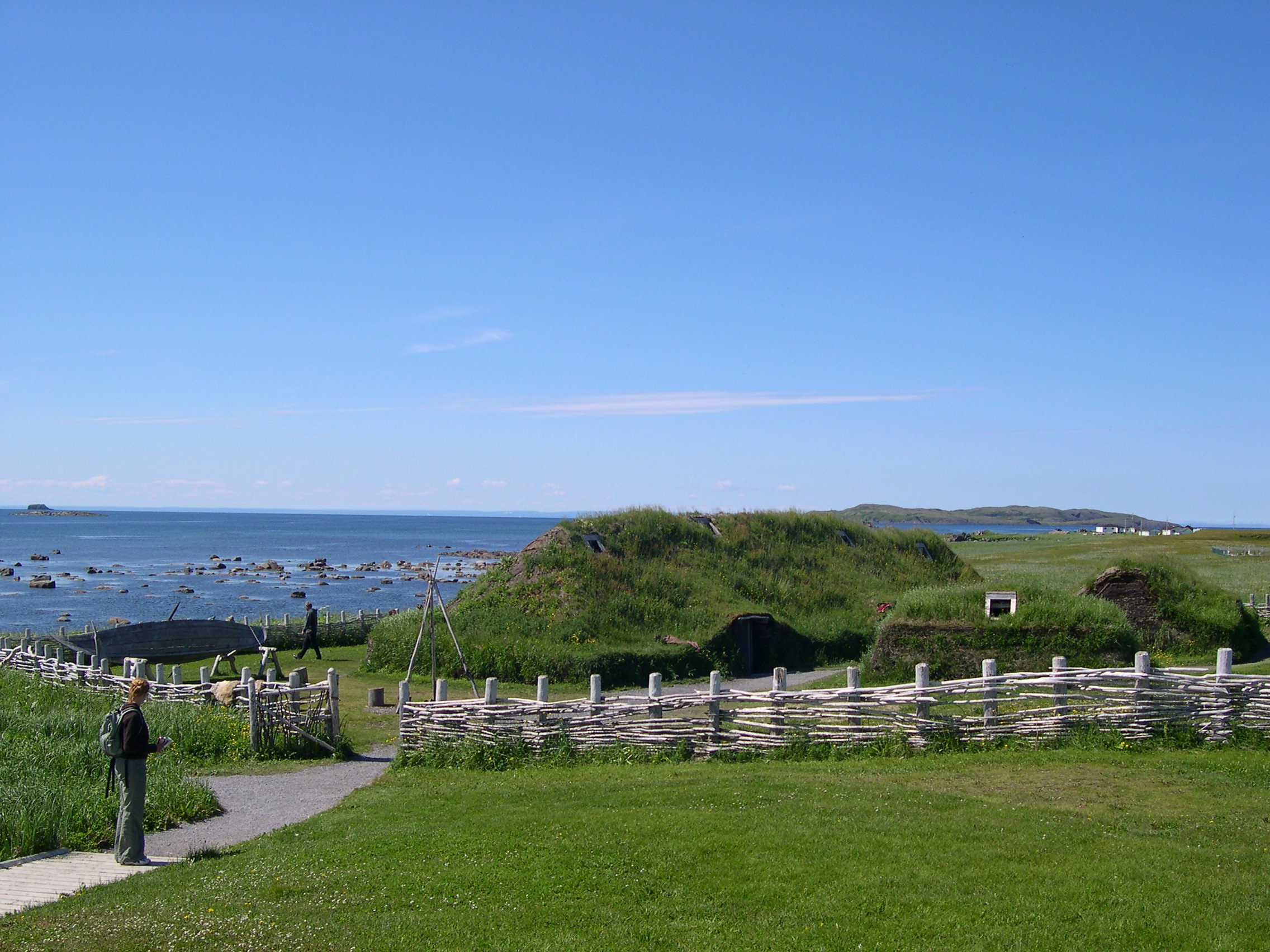
In 1960, local resident George Decker showed the Norwegian explorer Helge Ingstad the outlines of old buildings. Archaeological work led by Anne Stine Ingstad, followed by Parks Canada’s excavations, established their Norse character. The result rested on an assemblage of evidence, rather than an isolated object that might have traveled through exchange.
Eight timber-framed turf structures included dwellings and facilities for craft work and iron production. Their construction had close parallels in Iceland and Greenland. Objects associated with the settlement included a bronze cloak pin, a stone spindle whorl, and iron-working debris. UNESCO’s description of the archaeological remains explains how architecture and artifacts support one another.
A single foreign coin might arrive far from the person who first owned it. Buildings, hearths, manufacturing waste, and everyday tools provide a different kind of association. They show people establishing a working place. Modern reconstructed turf buildings help visitors imagine that environment, but they should always be distinguished from the protected archaeological remains beneath and around them.
How the year 1021 was established
The 2021 study examined three wooden pieces from Norse archaeological contexts. All retained their outer growth edge and cuts made by metal tools. A known radiocarbon increase from a cosmic radiation event in 993 supplied a marker inside the tree rings.
Once that marker was identified, counting annual rings outward established when the tree stopped growing. All three samples pointed to 1021. This was more precise than conventional radiocarbon ranges, which can span decades or longer. The research team explained the method and its controls in Nature; NASA’s account describes the connection between the terrestrial evidence and the atmospheric event.
The result fixes activity in a particular year. It cannot make 1021 the beginning of occupation merely because that is the first exact year presently available. A dated sample is a point within an archaeological sequence, not automatically the sequence’s starting boundary. Nor does it tell us how many voyages occurred before or after the wood was cut.
What the sagas can contribute
The Saga of the Greenlanders and the Saga of Erik the Red preserve narratives about voyages west of Greenland. They contain named people, encounters, resources, disputes, and places called Helluland, Markland, and Vinland. Their surviving written forms are medieval, separated from the voyages by centuries of transmission.
They also disagree. The Greenlanders’ Saga gives Bjarni Herjolfsson an initial sighting of western lands and describes later expeditions involving Leif Eriksson and others. Erik the Red’s Saga reshapes the sequence and gives much greater prominence to Thorfinn Karlsefni and Gudrid. These differences matter when someone attempts to turn a literary itinerary into a map.
Archaeologist Birgitta Wallace’s study of the sagas and the Newfoundland site examines both their historical content and the later interests that shaped them. Archaeology confirms a Norse presence compatible with the broad story of westward voyaging. It does not independently verify every conversation, family relationship, voyage count, or place name. Calling the excavation Leif’s own house goes beyond what a building plan can establish.
A base for work and further travel
The remains suggest a place equipped to support expeditions. Iron production and broken nails fit the practical demands of maintaining ships far from established settlements. Woodworking debris records another essential activity. A vessel that needed repairs could become a trap unless its crew could obtain materials and make replacements locally.
Parks Canada interprets L’Anse aux Meadows as a base camp for exploring and gathering resources. Its management plan’s archaeological summary distinguishes this function from that of a substantial, enduring farming colony. A place could be strategically important without becoming a town or supporting generations of settlers.
Butternuts and a worked piece of butternut wood add a geographical clue. The tree does not grow naturally in Newfoundland; its range lies farther south. Something connected the camp to other parts of eastern North America. Southern travel is a strong explanation, while exchange also deserves consideration. As Parks Canada’s archaeologists explain, the finds open possibilities without fixing a southern landing point. They cannot draw a boundary around Vinland.
A place with a much longer human history
The Norse entered an inhabited continent. L’Anse aux Meadows itself contains evidence of Indigenous use thousands of years before their arrival. Archaeologists have identified the tools and camps of several different groups. The Indigenous history of the site is therefore far longer than the brief Norse episode.
This changes the questions worth asking. European arrival does not mark the beginning of the place’s history. Researchers must distinguish occupations and ask which objects belong together, which could have been moved, and what evidence would establish contact between particular communities.
The sagas describe encounters with Indigenous people, including conflict. Direct archaeological evidence for these encounters at L’Anse aux Meadows remains limited. Norse and Indigenous objects at one site need not document a meeting; later occupants could disturb earlier remains. A saga’s collective labels cannot simply become modern ethnic names.
The questions still in the ground
Duration remains a problem of evidence. The site is usually interpreted as a comparatively short-lived Norse base, but one exact woodcutting year cannot establish the entire span of its use. New deposits also require careful attribution. In 2019, researchers reported charcoal and woodworking material from a later archaeological horizon. Their Memorial University report explicitly cautioned that the deposit’s cultural identity was uncertain and that its date could indicate Indigenous activity.
That caution is part of the discovery, rather than an obstacle to it. A layer’s resemblance to a Norse deposit elsewhere is a reason to investigate, not a substitute for diagnostic evidence. The same standard should apply to proposed camps beyond Newfoundland.
For now, the strongest evidence has a modest physical scale: turf walls, workshop waste, a fastener, a spinning tool, and three pieces of wood. Together they document an Atlantic crossing and a working Norse presence. The rings supply 1021. The people who cut them left no signature.
Sources and further reading
- L’Anse aux Meadows National Historic Site, UNESCO World Heritage Centre.
- Margot Kuitems and colleagues, Evidence for European presence in the Americas in AD 1021, Nature 601, 388–391, published online 20 October 2021; issue dated 2022.
- Burst of New Evidence for Viking Travels, NASA Earth Observatory.
- Birgitta Wallace, The Norse in Newfoundland: L’Anse aux Meadows and Vinland, Newfoundland Studies, 2003.
- L’Anse aux Meadows management plan, 2019, Parks Canada.
- L’Anse aux Meadows: The Saga of Vinland, Parks Canada podcast and expert interview transcript.
- Indigenous Sites, Parks Canada.
- New archaeological information uncovered at L’Anse aux Meadows, Memorial University, 16 July 2019.