Antikythera: The Shipwreck That Returned a Mechanical Cosmos
A dangerous salvage operation recovered a corroded machine. A century of research revealed its calendars, eclipse cycles and a planetary display that still invites competing reconstructions.
In 1900, sponge divers found a shipwreck off the small Greek island of Antikythera. Its cargo included jewelry, glass and statues in bronze and marble. Bringing such objects to the surface was a formidable undertaking. The divers worked in heavy equipment supplied with air from above, returning repeatedly to a depth where time and bodily endurance set narrow limits.
The recovery exacted a human cost. One diver died and two were severely injured. By the end of the operation in 1901, only a handful remained fit to continue, according to the history published by Woods Hole Oceanographic Institution. The objects subsequently displayed in Athens had been recovered through that dangerous labor.
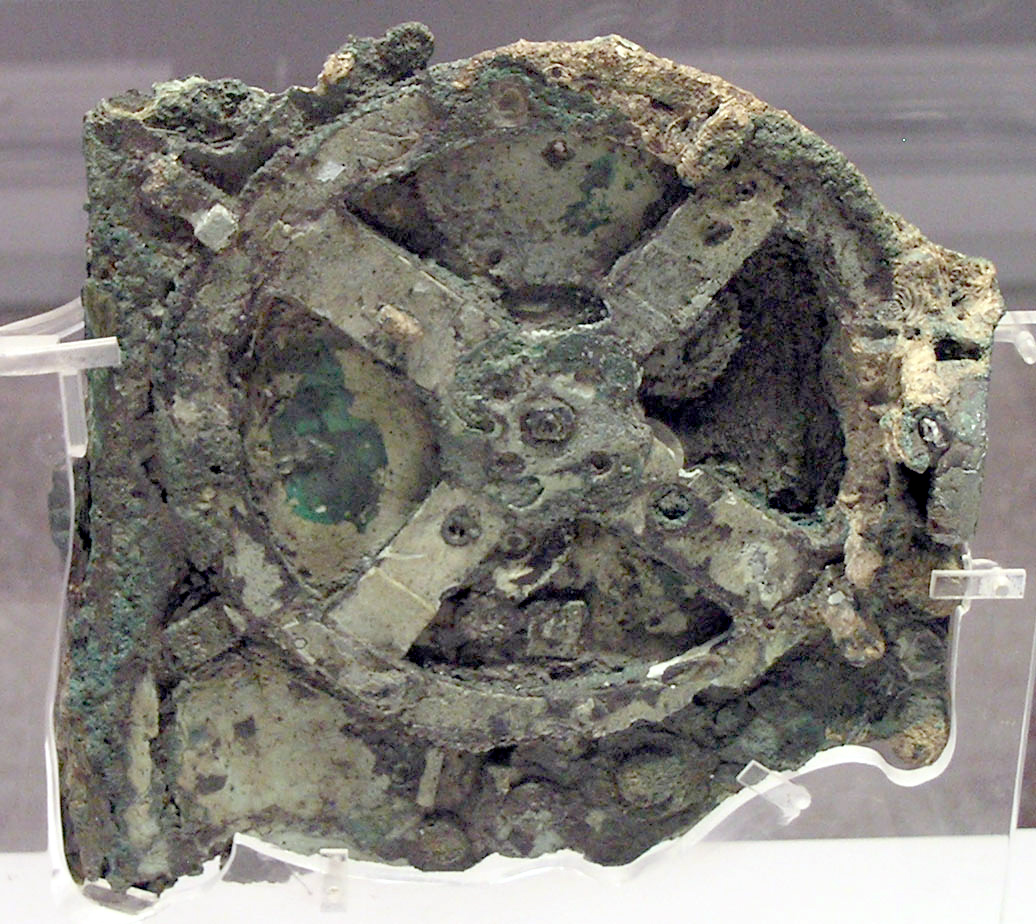
Among them was a mass of corroded bronze whose importance would emerge slowly. The statues could be recognized as bodies, their missing limbs supplied by familiar expectations. The little machine demanded a different kind of reconstruction. Its fragments belonged to an object whose parts had once moved together; understanding any one of them required discovering what the others had been made to do.

A cargo from a changing Mediterranean
The ship had gone down in the first century BCE. The National Archaeological Museum places the wreck broadly between 75 and 50 BCE and describes an estimated carrying capacity of about 300 tons. Its destination was probably in Italy. The route remains an inference from the cargo and its setting, rather than a surviving ship’s itinerary.
The museum’s archaeological account locates the voyage within a growing traffic in luxurious objects for Roman consumers. Sculptures, fine vessels and jewelry crossed a Mediterranean in which military power, wealth and cultural prestige were being redistributed. Greek art could furnish a Roman villa; a Greek scientific instrument could travel in the same commercial world.
That setting explains the company in which the mechanism was found without identifying its owner. It might have been a valued possession in transit, but the wreck does not tell us who commissioned it or who expected to receive it. Cargo gives the machine a historical neighborhood. It cannot supply a name for the person whose calculations were embodied in its wheels.
Learning to recognize the machine
When the mechanism attracted attention in 1902, scholars had to decide what kind of object they were seeing. An astrolabe, a navigational instrument and a model of the heavens were among the early interpretations. Albert Rehm recognized the significance of a planetary model; other investigators brought the expectations of archaeology or naval practice to the fragments.
During the twentieth century, increasingly effective ways of looking inside the bronze changed the discussion. Derek de Solla Price developed a major reconstruction with the assistance of radiographs made by the physicist Charalambos Karakalos. Price’s published work established the instrument as a serious problem in the history of mathematical machinery.
The museum’s research history traces the next stages through Allan Bromley and Michael Wright, who used tomography, and the later interdisciplinary project employing three-dimensional imaging. Each improvement permitted a different question. A visible toothed edge suggested a gear; an image through the fragment could disclose the wheel’s extent, the axle it occupied, and the layers above or below it. Interpretation advanced through a succession of material constraints.
The many kinds of ancient time
To understand why anyone would build such an instrument, it helps to leave the wreck and look at an ancient town. Public life required calendars. Religious observance, civic business and private appointments had to be placed within days, months and seasons. Yet the motions that supplied those units did not fit one another neatly. A lunar month and a solar year belong to different rhythms.
Surviving sundials, water clocks and calendar inscriptions show how widely the management of time occupied Greek and Roman society. The Institute for the Study of the Ancient World’s exhibition sets sophisticated instruments beside more ordinary devices used in households and public spaces. Technical ingenuity addressed a common need, although the cost and complexity of particular objects varied enormously.
Astronomy also supplied a picture of order. The zodiac and celestial sphere appeared in art; the same sky could organize a festival calendar and sustain speculation about an individual’s destiny. The mechanism belonged to that joined world of calculation, civic custom and celestial interpretation. Its usefulness need not be confined to a single modern category.
Ancient literature gives this material evidence a companion. In Cicero’s On the Nature of the Gods, a speaker refers to a sphere made by Posidonius that reproduced the movements of the Sun, Moon and five planets. The passage occurs in an argument about intelligence and the order of the universe. Cicero expected the example of a manufactured celestial model to be intelligible to his readers.
The description establishes neither the design of that device nor a direct connection with the Antikythera fragments. It does, however, place mechanical representations of the heavens within the intellectual culture of the late Roman Republic. A moving model could be something to demonstrate, discuss and use as an argument.
Cicero gives no workshop inventory, gear count or construction drawing. His testimony and the bronze answer different questions: the text shows how such a device could enter educated conversation; the artifact reveals what a maker could actually assemble. Read together, they enlarge the historical setting while leaving the identities of this particular maker and patron unresolved.
The Moon inside the bronze
The research published in 2006 brought an extraordinary quantity of evidence into view. Eighty-two surviving fragments were catalogued, with thirty bronze gears distributed among the principal pieces. Surface imaging and X-ray computed tomography exposed inscriptions and internal structures that ordinary photographs could not adequately resolve.
The study by Tony Freeth and colleagues identified a mechanical representation of the Moon’s varying apparent motion. The Moon does not progress across the sky at a perfectly uniform angular speed. A successful display therefore required more than wheels transmitting a single constant ratio. The mechanism incorporated a way to reproduce the variation described by ancient astronomical theory.
Calling the instrument an analogue computer describes the work its moving parts performed. Gear relationships represented numerical relationships; turning the input advanced the indicators through linked astronomical cycles. The calculation was carried in the geometry and tooth counts of the mechanism.
Its inscriptions mattered as much as its wheels. A number or astronomical term could suggest the function of a damaged scale, while the surviving gearwork could test whether a proposed reading made mechanical sense.
Calendars on the back
The upper rear dial arranged a nineteen-year calendar in a spiral. Its 235 lunar months expressed the Metonic relationship, a close correspondence between nineteen solar years and 235 lunar cycles. The spiral allowed a long sequence of months to be fitted into a compact surface. Time could be followed around successive turns rather than being crowded onto one circumference.
Further reading of the inscriptions revealed local month names and a smaller display associated with the recurring cycle of Greek games. The 2008 study brought civic time into clearer focus: this was a machine capable of relating celestial patterns to festivals and recognized calendar names.
The month names belonged to the Corinthian calendar tradition. That is valuable evidence about the calendar incorporated into the instrument, but it does not identify a workshop with certainty. A calendar can travel with its users, and an instrument can be made for someone elsewhere.
The games display similarly broadens the machine’s possible audience. Its lettering joined familiar public occasions to the much longer numerical cycles carried by the gearing. The heavens were being translated into an intelligible schedule.
When an eclipse was possible
On the lower rear dial, another spiral followed 223 lunar months, the cycle commonly called the Saros. This offered a means of anticipating the recurrence of eclipse conditions. Marks within the sequence distinguished solar and lunar events and included indications of time. A subsidiary Exeligmos dial accounted for the accumulated time shift over successive Saros cycles.
The necessary qualification is important: these were predictions of eclipse possibilities. A predicted event would not necessarily be visible from the user’s location. The machine’s inscriptions and arithmetic must be understood within the limits of the astronomical scheme they represented.
In his 2014 analysis, Freeth examined the arrangement of eclipse marks and their associated lettering, separating preserved characters from reconstructions. The mathematical relationships connected the device to traditions of Babylonian astronomical calculation as well as Greek geometry.
This was the long intellectual preparation behind the small bronze assembly. Observations gathered over generations could become numerical cycles; those cycles could become relationships between wheels. The turning instrument condensed knowledge that no single craftsman could have collected during one lifetime of watching the sky.
A clearer image is another discovery
The modern investigation did not move in a straight line from blurred photograph to complete understanding. Even the celebrated 2005 scans required scrutiny. The highest-resolution scan of the largest fragment had produced disappointing reconstructions. Researchers suspected missing projections and possible movement of the object during imaging.
A 2018 reanalysis by Ashkan Pakzad and colleagues identified missing projections, corrected their sequence and improved the reconstructed images. The authors found that the fragment had not moved during the scan. Some uncertain characters could be confirmed, while other readings could be corrected.
The distinction is consequential. An X-ray reconstruction is an image produced from measurements, and the route from measurement to image can introduce its own difficulties. Historical interpretation therefore depends partly on checking the modern instruments and calculations that make the ancient object legible.
There was no need to find another shipwreck for the evidence to change. Revisiting an existing scan yielded information from bronze already in the museum. The work passed between imaging specialists, readers of ancient Greek and researchers who could translate a newly visible mark into a possible mechanical function.
Rebuilding the missing heavens
The front of the mechanism presents a harder reconstruction problem because much of the relevant machinery is missing. Inscriptions describe the Sun, Moon and five known planets. They also preserve long numerical periods for Venus and Saturn: 462 and 442 years respectively. These numbers constrain what any proposed planetary system must explain.
In 2021, a UCL team published a new model of the front display, combining its reading of the inscriptions with proposed gear trains. The reconstruction developed ways to fit the planetary relationships into a restricted space, building on a long debate that included Wright’s alternative mechanical arrangements.
The authors’ achievement was a proposed solution compatible with their interpretation of the evidence. Its complete front gearwork was reconstructed, not recovered intact from the sea. For several planets, the required period relationships and mechanisms had to be inferred where the original evidence was absent.
A working reconstruction can demonstrate feasibility and expose contradictions. It cannot by itself prove that every missing wheel occupied precisely that position in antiquity. The most informative model therefore carries a visible boundary between surviving parts and the hypotheses that connect them.
The argument in a ring of holes
Even an apparently simple component can reopen a question. A broken ring preserves a series of small holes, but only part of the original circumference survives. How many holes completed the circle? The answer affects the interpretation of its calendar function.
Graham Woan and Joseph Bayley applied statistical analysis to the measured positions in a 2024 study. Their results favored a total near 354 or 355 rather than 365. Excluding holes beside fractures changed the estimate, making the treatment of damage an explicit part of the calculation. The authors stated their conclusion in relation to their model assumptions.
The study illustrates a different kind of uncertainty from an unreadable word. The surviving measurements are real; the completed circle must be estimated. An attractive probability distribution still depends on how the fragments’ geometry and errors have been represented.
Such work can challenge an established reconstruction without overturning the instrument’s broader identity. The secure evidence for a geared astronomical calculator remains. The argument concerns how one component fitted into its calendar system, and what the lost portion of that component most probably contained.
The dates a machine can remember
Dating the instrument requires another separation of questions. The shipwreck gives a latest possible limit for its manufacture, while letter forms provide a broad and debated range. Dates represented by its astronomical cycles are a different matter again.
In his study of the mechanism’s epoch dates, Alexander Jones examined arguments for a starting point in 205 BCE for its eclipse and calendar schemes. He emphasized that the choice of an earlier computational starting point need not place the making of the machine in that year. A later designer could select an earlier epoch. A date built into a calculation is not automatically the date when someone cut the gears.
These distinctions leave the mechanism securely within the Hellenistic world while preventing an unwarranted precision about its birth. The maker’s name, workshop and commission remain unsettled.
In Athens, the bronze survives in pieces: teeth, scales, supports and minute letters. Some preserve a motion that can be reconstructed with considerable confidence; others still permit competing arrangements. The machine has yielded its calendars and much of its astronomy, while the hands that made it remain beyond the surviving text.
For another case in which physical evidence narrows a larger historical story, read What the Vinland Evidence Really Proves.
Sources and further reading
1. Leslie G. Baehr, Woods Hole Oceanographic Institution: High-tech Dives on an Ancient Wreck (2014).
2. National Archaeological Museum, Athens: Archaeologist, The Mysteries of the Mechanism of Antikythera.
4. Institute for the Study of the Ancient World: Time and Cosmos in Greco-Roman Antiquity, introduction.
5. Cicero, On the Nature of the Gods, Book II, especially section 88, translated by H. Rackham.
12. Alexander Jones, The Epoch Dates of the Antikythera Mechanism, ISAW Papers 17 (2020).