
Inside Pompeii’s Bakeries: Bread, Skill, and Enslaved Labor
Pompeii’s mills, ovens, and surviving loaves reveal a food industry built on skill, animal power, and unequal freedom. The evidence also tells us where certainty ends.
A blackened loaf is an unusually intimate survival from Pompeii. Its round shape and divided surface remain recognizable across nearly two thousand years. Someone prepared the dough, handled it, and put it into an oven before the eruption of Vesuvius in 79 CE. The object preserves a product. Recovering the people behind it requires a different kind of attention.
The bakeries supply that wider evidence: heavy mills, ovens, workspaces, passages, and, sometimes, spaces for animals. Together they reveal an urban food industry whose efficiency depended on skilled judgment and sustained physical effort. Some of that effort was compelled. Yet neither a millstone nor a loaf can tell us the legal status of every person who touched it.
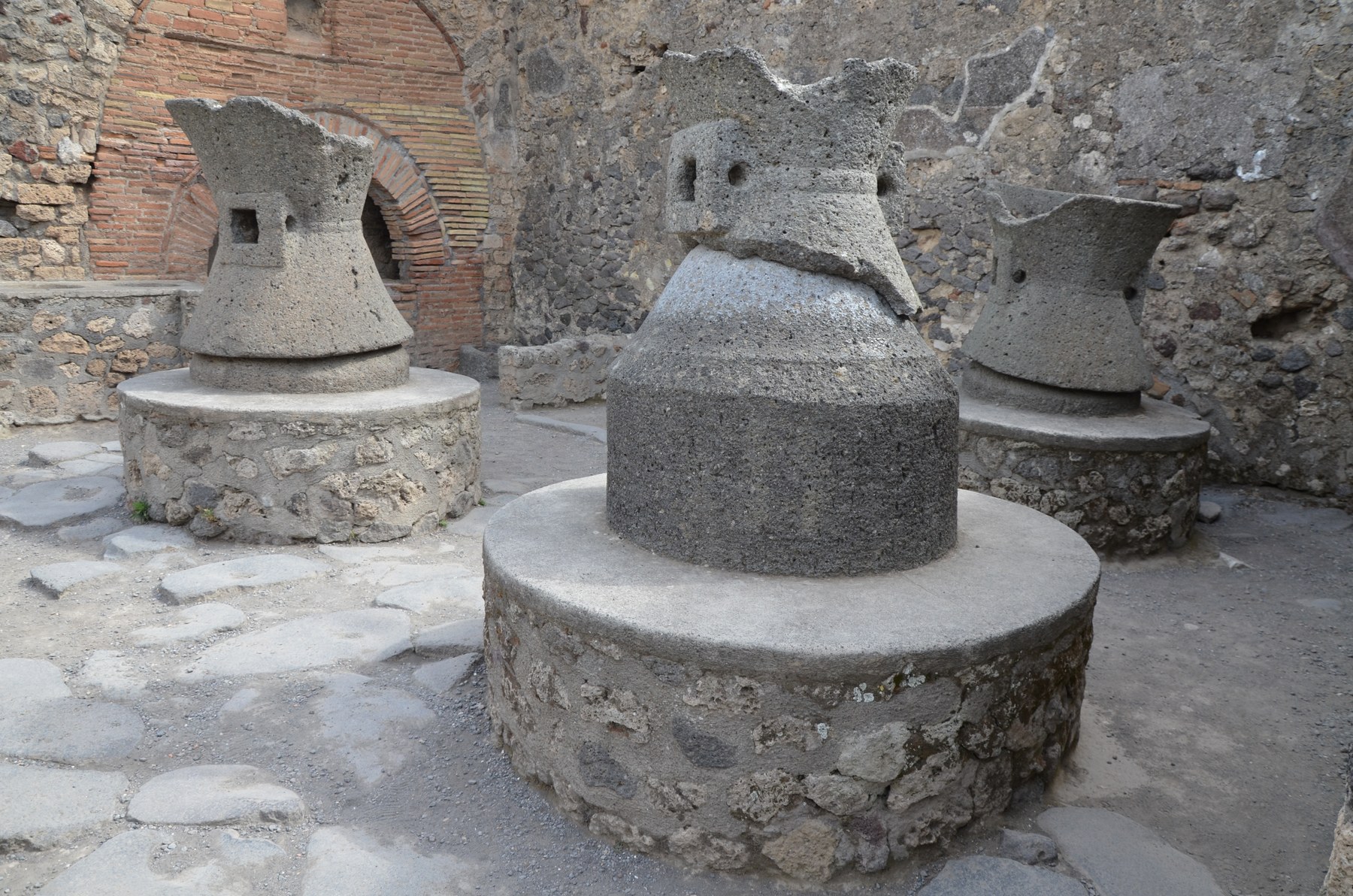
Grain becomes an urban industry
Bread reached the table through several transformations. Grain had to be acquired and moved, ground into flour, processed into dough, allowed to rise where the recipe required it, shaped, and baked. A bakery brought several of these activities together. The École française de Rome’s Pistrina research project has studied dozens of Pompeian establishments by examining mills, kneading installations, shaping tables, and ovens. These are traces of an organized sequence, rather than a collection of picturesque kitchen objects.
The familiar hourglass mill makes the relationship between machinery and bodies particularly clear. Its stationary lower element, the meta, was conical. Above it sat the catillus, the rotating stone into which grain was fed. Grain passed between the working surfaces and emerged below as meal or flour. Turning a large stone required a drive arrangement and a continuing supply of force. The wooden fittings have generally vanished, while the stone survives.
At the bakery conventionally named for Popidius Priscus, the archaeological park’s official guide identifies five mills. It also points out that the establishment lacks the sales counter found in some other businesses. Bread may have been made to order, supplied wholesale, or sold by itinerant vendors. The absence of a counter warns against assuming that every bakehouse served customers directly through its own doorway.
This distinction matters to the city around it. Production and purchase need not have happened in the same room, or even in the same building. A household’s loaf could embody a chain of transactions between grain supplier, baker, carrier, and seller. The ruins disclose parts of that chain unevenly: an oven is conspicuous; a delivery agreement is invisible unless a text happens to preserve it.
The knowledge inside a loaf
Ancient bread was not a single standardized food. In Book 18 of his Natural History, Pliny the Elder distinguished grains, flour grades, and kinds of bread. He discussed the effects of milling and sifting, the desirability of fine flour, and several ways of producing leaven. His descriptions show that Roman consumers and producers recognized differences in texture, quality, and preparation.
Pliny describes keeping material from an earlier batch for use in a later one, alongside other methods involving grain and fermentation. Such passages help make sense of bread as a living process that had to be managed. A baker needed to judge dough and heat, rather than merely follow a sequence of mechanical movements. An oven and a mill increased productive capacity, but neither removed the need for experience.
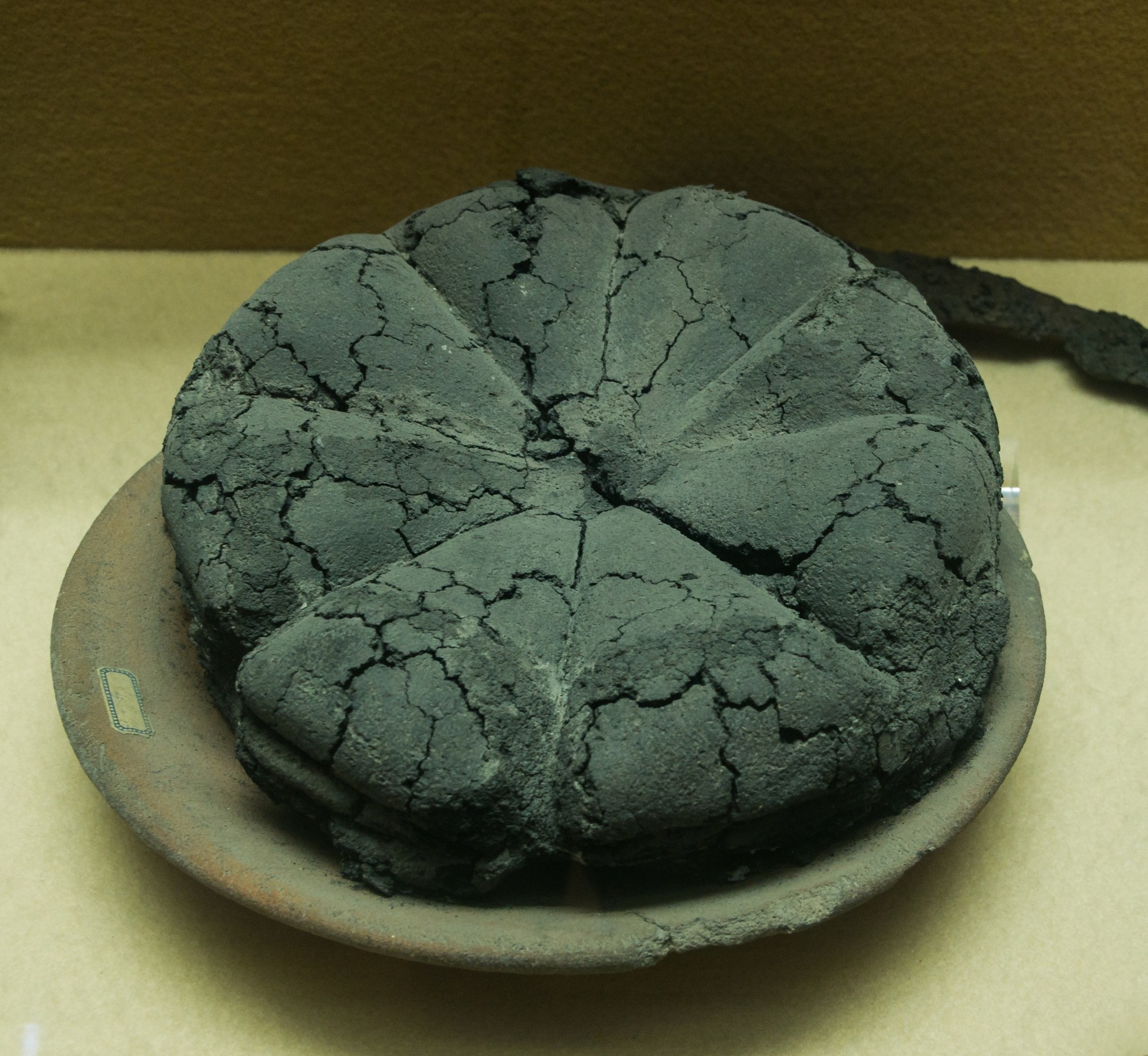
The carbonized loaves add another kind of information. Their visible shaping and scoring show decisions made before baking. They allow comparison with images of bread in Roman art. They cannot, by appearance alone, settle the proportions of ingredients, the duration of fermentation, or every technique used to obtain their shape.
Pliny also remembered a past in which Roman households made their own bread and commercial bakers had not yet established themselves in the capital. His account is a Roman author’s history of a craft, not a timetable for every Italian town. Pompeii’s material record must be studied on its own terms. Its bakeries changed through building work, reorganized rooms, and altered equipment before the eruption froze their last surviving arrangements.
Work arranged around stone and fire
It is tempting to imagine a single ideal Roman bakery and fit every ruin into it. Nicolas Monteix’s study of production layouts emphasizes a more practical world. Pompeian bakers inserted their workshops into existing buildings. Available space, investment, and productive ambition shaped what could be installed and how workers moved between tasks.
A mill needed room around it. Grain and flour had to reach the right places. Dough preparation and shaping called for working surfaces, while the oven imposed its own demands on access and heat. These needs could compete. An arrangement that looks inconvenient on a plan might represent the best solution available within a property’s inherited walls. The history of the workshop is partly a history of those compromises.
A published discussion of Monteix’s research also cautions that the complete production sequence is reconstructed from multiple establishments. Not every bakery preserves every stage, and not every establishment possessed the same equipment. Some used kneading machines; others evidently relied on hand work. Nor should every surviving mill be assumed to have been operating on the day of the eruption. Equipment could be inactive, displaced, or caught within a renovation.
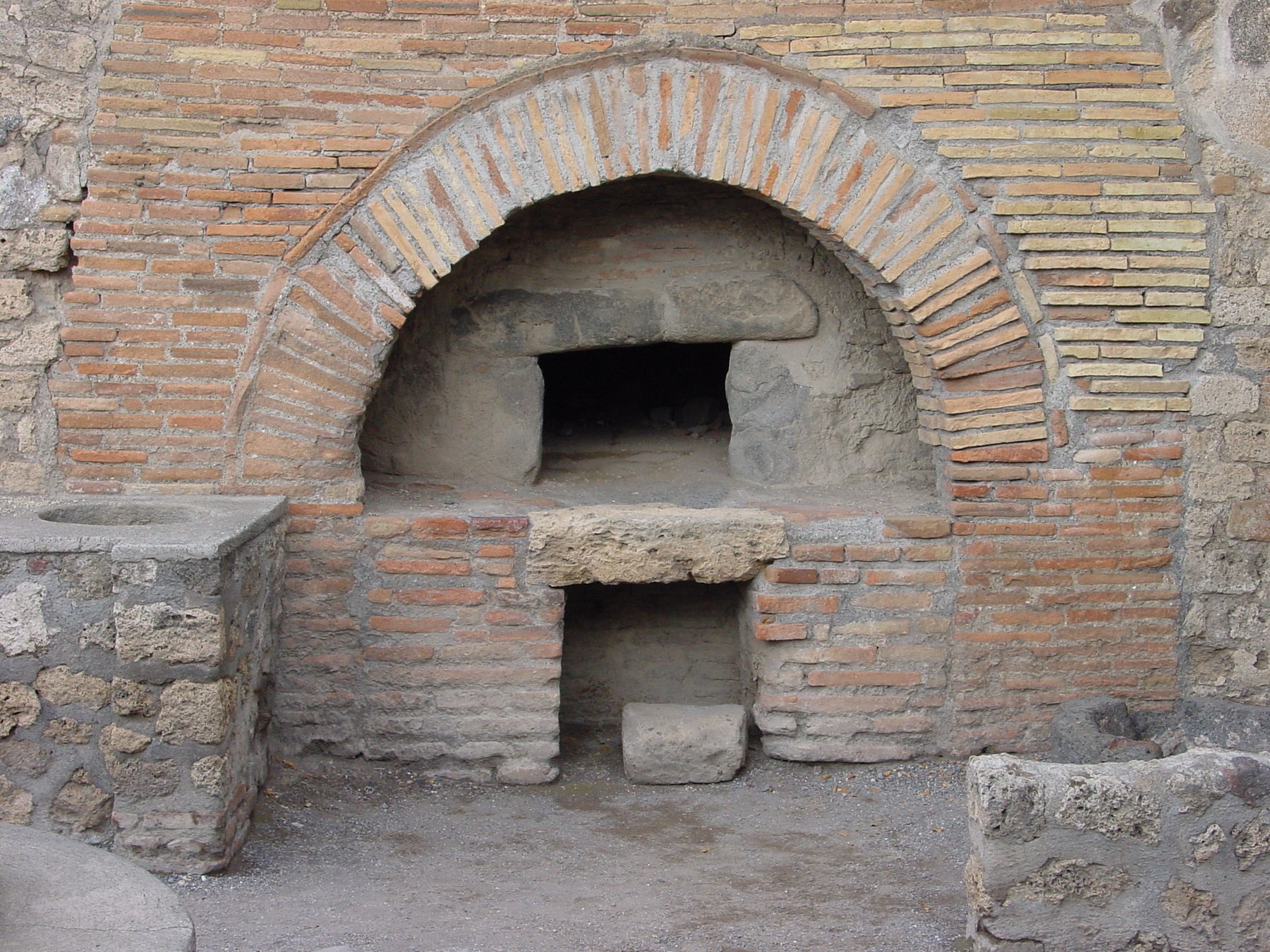
Fire added a further layer of judgment and risk. Fuel had to be obtained and heat maintained without ruining a batch. Dust, smoke, animals, and hot working areas made a bakery a demanding environment. Archaeologist Abigail Joy Staub-Green’s study of bakery shrines connects these settings with images of Vesta and her associated donkey. Such imagery suggests that protection and ritual belonged within the workplace. It does not tell us exactly what every worker believed or whether an owner and an enslaved laborer understood a shrine in the same way.
The bakery behind the barred windows
Excavations announced in December 2023 sharpened the question of freedom inside these productive spaces. In Regio IX, insula 10, archaeologists uncovered a bakery associated with a house containing richly painted residential rooms. The preliminary excavation account reports that the property was undergoing renovation when Vesuvius erupted. Three victims had been found in one room. A building under repair could still be occupied.
The productive area had no direct exit to the street. Its route outward passed through the house’s atrium, and small high windows were barred. Around the mills, indentations cut into the basalt paving marked circular movements. In the archaeological park’s interpretation, these features belonged to a tightly controlled workplace where enslaved people and donkeys ground grain. The excavators proposed that deliberate grooves helped animals keep their footing and follow a route through the confined space.
The phrase “prison bakery,” used in the announcement, captures that interpretation of enforced confinement. It should not be mistaken for an ancient administrative label or proof that this was a state prison. Nor can the skeletons automatically be identified as the workers who operated the mills. The compelling evidence is spatial: controlled access, narrow movement, and productive machinery integrated into an owner’s property.
The building gives unusually concrete form to a relationship that literary sources often treat as ordinary. Controlled access and productive machinery occupied the same domestic property as the residential rooms.
People and animals under compulsion
A later Roman text supplies a disturbing comparison. In Book IX of Apuleius’s The Golden Ass, the protagonist Lucius, transformed into a donkey, is bought by a miller. His eyes are covered and he is put to work turning a mill. When he refuses to move, he is beaten into motion. The story places animal suffering alongside the harsh condition of the people who labor there.
Apuleius wrote in the second century CE, after Pompeii’s destruction. His work is fiction, with satire, adventure, and a deliberately extraordinary narrator. It is not an eyewitness description of the excavated bakery. Its value lies in showing that coercive mill labor was recognizable to a Roman audience. The episode can illuminate an archaeological interpretation without becoming a transcript of what happened in a particular room.
Roman slavery also requires more precision than simply replacing every anonymous worker with an enslaved person. The scholarship of Sandra Joshel and Lauren Hackworth Petersen treats bakeries as an especially useful setting because literary and legal evidence confirms enslaved labor in the trade, while mills and ovens make the workplace archaeologically identifiable. That combination establishes an important context. It does not make a person’s status visible in every footprint or working surface.
Enslaved labor could include practical knowledge and responsibility. Skill and coercion were compatible. A person might understand fermentation, machinery, or oven management and still lack the freedom to leave. Remembering expertise therefore should not become a comforting story about the benevolence of slavery. Remembering violence should not erase the abilities and decisions through which workers kept a bakery functioning.
Bread in public life
One Pompeian fresco offers a view of bread after production. A seated, toga-clad figure passes loaves toward a group beside a wooden structure. It has often been reproduced as a bakery scene. Historian Steven Tuck has argued for a distribution of bread connected with civic generosity, drawing attention to the clothing, setting, and lack of a visible exchange of money, alongside inscriptional evidence for bread benefactions.
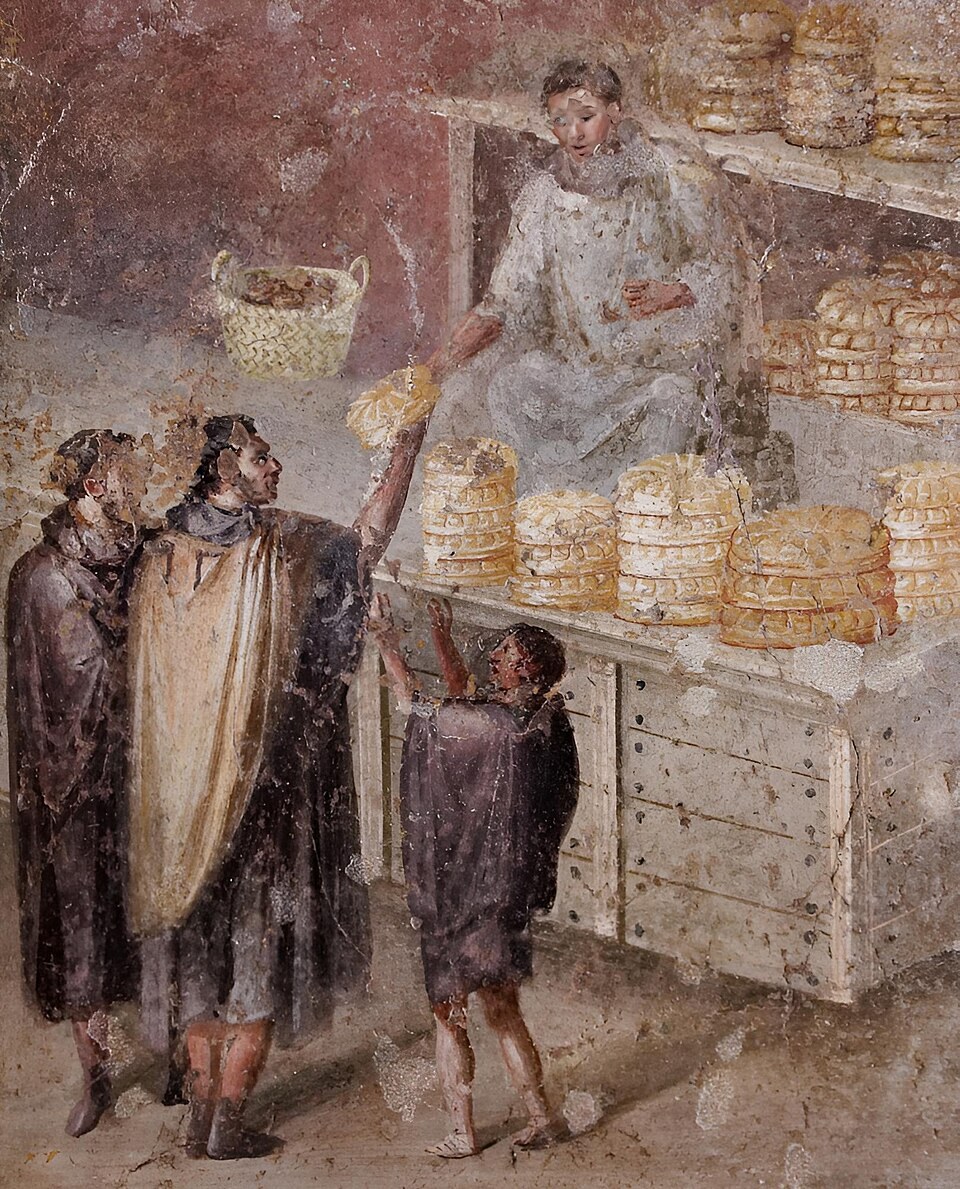
The image gives bread a social meaning beyond nourishment. A painted act of giving made relationships visible: the provider occupied a prominent position and the recipients gathered around. Food could advertise resources, public standing, and useful connections.
The people who performed the hardest stages of production are not foregrounded in this scene. That imbalance is itself instructive. Roman commemoration might celebrate the person who supplied bread while leaving the mill worker unnamed. Archaeology can partially reverse that perspective by returning attention to the spaces, implements, and constraints through which the gift became possible.
What the eruption preserved
Pompeii’s destruction preserved parts of an ordinary economy with extraordinary force. Yet the site is not a complete photograph of a working day. Buildings were in different conditions, equipment had different histories, and later excavation removed objects from their original relationships. A twentieth-century photograph of a bakery records another stage in that history, after clearance and exposure.
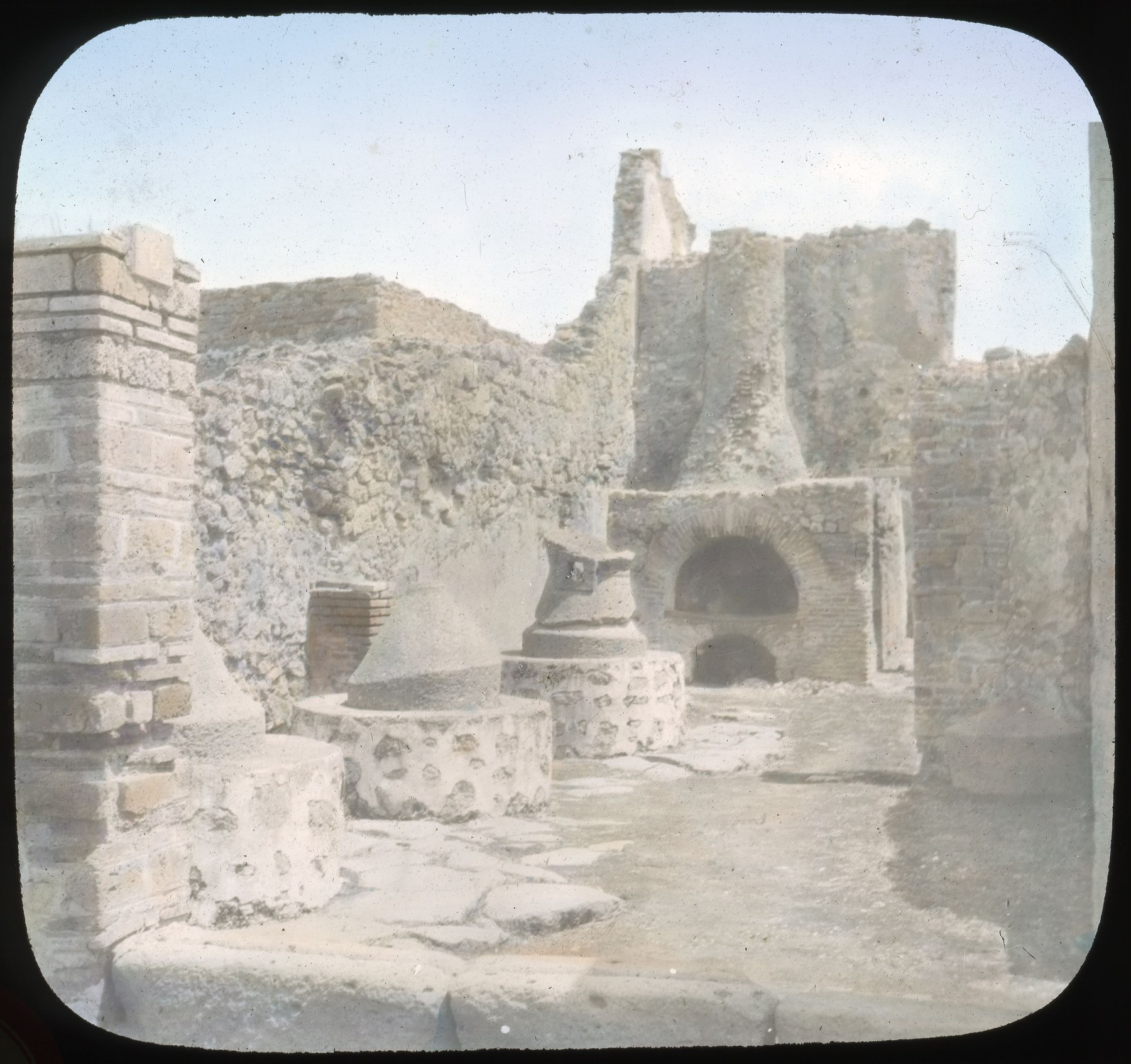
The surviving evidence consequently asks for two kinds of attention at once. One follows the technological achievement: grain processed in quantity, dough handled with experience, and ovens integrated into a dense town. The other follows the distribution of freedom. Who owned the building? Who controlled the exits? Who could profit from the loaf, and who could be compelled to keep a mill turning?
A carbonized loaf cannot answer all those questions. Placed beside architecture, ancient writing, and careful archaeological comparison, it can help us ask them. Pompeii’s bread becomes more than a charming resemblance to food on a modern table. It becomes evidence of the skilled work, animal effort, and human inequality that sustained a Roman city.
Sources and further reading
- Pompeii Archaeological Park, Guide to the Excavations, Bakery of Popidius Priscus, p. 98
- École française de Rome, Pistrina project
- Nicolas Monteix, Contextualizing the Operational Sequence (2016), abstract
- Pliny the Elder, Natural History, Book 18, sections 83–108
- Pompeii Archaeological Park, Prison Bakery Emerges (8 December 2023)
- G. Iovino and colleagues, La disciplina dell’odiosa baracca (2023)
- Apuleius, The Golden Ass, Book IX, William Adlington translation
- Sandra R. Joshel and Lauren Hackworth Petersen, Slaves in the Workshop, chapter opening (2014)
- Steven L. Tuck, Baked bread to the people (2023)
- Abigail Joy Staub-Green, A Vesta’d interest (6 October 2026)
- Antiquity, New Book Chronicle, discussion of Monteix’s bakery study (2017)