
The Great Exhibition of 1851: Glass, Labour, and Empire
How a temporary glass building brought industrial labour, design reform, mass tourism, and the British Empire into a single crowded spectacle.
On 1 May 1851, Queen Victoria opened an exhibition in Hyde Park that placed industrial machinery, handmade furniture, textiles, minerals, and imperial trophies beneath one enormous glass roof. The Great Exhibition of the Works of Industry of All Nations made manufactured things into a public spectacle. Its organizers also wanted visitors to compare them, learn from them, and buy better-designed goods.
Prince Albert and the reformer Henry Cole helped turn that ambition into an international event. Almost 14,000 exhibitors participated, and attendance exceeded six million over the season. Those figures describe the scale of the undertaking; they do not tell us how equally its many makers and visiting publics were represented. The Royal Commission’s record of the exhibition places Albert at its center. Looking closely at the building and displays brings thousands of other contributors into view.
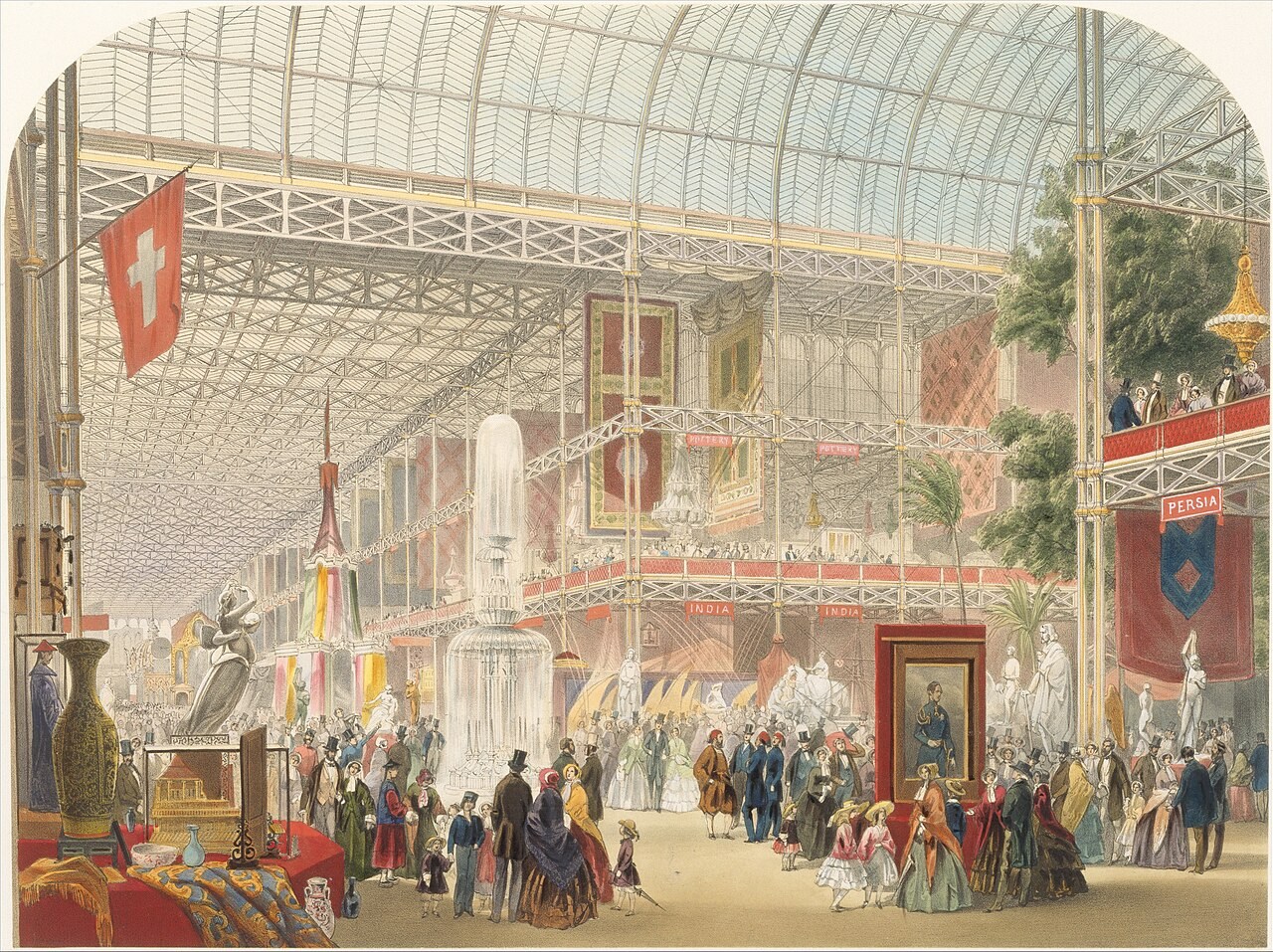
A palace assembled against the clock
The organizers needed a vast temporary building, ready for a fixed opening date. Their architectural competition attracted more than 200 proposals, but none resolved the problem to their satisfaction. A substantial brick alternative developed by the Building Committee also sat uneasily with the promise to restore the park after the exhibition.
Joseph Paxton offered a different approach. His experience designing conservatories at Chatsworth helped him imagine a structure assembled from repeatable components. Published in July 1850, his proposal gained public support, and Fox, Henderson & Co. undertook construction. The Royal Collection’s planning history explains the practical advantage: much of the building could be prefabricated before being brought together on site.
This method made the building an exhibit in its own right. The repeated parts depended on disciplined manufacture, accurate measurements, transport, and coordinated assembly. A spectacular architectural idea became possible because large numbers of people could make and fit standardized pieces. Calling the result simply “Paxton’s Crystal Palace” obscures that collaboration.
The V&A’s history of the project records an average of about 2,000 workers and 200 horses on site each day. Chance Brothers supplied 293,655 panes of glass. Glazers, painters, ironworkers, and other workers produced the transparent enclosure that visitors would later admire. Construction itself attracted paying spectators. Before the objects arrived, organized labour was already part of the show.
Why a modern exhibition contained a medieval court
The exhibition’s interest in industry extended far beyond steam engines. It included the quality of everyday objects and the relationship between materials, workmanship, and decoration. A machine might make production faster, but that did not settle what a chair, cabinet, or church fitting should look like.
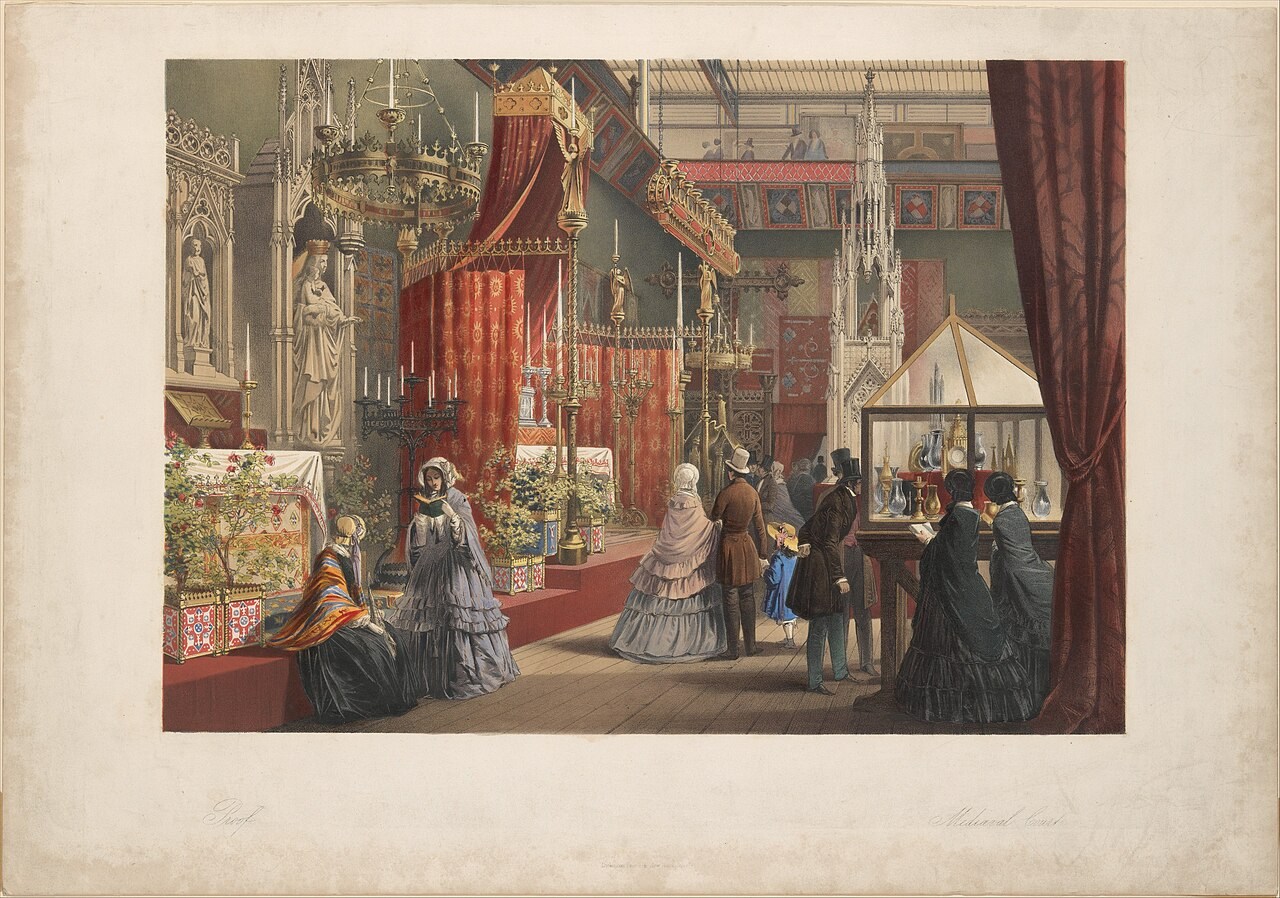
Augustus Welby Northmore Pugin’s Medieval Court brought this question into sharp focus. Its church furnishings, metalwork, textiles, and other objects presented Gothic design as a living resource for contemporary manufacturers. Louis Haghe’s 1851 watercolour, preserved in the Royal Collection, records candlesticks, furniture, a Virgin and Child, and richly patterned surfaces gathered in one display.
The court complicates the familiar image of 1851 as a unanimous celebration of mechanical novelty. Its appeal rested on a selective return to older forms. Manufacturers could exhibit commercial skill through objects that looked deliberately medieval. Under the same roof, industrial progress and historical revival were mutually useful possibilities.
How the displays organized the world
Exhibition displays turn decisions into apparent order. An object needs a label, a place, and a group of neighboring objects. In 1851, this process gave visitors a framework for understanding how things were made and where they belonged.
The exhibition’s four principal divisions covered raw materials, machinery, manufactures, and fine art. They suggested a movement from natural resources through processing and production to artistic refinement. Britain and its imperial territories occupied the western portion of the building; foreign exhibitors occupied the eastern portion. As the V&A explains, the space allocated to foreign countries reflected their trade with Britain.
The arrangement therefore expressed several kinds of hierarchy at once. It compared objects by industrial category while placing Britain in the position of host, organizer, and commercial reference point. An international exhibition could encourage exchange while still presenting the world through the priorities of the country that staged it.
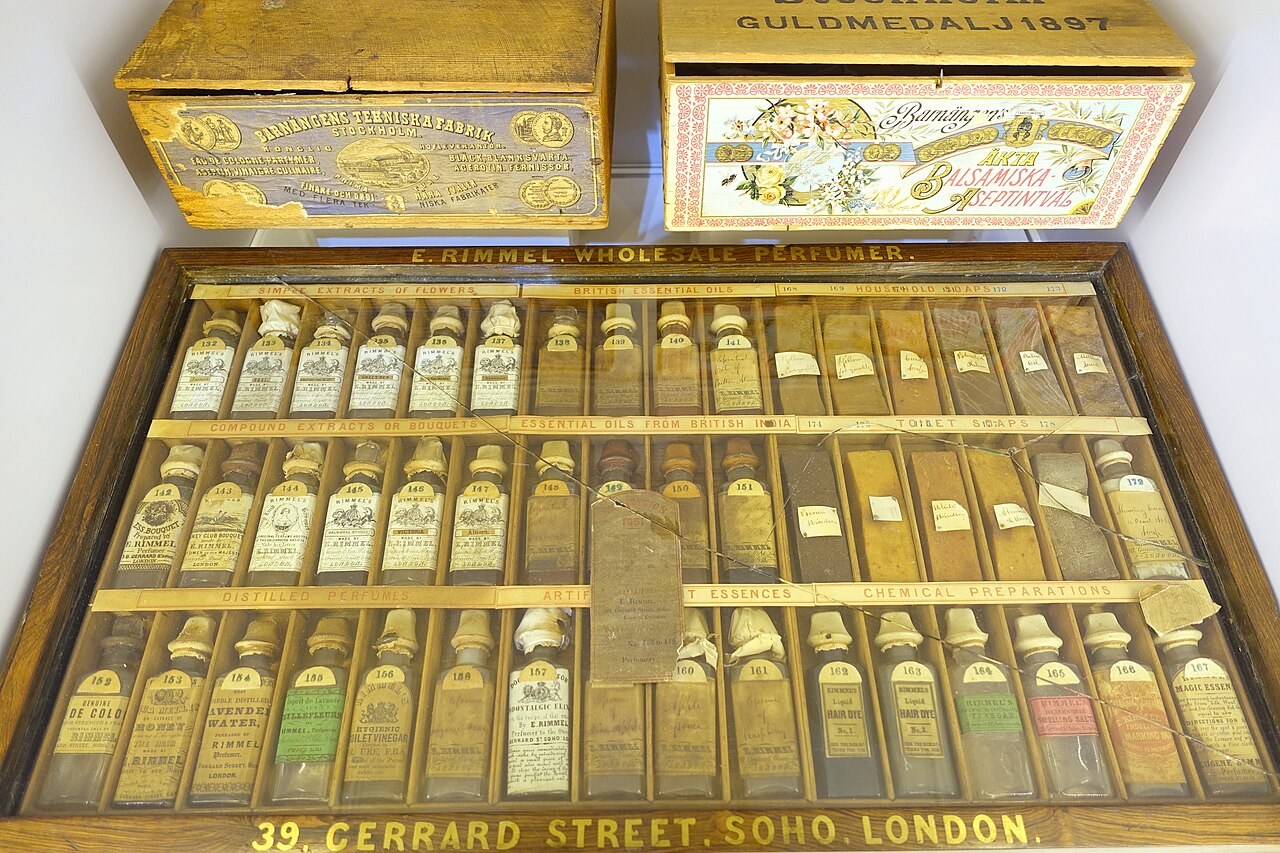
The less spectacular exhibits mattered to that purpose. Samples of oils, fibres, and other materials could tell manufacturers about potential supplies. Their value lay partly in what someone might subsequently make from them. A cabinet of samples and a lavish throne served different commercial and political functions, even when both appeared under an expansive claim to represent the world’s industry.
India between commercial resource and artistic authority
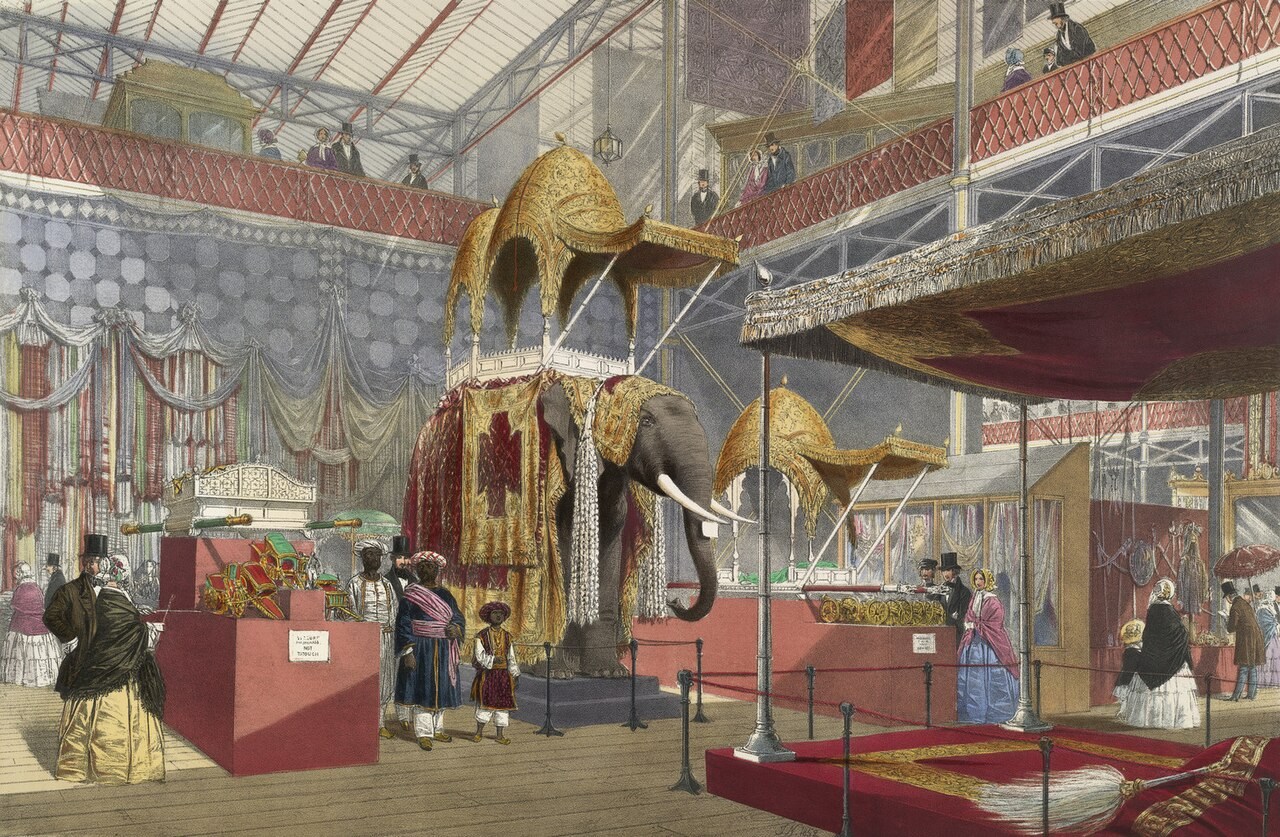
The Indian displays exposed the tensions within the exhibition’s ordering of the world. John Forbes Royle, who supervised the India section, wanted to connect British manufacturing with Indian products and materials. The exhibition offered an opportunity to show what could enter an expanding network of commercial exchange.
Yet the collection was not assembled by a single directing mind in London. Historian Jessica Ratcliff’s study of the East India Company’s knowledge collections describes the organizing committees, including Indian and British participants, whose choices helped determine what was actually sent. Local judgments could diverge from Royle’s requests. The display was shaped by negotiations across distance as well as by metropolitan ambition.
That distinction matters. Indian makers and organizers should not disappear into an account in which Britain collected and India merely supplied. They produced the objects and influenced their selection, although the exhibition’s political setting did not give them equal authority over the meaning attached to their work.
Imperial power remained conspicuous. The Koh-i-Noor diamond reached Queen Victoria following the British conquest and annexation of Punjab in 1849. Displaying it in London transformed an object obtained through conquest into a public attraction. The London Museum’s account also emphasizes the way colonial displays encouraged visitors to see imperial territories as sources of useful produce and exotic spectacle.
These meanings were not identical to the qualities of the objects themselves. Richly worked textiles and other Indian manufactures could demonstrate highly developed skill even within an exhibition that promoted British industrial leadership. The viewer who admired the workmanship encountered evidence more complicated than a simple ranking of industrial and supposedly undeveloped societies.
A shilling bought entry, but access took organizing
The crowds did not arrive through royal enthusiasm alone. Railways connected provincial visitors to London, while local organization helped turn the idea of a visit into something affordable and practical. Admission charges also changed the social composition of the exhibition from day to day.
Japan’s National Diet Library study of the exhibition’s admission system describes the cheaper weekday tickets: one shilling from Monday to Thursday, with higher prices on Friday and Saturday. Thomas Cook’s organized excursions brought farmers and workers from outside London. The same event could consequently attract different publics at different prices.
The arrangements widened participation, but a low ticket price did not eliminate every expense. Travel, food, and time away from paid work still had to be managed. Local assistance mattered: the Royal Collection records committees in 297 British towns and districts, some of which raised charitable funds to help working-class visitors. The exhibition’s large audience was the outcome of a transport and organizing effort as well as public curiosity.
What survived the temporary spectacle
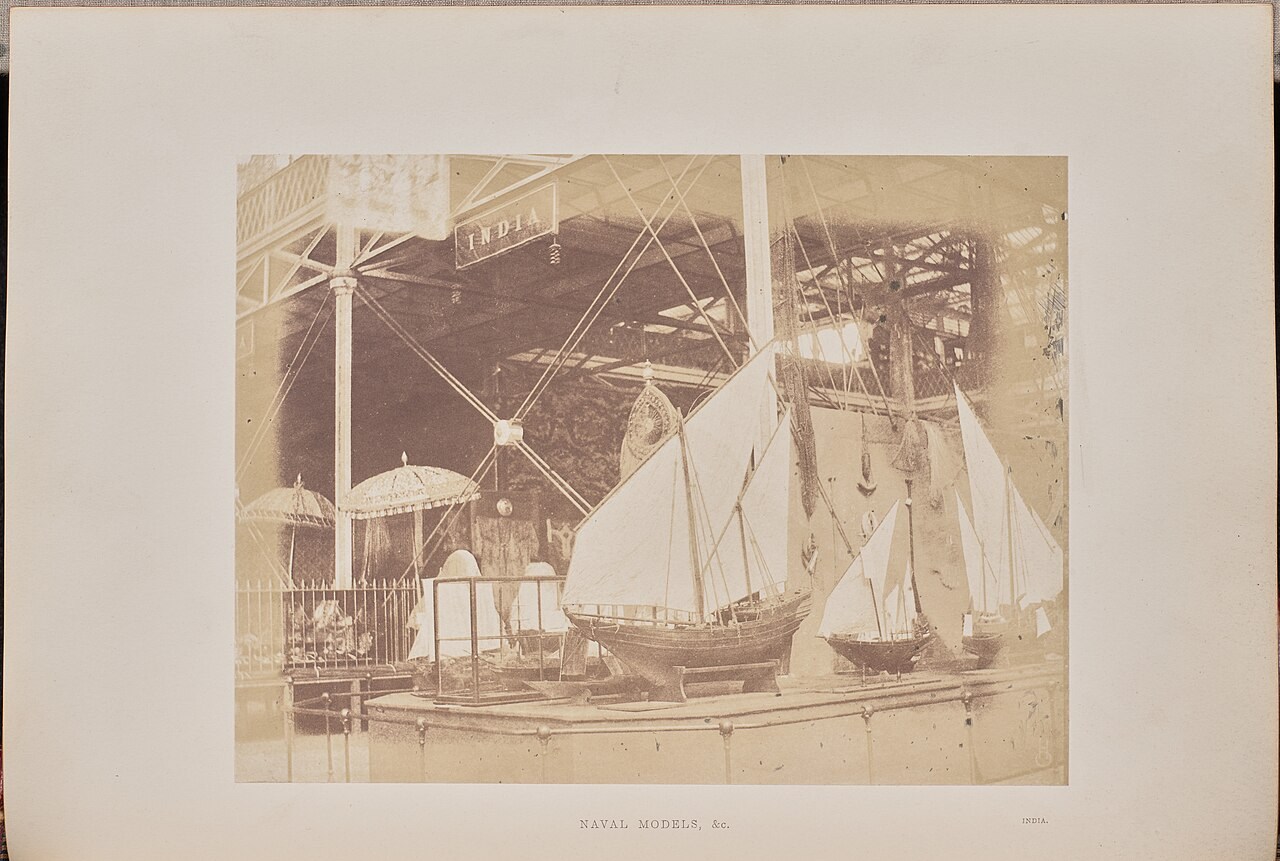
The exhibition also generated a durable record. Hugh Owen’s photograph of naval models in the Indian display survives among the illustrated jury reports. The Royal Collection’s catalogue explains that copies of these reports went to foreign governments and important participants after the exhibition. Photography helped turn a temporary encounter with objects into material that could circulate and be studied elsewhere.
Another legacy was financial. The exhibition produced a surplus of roughly £186,000. The Royal Commission’s own institutional history describes how its continuing charter allowed it to use the proceeds, including purchasing an estate in South Kensington. The museums, colleges, and other institutions later concentrated there developed over time; they were not all created together when the exhibition closed.
The Science Museum’s institutional history makes that sequence clear. Art and science collections initially belonged to the South Kensington Museum, which opened in 1857. Their administrative separation came much later, in 1909. A five-month exhibition helped support a much longer experiment in public education.
The glass building left Hyde Park and was reassembled in altered form at Sydenham, opening there in 1854. It eventually burned in 1936. The Royal Parks’ history connects both sites while preserving the distinction between the original exhibition and the building’s later career.
The Great Exhibition’s importance lies in that combination of temporary spectacle and lasting institutions. It gave millions of visits a common setting, made unfamiliar objects available for comparison, and demonstrated what coordinated industrial labour could build. At the same time, it presented commercial opportunity and imperial possession as parts of an orderly world. Reading its surviving images closely means attending to both the achievement on display and the people whose work made the display possible.
Read the related book
To explore another side of Victorian London’s engineering and labour, read The River That Could Not Wait, Histovia’s history of the city’s modern sewer system.