Science, Invention & Exploration
John Harrison’s Long Passage to Longitude
Harrison’s sea watch crossed an ocean, but its journey to acceptance took much longer. Clocks, lunar tables, public money, and repeated trials together changed navigation.
In 1761, William Harrison carried his father’s fourth marine timekeeper toward Jamaica. On the outward passage, its reading placed Madeira nearer than the ship’s crew expected. The landfall vindicated the watch, and the captain was sufficiently impressed to ask for another. Yet the voyage did not settle John Harrison’s claim. Once William returned to England, the commissioners responsible for longitude judged the test insufficient. A machine that could help find an island still had to pass through a world of experiments, payments, and disputed requirements.

Carrying the time of another place
The reason for taking a watch across the Atlantic was simple enough to explain on shore. The earth turns through 360 degrees in twenty-four hours. One hour of difference between the local times of two places therefore corresponds to fifteen degrees of longitude; four minutes correspond to one degree. A navigator who could establish local time and compare it with the time at a known reference meridian could work out how far east or west the ship had traveled.
The difficulty lay in preserving or recovering that distant time. The Sun could help reveal local noon, but it could not announce, unaided, what a clock in England ought to read at that instant. A timekeeper carried from the reference place offered one solution. If its rate wandered during the voyage, the apparent distance would wander too. The relationship between time and longitude made small mechanical errors into substantial geographical ones. No elegance of calculation could repair a comparison made with an unreliable clock.
Britain’s Parliament had put public money behind the problem in 1714. The Longitude Act promised rewards graduated by accuracy: £10,000 for determining longitude within one degree, £15,000 within two-thirds of a degree, and £20,000 within half a degree. The act described an ocean trial from Great Britain to a port in the West Indies chosen by the commissioners. It also allowed smaller rewards for proposals of considerable public use.
The scheme concerned ships, lives, cargo, and the expanding reach of a maritime state. It was open to a method, not solely to a clock. The language of experiment and usefulness left the commissioners with work to do after an attractive invention appeared. Someone had to arrange the voyage, determine the destination’s position, compare results, and decide what had actually been proved. The promise of a fortune could draw a craftsman into this undertaking; collecting it required him to persuade an institution whose responsibilities extended beyond his own machine.
The long labor in brass and wood
Harrison came to clockmaking from carpentry. In London, the astronomer Edmond Halley directed him to the established clockmaker George Graham. His first sea clock traveled to Lisbon in 1736. The commissioners granted support in 1737; an improved machine followed, but Harrison found a flaw in it before a sea trial.
The first instrument, now called H1, had been made at Barrow upon Humber between 1730 and 1735. It was a substantial arrangement of brass, steel, and wood, very far in appearance from the watch William would carry. Two linked swinging balances were designed to counter the effects of a ship’s movement. Temperature compensation addressed another source of error, while anti-friction devices allowed the mechanism to run without lubrication.
Those features describe the sea as a clockmaker had to confront it. A moving deck challenged the regulator; changing temperatures altered the behavior of its materials; friction interfered with the smooth delivery of power. A good sea clock had to make these disturbances matter less to its rhythm. H1 brought several answers together in one experimental object. When Harrison displayed it in London in 1735, its construction gave learned observers something concrete to examine. The proposed solution had wheels and balances that could be inspected, tested, and improved.
That improvement took years, and the years required money. A surviving Navy Office account drawn up in January 1765 records payments toward Harrison’s work from June 1737 through September 1764. The same account includes money for Nevil Maskelyne’s observations in Barbados during the trial of Harrison’s timekeeper. The documentary evidence places the maker and the astronomer inside the same publicly financed enterprise.
This matters to the story before their later quarrel begins to dominate it. Harrison could be in conflict with the commissioners and still have depended upon their sustained assistance. The government was paying for development and for the observations needed to judge development. A voyage alone could not establish accuracy: the clock’s result needed an independent comparison. Money therefore supported more than the object on the workbench. It supported the journey and the work at the far end, where another set of instruments would help decide whether the clock had kept its promise.
Harrison began his third timekeeper in 1740. Nearly nineteen years went into building and adjusting it. The difficulty was no longer the absence of ingenious devices. H3 contained a bimetallic strip for responding to temperature change and a caged roller bearing to reduce friction. Both were important mechanical developments. Yet its two heavy circular balances would not keep time with the consistency he needed.
It is easy to compress these years into a procession of numbered clocks, as though each naturally led to the next. The surviving machine makes that progression less comfortable. A mechanism could embody successful inventions and still fail as the instrument for which they had been assembled. Its components had to cooperate under changing conditions, maintaining a regular rate throughout the whole journey. Nineteen years of refinement could improve particular answers without making the complete system satisfactory. Harrison’s eventual success required a change in the scale and behavior of the regulator itself.
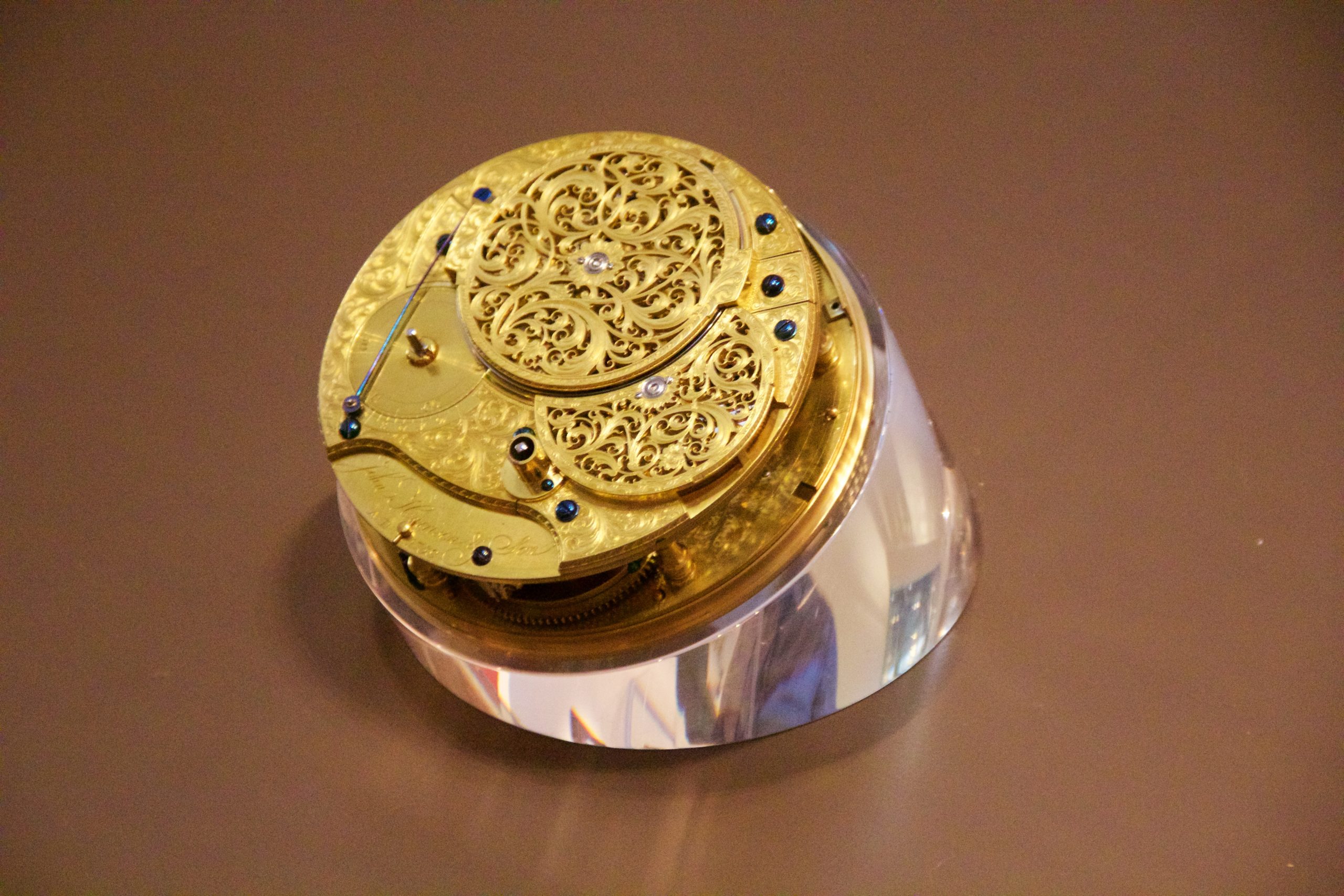
A watch offered the new direction. In 1753, the London maker John Jefferys produced a pocket watch to Harrison’s design. Harrison had pursued improvements to watches alongside the larger clock, and this collaboration made the smaller form more promising. Work on H4 began in 1755; the instrument was completed in 1759.
Its stable, rapidly oscillating balance lay at the center of the achievement. The object retained the familiar language of a watch, with an enamel dial and silver cases, while its mechanism was constructed for a much more exacting purpose. At roughly 1.45 kilograms overall, it was hardly an everyday pocket companion. The case enclosed years of experiments compressed into an instrument that could travel with a custodian. Its inscription names Harrison and Son. The object thus gives material form to a collaboration that the phrase ‘Harrison’s clock’ can obscure: Jefferys had helped develop the promising watch, and William would take responsibility for carrying the result to sea.
A second way across the ocean
While Harrison worked, astronomers were making another route to longitude practicable. The Moon changes position against the stars. If that movement could be predicted accurately, its observed position could supply the time at a reference meridian. Comparing that inferred time with local time would yield longitude without requiring a watch to preserve the reference time across the entire voyage.
Tobias Mayer improved lunar tables using careful analysis of observations, including those of James Bradley at Greenwich. Instrument makers also mattered: better instruments made angular measurement at sea more useful. Maskelyne tested the lunar-distance method on a voyage to St Helena in 1761 and became an energetic advocate. The calculations were demanding, but their difficulty could be reduced by preparing tables in advance. As the museum’s account of the lunar method makes clear, the choice was never simply between an ingenious mechanic and men incapable of seeing his achievement. An alternative technique was becoming usable, supported by a chain of observation, mathematics, instrument-making, and calculation.
H4 went to Barbados in 1764 for another trial. Maskelyne’s task included establishing the island’s longitude through observations of Jupiter’s satellites, giving the competing methods a reference against which to be measured. In February 1765, the Board accepted that the watch’s performance met the strictest accuracy requirement of the original act. Payment still depended on further conditions.
The astronomical work soon acquired a portable form of its own. Published in 1766 for the year 1767, the first Nautical Almanac provided predicted positions of the Moon relative to bright stars. A companion handbook explained the necessary calculations. The navigator received a book representing observations and computations performed elsewhere before the voyage began.
Behind those pages stood an institution founded almost a century earlier. Charles II had established the Royal Observatory at Greenwich in 1675 to advance the work required for longitude. Successive astronomers and their assistants had accumulated the observations upon which improved predictions depended. The almanac made that slow accumulation useful aboard ship. A printed table and a sea watch solved the problem in different ways, but both carried the work of people on land into the navigator’s hands. Their practical value also depended upon instruments, instruction, and the user’s ability to take a sound observation. The watch did not remove the need to look at the sky.
Who owned a working invention
A payment proposal preserved among the Board’s papers, dating from before August 1765, shows the conditions in concrete form. Harrison was to receive £7,500 when he fully disclosed the principles of the watch and assigned his timekeepers to the commissioners for public use. A further £10,000 would follow after other timekeepers had been made and shown by trial to meet the required accuracy.
The disagreement now reached inside the workshop. A successful object had to become a disclosed method that another maker could reproduce. From the public side, that requirement promised a benefit extending beyond possession of a single watch. For its inventor, it required surrendering knowledge as well as instruments while payment remained conditional. The document does not decide whether every demand was fair. It reveals what the argument had come to concern. A result obtained at sea was being translated into obligations about explanation, ownership, copying, and further proof. Each obligation created another place at which the settlement could stall.
Harrison eventually carried his case beyond the commissioners. In 1772, George III agreed to test the later timekeeper H5 at his observatory in Richmond. Its performance won royal support, but a trial outside the Board’s authority did not settle the Board’s requirements. The route to payment shifted toward the king, the prime minister, and Parliament.
In 1773 Parliament awarded Harrison another £8,750. It was a substantial recognition after decades of work and dispute, rather than a single ceremonial handover of the original £20,000 prize. Development grants and earlier payments complicate every short version of the reckoning. The documentary chronology assembled by Cattani, Ferriani, and Lanza shows a craftsman pursuing support through several institutions and audiences. His claim had traveled almost as laboriously as his watches. The intervention resolved the immediate payment struggle, while the larger practical question remained at sea: how would instruments based on this achievement perform in other hands, on longer routes, and in sufficient numbers?
The watch that sailed again
By then, another maker’s answer was already traveling. The Board had commissioned Larcum Kendall to copy H4 in 1766. He completed K1 in 1769, and James Cook took it on his second Pacific voyage in 1772. Kendall’s copy performed well enough to become a trusted part of the expedition’s navigation. Reproduction had proved possible, although an elaborate instrument remained expensive to make.
Attempts at cheaper, simplified versions did not immediately preserve that performance. Kendall’s later K2 and K3 were less successful. The path from an exceptional watch to a dependable supply of sea timekeepers still demanded further craftsmanship and redesign. K1 itself kept traveling: with Cook again, then with Arthur Phillip and the First Fleet to Australia, and later aboard the Victory under John Jervis. Its journeys joined measurement to the naval and colonial movements of Britain. When it finally returned to the Board in 1802, the watch had spent decades doing what the commissioners had once asked a proposed invention to do. It had gone out into the world, repeatedly, and kept time.
For a different navigational tradition, read how Hōkūleʻa reached Tahiti without instruments in 1976, when Mau Piailug’s living Micronesian knowledge helped renew Hawaiian ocean voyaging.
Sources and further reading
- Royal Museums Greenwich, Longitude found: the story of Harrison’s timekeepers
- Royal Museums Greenwich, What is longitude?
- Longitude Act of 1714, text and parliamentary proceedings, reproduced by Royal Observatory Greenwich historical resource
- Royal Museums Greenwich, H1, collection object ZAA0034
- Navy Office account, 28 January 1765, BGN/4, Royal Museums Greenwich
- Royal Museums Greenwich, H3, collection object ZAA0036
- Royal Museums Greenwich, H4, collection object ZAA0037
- Royal Museums Greenwich, Longitude found: Nevil Maskelyne and the lunar method
- Royal Museums Greenwich, History of the Royal Observatory
- Board of Longitude payment proposal, before August 1765, BGN/9, Royal Museums Greenwich
- Gino Cattani, Simone Ferriani, and Andrea Lanza, Deconstructing the Outsider Puzzle: The Legitimation Journey of Novelty, Organization Science 28 (2017), accepted manuscript
- Royal Museums Greenwich, K1, collection object ZAA0038