
Rubber, Hostages, and Testimony in the Congo Free State
Rubber extraction in Leopold II’s Congo depended on more than quotas. Witnesses described hostage-taking, food requisitions, and violence whose full human cost cannot be reduced to one exact number.
In 1903, villagers along the Congo River described their working week to the British consul Roger Casement. They had to plant and weed their gardens, prepare cassava, cook it, and carry the resulting food to a government post. If the portions were judged inadequate, punishment could follow. Their question was practical: how could they do all that was demanded and still maintain their own households? Casement recorded the complaint in the report published the following year. [1]
This episode was not about rubber alone. It reveals the wider labor system that sustained rubber extraction: food requisitions, transport, armed posts, and people whose time could be claimed by authorities they had little power to challenge. Behind the exported commodity lay an attempt to commandeer everyday life.

A sovereign’s commercial state
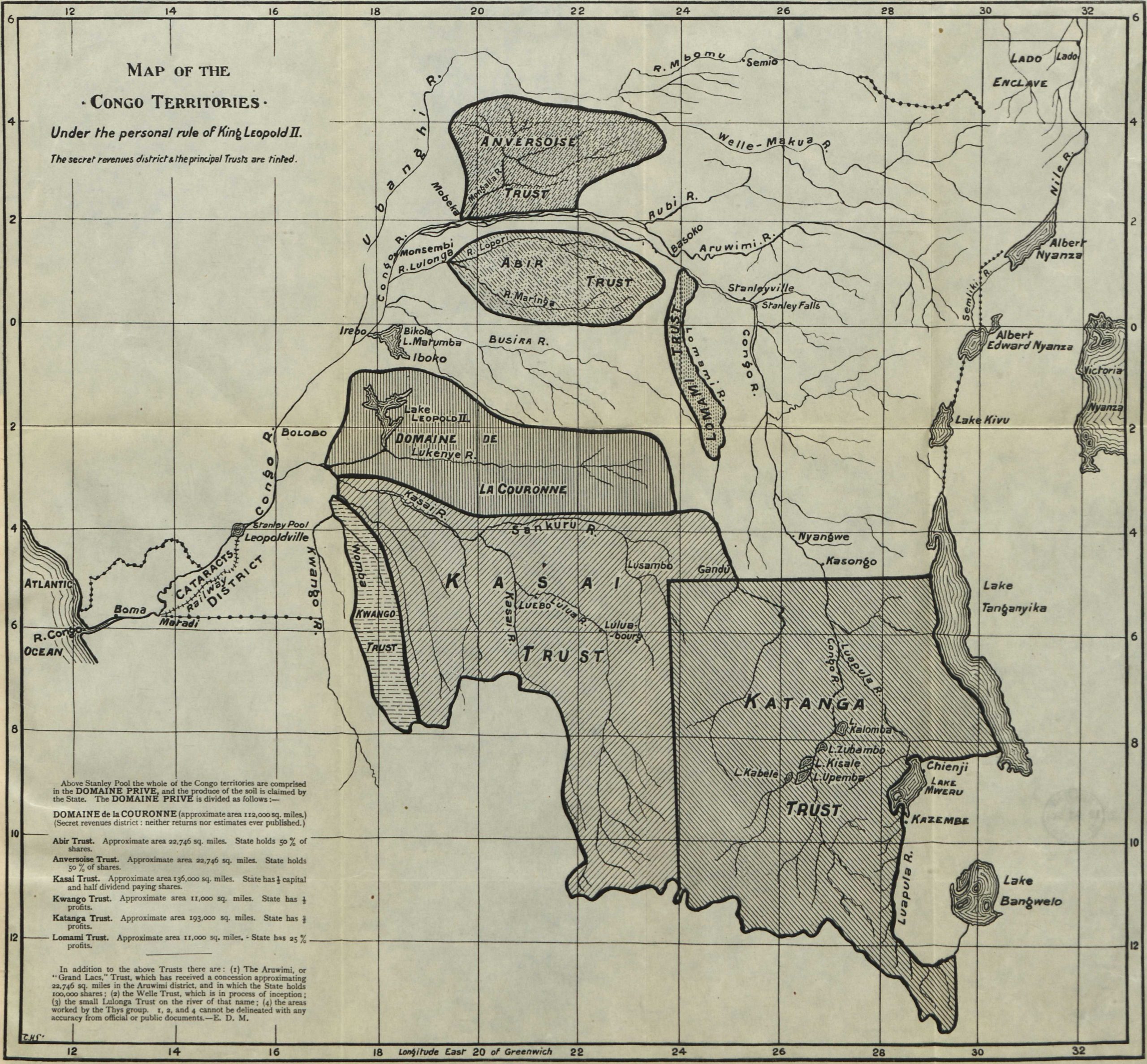
From 1885 to 1908, the Congo Free State was a distinct political entity under Leopold II, king of the Belgians. It was not yet the Belgian colony that succeeded it. Calling it the king’s private possession captures his exceptional personal control, but the territory was also administered through laws, officials, armed forces, and concession companies. Its violence operated through institutions, not merely through one man’s distant orders. [2]
The state claimed extensive rights over land and its products. In forest regions, companies received concessions that allowed them to extract resources while the population bore compulsory demands. ABIR, founded in 1892, operated in the Maringa-Lopori basin. The AfricaMuseum’s archival history describes a network of posts collecting forest products and a system that required villagers to deliver rubber as taxation. The Congo state received a substantial share of the company’s profits. [3]
Rubber was therefore not necessarily purchased from independent producers free to negotiate a price or refuse a buyer. Under coercive arrangements, the demanded quantity came first. The problem of obtaining it, and the consequences of falling short, were transferred to the village.
How a quota reached a household
Casement found armed company sentries stationed away from commercial establishments and among communities. Their work extended beyond protecting stores or employees. They compelled deliveries of rubber and provisions. In districts where vines had been depleted, producing the required quantity became increasingly difficult. Extraction could exhaust its own resource base while the obligation to supply it continued. [1]
Women were taken hostage to pressure men and communities into compliance. At one ABIR station, Casement described an agent explaining that capturing women brought in supplies more quickly. This was not merely a hostile observer inferring the purpose of an arrest: the report records an agent’s explanation of the method. The demands included food for the station as well as export products.
Hostage-taking turned relationships into instruments of extraction. A person’s safety could depend on work demanded from someone else. It also disrupted the activities that kept households alive. Time spent collecting rubber, carrying provisions, or seeking a detained relative was time unavailable for tending fields and other necessary tasks. Violence included killings, beatings, and mutilation, but its consequences also ran through hunger, flight, illness, and the breakup of communities.
The people behind the report
Casement’s document contains his observations, statements by officials, missionary information, and testimony from Congolese people. Those categories should not be collapsed. A scene he witnessed has a different evidentiary basis from an event reported to him. The published text sometimes identifies places and people by letters or substitutes, so the reader encounters a record already shaped for diplomatic circulation. [1]
Nor was Casement free from the assumptions of empire. He could criticize particular demands while accepting other compulsory obligations as normal. His report is valuable because of its detailed investigation; it is not an unfiltered transcript of Congolese society or a complete rejection of colonial authority.
Congolese witnesses were active participants in making the evidence. Some sought him out and explained why they had not complained elsewhere: they believed it useless while the compulsory rubber system remained sanctioned. Their testimony connected individual injuries to the structure that produced them. They were identifying a system, not simply providing illustrations for a European reformer’s argument.
The inquiry could not dismiss the pattern
Leopold’s government appointed a commission of inquiry in July 1904. Its report, submitted in 1905 and published in English translation in 1906, acknowledged serious abuses. At ABIR posts it visited, the commissioners reported that taking women hostage, compelling chiefs to work, and the use of punishments were habitual practices. [4]
The report also exposed the difference between a legal limit and a demand on the ground. A decree nominally limited obligatory labor to forty hours a month. In practice, an amount of produce was substituted for a measured period of work. Officials’ calculations could therefore conceal the actual time needed to gather and deliver it. A limit on paper did not ensure a limit in a worker’s life.
Yet the commission accepted compulsory labor in principle and proposed reform within colonial government. It must be read as evidence against practices it documented and as evidence of what its authors still considered legitimate. British parliamentary debate in 1906 also noted that the underlying testimony had not been published alongside the report. What the public could inspect was a selected official presentation, not the full evidentiary record. [5]
Why a single death total is misleading
The scale of loss was immense, but a precise total cannot be recovered from a reliable before-and-after census. AfricaMuseum identifies several intertwined causes of demographic catastrophe: conquest, forced labor, punitive expeditions, displacement, disrupted agriculture, epidemic disease, and falling birth rates. Its assessment explicitly acknowledges the uncertainty of the available population evidence. [6]
A population deficit is not identical to a count of people killed. It can include excess deaths, births that did not occur, and migration; estimates also depend on the territory and years being compared. The frequently repeated figure of ten million should therefore not be presented as an exact register of murdered individuals.
Uncertainty about a territory-wide estimate does not make documented local violence uncertain. Nor can disease be cleanly separated from coercion when forced movement, hunger, and disrupted care increased vulnerability. The strongest account keeps both scales in view: specific actions established by testimony and records, and a demographic disaster whose full dimensions remain difficult to measure.
After Leopold’s rule
Belgium annexed the territory on 15 November 1908. Leopold’s personal sovereignty ended; Congolese independence did not begin. [2] The history of exploitation also cannot be contained by that administrative boundary. Research by Sara Lowes and Eduardo Montero finds lasting differences associated with former concession areas, while carefully examining particular borders and institutions rather than treating the whole country as one identical case. [7]
Casement’s account of cassava deliveries preserves a smaller scale that statistics cannot replace. The villagers described planting, cooking, carrying, and punishment in the same explanation. A report organized around administration had recorded something more intimate: how a regime could take possession of the hours required to keep a family fed.
Sources and further reading
- Roger Casement, Correspondence and Report from His Majesty’s Consul at Boma Respecting the Administration of the Independent State of the Congo (1904). Public-domain primary source; includes report, testimony, and subsequent official correspondence.
- Office of the Historian, US Department of State, “The Congo Free State.” Statehood and the 15 November 1908 annexation.
- AfricaMuseum Archives, “Anglo-Belgian India Rubber Company. ABIR.” Institutional account citing historian Robert Harms.
- The Congo: A Report of the Commission of Enquiry Appointed by the Congo Free State Government (1906 English translation). Primary source; especially chapters II, IV, and V.
- House of Lords debate, “The Congo Free State,” 3 July 1906, Hansard. Contemporary discussion of the inquiry and unpublished evidence.
- Royal Museum for Central Africa, “The viewpoints of the museum.” Assessment of violence and demographic uncertainty.
- Sara Lowes and Eduardo Montero, “Concessions, Violence, and Indirect Rule: Evidence from the Congo Free State,” NBER working paper (2020), published in The Quarterly Journal of Economics (2021).