
Bouvines 1214 and the Battle for Power in Western Europe
A Sunday battle strengthened Philip Augustus, shattered a coalition, and deepened King John’s crisis. Its medieval witnesses and later images tell different parts of the story.
On Sunday, 27 July 1214, an army on the road from Tournai toward Lille turned to fight near the bridge at Bouvines. By the end of the day, Philip II of France had survived a dangerous encounter, Emperor Otto IV had escaped, and several of the coalition’s most important commanders were prisoners. The consequences reached well beyond the fields on which the armies met.
Bouvines secured a major victory for the Capetian monarchy, undermined an emperor, and helped ruin King John of England’s attempt to recover his continental position. It also acquired a second life in chronicles, paintings, classrooms, and public monuments. Understanding the battle requires moving between those two histories: the hard-to-reconstruct fighting of 1214 and the remarkably durable meanings attached to its outcome.
A coalition with several stakes
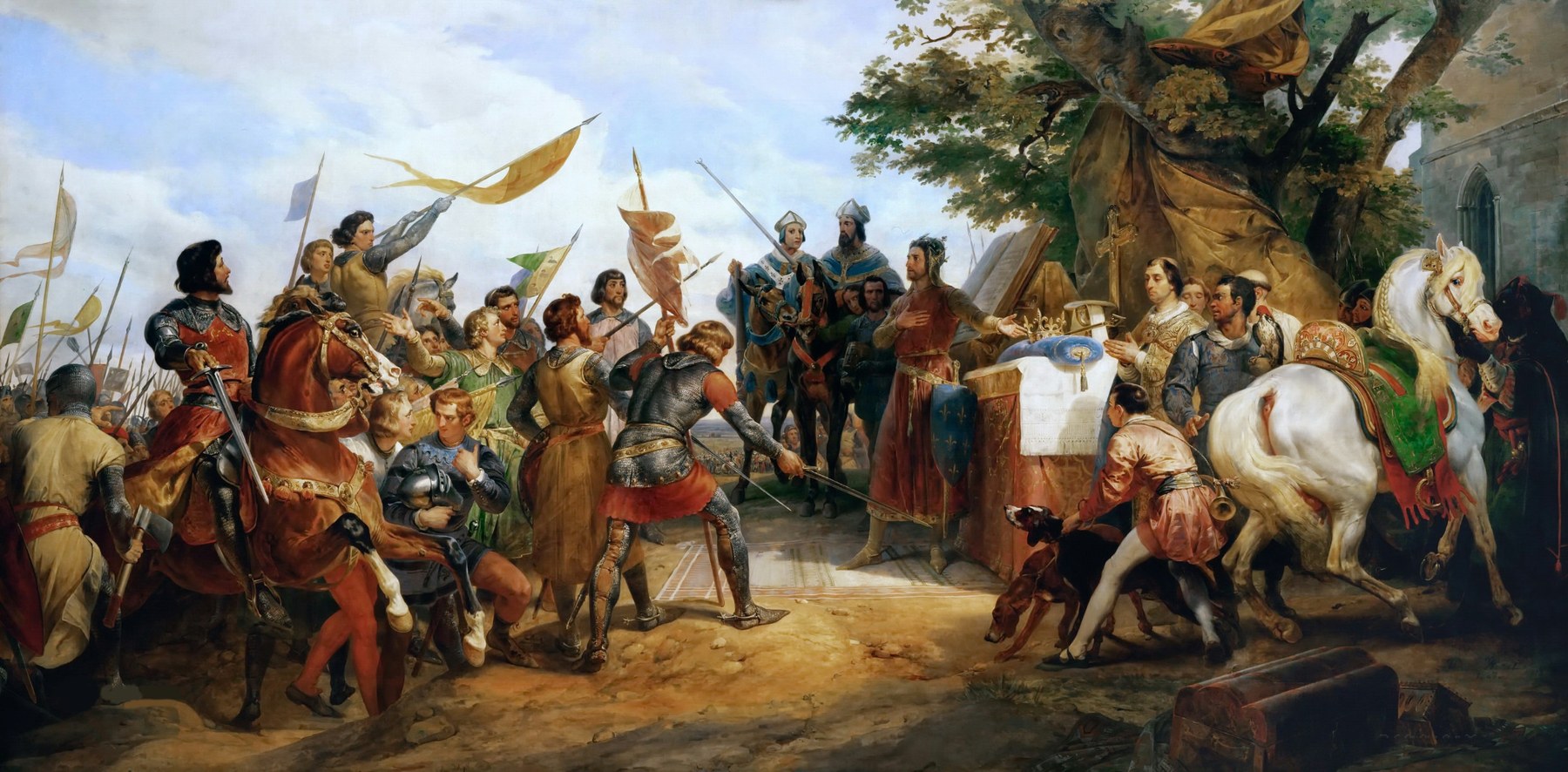
John’s role is easy to misunderstand because he was not personally on the battlefield. His campaign operated on separate fronts. He fought in western France while a northern coalition included Otto, Count Ferrand of Flanders, Count Renaud of Boulogne, and English forces associated with William Longespée, earl of Salisbury. John’s money helped sustain the enterprise. Its participants had overlapping reasons to oppose Philip, rather than a common national identity or a single uncomplicated grievance. the National Archives’ 1214 chronology
Philip’s earlier gains at the expense of the Plantagenets made the stakes especially high. John wanted to reverse losses; Philip wanted to preserve an enlarged royal position. For the French king, success depended on more than one afternoon’s courage. As Laurence Marvin emphasizes, the foundations of victory included strategic and operational decisions made before battle. Philip could meet the northern threat while his son Louis opposed John farther south. An army that reached a battlefield had already been shaped by diplomacy, finance, mobilization, and the management of several dangers at once. Laurence Marvin’s study of Philip’s command
The language of “France against Europe” can obscure these relationships. Ferrand and Renaud were not simply foreign invaders: their conflicts with Philip also concerned the bonds and obligations of lordship. Political allegiance did not follow a modern map of nation-states. The armies contained men whose loyalties were personal, territorial, dynastic, or financial, and whose families might hold connections across the lines of battle. That mixture would matter again when prisoners were ransomed, forgiven, or kept in captivity.
A retreat becomes a battle
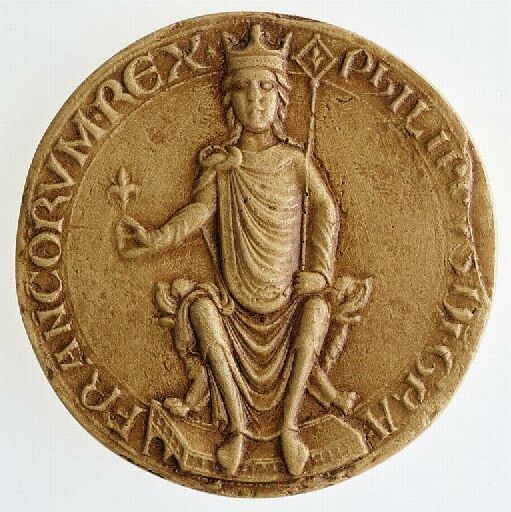
The fullest narrative comes from William the Breton, Philip’s chaplain. In his account, the French army was withdrawing when news arrived that the enemy was pressing its rear. Much of the force had already crossed the bridge. Philip had to halt and bring troops back into position. William gives a prominent role to Guérin, the bishop-elect of Senlis, in recognizing the danger and helping organize the response. What might have become a damaging attack on a divided column became a pitched encounter. William the Breton’s account
The Anonymous of Béthune tells a related but distinct story. Writing after 1220 for Robert of Béthune, a participant, this author describes the rear guard repeatedly having to turn against pursuit. The narrative stresses the restoration of order and the gathering of men into their formations. Agreement on the broad danger does not mean that every colorful exchange in either account can be recovered as spoken dialogue. Both writers arranged the events into stories about conduct, courage, and reputation. the Anonymous of Béthune
Sunday gave those stories an additional moral problem. A battle on a holy day needed explanation. Roger of Wendover’s English account places objections to fighting on Sunday inside the coalition’s council, followed by angry accusations that help make combat unavoidable. We cannot treat that scene as a verbatim record. It does show how a chronicler could use the timing of battle to evaluate the participants, making military judgment and religious propriety part of the same narrative. Roger of Wendover’s version
The march and the bridge remain more secure foundations than the speeches. An army moving through a constricted crossing could be vulnerable. Recalling units, making space, identifying the enemy’s direction, and establishing a line required practical decisions under pressure. The sources give different degrees of credit to the king, his advisers, and his nobles. Their disagreements leave room for analysis while warning against the impression that a modern map can place every unit with certainty.

Fighting across the line
On the French right, the forces confronting Ferrand included major nobles and mounted troops. William describes an initial attack by mounted sergeants, followed by a prolonged struggle in which men were knocked down, horses killed, and fighters captured. His account culminates in the wounded and exhausted count of Flanders being taken. The language celebrates individual feats, yet it also reveals units moving, supporting one another, and returning to combat. Even in a highly partisan account, the battle was more complicated than a single charge by a king. William the Breton’s account
Elsewhere the French ruler himself was unhorsed. The Anonymous of Béthune reports the fall and his rapid recovery, along with the sounding of the king’s trumpets. Such an episode helps explain the political vulnerability inherent in personal kingship: a ruler’s body could suddenly become the focus of a much larger contest. His survival depended on companions and the cohesion of men around him. The account’s list of captured nobles also makes clear that seizure of high-status opponents was central to what victory meant. the Anonymous of Béthune
Otto escaped. How he did so became a matter of interpretation. The Marchiennes account, composed near the battlefield, portrays an isolated and defeated ruler fleeing almost alone. It refuses him an unqualified imperial title because of his excommunication and presents the outcome as divine judgment. That treatment tells us as much about the author’s religious-political commitments as it does about Otto’s last moments on the field. the Marchiennes narrative
Wendover instead gives Otto a vigorous final resistance before describing his departure. These versions cannot simply be combined into one seamless cinematic scene. The underlying result is clear: the coalition failed, the emperor left the field, and important allies fell into Philip’s hands. The exact sequence of clashes, withdrawals, and collapses is less certain. A responsible narrative keeps that difference visible rather than smoothing away conflicting evidence.
What the accounts leave unresolved
Modern historians continue to debate both the scale and the character of the fighting. Estimates of troop strength vary, and medieval numbers can reflect rhetorical purpose as much as counting. Studies of the armies and tactics extend back through generations of scholarship. Giving an exact total, or a neat ratio of deaths on either side, would suggest a precision the evidence does not securely supply. Infantry losses are especially difficult to recover from narratives fascinated by named nobles. long-running research on troop numbers
Dominique Barthélemy’s reassessment questions how readily historians have accepted William’s royal-centered version. It draws attention to the Anonymous of Béthune and to different kinds of engagement across the field. It also challenges confident identification of some troops as organized mercenaries. Such arguments do not dissolve the battle into unknowability. They ask whether categories and emphases inherited from chroniclers have become embedded in modern descriptions without sufficient testing. Dominique Barthélemy’s reassessment
The problem extends to casualty figures. A chronicle might carefully remember a prominent knight and barely notice the foot soldiers around him. Captivity could be a profitable outcome for someone valuable enough to ransom, while others had far fewer protections. The surviving record is therefore socially selective. We can establish that Bouvines produced significant prisoners and a decisive political result without pretending to possess a complete accounting of every person who fought there.
Victory and its limits
For Philip, the immediate gains were substantial. His northern opponents had been beaten, and leading adversaries were in captivity. John Baldwin’s article situates the victory within the consolidation of royal government, arguing that the years after Bouvines brought a favorable setting for institutions Philip had already developed. The battle confirmed work undertaken over a reign; it did not create an administrative monarchy on the spot. John Baldwin’s study of Bouvines’ meaning
Nor did it abolish the power of the great nobles. John France emphasizes both the prestige Bouvines gave Philip and the continuing limits of royal authority. Even in Flanders, noble rights and claims remained matters with which the monarchy had to deal. Later tensions under Philip’s successors show why the result should not be read as an instant arrival of centralized sovereignty. A victorious king possessed stronger leverage, but still governed through relationships, rights, and negotiated obligations. John France’s account of the aftermath
For Otto, the defeat accelerated the loss of political support in his struggle with Frederick II. His effective authority contracted; he did not cease to exist as a claimant through some formal act on the battlefield. The distinction is worth keeping because the shorthand “Bouvines deposed the emperor” compresses a political process into a moment. Military defeat altered what allies and opponents believed possible. Its consequences unfolded through their subsequent decisions. the Larousse biography of Otto IV
In England, the failed campaign intensified John’s crisis. The money and effort invested in recovering his continental position had not produced the expected result. Opposition to his government soon developed into the rebellion that led to Magna Carta in 1215. Bouvines belongs in that chain of events, but it was neither the whole explanation of English grievances nor a battle fought to produce constitutional liberty. People drawing up the charter responded to a much longer experience of kingship, finance, and justice. the National Archives’ 1214 chronology
How a medieval victory became a national scene
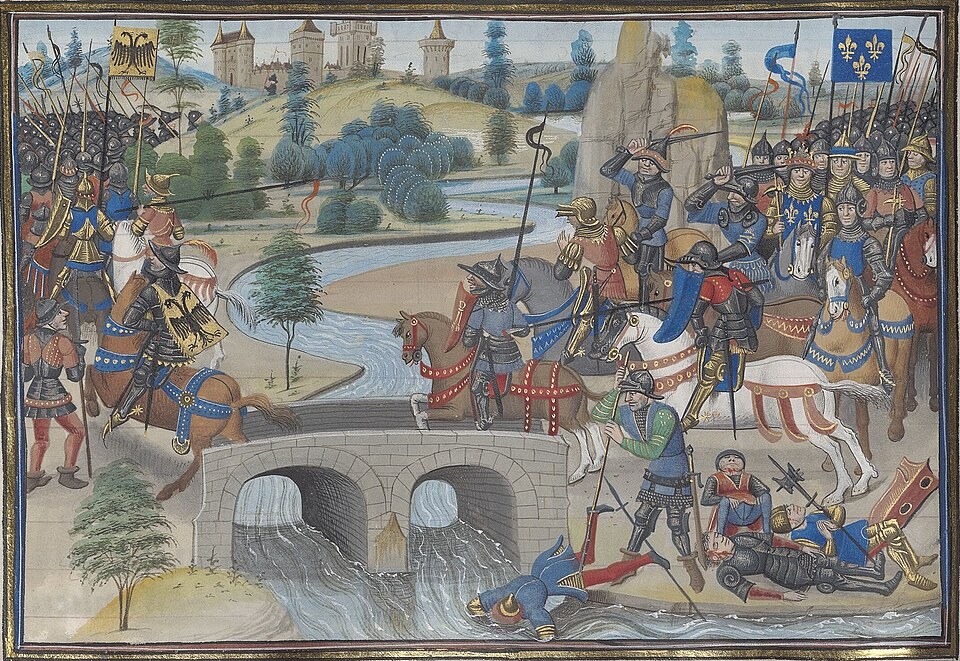
The battle’s later images are striking precisely because they are not neutral windows onto 1214. Fifteenth-century manuscript artists gave the encounter forms intelligible to their own audiences. Centuries later, Horace Vernet painted Philip at Bouvines, and that work entered the historical display at Versailles. Louis-Philippe’s Gallery of Great Battles assembled victories from different dynasties into a shared history of France. In that setting, Bouvines could serve a national story whose shape would have been unfamiliar to many of the combatants. Versailles’ account of the Gallery of Great Battles
Bouvines itself became a place of commemoration. Its rebuilt Saint-Pierre church was designed to honor the battle, and a sequence of large stained-glass windows was installed between 1889 and 1906. The episodes drew on William the Breton’s narrative. A royal chaplain’s interpretation was thus translated into a much later religious and patriotic setting, where viewers could follow the story in luminous scenes. The windows are valuable historical evidence for commemoration, alongside their artistic interest. They are not surviving medieval depictions. the town’s history of Saint-Pierre church
The durability of Bouvines owes much to this capacity for reinterpretation. It was a victory that could be told as providence, royal salvation, dynastic consolidation, or national unity. Yet its historical force does not depend on accepting any one of those frames. On a particular Sunday, a coalition failed to defeat Philip, important men became prisoners, and the political balance shifted across several realms. The distance between that event and its later images makes the story richer, provided the two are kept in view.
Sources and further reading
- The National Archives, Magna Carta 1214–1225 John’s campaign, defeat of his northern allies, and the later English crisis; John was not personally at Bouvines.
- Laurence W. Marvin, Philip II’s “Eye of Command” and the Battle of Bouvines (2023) Strategic/operational preparation; cautions against treating the battle as merely a knightly duel.
- William the Breton, Gesta Philippi Augusti, chapters 181–190, translated by the United States Military Academy Turma ad Latinam Near-eyewitness royal chaplain, strongly partisan. Used selectively for retreat, recall, right-wing engagement, and Ferrand’s capture. The online translation’s Saturday bracketed date is inconsistent; article follows securely established Sunday 27 July.
- The Battle of Bouvines according to the Anonymous of Béthune, translated in Georges Duby, The Legend of Bouvines Written after 1220 for participant Robert of Béthune. Royal unhorsing, flight, and prisoners; retrospective and not neutral.
- The Battle of Bouvines according to Roger of Wendover English monastic account; used to show conflicting presentations of Sunday debate and Otto’s withdrawal, not as a literal transcript.
- The Marchiennes account of the Battle of Bouvines Early nearby monastic account. Excommunication and providential reading reveal authorial agenda.
- Dominique Barthélemy, La Bataille de Bouvines reconsiderée (2018) Questions William’s framing, scale, military categories, and centrality of Philip; scholarly interpretation, not consensus on every tactical detail.
- J.-F. Verbruggen, Le problème des effectifs et de la tactique à la bataille de Bouvines (1214) (1949) Evidence for longstanding dispute over strengths/tactics. No precise army or casualty totals adopted.
- John W. Baldwin, Le sens de Bouvines (1987) Royal governmental institutions and post-1214 consolidation.
- John France, The Expansion of France, in Medieval France at War (2023) Great prestige but surviving noble rights and limits on royal consolidation.
- Larousse, Otton IV de Brunswick Defeat and contraction of authority; no claim of a formal instantaneous battlefield deposition.
- Château de Versailles, The Gallery of Great Battles Louis-Philippe’s historical gallery and inclusion of Vernet painting.
- Commune de Bouvines, Église Saint-Pierre Nineteenth-century rebuilding and stained glass installed 1889–1906; later commemoration, not medieval evidence.