
Tenochtitlan 1521: A City Besieged by Land and Water
The siege of Tenochtitlan was a war of Indigenous alliances, shipbuilding, broken water supplies, and determined resistance in a city already scarred by epidemic.
At the opening of the siege, the attackers went for the water. Spanish troops and their Tlaxcalan allies moved from the western side of the lake toward the aqueduct carrying fresh water from Chapultepec to Tenochtitlan. Mexica defenders resisted. Once driven away, they could no longer protect the conduit, which the attackers broke. Bernal Díaz del Castillo, who fought in the campaign and described it decades later, placed this operation at the beginning of the assault on the island capital.
Water still surrounded the city. What had been removed was a dependable supply fit to drink. The difference would govern the coming months. Causeways connected Tenochtitlan with the shore, canoes crossed the lake, and waterways threaded its neighbourhoods. To conquer such a place required control over movement: who could approach, who could retreat, and who could bring another load of food or fresh water through the narrowing ring. Díaz’s account.
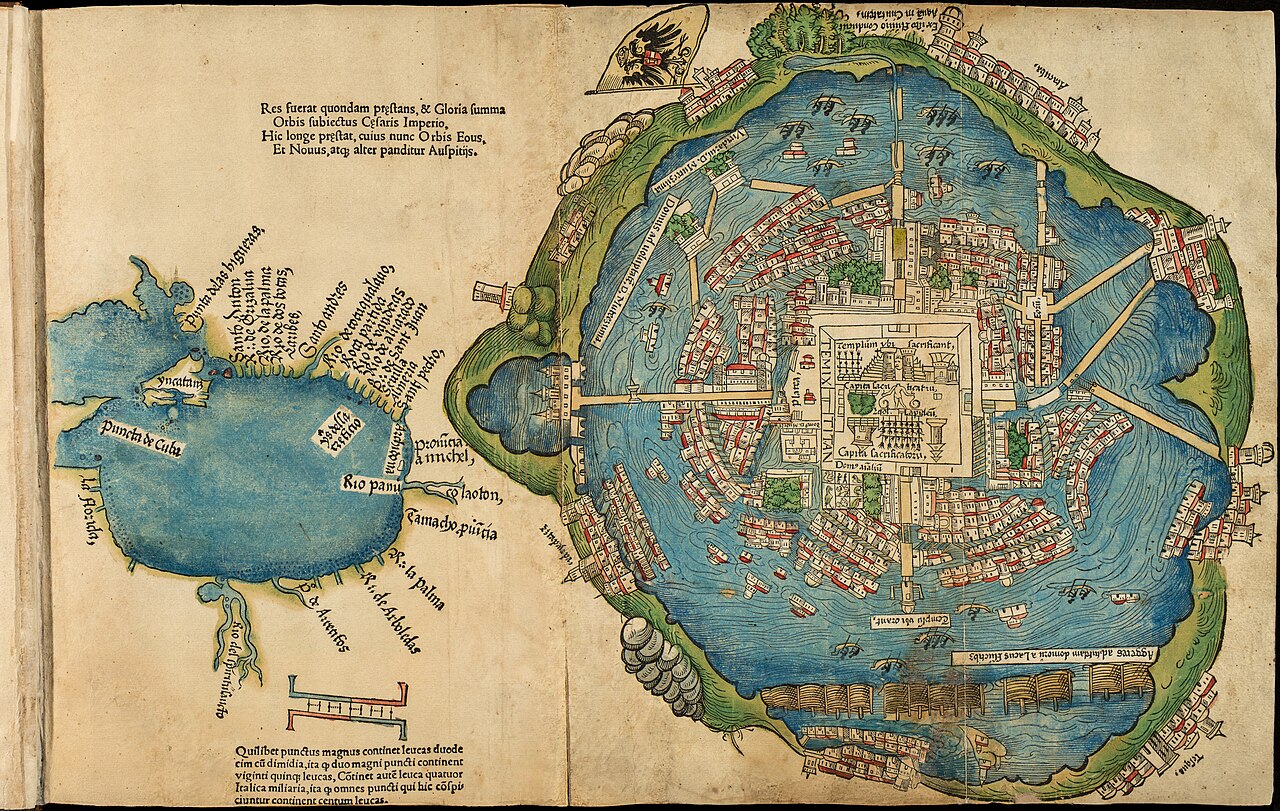

The city before the blockade
At the city’s ceremonial centre stood the Templo Mayor, enlarged by successive rulers until its twin shrines dominated the sacred precinct. One was dedicated to Tlaloc, associated with rain and sustenance; the other to Huitzilopochtli, the Mexica patron deity associated with war. The pairing joined powers on which the city depended, while the building’s successive enlargements gave royal ambition a monumental form.
The temple had itself grown with Tenochtitlan. Construction began with a relatively modest sanctuary in the fourteenth century; later phases covered and expanded their predecessors. Flooding and the unstable lakebed sometimes demanded repairs, while rulers used rebuilding to mark accessions and enhance political authority. The imposing structure encountered by the Spaniards in 1519 was the result of repeated investment. Its destruction would therefore cut through layers of urban and dynastic history, not merely remove a landmark from the skyline. Temple history.
Tenochtitlan and its northern neighbour, Tlatelolco, belonged to the Mexica world, though their inhabitants retained distinct identities. The broader empire commonly called Aztec rested on tribute and the power of allied city-states. It did not dissolve every local community into one people with one political interest. That distinction became decisive when enemies and former partners of the Mexica joined the campaign against their capital.
Historian Inga Clendinnen described the victorious force as a Spanish body accompanied by a shifting coalition of Indigenous allies. The adjective matters. This was a war fought through changing relationships, in which communities assessed their positions as rulers died, armies moved, and opportunities appeared. “Spanish conquest” names the colonial order that emerged; it compresses the much more crowded field of participants who brought that order into being. Historical interpretation.
From entry to expulsion
Cortés first entered Tenochtitlan in November 1519. His party had already fought the Tlaxcalans and then made an alliance with them. Inside the capital, the Spaniards placed Moctezuma under restraint. Their precarious residence became open war in 1520, when Pedro de Alvarado’s men massacred participants in the Toxcatl festival while Cortés was away confronting another Spanish expedition on the coast.
Cortés returned to a hostile city. Moctezuma died amid the crisis, and at the end of June the invaders attempted to escape across the western causeway. They suffered severe losses. Survivors eventually reached Tlaxcala, where the alliance allowed them to recover and prepare another campaign. The victory of 1521 followed a near catastrophe for the force that claimed it.
Political succession continued inside Tenochtitlan. Cuitlahuac ruled after Moctezuma but died during the smallpox epidemic late in 1520. Cuauhtémoc became ruler early the following year and would direct the final defence. Campaign chronology.
The alliances required speech as well as weapons. Malintzin, known in Spanish as Doña Marina and commonly as La Malinche, served as an interpreter for Cortés. Sources present her unevenly, sometimes placing her conspicuously between negotiating parties, sometimes reducing her contribution to a passing reference. Even her names carry the complications of movement between languages and social worlds.
She cannot be made to stand for every Indigenous participant, still less for an entire continent choosing its future. Her role does, however, expose a practical dependence often concealed by a story centred on the Spanish commander. Orders, proposals, warnings, and agreements had to become intelligible across languages. The military coalition was also a sustained undertaking in translation. The evidence for Malintzin.
The epidemic between campaigns
Before the siege tightened, smallpox had already entered the city’s homes. The Nahuatl account preserved in Book 12 of the Florentine Codex describes sufferers unable to move, turn themselves, or rise from their sleeping places. Some survivors were scarred or lost their sight. It also records deaths from hunger because the household work of preparing food could no longer be done.
This was the epidemic of 1520, preceding the final siege of 1521. Keeping the sequence clear helps explain its effects without turning disease into a force that automatically won a later battle. Illness killed people, interrupted care, and damaged a society’s capacity to feed itself. The surviving population nevertheless continued to organize defence.
The account’s attention to helpless bodies and unattended meals gives the catastrophe a scale different from a list of rulers. A city lost capacity household by household. When military pressure returned, it fell upon communities that had already suffered a profound disruption. Nahua account of the epidemic.
A fleet built far from the sea
Meanwhile, the attackers prepared to contest the lake itself. Thirteen brigantines were constructed in an enterprise extending from Tlaxcala’s forests to the shore at Tetzcoco, also spelled Texcoco. Timber had to be selected, cut, shaped, and carried. Vessels had to be assembled, and a canal excavated to bring them into the lake. Spanish shipbuilding expertise formed only part of that undertaking.
Kristian Fabian’s reconstruction restores Indigenous workers and organizers to the centre of the project. Their knowledge of materials, terrain, transport, and water made the operation possible. The ships that would later seem to embody a European advantage were the product of a much wider concentration of labour and skill.
Tetzcoco supplied an essential base on the lake’s eastern side. By spring 1521, the coalition could prepare simultaneous pressure by land and water. Artillery mounted aboard the vessels increased their power, while their mobility helped connect separated forces and threaten the canoe traffic sustaining the capital. Months of work away from the battlefield had changed the conditions under which the battle could be fought. Research on the naval project.
The causeways and the canoes
The fleet did not make the defenders helpless. Díaz describes canoes darting into spaces where the larger vessels could not follow. Mexica fighters drove stakes beneath the water’s surface to obstruct the brigantines. They prepared ambushes near the reeds and tried to lure pursuing vessels into them. On the causeways, breaches and barricades channelled an advance into narrow, exposed passages.
The attackers learned that progress on land depended on support from the lake. Brigantines protected the flanks of troops moving along the causeways by keeping hostile canoes at a distance. Even then, taking a crossing during the day did not guarantee possession the following morning. Defenders could return after dark, reopen gaps, and construct new obstacles. The campaign repeatedly consumed effort in gaining ground that had already been gained.
Horses, so imposing on open terrain, were constrained by these approaches. A broken causeway offered little room to manoeuvre, while water allowed defenders to withdraw from cavalry and reappear elsewhere. Díaz’s account is particularly revealing here because it records the limits of the army to which he belonged. The weapons mattered, but their usefulness depended on a terrain the defenders understood and continued to alter.
The blockade also required patience. Canoes carrying provisions still attempted to reach the city, and some slipped through. The besiegers sent vessels out at night to intercept them. A lake that had distributed supplies between communities was being reorganized into a field of pursuit. Captured food could feed the attackers while reducing what reached those inside. Military advantage accumulated in loads of maize as well as captured positions. Díaz’s account.
Nor did the coalition advance without serious reverses. In one major assault, troops pushed forward while an inadequately secured crossing remained behind them. The retreat through the constricted approach became a disaster. Cortés narrowly avoided capture, and other Spaniards were taken. News of losses threatened the confidence on which the wider army depended.
Díaz also describes captured Spaniards being sacrificed, a subject that carried enormous emotional and polemical weight in conquest narratives. His account should be read as the testimony of an interested participant, rather than as permission to accept every number or claimed observation unquestioningly. What the reverses establish without such embellishment is that the defenders remained capable of coordinated counterattack. The final outcome was produced through continued fighting and deprivation, not through the instantaneous collapse of Mexica resistance at the sight of unfamiliar weapons. Díaz’s account.
Demolishing the ground ahead
Cortés eventually described a method for making territorial gains irreversible. As his forces advanced, buildings on either side of their route were to be demolished. Their material would fill canals and difficult crossings, leaving firm, level ground behind the leading troops. Indigenous labourers were requested from allied leaders to carry out the work.
In his third letter to Charles V, Cortés presented this destruction as a necessity imposed by the defenders’ persistence. That explanation was part of his argument to the monarch; it should not become the historian’s unexamined verdict. The letter nevertheless exposes the operational choice clearly. The attackers would dismantle the urban fabric that enabled the defence.
Conquest proceeded through demolition. Every filled channel reduced one avenue of movement for the canoes; every cleared stretch diminished a place from which defenders could attack. The same labour that made an advance safer also removed houses and familiar spaces from the people still crowded into the shrinking city. Cortés’s third letter.
The last weeks
As the fighting contracted toward Tlatelolco, hunger and loss of drinking water sharpened the pressure. Díaz’s descriptions of the final conditions are harrowing, and his numerical estimates cannot be treated as a reliable census of the dead. The convergence of broken supply, prolonged combat, and the destruction of shelter is more securely established than any precise casualty total.
The chronology ends on 13 August 1521 with the capture of Cuauhtémoc. A Spanish brigantine intercepted the canoe in which he was travelling. His seizure marked the end of the organized defence of the capital. The last ruler of an independent Mexica Tenochtitlan entered captivity, while the city around him had been reduced by the means employed to take it.
Díaz records that one of the first tasks imposed after victory was repair of the Chapultepec aqueduct. The conquerors also ordered the removal of bodies and the restoration of streets, bridges, and buildings. The conduit broken at the beginning had to be made to carry water again. The captured city still occupied its lake, and anyone intending to rule from it inherited the practical demands of keeping people alive there. Díaz’s account.
Whose victory entered the record
The written history of the siege carries the interests of those who recorded it. Cortés addressed an emperor whose favour he needed. Díaz defended the contribution of soldiers against accounts that concentrated glory in their commander. Neither was a detached observer. Their admissions of difficulty are valuable, but their explanations of responsibility and their estimates of enemy losses require scrutiny.
Tlaxcalan histories preserved another claim: Indigenous allies had helped accomplish the conquest and expected their service to be remembered. These accounts differ from Mexica memories of the same catastrophe. There was no single Indigenous verdict waiting behind the Spanish documents. Reading across traditions recovers disagreements among participants as well as the gap between victors and defeated. Guide to the source traditions.
The Florentine Codex offers a particularly important path into Nahua knowledge and memory. Created by Bernardino de Sahagún together with Nahua elders, writers, and artists, it was completed in 1577. Its parallel Nahuatl and Spanish texts and extensive images preserve an account made after the conquest, within the world the conquest had changed.
That distance in time demands care, but it does not make the work dispensable. Its testimony restores experiences largely absent from a commander’s dispatch: the body that cannot rise, the household that cannot prepare a meal. Set beside the attackers’ accounts of bridges, vessels, and demolished houses, these passages show how the operations of a siege entered the ordinary structures of life. About the manuscript.
Spanish Mexico City rose on the site of Tenochtitlan. Its reconstruction depended heavily on Indigenous labour, and Nahuas continued to form much of its population. The fall of the capital brought a new ruling order without bringing Indigenous urban life to an end. Conquest elsewhere in Mesoamerica also continued beyond the surrender of this city.
The coalition that overcame the city’s last resistance had helped create a political future its members would experience unequally. Within the rebuilt capital, older communities persisted amid the new institutions and demands. Tenochtitlan’s sovereign power had ended; its inhabitants and their descendants remained part of the city being built over its damaged ground. The restored water supply served a place whose rulers, sacred centre, and conditions of life had been violently changed. Indigenous continuity after 1521.
For other histories of supply and urban warfare, see Imphal and Kohima: How Air Supply Changed the Meaning of Encirclement and Stalingrad: The City Battle and the Trap Beyond Its Flanks. Each belongs to a very different military world.
Sources and further reading
- Bernal Díaz del Castillo, The Memoirs of the Conquistador, vol. II, chapters CXL–CLVII, translated by John Ingram Lockhart (1844)
- Heidi King, Tenochtitlan: Templo Mayor, Metropolitan Museum of Art (2004)
- Inga Clendinnen, Aztecs: An Interpretation, Introduction, Cambridge University Press
- Nancy Fitch, The Conquest of Mexico: Timeline, American Historical Association (2004)
- Nancy Fitch, Who Was Malinche?, American Historical Association (2004)
- Florentine Codex, Book 12, chapter 29, folio 53r; Digital Florentine Codex, Getty Research Institute
- Kristian J. Fabian, Masters of the Land: Native Ship and Canal Building During the Spanish-Aztec War, The Americas (2024; online 2023)
- Hernán Cortés, Third Letter, extract: Cortés Tries to Take Tenochtitlan, American Historical Association
- Nancy Fitch, A Brief Guide to the Sources, American Historical Association (2004)
- Getty Research Institute, Digital Florentine Codex: An Encyclopedia of 16th-Century Indigenous Mexico
- Matthew Restall, Lisa Sousa, and Kevin Terraciano, Mesoamerican Voices, introductory excerpt, Cambridge University Press