
The Diamond Sutra of 868: Printing, Merit and a Sealed Cave
A dated dedication, finely cut images and a hidden chamber reveal why an early printed Buddhist scroll was made, how it survived and what its famous date actually proves.
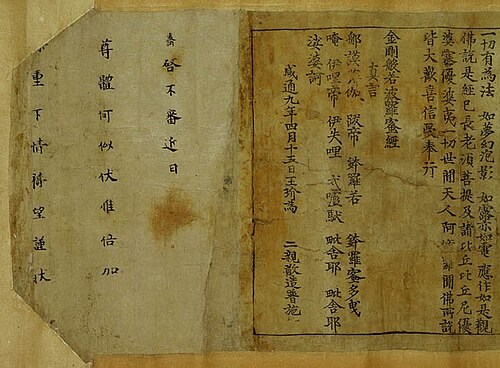
At the end of a printed Buddhist scroll, a short dedication gives a name, a purpose and a date. Wang Jie sponsored its production for the benefit of his parents and for distribution. The date corresponds to 11 May 868. That small statement is why this particular copy of the Diamond Sutra occupies such a prominent place in the history of books.
It is the earliest surviving complete printed book with an explicit date. The qualification matters. It is not the first writing, the first book, or proof that printing was invented in 868. It is an exceptionally well-preserved witness to a technology already capable of intricate images and sustained text.
A scroll made to carry a teaching
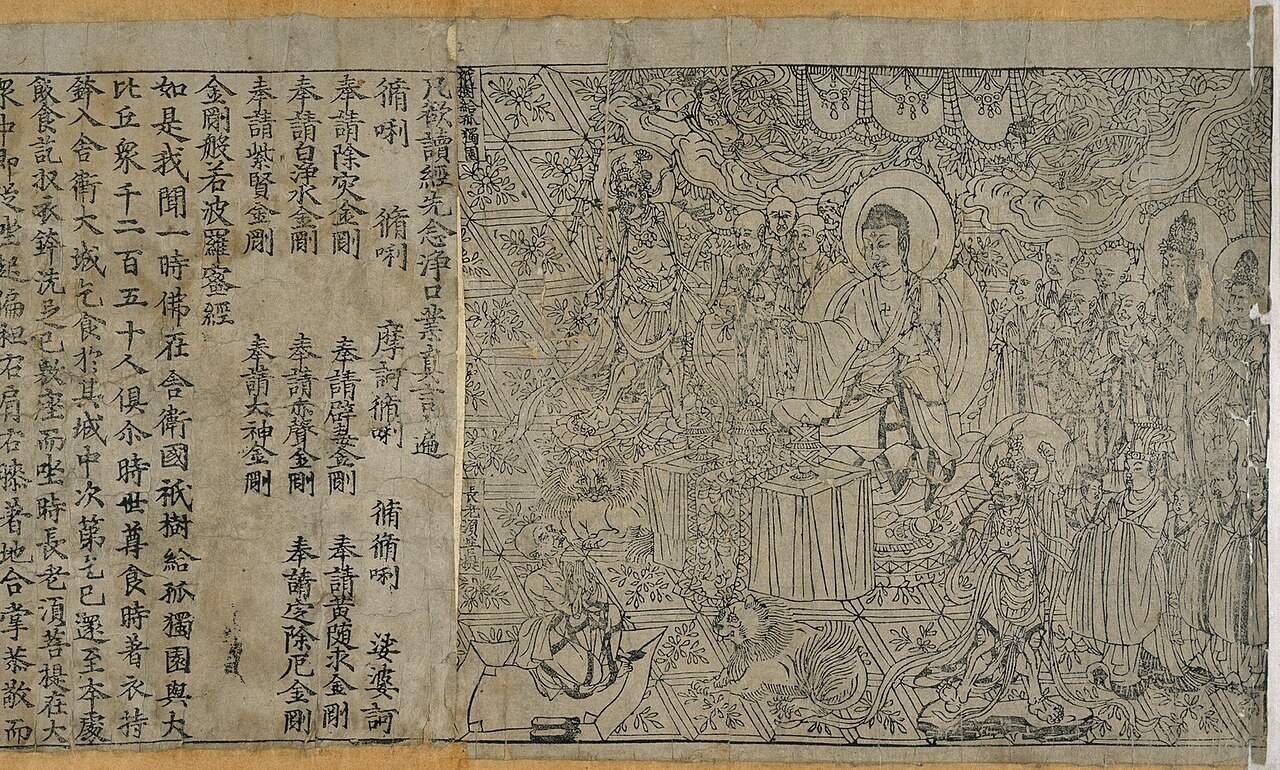
The object now catalogued by the British Library as Or.8210/P.2 is a scroll rather than a volume with a spine. Its illustrated opening and text were printed on seven sheets joined into a continuous length of more than five metres. The International Dunhuang Programme’s introduction explains both its physical form and its religious purpose.
The Diamond Sutra is a Mahayana Buddhist scripture associated with the perfection of wisdom. Its dialogue between the Buddha and Subhuti challenges attachment to fixed appearances and categories. The frontispiece gives that teaching a visual setting: the Buddha is surrounded by an assembly, with the elderly disciple represented among those hearing him.
The picture is not documentation of an eyewitness event in ninth-century China. It is a devotional representation accompanying scripture. Its details tell us about the visual and printing culture that produced the scroll, while the teaching it presents had already circulated for centuries.
Why pay for copies that others would receive?
Wang Jie’s dedication puts a family relationship inside a work intended to circulate beyond the family. As discussed in the IDP newsletter’s study of the scroll and its teaching, copying and disseminating scripture could generate merit within Buddhist practice. Sponsorship therefore connected material expenditure, religious action and concern for one’s parents.
The colophon identifies a patron. It does not identify him as the person who cut every block or pulled every impression. It also leaves most of his life unknown. Turning his name into a detailed biography would outrun the evidence.
That modest amount of information is nevertheless revealing. A dated printed object need not announce commercial ownership or a sale. Reproduction could serve devotional distribution. The labor of preparing paper, carving a printing surface and producing impressions made it possible for a patron to multiply an act of giving.
The surviving dedication does not tell us how many copies were made or who received the others. We possess a witness to an intended circulation, not the complete distribution list.
The skilled work inside a repeated impression
Woodblock printing required a surface carrying the reversed design, ink and paper suited to it. Once a block was prepared, the same arrangement of words and images could be reproduced. Repetition saved the need to rewrite each copy, but it did not remove the demanding initial work of preparing a reliable printing surface.
A technical study of the scroll’s paper emphasizes the sharpness of the printed lines and the careful relationship between paper and ink. The quality of the result indicates practiced decisions about materials. It should not be treated as a crude first experiment merely because it is the earliest complete dated survivor.
The same study explains why conservation affects research. Later linings and repairs can conceal the structure of a sheet and introduce additional substances. Removing or examining them under controlled conditions may reveal features of the original manufacture. Conservation is therefore not just cosmetic care for a famous object; it can change which historical questions can be answered.
A different history from movable type
A carved block and movable type solve the problem of reproduction differently. A block keeps a whole prepared arrangement together; separate type can be rearranged for another text. Neither system should be reduced to a preliminary step whose only purpose was to lead to a later European press.
The Library of Congress’s account of the Jikji-to-Gutenberg research project places the Diamond Sutra alongside the Korean Jikji of 1377 and Gutenberg’s Bible of the 1450s. Jikji is the earliest surviving book printed with movable metal type. The Diamond Sutra is an earlier woodblock-printed work. These are distinct claims, about distinct objects and technologies.
Survival is uneven. An earliest surviving example sets a firm point in the evidence; it does not establish the first occasion on which anyone used a process. Nor does a chronological sequence by itself prove a direct chain of transmission between workshops separated by centuries and continents.
A cave was part of the book’s afterlife
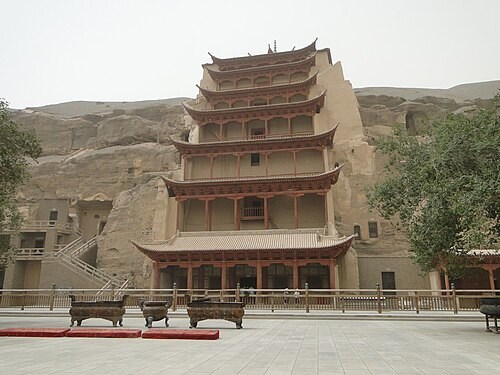
The scroll survived at Mogao, near Dunhuang, a place connected with routes around the Taklamakan Desert. The decorated cave temples were a long-lived Buddhist landscape, not simply a storage depot awaiting modern discovery. The IDP overview of Dunhuang Mogao locates the manuscript finds within that broader religious setting.
Cave 17, now called the Library Cave, held manuscripts, prints, paintings and textiles. Its contents preserve several languages and many kinds of activity, including religious and administrative writing. The Diamond Sutra’s modern fame can obscure the scale and variety of the collection around it.
Why was the chamber sealed? The answer remains unsettled. The IDP’s discussion of the cave’s mysteries reviews explanations ranging from protection against a perceived threat to the closing of a space filled by accumulated deposits. Most scholars place the sealing in the early eleventh century. An invasion story makes a dramatic opening, but the available evidence does not justify presenting one particular emergency as established fact.
Discovery and dispersal
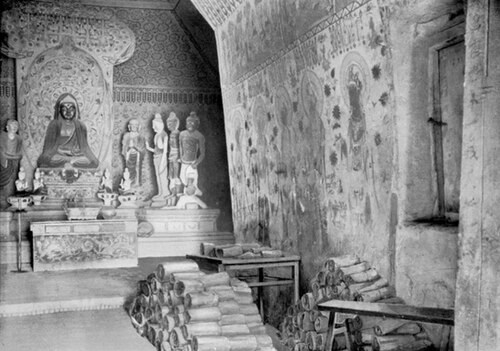
In 1900, Wang Yuanlu, a Daoist priest caring for the caves, found the sealed chamber. The distinction between him and Wang Jie is easy to lose: the first is associated with the modern discovery, the second with the ninth-century printed dedication. They lived more than a millennium apart.
Aurel Stein acquired large quantities of material from Wang Yuanlu in 1907, including the Diamond Sutra. Paul Pelliot visited in 1908 and acquired further manuscripts. The IDP account of the discovery describes the negotiations and the resulting distribution of the cave’s contents abroad.
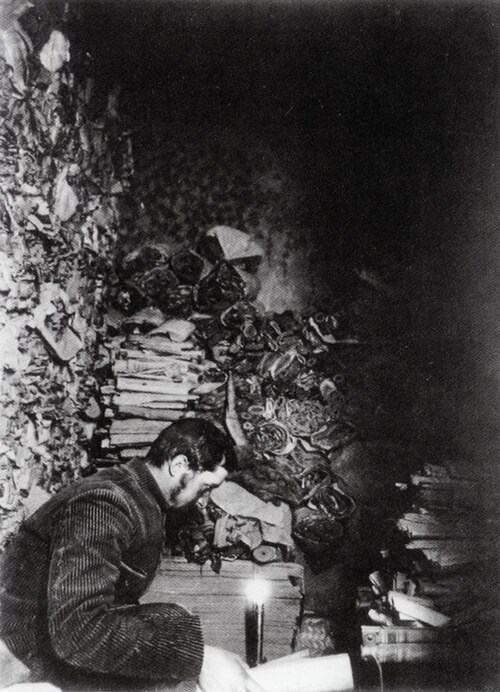
This is a history of dispersal as well as scholarship. Chinese officials and scholars were involved in efforts to understand and protect the material, while foreign expeditions transferred major collections into institutions elsewhere. A photograph of a European scholar among the manuscripts records one episode in that process. It should not replace the Chinese custodians, workers and scholars with a story of a place that became significant only when outsiders arrived.
What its date can still teach us
The scroll’s significance is larger than a record for being first. Its printing joins anonymous technical skill to a named act of patronage. Its survival connects a religious landscape with the protection, concealment and later dispersal of fragile materials. Its modern study depends on editors, conservators and the difficult work of bringing separated collections into conversation.
The dated dedication is the most compact evidence of all. It places one act of production on a calendar without supplying everything we might wish to know about it. Reading that evidence carefully preserves the achievement: in 868, a sophisticated printed scripture was made so that a teaching, and the merit associated with sharing it, could travel beyond a single owner.