
Ashoka’s Edicts and the Limits of Imperial Dhamma
Ashoka’s inscriptions joined remorse, welfare, and religious restraint to an imperial government that still claimed the power to punish.
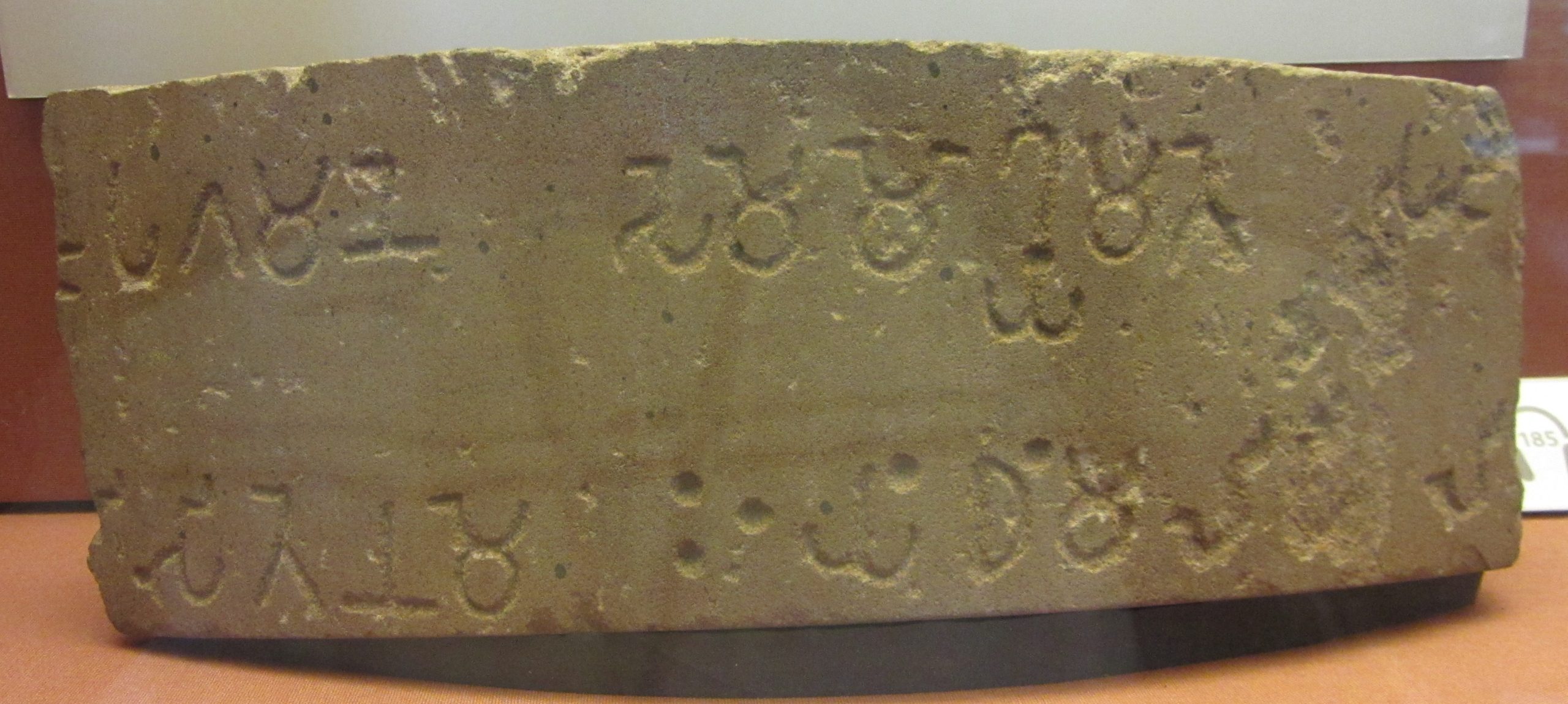
A curved fragment of polished sandstone in the British Museum preserves part of an emperor’s instructions. The pillar has broken; the writing remains. Its lines belong to the sixth Major Pillar Edict of Ashoka, the Mauryan ruler whose messages were cut into rocks and columns across much of South Asia in the third century BCE. The fragment’s museum record identifies a surviving piece of an unusually ambitious experiment: using royal authority to teach people how to live.
Ashoka’s inscriptions offer something rare in ancient history. A ruler discusses wrongdoing, regret, administrative failures, and the behavior he hopes to encourage. They also present difficulties. An imperial statement about compassion is evidence of what the government proclaimed. Measuring what changed in people’s lives is a different task.

The king in the inscription
The edicts often identify their speaker as Piyadasi, commonly translated as one who looks favorably, and Devanampiya, beloved of the gods. The corpus includes large public proclamations, messages to officials, and texts directed toward Buddhist communities. Treating all of them as a single speech obscures their different audiences and purposes.
Their material settings and intended audiences matter too. A message on a prominent rock, a polished pillar, and an instruction intended for recitation reached people differently. Readers were only part of the potential audience. Officials could speak the text aloud, allowing a written order to operate in a society where literacy was limited. Survival also favors stone: we cannot assume that every royal communication was inscribed, or that everything inscribed has survived.
Languages and scripts varied across the realm. Middle Indo-Aryan forms were written principally in Brahmi, with Kharoshthi used in the northwest. Greek and Aramaic inscriptions from Afghanistan demonstrate further adaptation. These are languages and writing systems with distinct histories; Brahmi should not be confused with a spoken language. Encyclopaedia Iranica’s survey of regional epigraphy places these inscriptions within their multilingual setting.
What Kalinga changed
Major Rock Edict XIII dates the conquest of Kalinga, on the eastern side of the subcontinent, to the eighth year after the king’s consecration. It reports 150,000 people deported, 100,000 killed, and still more deaths from other causes. Those figures come from the conquering ruler’s proclamation. They are not an independently audited casualty count.
The text’s emphasis is striking. It describes suffering that spreads beyond immediate victims, reaching relatives and friends who survive. Ashoka presents that suffering as a reason for remorse and advocates conquest through dhamma. The translation of Edict XIII in Oregon State University’s source collection makes this wider account of war’s damage clear.
Yet the inscription cannot supply a complete psychological biography. It tells us how Ashoka chose to explain his rule after the conquest. The familiar scene of a king walking through a battlefield and converting in a single moment is more precise than the evidence permits. Nor does remorse undo annexation: the king continued addressing people within an imperial order that the war had enlarged.
A moral vocabulary for a diverse empire
Dhamma, related to Sanskrit dharma, resists a neat one-word translation. In Ashoka’s public program it includes generosity, restraint, respect for parents and elders, consideration for servants, and care toward living beings. These obligations could be urged on people who belonged to different religious communities.
Patrick Olivelle interprets this as a distinctive royal moral project intended to give a heterogeneous population shared practices. Ashoka’s Buddhist commitments mattered, but his general proclamations did not require every subject to adopt a complete Buddhist doctrinal system. Olivelle’s discussion of Ashoka’s moral philosophy helps distinguish personal allegiance from the broader program.
Rock Edict XII places particular weight on speech about other traditions. Praising one’s own community while denigrating another could damage the very community one wished to honor. The instruction encouraged restraint and learning across religious boundaries. That was an active attempt to regulate relations among groups, rather than a modern declaration that religion should occupy a separate sphere from government.
Compassion became an official duty
The program required an administrative workforce. The edicts ordered officials to travel through their districts, teach dhamma, and attend to welfare. Special officers, the dhamma-mahamatras, received responsibilities extending across different communities. The king also represented himself as available to receive urgent reports, even during activities that might otherwise have interrupted official business.
The National Museum of India’s account of the Girnar edicts brings these measures together: inspection tours, moral instruction, attention to religious groups, and the ruler’s stated duty to respond. This was a language of service, but also a claim that royal supervision should reach deeply into social life.
Edicts describe medical provision for humans and animals and the planting of useful vegetation. Such statements reveal priorities and announced measures. They do not establish equal provision in every district. An inscription that says an institution exists cannot, by itself, tell us how frequently it functioned or whom it failed to reach.
The power to punish remained
The limits appear inside the moral language. Pillar Edict IV grants a three-day reprieve to prisoners sentenced to death, allowing appeals or religious preparation. It regulates capital punishment rather than abolishing it. Major Rock Edict XIII similarly reminds forest peoples that the remorseful king still possesses coercive power.
These passages complicate claims that Ashoka simply gave up force. He sought to change its exercise while retaining the authority to punish. In the separate Kalinga edicts, he warns judicial officers against anger, cruelty, and unjust imprisonment. The need to issue those warnings also reveals the problems his government faced. S. Dhammika’s translation of the edicts lets these measures be read beside the better-known expressions of compassion.
The prescriptions concerning animals were also specific. Restrictions addressed particular creatures, circumstances, and days. They should not be expanded into a claim that every form of animal killing throughout the empire ended at once. Legal detail preserves distinctions that a reputation for nonviolence can hide.
How a ruler became a legend
Later Buddhist narratives made Ashoka a powerful figure in stories about kingship, merit, cruelty, and religious transformation. The Sanskrit Ashokavadana took shape centuries after his lifetime; John S. Strong’s study and translation examines that legendary tradition in its own religious setting.
These accounts are valuable evidence for what later communities wanted a Buddhist king to mean. Their distance from the reign requires care when they are used to reconstruct events. Conversely, the inscriptions deserve scrutiny even though they are contemporary. A text issued under royal authority can preserve accurate administrative detail while arranging it to enhance the ruler’s reputation.
Ashoka repeatedly asked officials and descendants to continue his work. Instructions had to be carried into districts and interpreted beyond his immediate reach. Whether an impatient judge actually changed his behavior remains harder to recover.
Sources and further reading
- Fragment of Ashoka’s sixth Major Pillar Edict, 1880.21, British Museum.
- Epigraphy: Old Persian and Middle Iranian epigraphy, Encyclopaedia Iranica, including Ashokan languages and scripts in the northwest.
- The Edicts of Ashoka, Oregon State University open sourcebook, using N. A. Nikam and Richard McKeon’s translation.
- Patrick Olivelle, A Shining Star of Kingship, Yale University Press, 2024.
- Edict of Ashoka, cast of the Girnar inscriptions, National Museum, New Delhi.
- S. Dhammika, The Edicts of King Asoka, Buddhist Publication Society, 1993.
- John S. Strong, The Legend of King Asoka: A Study and Translation of the Asokavadana, Princeton University Press.
- Patrick Olivelle, Asoka’s Inscriptions as Text and Ideology, in Reimagining Asoka: Memory and History, Oxford University Press, 2012, pp. 157–183.
- J. G. de Casparis, Asoka: The Life and Teaching, Encyclopaedia Iranica, used here for the limits of animal-killing prohibitions.