
Santiago’s Pilgrims: How a Sacred Destination Made a Network
A shell, a manuscript and a cathedral reveal how devotion became a journey—and how the journey depended on buildings, patrons, goods and competing stories.
A scallop shell could travel farther than the person who first wore it. Fastened to a hat or pouch, it announced a connection to Santiago de Compostela; buried with its owner, it could become evidence for archaeologists centuries later. At Saint-Denis, excavators found three shells with a person buried in the late twelfth or early thirteenth century. A small object linked a grave in France to a distant shrine in Galicia.
The French Ministry of Culture’s account of this evidence explains that shells were sold outside Santiago’s cathedral and worn as signs of an accomplished pilgrimage. Their meaning depended on recognition. The shell was not simply decoration: it made a journey visible to people who had not witnessed it.
That is one way into the history of the Camino. The famous destination attracted travellers, but the practice also required a network of shared signs, places to stop, routes across difficult ground and stories worth repeating. The road did not come into existence merely because a tomb had been identified. People and institutions had to turn a sacred claim into a journey others could make.
A claim about a tomb, and the history of belief
The distinction between religious tradition and historical evidence is essential. James the Greater appears in the New Testament as an apostle; the identification of his remains in Galicia belongs to a much later history. The Museum of Pilgrimage and Santiago separates the apostle’s life, traditions of his preaching in Iberia and legends about the transport of his body. It also notes that accounts describing the discovery were written after the events they describe.
A tomb identified with James in the ninth century became the focus of a cult, patronage and pilgrimage. That development is historical whether or not the attribution of the remains can be demonstrated. The question “Why did people believe this place was sacred?” is not identical to “Can we independently identify the person buried here?” Confusing them either turns tradition into an archaeological certainty or makes the history of devotion disappear.
The journey needed somewhere to sleep
Medieval Christians travelled for different reasons: to fulfil vows, seek healing, perform penance or deepen devotion. Santiago was one destination within a much wider world of shrines, including Rome and Jerusalem. The Metropolitan Museum’s survey of medieval pilgrimage stresses both the range of participants and the effects on art and architecture. The common destination did not make every traveller’s circumstances the same.
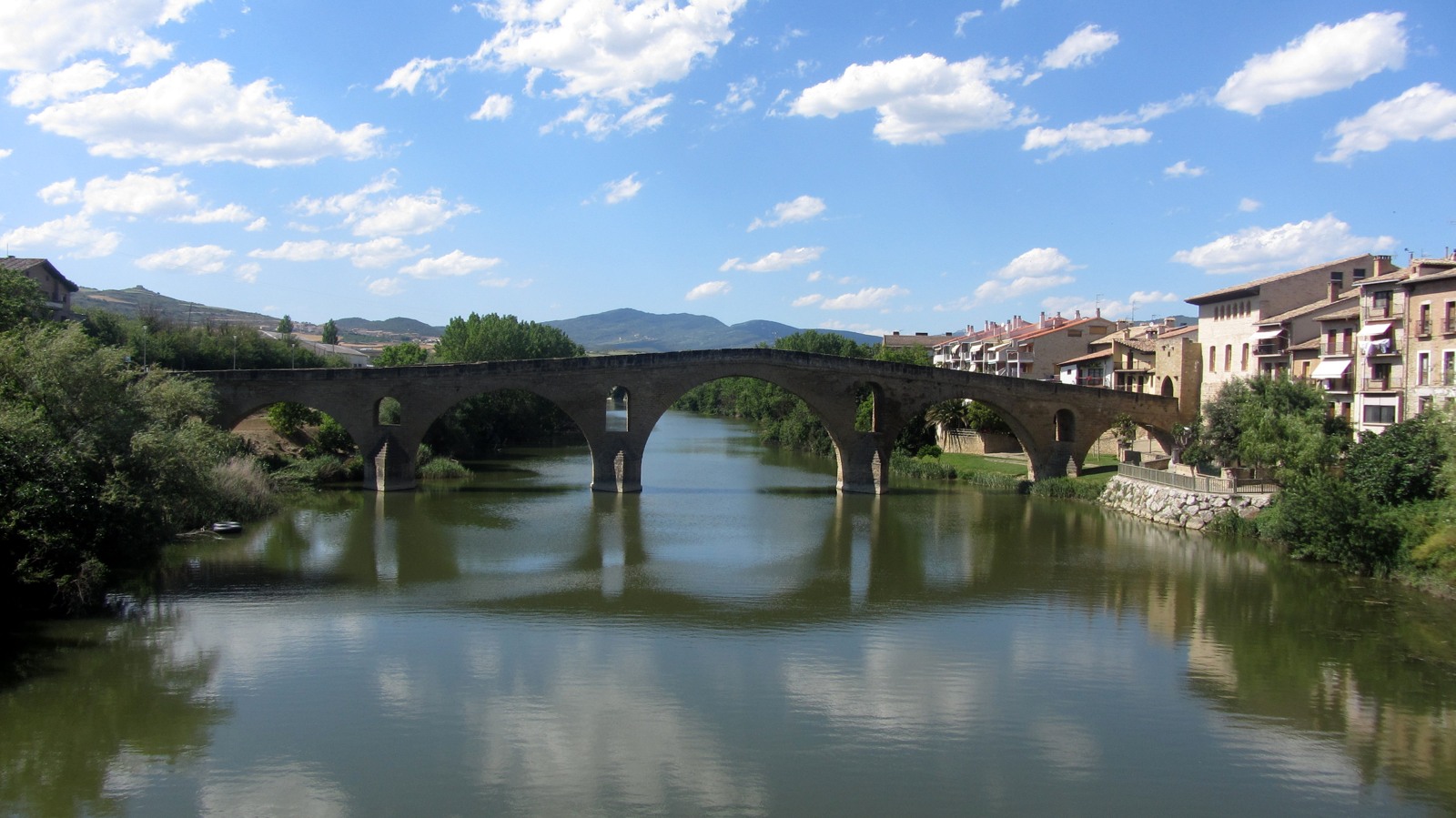
Nor was there just one road. UNESCO’s account of the Spanish routes describes an interconnected network and the changing importance of northern itineraries and the Camino Francés. Churches, monasteries, hospitals, hostels and bridges served movement across the landscape. Those buildings show how a spiritual undertaking created recurring practical needs.
A bridge is particularly revealing. It assists bodies, animals and goods without asking why they are travelling. A pilgrimage route could also function as a commercial and cultural corridor. Religious purpose and ordinary exchange were not separate systems laid side by side; the same settlement could provide worship, food, lodging and a market. The infrastructure made movement more practicable, while movement helped support the infrastructure.
The French side of the network was similarly varied. The World Heritage description of the routes in France recognises large sanctuaries alongside modest churches, hospitals and bridges. Its four symbolic routes should not be mistaken for the only tracks ever taken by medieval travellers. The selected monuments preserve examples of a much wider pattern of journeys.
There is a difference between a line drawn on a modern map and a route sustained over centuries. The latter depends on repeated maintenance, hospitality and local decisions. Seeing the Camino as a network helps explain why its history belongs as much to the communities along it as to the travellers who passed through them.
A book for the cult, not merely a travel guide
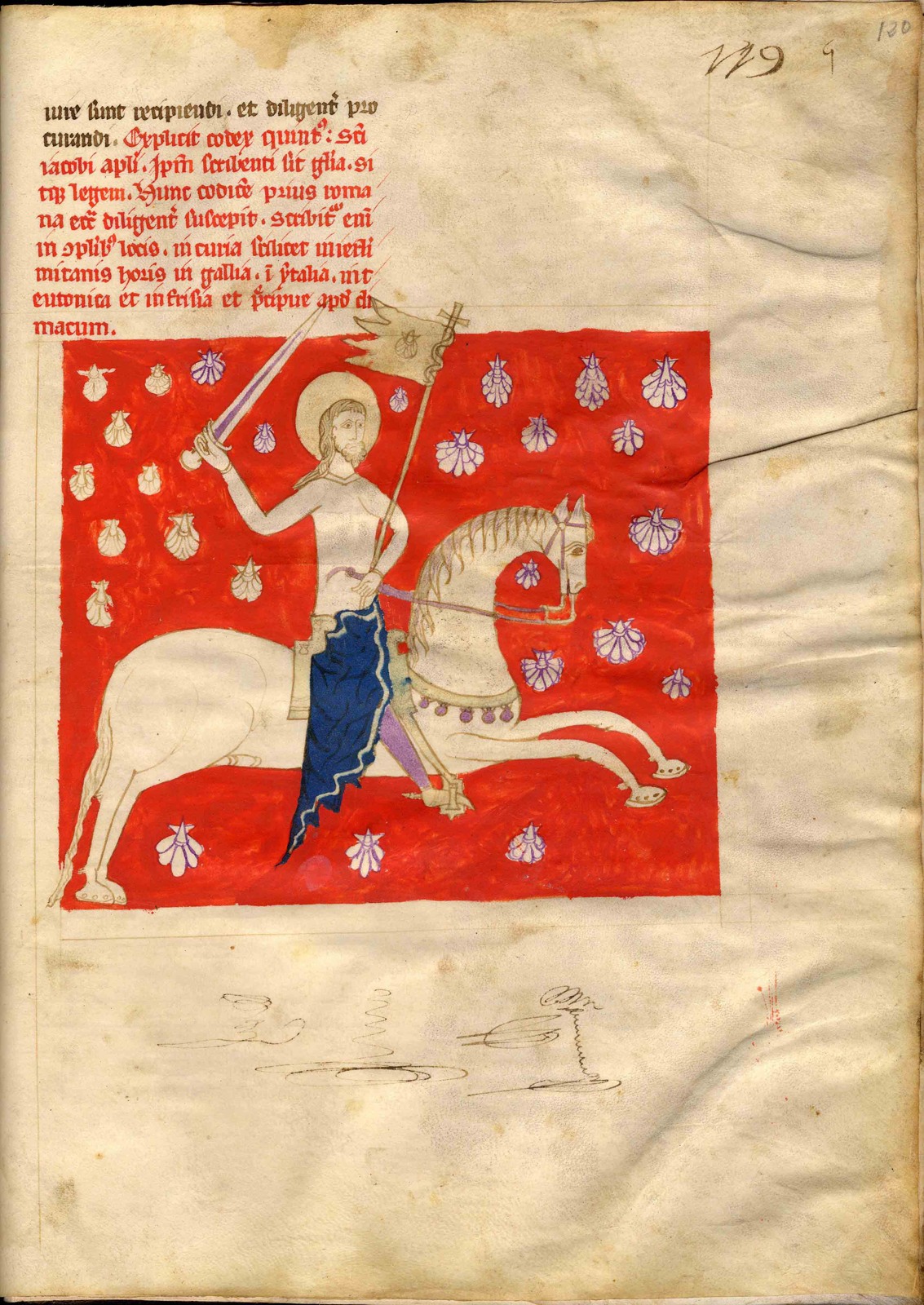
The twelfth-century Codex Calixtinus is often introduced through its guide to the road. That is only one part of the compilation. The Xunta de Galicia’s description sets out a five-book collection containing liturgical material, miracle stories, the account of the body’s translation, a literary narrative of Charlemagne and information about the journey. The manuscript assembled different kinds of authority around the apostle.
Book V supplied information on places, people, food, dangers and the cathedral. Yet a compilation that also preserved miracles and heroic narrative was doing more than giving directions. It located travel inside a sacred history and offered ways to interpret what the traveller encountered. Practical information and devotion strengthened one another.
These genres require different kinds of reading. A description of a building, a miracle narrative and a story about Charlemagne cannot all be treated as eyewitness reports of the same order. Their presence together tells us how the cult represented itself, not that every narrated event happened as described. A historian can take the manuscript seriously without treating it as a neutral camera.
The Spanish Ministry of Culture’s account of the Camino places this text among a longer tradition of pilgrimage narratives. Such writing helped make routes intelligible across distances. It also means that the road reaches us through selection: writers described what they considered important, memorable or useful. The surviving text is not the combined testimony of every poor traveller, host or craftsperson along the way.
A manuscript could therefore enlarge the shrine’s world beyond the city itself. Readers and listeners could encounter its claims before reaching Galicia—or without going there at all. The sacred destination circulated in stories as well as through actual movement.
The cathedral was an argument in stone
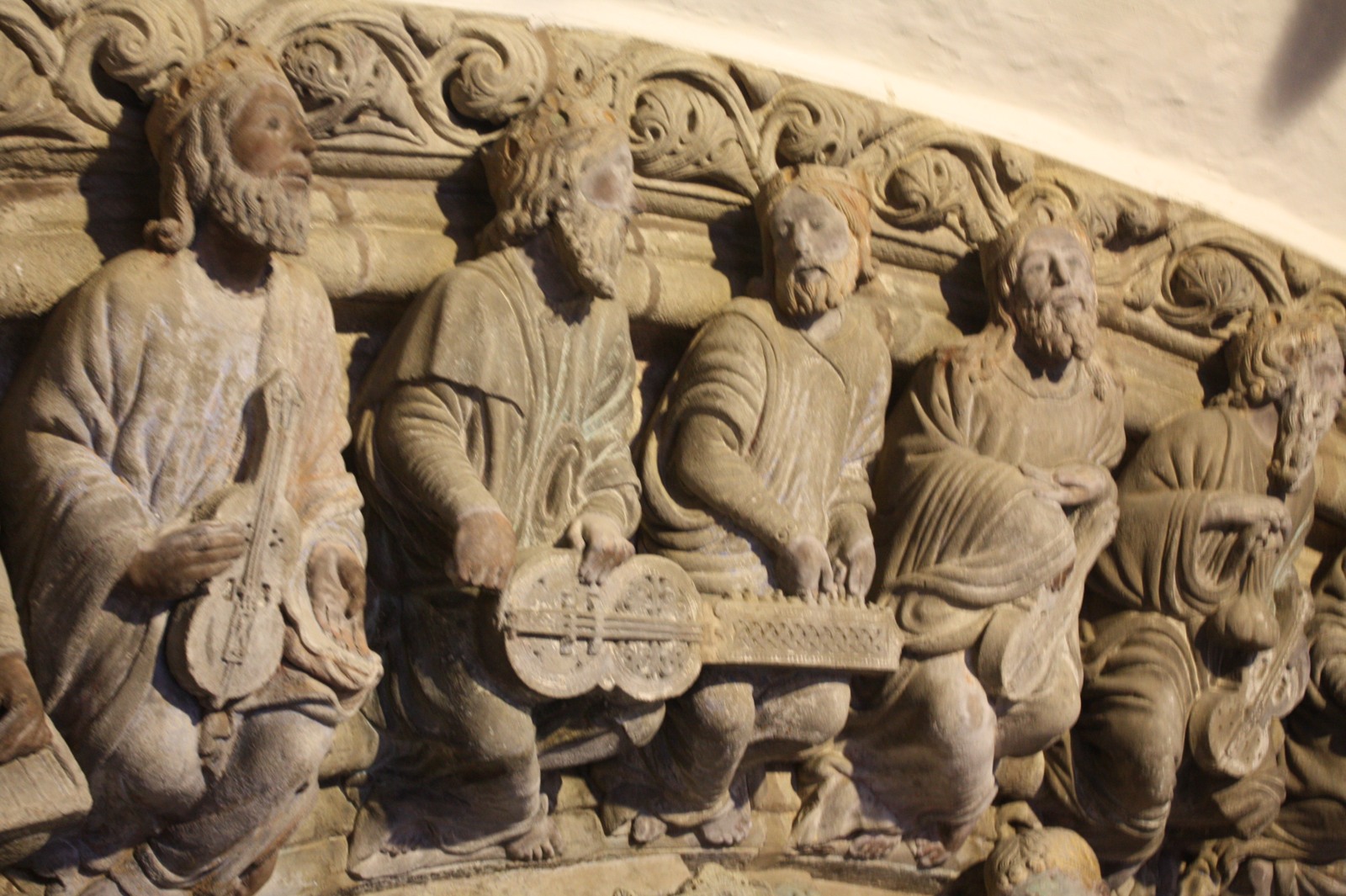
The cathedral’s own historical account dates the beginning of the Romanesque building to 1075 and its consecration to 1211. Construction passed through several phases rather than proceeding as one uninterrupted campaign. Master Mateo was commissioned in 1168 to complete major work at the western end; the famous lintel inscription dates the placing of the Portico of Glory’s lintels to 1 April 1188.
Those dates describe more than an architectural timetable. A major shrine required sustained resources, skilled labour and patrons whose interests did not cease at the church door. Its sculpture presented a religious order to visitors. The Portico’s biblical programme made the threshold a place of interpretation, not just an entrance through which a crowd passed.
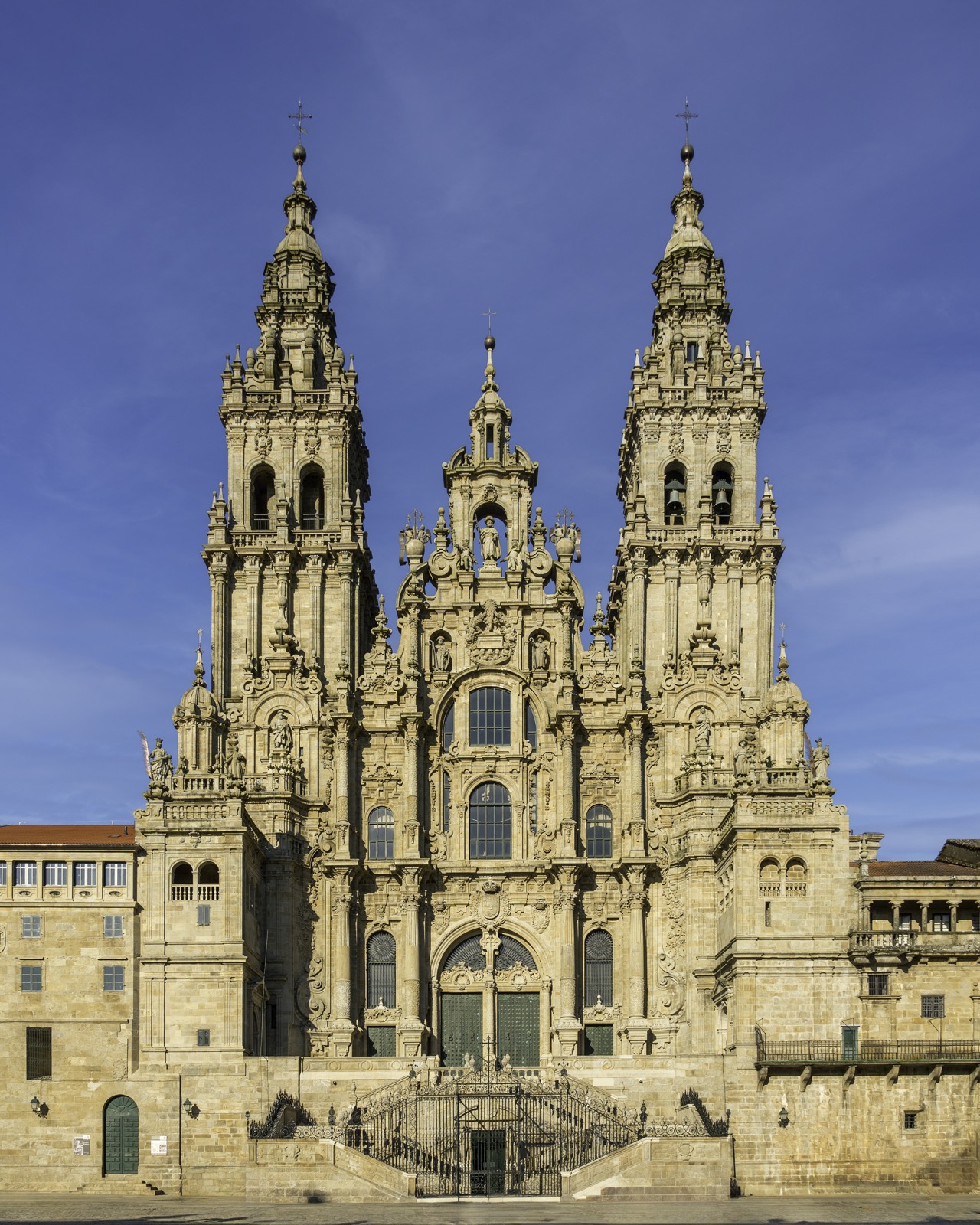
The present building should not be projected unchanged into a pilgrim’s medieval experience. Its celebrated western exterior is Baroque, while much of the underlying structure is medieval. UNESCO’s account of the Old Town emphasises the coexistence of Romanesque, Gothic and later architecture. Santiago is a layered city, not a single surviving moment.
This layering affects how photographs tell the story. An image of the modern façade can identify the destination, but it cannot show exactly what an arriving twelfth-century pilgrim saw. The same caution applies to reconstructed routes and restored interiors. Later care and rebuilding have preserved the shrine while also changing the forms through which it is encountered.
When the saint dressed as a traveller
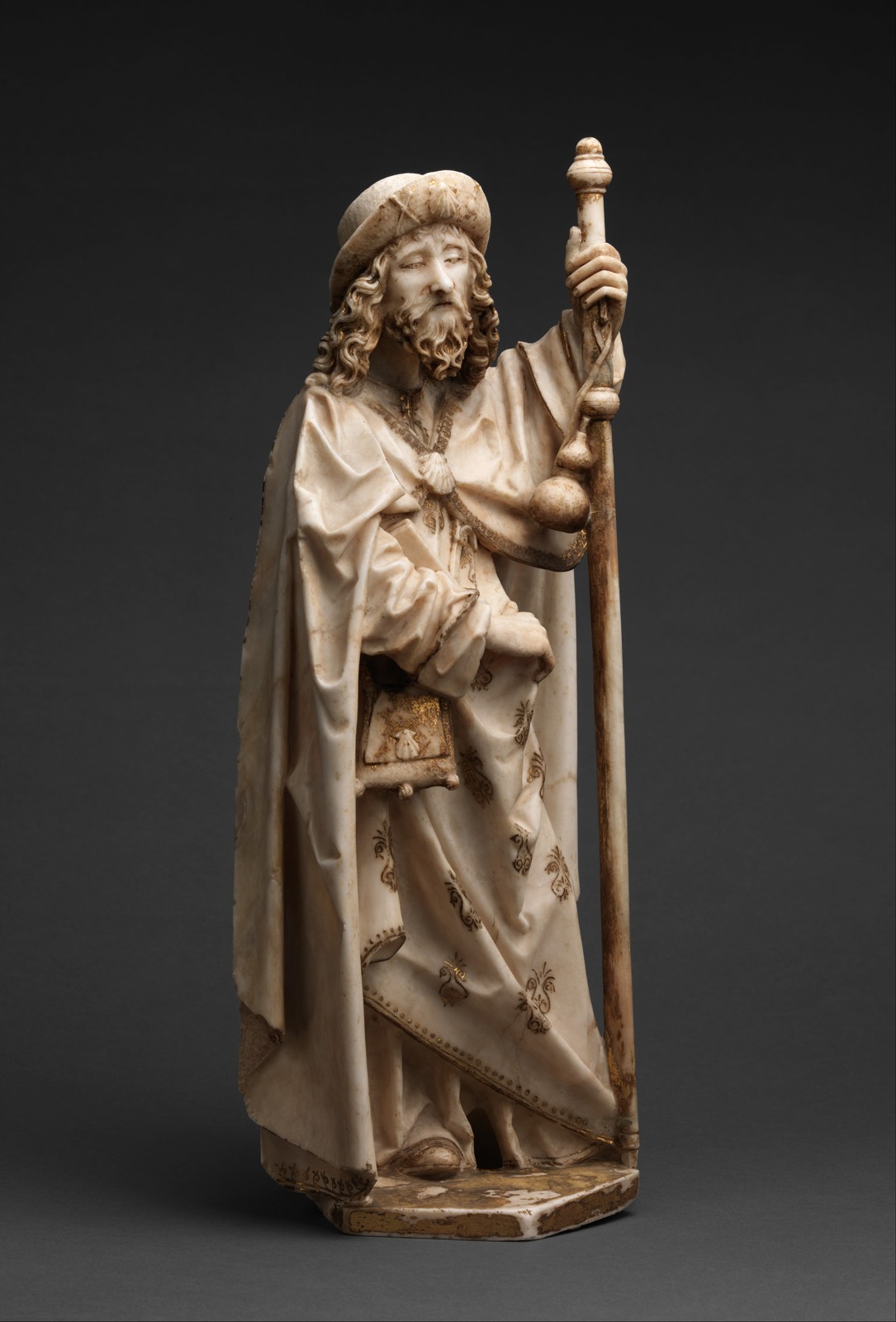
A late-fifteenth-century statuette by Gil de Siloé gives the relationship between shrine and traveller an especially vivid form. James wears a pilgrim’s hat and carries the equipment of a journey. Shells identify him with the destination to which other pilgrims travelled in his name. The apostle has become recognisable through the practice of his own cult.
The Metropolitan Museum’s record of the sculpture dates it to 1489–93 and identifies its original place on the royal tomb at Miraflores, outside Burgos. It was not a souvenir acquired by an ordinary walker. An image whose attributes evoked travel formed part of an elaborate monument commissioned for royal parents.
That setting joins devotion to dynasty. Smarthistory’s analysis of the work draws attention to the political significance of the commission for Isabel of Castile as well as its spiritual setting. Patronage of sacred art could commemorate the dead, express faith and articulate legitimate descent at the same time. Calling it political does not prove the devotion insincere; calling it devotional does not remove its political uses.
The contrast with a wearable shell is instructive. Both could invoke the same apostle, but they operated at very different scales of wealth and visibility. Medieval pilgrimage crossed social boundaries without abolishing them. Shared symbols made a religious world recognisable; the materials and settings in which people used those symbols still disclosed unequal resources.
Reading the network without flattening it
The surviving evidence does not give us one representative pilgrim. A shell from a grave, a liturgical compilation, a bridge and a royal sculpture each preserve a different relationship to Santiago. None can stand for every traveller. Their value lies partly in the contrasts between them.
Nor does the existence of a common Christian destination imply a continent without conflict. The histories promoted by the shrine could connect devotion to political struggles, while the roads themselves crossed jurisdictions and communities with their own interests. Exchange did not require everyone to understand the journey in the same way.
Santiago’s medieval importance is clearest when the destination and its supporting work remain in view together. The shrine supplied a focus, but the road was made usable by buildings, services and repeated journeys. Manuscripts explained and celebrated the cult; portable signs carried its recognition home. The small shell and the monumental cathedral belonged to the same system, though neither tells the whole story by itself.