
Trafalgar, 1805: What a Naval Victory Could—and Could Not—Decide
Nelson’s fleet broke its opponents’ line, but Collingwood still had to save ships and men in a gale. The battle’s consequences were immense without making it the single event that defeated Napoleon.
In the official account of Trafalgar published in London on 6 November 1805, a thanksgiving order contained a blank where the appointed day should have been. An accompanying note explained why: the fleet had been dispersed by a gale, and no day could yet be fixed. The victory was complete enough to celebrate, but the ships that had won it could not conveniently assemble to give thanks.
That small interruption in the London Gazette’s dispatches is a useful entrance into the battle. Trafalgar was not only the moment when Horatio Nelson’s two columns broke the Franco-Spanish line. It was also the battered fleet inherited by Cuthbert Collingwood, the prisoners and wounded aboard disabled vessels, and the urgent choice between preserving captured ships and preventing their recovery.
The distinction extends to strategy. The victory of 21 October secured a formidable British advantage at sea. It did not stop Napoleon’s army in central Europe, and it did not end the war. To understand what Trafalgar decided, we need to separate a spectacular tactical result from the different contests that continued around it.
The invasion army had already moved
Napoleon’s preparations to cross the Channel were substantial, not simply a theatrical threat. In his assessment of the invasion project, historian Thierry Lentz points to the assembled troops, transport craft and resources committed along the coast. The difficulty was not merely putting soldiers into boats. They required a protected passage through waters in which the Royal Navy could interfere.
By the time Trafalgar was fought, however, Napoleon and his army had left the Channel camps. The emperor was fighting the continental coalition, and his victories at Ulm and, later, Austerlitz followed a logic that a naval battle could not simply reverse. Trafalgar therefore did not intercept an invasion flotilla already crossing towards Britain. Its significance was to make a renewed maritime challenge much harder, not to perform an immediate rescue that the chronology does not support.
The combined fleet under Pierre-Charles Villeneuve sailed from Cadiz on 19 October. Royal Museums Greenwich places its orders in the Mediterranean campaign: the fleet was to move towards Naples and support operations connected with the wider war. Nelson’s task was to bring that force to battle, rather than allow it to remain an uncertain threat moving between theatres.
Collingwood’s report records the practical importance of information. Watching ships reported the departure; Captain Henry Blackwood supplied further intelligence about whether the enemy had passed the Strait of Gibraltar. The famous battle depended on a less spectacular sequence of observation, communication and interception. A fleet could possess powerful guns and still fail if it could not find the ships it needed to engage.
A plan designed for imperfect control
Nelson’s memorandum of 9 October began with a problem of time. Bringing a large sailing fleet into a conventional battle line, amid variable wind and weather, might allow the opportunity for a decisive engagement to disappear. His intended answer was to make the sailing formation itself the basis of the attack.
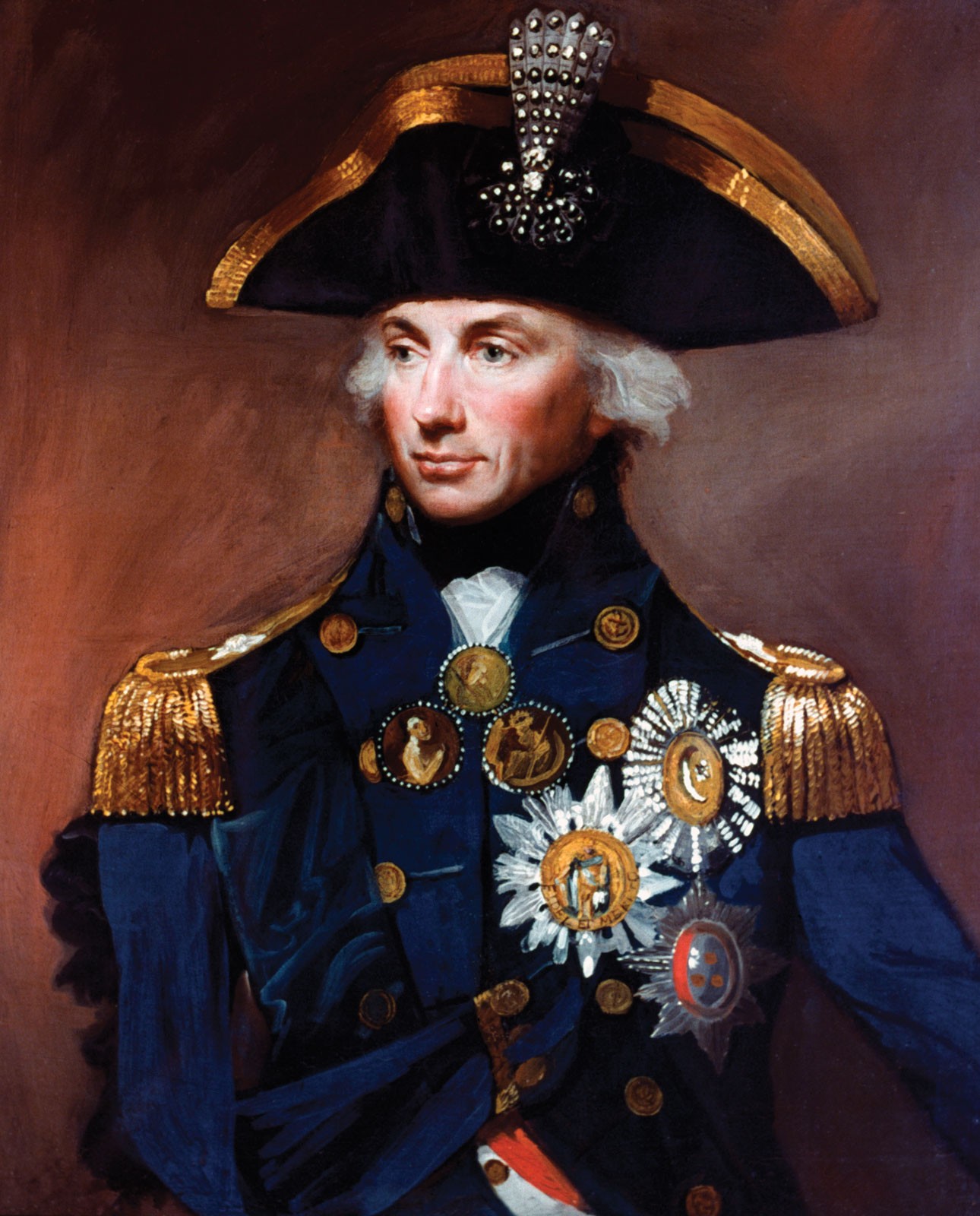
The document discussed a larger hypothetical force than the twenty-seven British ships of the line actually present at Trafalgar. It was not a photograph of the future battle in written form. It described relationships: concentrate against part of the enemy, prevent the unengaged ships from helping quickly, and give subordinate commanders enough understanding to act when signals failed.
Two columns were a means, not the whole explanation
The memorandum gave the second-in-command responsibility for directing his own line once Nelson’s intention was understood. Captains were to regard their division as a rallying point. If signals became invisible or ambiguous, close engagement with an enemy vessel remained the guiding principle. The purpose was not disorder for its own sake; it was to make action possible when central control inevitably weakened.
Nelson explicitly allowed for chance and damage to masts and yards. His confidence did not rest on a belief that the enemy would politely maintain a diagram. It rested on concentrating force quickly enough that the rest of the opposing fleet would take too long to intervene. This is why the two arrows familiar from classroom maps explain only part of his approach.
On 21 October, Nelson led one column in Victory and Collingwood the other in Royal Sovereign. Their opponents numbered thirty-three ships of the line, eighteen French and fifteen Spanish according to Collingwood’s dispatch. The national contingents were intermixed rather than forming two wholly separate fleets. British success required breaking a combined formation, not defeating one nationality and then turning to the other.
The approach was dangerous. The National Museum of the Royal Navy’s account emphasises the light wind and slow advance, which exposed the leading ships to fire before they could fully use their own broadsides. After reaching the line, they could bring heavy fire to bear at close range. Nelson was fatally wounded during the action and died later that afternoon; victory did not protect the fleet’s commander from the risks his method imposed.
Collingwood described relatively few signals during the approach because the plan had already been communicated. His account praises the gallantry of the opposing ships even while declaring the attack irresistible. It is a victory dispatch, written to the Admiralty, but it does not support the notion that the French and Spanish simply declined to fight.
What the defeated commanders could see
Villeneuve’s report from captivity described a collapsing ability to command from Bucentaure. Masts fell, guns were obstructed or disabled, and the boat he hoped to use to transfer his flag proved unusable. His account defended the courage of his men and explained defeat through damaged ships and British handling. It was also a commander’s justification to his superiors, not an impartial overview of the entire battlefield.
Captain Lucas’s report on Redoutable offers a much closer view. It describes efforts to board Victory, the intervention of Temeraire, and damage that left his own ship unable to continue. This too is an interested account, intent on showing that surrender followed resistance rather than lack of courage. Read beside Collingwood, it changes the texture of the encounter: a successful British manoeuvre became a series of violent local struggles, not one smooth movement through a passive line.
Collingwood’s second battle
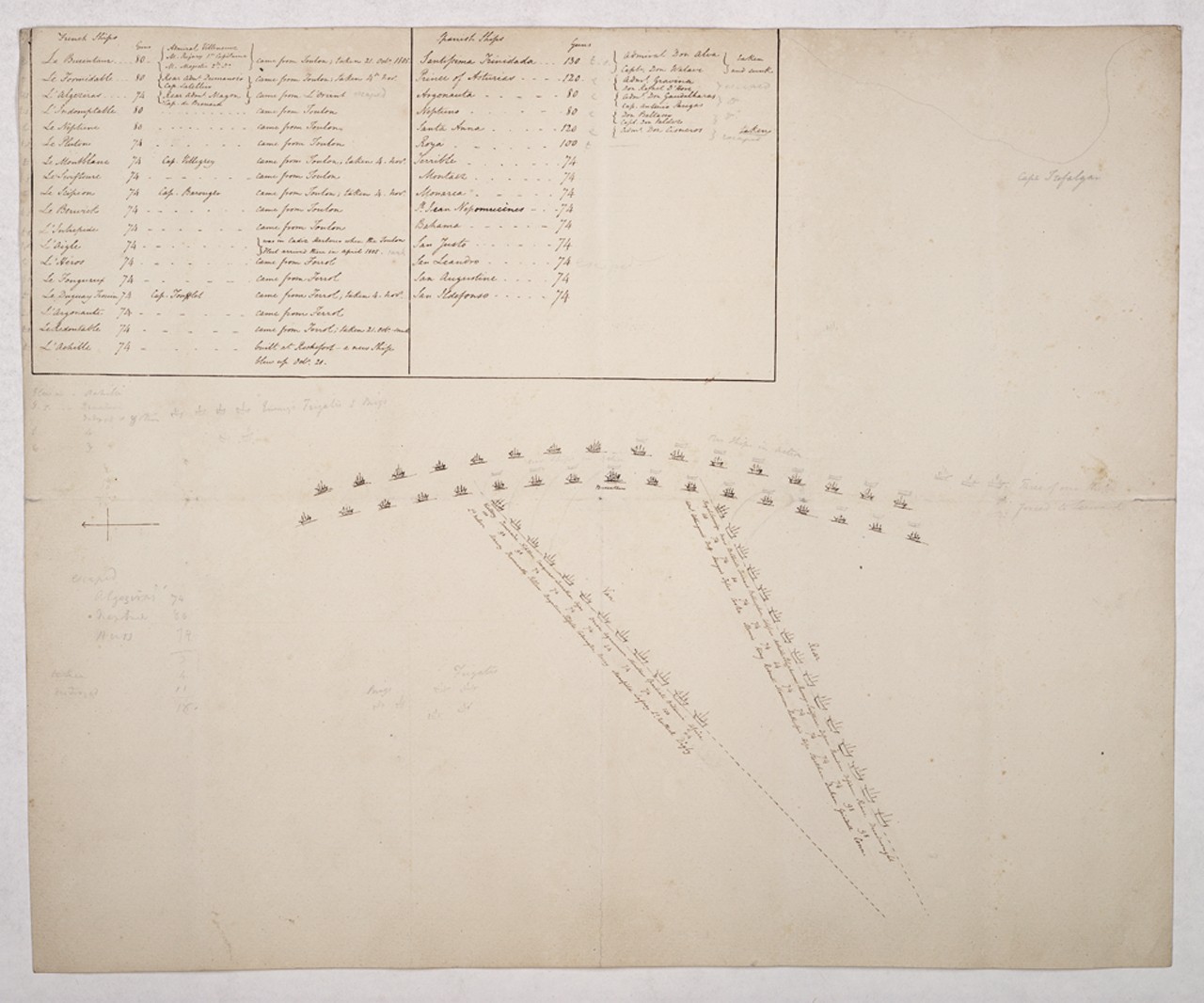
Nelson’s death made Collingwood commander of the victorious force. His own flagship was severely damaged. In the dispatch of 22 October, he explained that Royal Sovereign had lost its masts apart from a precarious foremast. The frigate Euryalus became essential to his ability to move and direct operations.
The same dispatch admitted that he could not yet assemble complete casualty returns because of the weather. This is worth retaining when reading its confident language of triumph. Information arrived unevenly. A commander could know that the enemy’s line had been defeated without knowing the final number of dead, the ultimate fate of every prize, or how many damaged ships could be brought into port.
His letter of 24 October is dominated by those practical uncertainties. British ships had taken prizes in tow, but the worsening gale broke towropes and scattered vessels. Surviving enemy ships appeared from Cadiz, forcing Collingwood to gather a defensive force from ships that were themselves damaged. Battle, rescue and the threat of renewed attack overlapped.
He therefore ordered the destruction of vulnerable prizes that could be cleared of their people. Retaining a captured hull mattered less, in his account, than denying its return to the enemy. Even carrying out that order was difficult in a high sea. His report records the sinking of Santísima Trinidad after evacuation and the loss of Redoutable while under tow.
The dispatch also contains expectations and suppositions. These should not be silently promoted into verified final outcomes for every ship. Collingwood was reporting from within an unfolding emergency. His uncertainty is evidence of the conditions under which decisions were made, not an inconvenience to remove from a tidy narrative.
This aftermath explains why “captured” and “safely delivered as a prize” are not interchangeable categories. A ship could strike its colours and later sink, be destroyed, or escape possession. Counting flags lowered at the end of combat does not by itself measure the material fleet that survived the following days.
The victory that did not finish the war
At the level of the engagement, Trafalgar was decisive: the combined fleet suffered a defeat from which it could not simply resume its former operation. At the level of the war, the result was more complicated. Napoleon still possessed powerful armies, and continental states still had to confront them. Britain’s naval position did not automatically translate into the defeat of those armies.
The contrast between Trafalgar and Austerlitz is therefore not a contradiction. Sea power could obstruct movement, protect access and narrow an enemy’s options while leaving a land campaign to be decided elsewhere. Napoleon’s continental successes did not make the loss of ships irrelevant; British naval victory did not make his continental successes disappear.
The operational documents show this division especially clearly. Nelson’s memorandum aims to capture or destroy an enemy fleet. Collingwood’s reports explain how that aim was pursued and what remained possible in the storm. Neither document is a treaty, a continental campaign plan or a guarantee that no future naval threat could emerge. Later claims of a century of automatic security compress continued naval labour into one memorable afternoon.
How the battle became an image
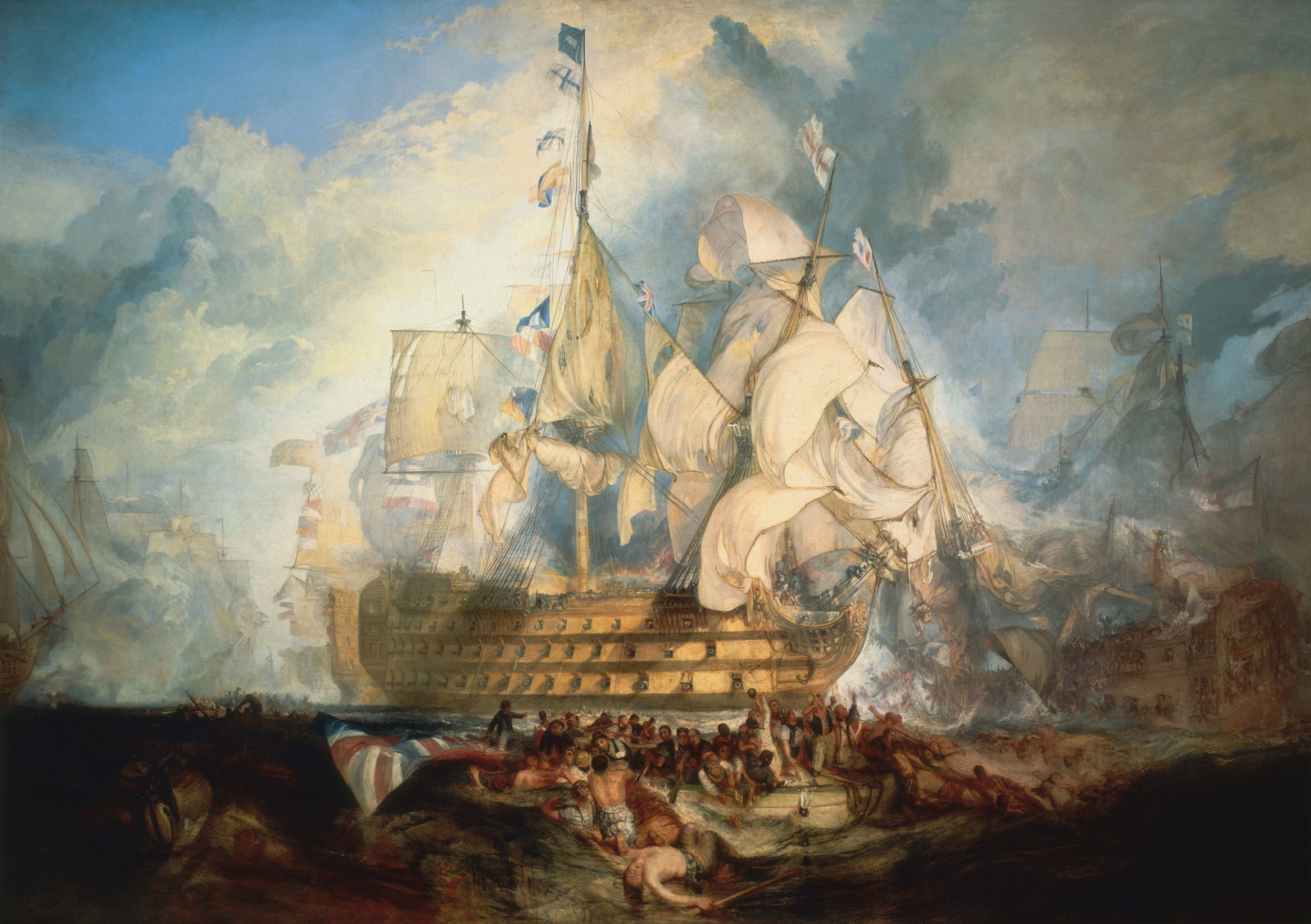
The event acquired another coherence in paintings and public memory. J. M. W. Turner’s large Battle of Trafalgar, commissioned in the 1820s, places Victory at the centre of a crowded scene. It is not an eyewitness snapshot. As Royal Museums Greenwich curator Katherine Gazzard explains, Turner combined different phases of the action, prompting criticism from viewers who expected greater literal accuracy. The painting’s ambition was to bring victory, Nelson’s death and the danger faced by ordinary sailors into one composition.
That distinction makes the picture more useful, not less. It documents how the battle was commemorated after the fact. It should not determine the exact position of every ship at a particular minute. A contemporary dispatch, a tactical memorandum and a later history painting each answer different questions.
Beyond the last broadside
In 1905, naval historian Julian Corbett published Nelson’s instructions alongside extensive commentary in Fighting Instructions, 1530–1816. He warned against treating the successful memorandum as a sacred formula whose imitation could replace thought. This was a centenary interpretation, written in a different naval age, not Nelson’s own explanation. Yet it identified a problem already visible in the document: a plan designed to accommodate uncertainty could be remembered as a mechanically reproducible diagram.
Trafalgar’s achievement was more demanding than that diagram suggests. Ships had to locate the enemy, approach under fire, cooperate after the formation broke up, and remain effective after the commander’s death. The end of the fighting then required different decisions about towing, rescue, prisoners and the destruction of prizes. Collingwood’s work belongs inside the victory, not in a footnote after it.
The blank date in his thanksgiving order preserves that unfinished business. London could receive the news as a great national event. Off the Spanish coast, the men who had made it possible were still trying to keep damaged ships afloat. Trafalgar had changed the balance at sea; it had not made either the sea or the rest of the war obedient.