The Voynich Manuscript: What We Can Know Without Reading a Word
Parchment, handwriting and even the order of folded sheets offer ways into the Voynich manuscript. They also show why a promising discovery is different from a successful decipherment.
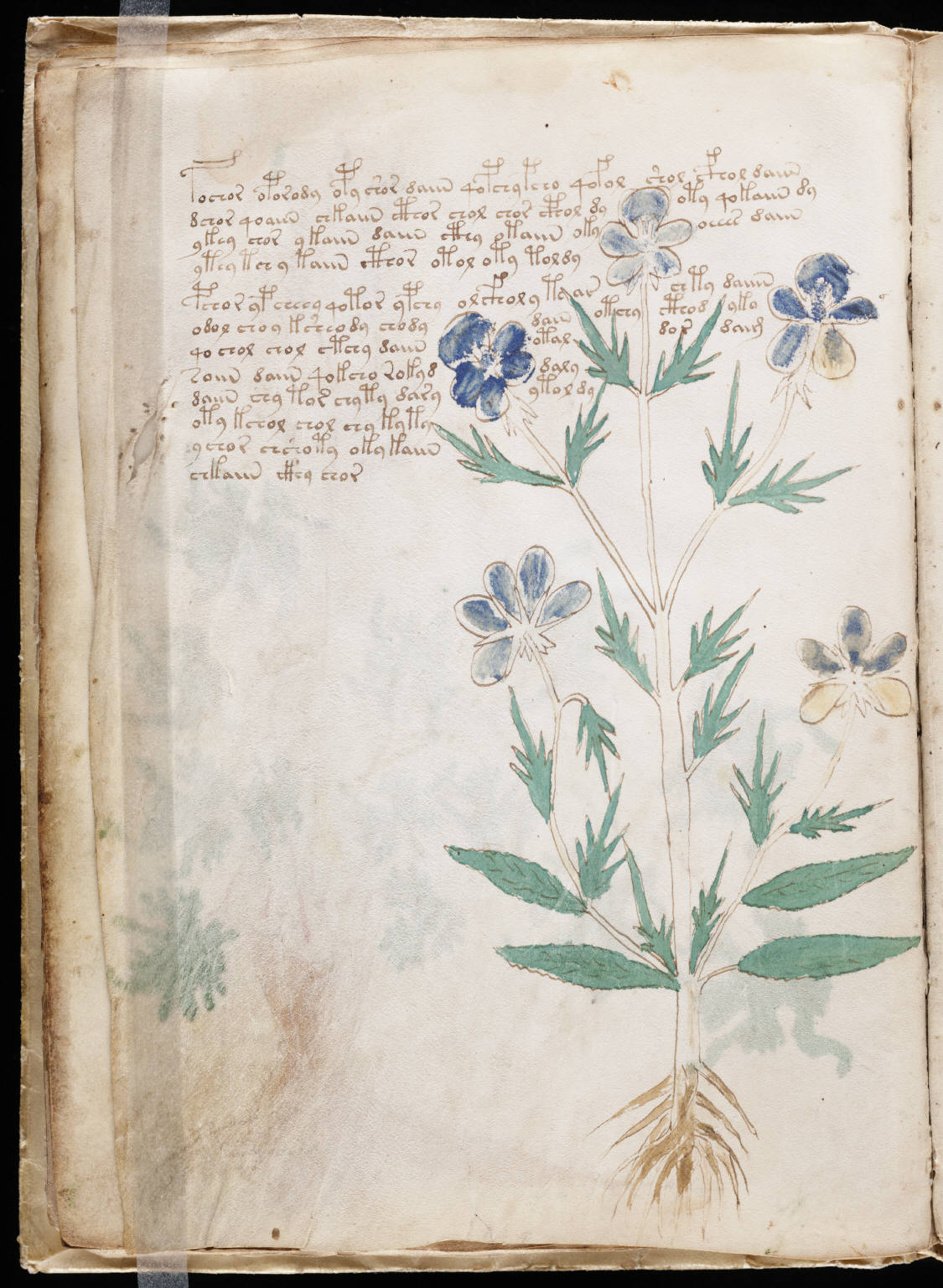
A blue-flowered plant fills much of a parchment page. Its roots spread below the stem, while neat lines of brown writing occupy the space above and alongside it. The visual grammar is inviting: here is a plant, and here, apparently, is something written about it. Yet the apparent familiarity ends where reading should begin.
The Voynich manuscript, held at Yale’s Beinecke Library as MS 408, remains undeciphered. Its unknown script has generated more proposed solutions than agreed readings. Looking for the one brilliant key can obscure a quieter development: researchers have learned a substantial amount about the book without translating a sentence.
The productive questions concern materials, hands and structure. What was written on? How many people appear to have copied it? Were the pages arranged as their makers intended? Answers to those questions constrain interpretation. They also help separate a genuinely useful advance from another announcement that the mystery has been solved.
A book with a history before its modern name
“Voynich” names an owner, not an identified author. The bookseller Wilfrid Voynich acquired the volume from the Jesuits in 1912. It eventually passed through the hands of his widow Ethel, Anne Nill and the dealer H. P. Kraus, who gave it to Yale in 1969. The Beinecke’s account records this modern chain of custody while distinguishing it from uncertain stories about the manuscript’s creation.
Earlier evidence connects the volume with seventeenth-century Prague and the scholar Athanasius Kircher in Rome. A letter sent with the manuscript by Johannes Marcus Marci reports an association with Emperor Rudolf II and an attribution to Roger Bacon. Reporting what an earlier owner believed is different from verifying that belief. The manuscript’s reputation and its authorship have separate histories.
This distinction matters whenever a famous name becomes an explanation. A collector’s attribution may tell us why an object seemed valuable, why it changed hands, or why someone tried to read it. It does not make the proposed author present at the writing desk.
Dating the support, not a hidden message
The radiocarbon range commonly given for the parchment is 1404–1438. Claire Bowern and Luke Lindemann’s linguistic review treats that physical dating as a starting constraint, not as a translation or the identification of an author. Parchment supplies a material chronology; the relationship between the prepared skin and the moment of writing still has to be considered.
Yale’s account of conservation and scientific examination describes complementary tests of ink, pigments and construction. Researchers found materials consistent with fifteenth-century manuscript production, without evidence of modern inks or pigments. Amino-acid analysis identified calfskin. These results make a modern fabrication a much less satisfactory account of the object than its real medieval material setting.
They leave other questions open. An old book can contain truthful information, fiction, deliberate obscurity or text that no modern reader understands. Authenticity of materials and intelligibility of language are different tests. Chemistry cannot decide between competing translations simply because one sounds more plausible.
Pictures classify the pages, but do not translate them
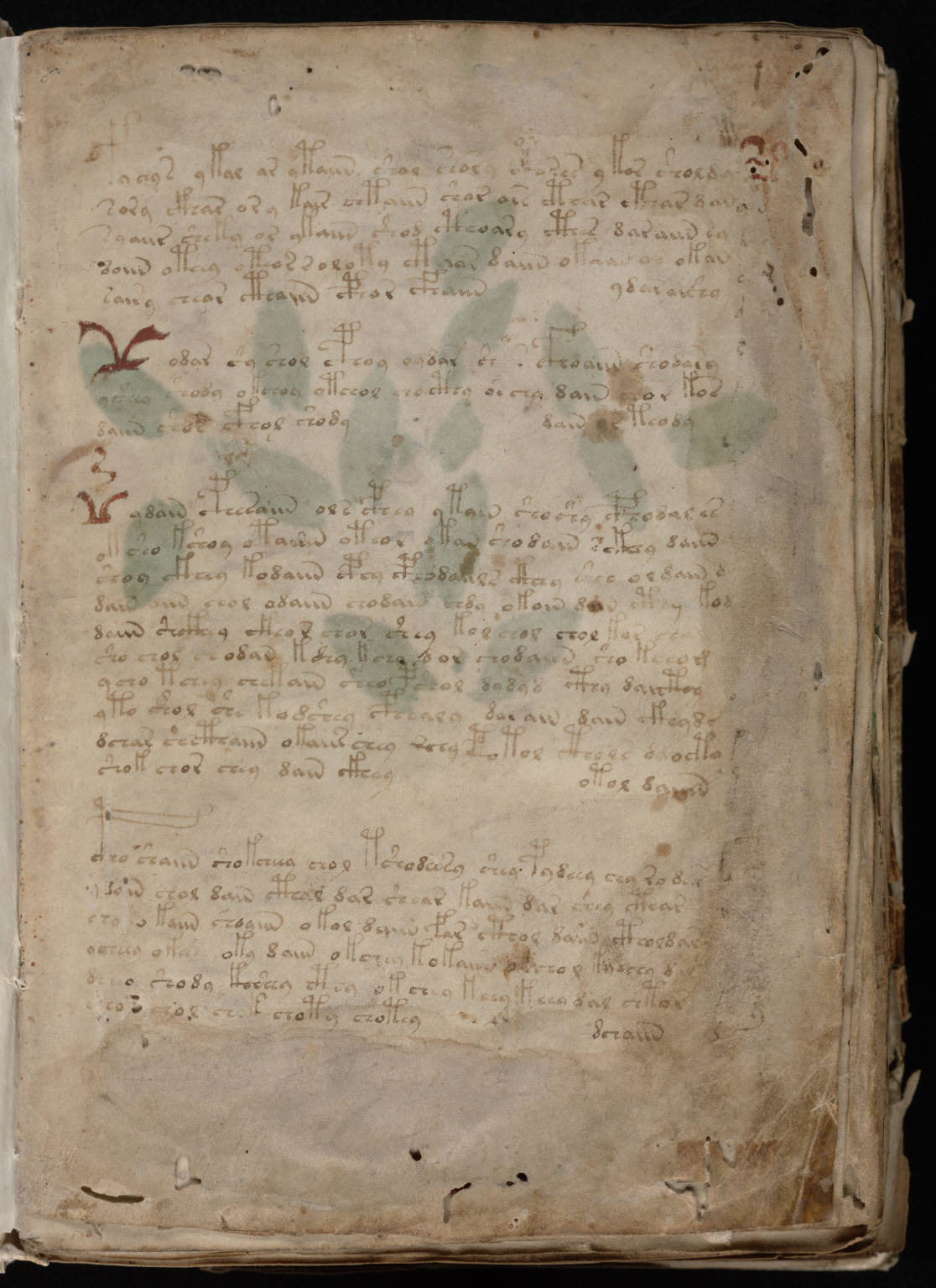
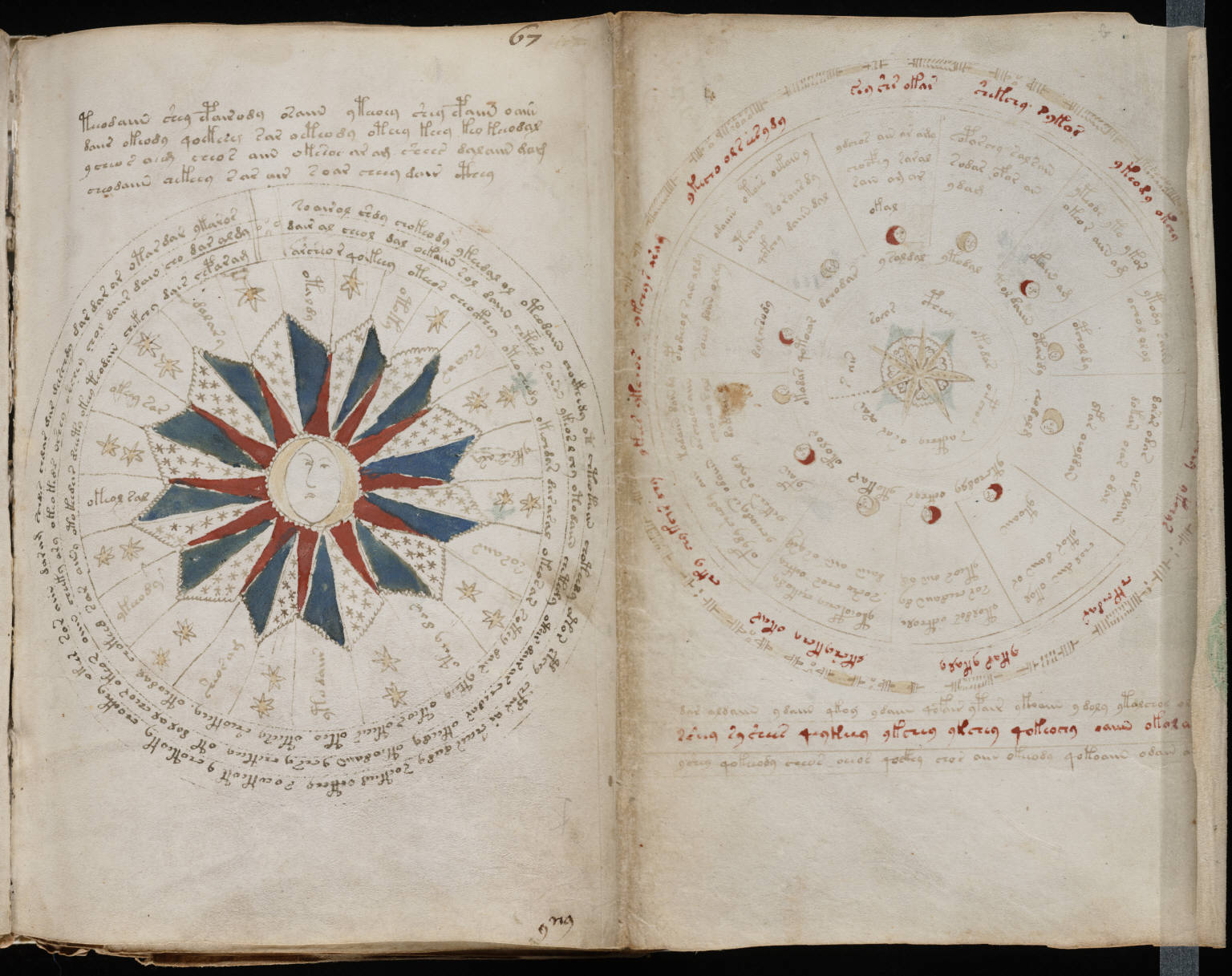
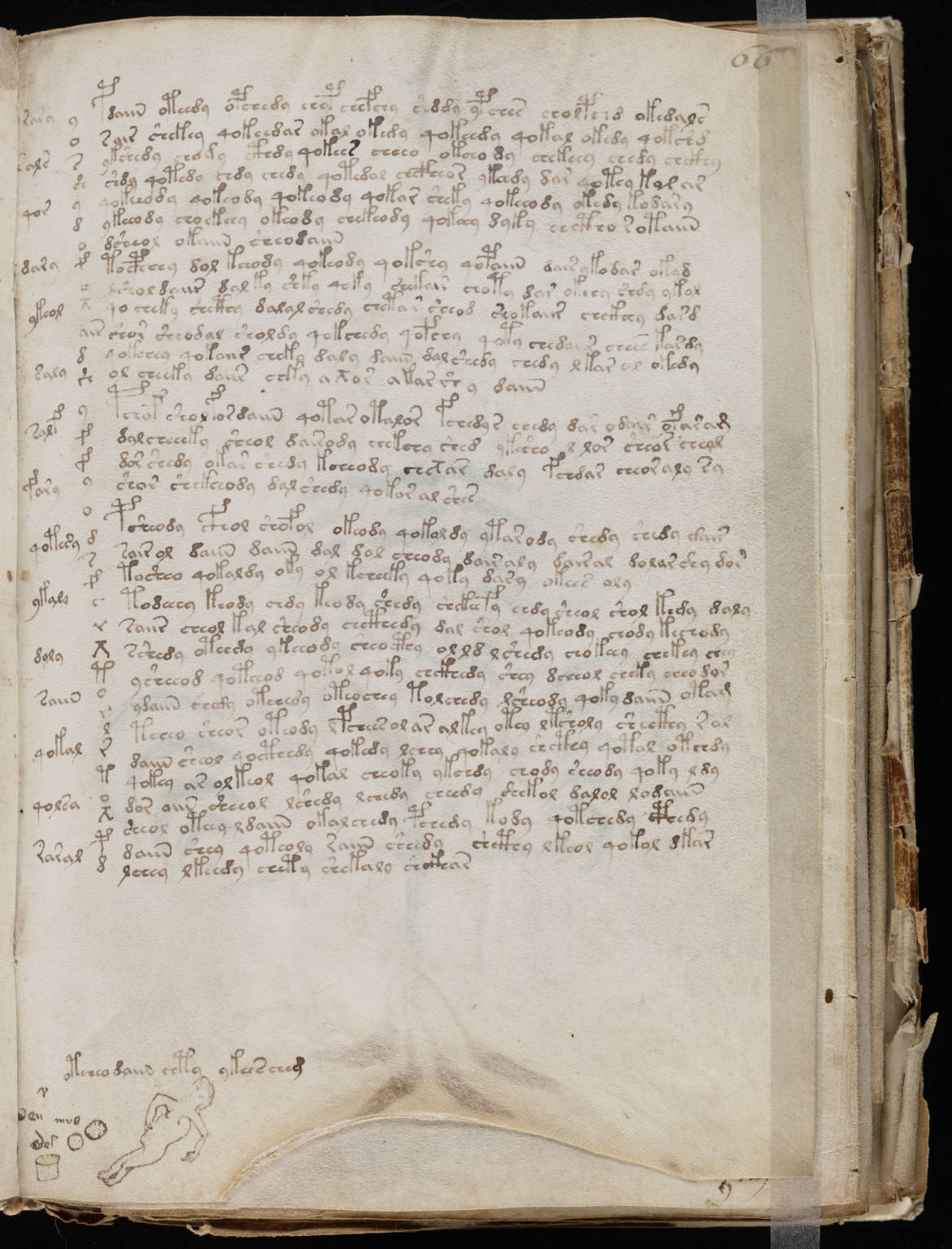
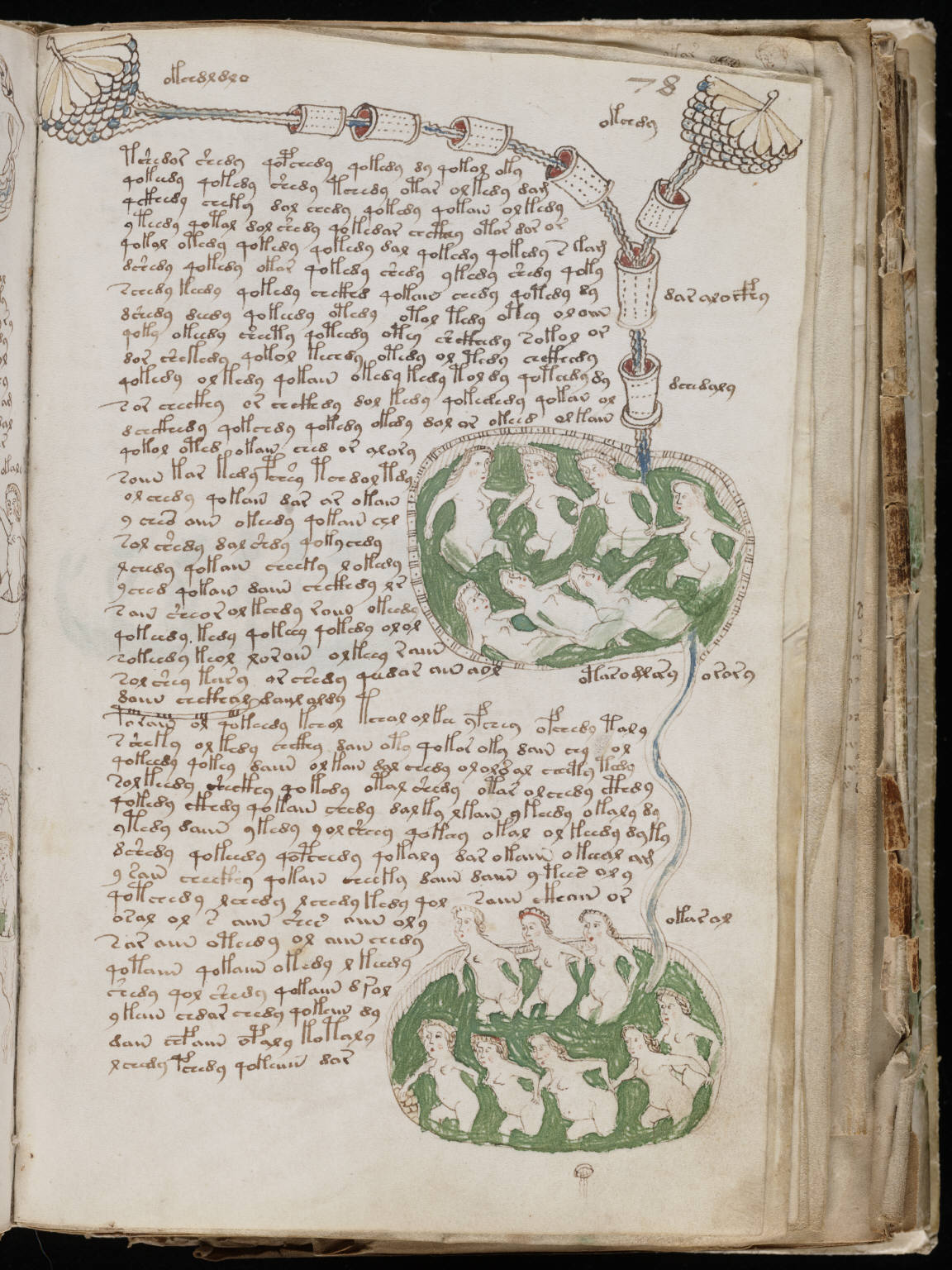
The Beinecke’s physical catalogue describes plant drawings, circular astronomical or astrological diagrams, figures in bathing-like settings, an elaborate foldout, containers and roots, and pages of continuous text marked by small stars. Those visible differences make the volume navigable even while its writing resists reading.
Such descriptions are working labels. Calling a section “pharmaceutical” is a way to identify pages with containers and plant parts. It does not establish that every adjoining passage is a prescription, that a particular plant treats a particular illness, or that the figures depict an actual therapy. In the same way, a circle containing stars can be catalogued before its intended calculation or cosmology has been reconstructed.
A useful discipline is to separate observation from identification. “A green pool connects with a channel” describes marks that another viewer can inspect. “This is a diagram of a particular organ” adds a theory. The theory might eventually prove fruitful, but it must account for the rest of the image and survive comparison with contemporary material.
Visual resemblance becomes especially precarious when it is used twice: first to name an ambiguous plant, then to assign sounds to its nearby symbols, and finally to claim those sounds prove the plant’s identity. That is a circle of mutually supporting guesses. Independent evidence must enter somewhere.
Even counting needs a definition
The catalogue records missing leaves and unusually complicated foldouts. A folio is a leaf with two sides; a photograph, a numbered page and an unfolded panel need not be equivalent units. This helps explain why casual descriptions give different totals for the manuscript.
The practical lesson reaches beyond this book. Before comparing two statistics, ask what each counts. A claim about the number of words likewise depends on transcription choices and boundaries. Precision begins with the unit, not with adding more digits.
Five hands, still unnamed
Paleography examines writing as a learned physical action. In her study presented at the 2022 Voynich conference, Lisa Fagin Davis compared the formation of recurring glyphs: crossbars, loops, final flourishes, spacing and angle. Rather than infer different writers from a single odd letter, she checked the proposed groups against several repeated forms.
Her analysis distinguishes five scribal hands. That conclusion changes the questions one can ask about production. It directs attention to collaboration and the allocation of work across the manuscript. The labels Scribe 1 through Scribe 5 do not disclose names, occupations, sex, nationality or personal beliefs.
A copied text also need not originate with its copyist. Even if the five-hand analysis is accepted, it does not follow that five people invented the content, or that all understood it in the same way. The most defensible gain is narrower: differences in the writing can be mapped and compared with the book’s physical organization.
A pattern can be meaningful before its meaning is known
Computational analysis offers another route. Marcelo Montemurro and Damián Zanette’s 2013 information-theoretic study examined the distribution and co-occurrence of word-like groups across the manuscript. They found structured relationships compatible with meaningful language and argued that these supported the presence of a message.
A 2021 preprint by Rachel Sterneck, Annie Polish and Claire Bowern used topic-modeling methods to group pages. The resulting clusters corresponded closely to combinations of illustration type and scribal hand. Here, too, the result is a relationship among features, rather than a dictionary mapping Voynich symbols to known words.
Imagine sorting an unfamiliar library by repeated patterns on its pages. Successful sorting could distinguish subjects or makers while leaving every title unread. That analogy captures both the value and the limit of clustering. Statistical regularity supplies a constraint on an explanation. It does not by itself choose a language or prove a proposed sentence.
Could the binding have rearranged the reading?
In a study published online on 10 July 2026, Colin Layfield and Lisa Fagin Davis proposed that the manuscript’s folded sheets were originally intended to be read as individual four-page units, called singulions, rather than nested into the gatherings now bound together. This would alter which pages belonged next to one another in reading order.
Their argument combines physical features, scribal distribution and statistical comparisons. Some illustrations cross a fold and resume on the attached leaf, although other leaves intervene in the present arrangement. Their analysis of textual similarity supports treating certain separated pages as sequential.
The authors also acknowledge alternative explanations and uncertainty about reconstructed sequences. Some sections may never have had one uniquely correct order. Without being able to read the text, a proposed rearrangement remains a hypothesis. The study offers a different way to test the object; it does not supply a translation.
Why a “solution” needs more than an announcement
There is a recent institutional lesson in restraint. On 16 May 2019, the University of Bristol issued a statement about a Voynich research paper after concerns from specialists. It removed its earlier news story while seeking further validation. The statement noted that the paper had undergone journal peer review. Publication and a publicity campaign had not settled the scholarly questions.
A convincing reading should make its procedure explicit enough for another researcher to apply it. It should work across substantial passages, including material not selected to demonstrate the method. Rules should not change whenever an inconvenient symbol appears. Grammar, repetition and the relationship between text and images need explanations that remain consistent.
These are tests readers can keep in mind without becoming cryptographers. Does a claimed solution predict anything? Can it fail? Can someone else obtain the same result? A fluent paragraph produced from a few chosen signs answers none of those questions on its own.
The mystery has edges
The phrase “nobody knows” is too blunt for the Voynich manuscript. Researchers know where the surviving object is, can inspect its pages in detail, and can compare its materials with other books. They have identified patterns of writing and relationships between sheets. What they cannot yet do is turn those findings into an independently convincing reading of the whole text.
That mixture of knowledge and uncertainty is not a failure of historical method. It is the ordinary shape of progress when different kinds of evidence answer different questions. A date narrows a chronology. A scribal distinction changes a production history. A binding hypothesis changes the sequence to be tested. None should be made to carry the weight of all the others.
The next important discovery may therefore arrive without a decoded sentence. It could establish that two leaves belonged together, show why a previous comparison used the wrong units, or eliminate an attractive but inconsistent reading. The manuscript remains mysterious, but the space available for an adequate explanation can still become more exact.
Sources and further reading
This article distinguishes direct observation, scientific findings and researchers’ interpretations. It makes no claim to decipher the manuscript. The 2026 binding study was read in the journal’s full PDF; it is treated as a proposal, not a settled reading order. Images reproduce the historical manuscript, not AI reconstructions.
- Beinecke Library, The Beinecke Cipher (Voynich) Manuscript. Current collection overview, access, provenance and the undeciphered status of the text.
- Beinecke MS 408, physical catalogue description. Foliation, foldouts and visible subject groupings. Older proposed dates, identifications and attributions in this record are not adopted here.
- Yale News, Mysterious Voynich Manuscript reborn in facsimile edition (2016). Reporting on the conservators’ and scientists’ examination of the material object.
- Claire Bowern and Luke Lindemann, The Linguistics of the Voynich Manuscript. Yale-hosted preprint of the Annual Review of Linguistics article; linguistic constraints and the radiocarbon range.
- Lisa Fagin Davis, Voynich Paleography (2022). Primary scholarly explanation of the identification and testing of five scribal hands.
- Montemurro and Zanette, Keywords and Co-Occurrence Patterns (2013). Primary statistical study; its interpretation of meaningful structure is attributed to its authors.
- Sterneck, Polish and Bowern, Topic Modeling in the Voynich Manuscript (2021). Research preprint on the correspondence of computational clusters, illustration types and scribes.
- Layfield and Davis, Singulion Structure and the Voynich Manuscript (2026). Primary paper, DOI 10.4000/16k0a. The journal PDF identifies 10 July 2026 as its online publication date. Page-sequence arguments remain hypotheses.
- University of Bristol, Statement re: Voynich research paper (16 May 2019). Primary institutional statement concerning the removal of a news story pending further validation.