
The Rhinoceros Dürer Never Saw: How an Image Became an Authority
A 1515 woodcut carried an Indian rhinoceros across Europe on paper, spreading second-hand reports, invention and borrowed authority together.
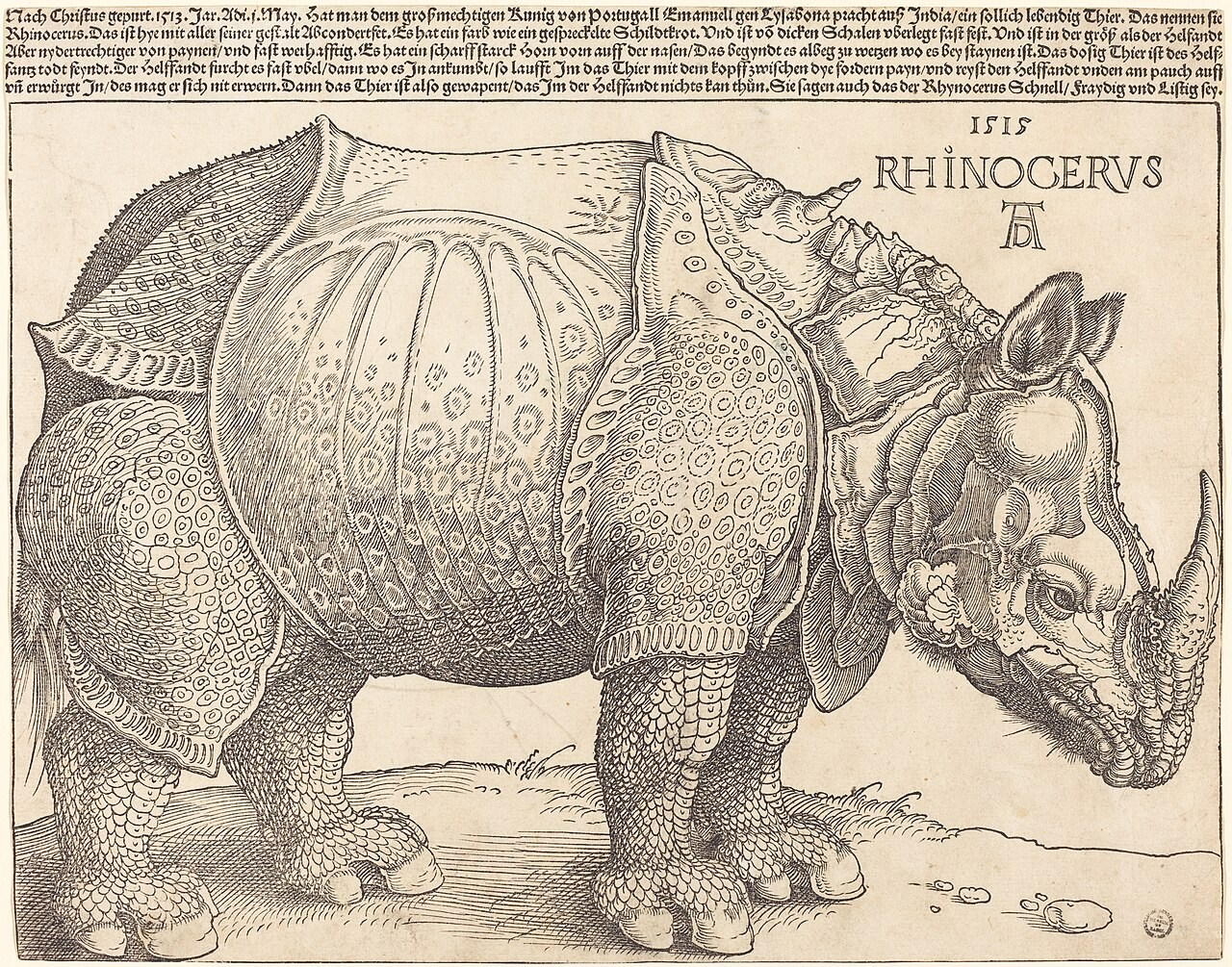
A small horn rises from the animal’s shoulders. Its body seems assembled from plates, each fitted to the next, while scales run down its legs. Albrecht Dürer’s rhinoceros is immediately recognizable, even to people who have never studied a Renaissance print. It is also an unusually successful image of an animal its maker never saw.
The woodcut belongs to 1515, when a living Indian rhinoceros reached Lisbon and reports of it travelled across Europe. Dürer worked in Nuremberg from information that had already passed through other hands. The resulting picture was more durable than the animal’s European journey. Its history shows how an arresting image could acquire authority through reproduction, and how the surviving sheets preserve evidence of that process.
An animal moving through diplomatic networks
The rhinoceros did not appear in Portugal by accident. According to the Cleveland Museum of Art’s account, Sultan Muzaffar II of Gujarat presented it to Afonso de Albuquerque, governor of Portuguese India, who sent it to King Manuel I. It arrived in Lisbon in May 1515. Manuel later dispatched it toward Rome as a gift for Pope Leo X, but the ship carrying it sank and the animal drowned.
The diplomatic chain matters. The rhinoceros moved through relationships connecting rulers in South Asia, Portuguese imperial expansion and the papal court. What Europeans encountered as a rare spectacle was an animal transported from a region where people already knew the species. Calling it a European “discovery” would erase that knowledge and the human networks that made its arrival possible.
Reports moved more readily than the rhinoceros itself. A description could be copied into a letter; a drawing could be sent to a distant city. By the time such information reached an artist, observations, comparisons and misunderstandings might already be entangled. Dürer’s task was to turn that incomplete material into a coherent form.
What reached Nuremberg?
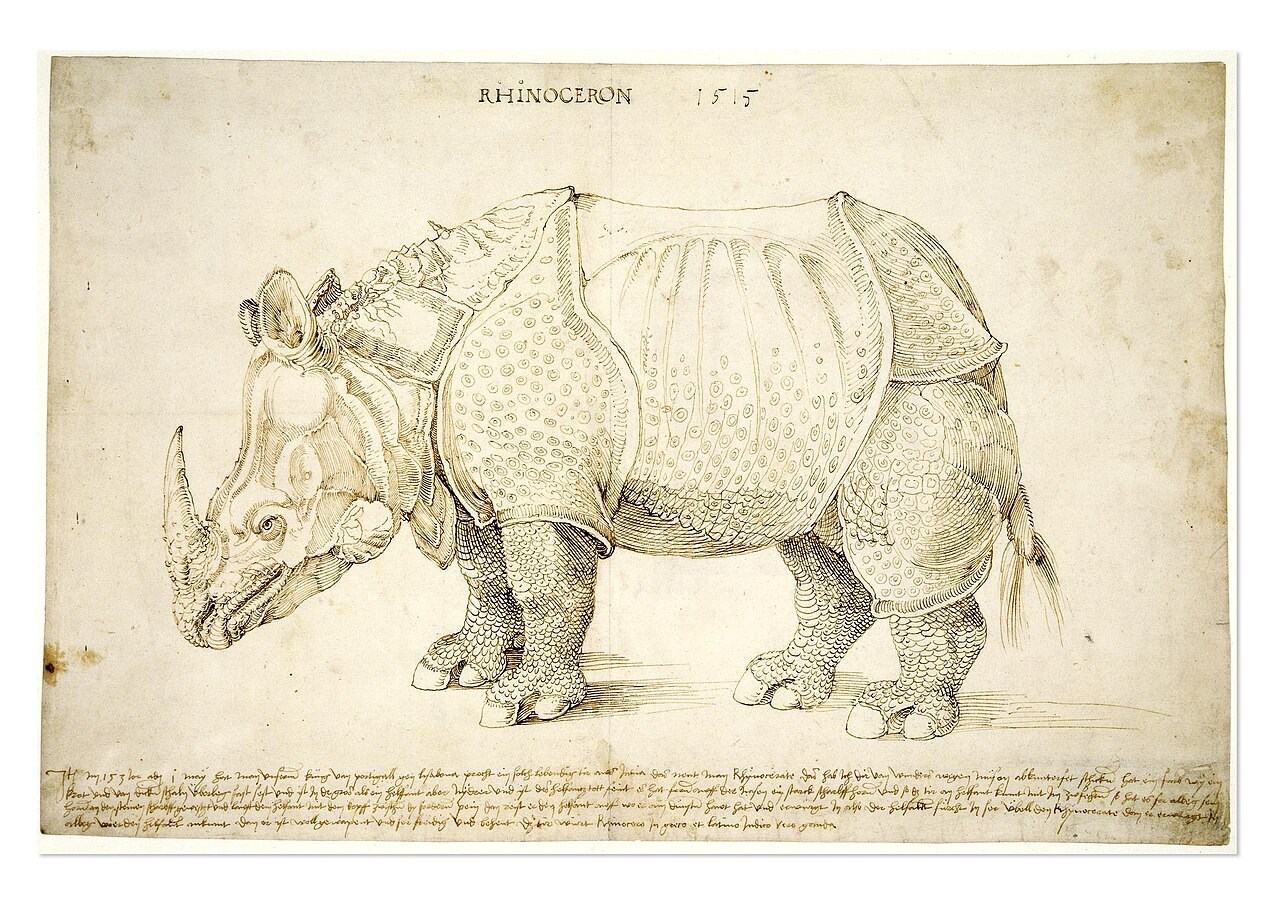
Dürer’s preparatory drawing survives in the British Museum. The museum’s catalogue entry connects it, cautiously, with a Portuguese newsletter sent to Nuremberg’s merchant community by the printer and publisher Valentin Ferdinand. Sketches probably accompanied the report, but those proposed source drawings have not survived.
That qualification is important. We have Dürer’s drawing and the printed image. We do not have a complete, securely documented chain showing every picture he consulted. It is reasonable to describe the work as based on second-hand reports, while leaving the precise combination of intermediaries open.
The surviving pen-and-ink study already organizes the unfamiliar animal into an intelligible shape. The rhinoceros faces left; in the famous woodcut it faces right. Reading the drawing alongside the print makes the image’s construction visible. It also prevents the surviving study from being mistaken for an eyewitness sketch made beside the animal in Lisbon.
Accuracy and invention in the same body
Dürer did not produce a wholly imaginary beast. The heavy body, prominent nasal horn and three toes make the animal recognizable. The National Gallery of Art’s close examination also points to the convincing ears, alongside the invented shoulder horn and the exaggerated armor-like surface.
An Indian rhinoceros does have thick skin arranged in conspicuous folds. The print turns those folds into something more rigid and engineered. Its patterned surfaces are extraordinarily persuasive because they are so carefully differentiated. The image supplies detail exactly where the artist’s access to direct observation was weakest.
The text above the woodcut helps frame the encounter. It presents information about the animal’s arrival, appearance and supposed strength. Image and words work together: the reader is offered both a visible creature and an explanation of what sort of creature it is. Their combination can look like corroboration even when both depend on the same limited information.
We cannot confidently reconstruct why Dürer added every unfamiliar feature. It is safer to examine the result than invent a private moment in which he supposedly decided that a rhinoceros must wear armor. The surviving image establishes what he depicted, not every thought that led him there.
Another rhinoceros was possible
Dürer was not the only artist responding to the animal’s arrival. Hans Burgkmair the Elder made a rhinoceros woodcut in the same year. The Albertina’s catalogue identifies its surviving impression as a work of 1515.
Placed beside Dürer’s print, Burgkmair’s version is revealing. It lacks the small horn on the shoulders and gives the body a different surface. Restraints around the animal’s feet make its captivity visible. The two images demonstrate that the same distant event did not dictate a single visual solution.
This comparison should not be turned into an unsupported claim that Burgkmair personally saw the rhinoceros. Nor does one apparently more plausible feature prove that every part of his image is accurate. What the comparison does establish is the existence of alternatives. Dürer’s eventual prominence was not inevitable merely because no competing picture existed.
Repetition made the picture familiar
A woodblock could generate many impressions from one design. It could also continue to work after the artist’s death, while other artists copied the resulting prints in different media. Dürer’s rhinoceros therefore travelled by more than one route: new impressions from an existing block, and new images derived from its familiar form.
The Natural History Museum’s survey of its legacy traces the model into later natural-history publications, including Conrad Gessner’s History of Animals. Repetition helped the shoulder horn and armored body survive alongside more accurate information. A reader encountering the same form in several books might reasonably assume that those books confirmed one another.
But copies are not independent observations. Ten images can descend from one source and reproduce the same error ten times. Dürer’s case makes that distinction unusually easy to see because the features are so memorable. The strength of the design helped carry both useful information and mistakes.
A later edition improved one fact and invented another
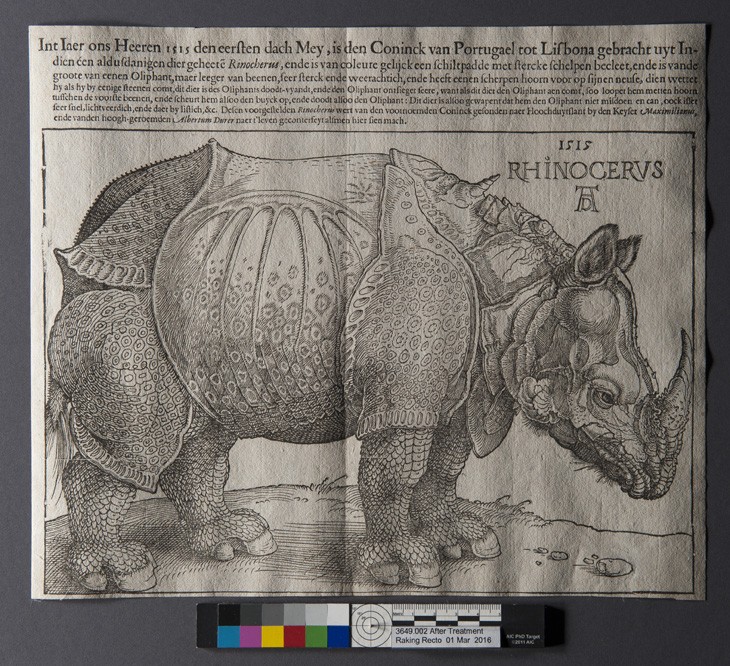
An impression at the Library of Congress reveals a particularly instructive stage in that history. It was printed by Hendrick Hondius in The Hague around 1620, using Dürer’s original block. Its Dutch text corrected an earlier mistaken arrival date from 1513 to 1515. Yet it also introduced a false claim that Dürer had drawn the animal from life.
The Library’s technical study explains how scholars distinguish this later impression. The language of the text is one clue. Cracks that had developed in the woodblock are another; the paper’s watermark supplies further evidence. The date of a design and the date of a particular sheet are different questions.
This is more than a detail for print collectors. A later publisher could correct one error while strengthening another. The apparent improvement of a source does not guarantee that everything in it has become more reliable. Here, material examination helps recover the distance between Dürer’s 1515 work and a claim attached to it more than a century later.
Clara and the return of sustained observation
In the eighteenth century, another Indian rhinoceros offered artists repeated opportunities to look. Clara toured Europe for years, appearing before paying audiences and attracting drawings, measurements and portraits. The Rijksmuseum’s account of her travels includes Jean-Baptiste Oudry’s life-size painting made in Paris in 1749.
Oudry’s great canvas offers a useful contrast with Dürer’s print. The folds belong to a heavy, continuous body rather than a fitted suit of plates. The Getty’s conservation account describes the portrait of this particular touring animal during its 2007 conservation loan from Schwerin. It is not a corrected version of the same 1515 individual.
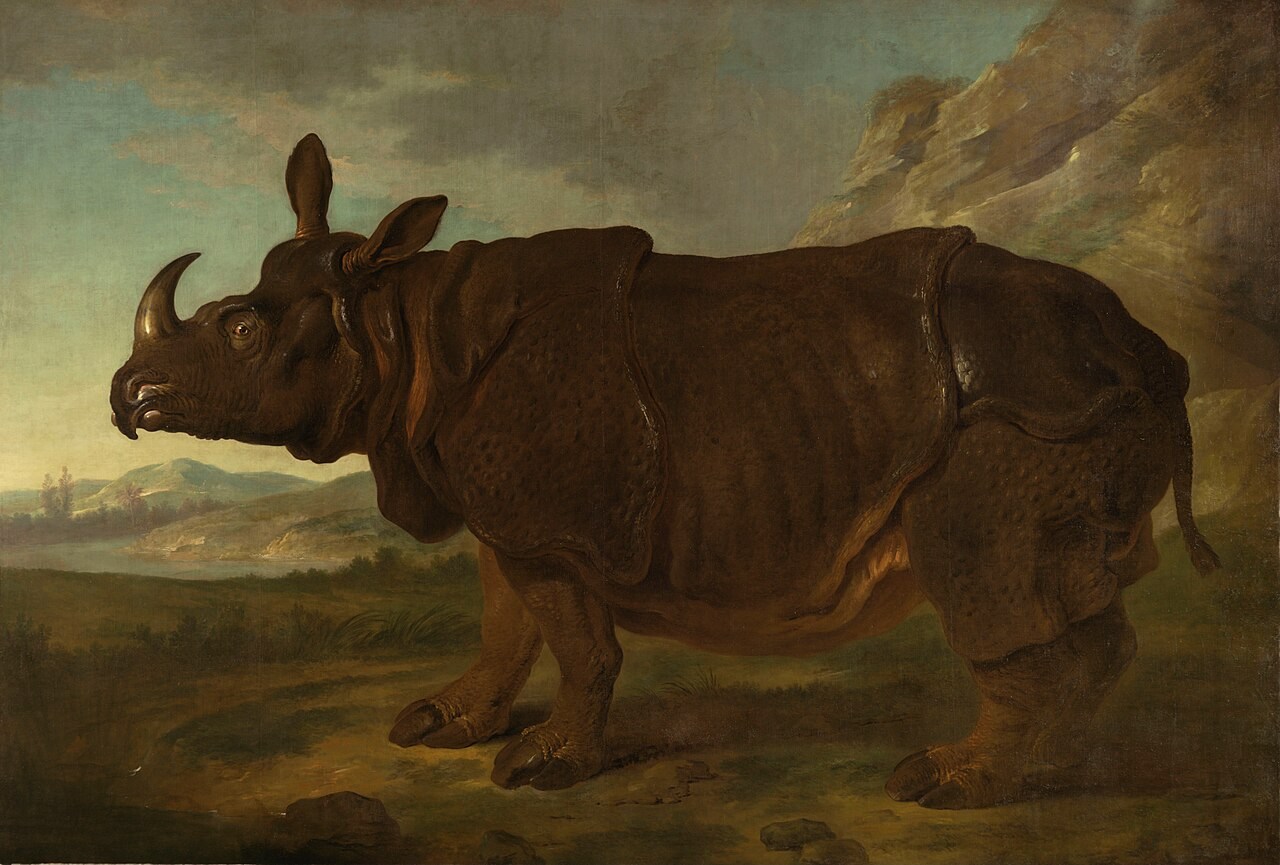
Direct access did not remove every mediation. Clara was transported and exhibited by people who charged admission; artists selected poses and presentation. A painted portrait still differs from the animal it depicts. Nevertheless, the opportunity for sustained observation changed the evidence available to an artist.
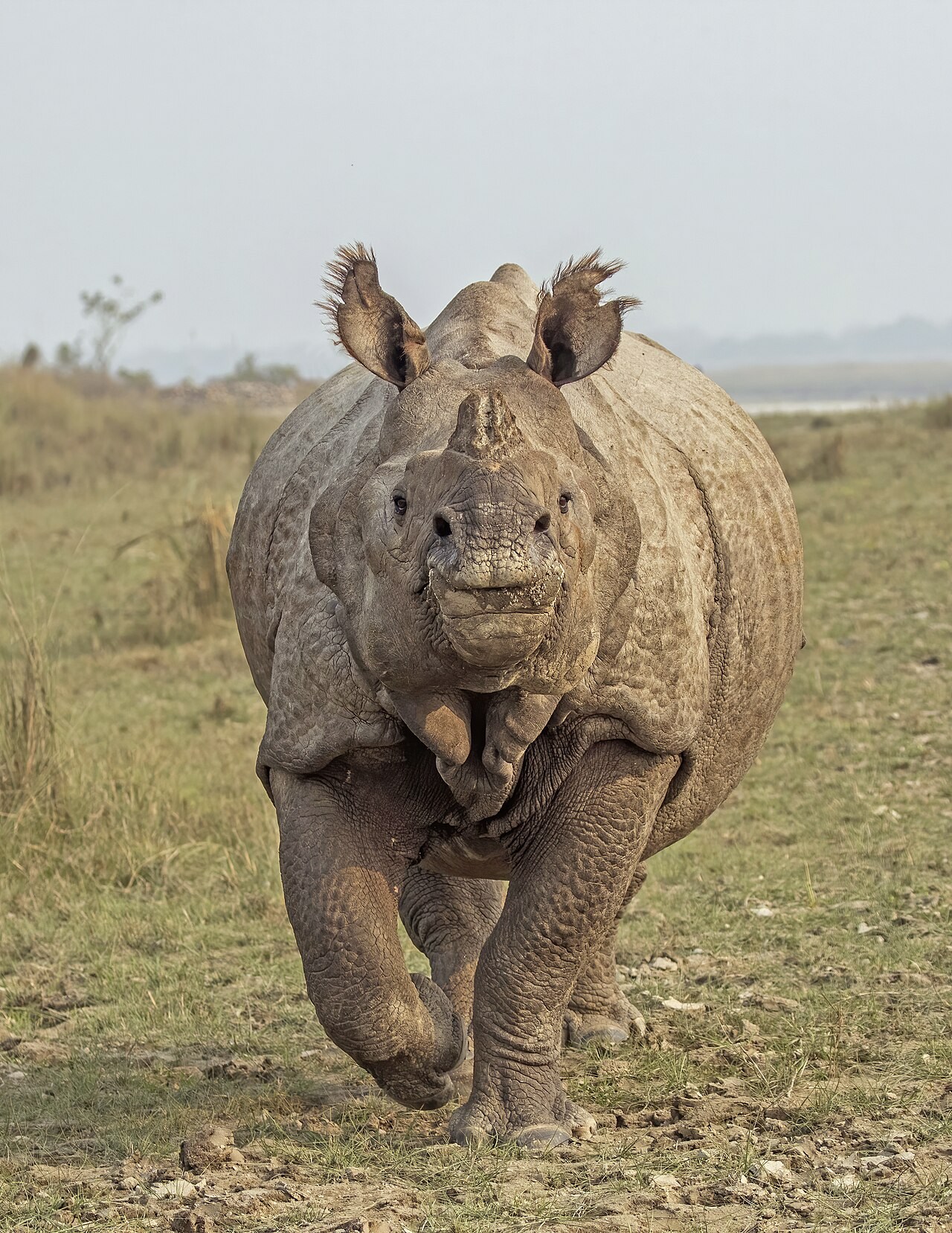
Dürer’s rhinoceros remains valuable precisely because it records more than anatomy. It preserves an encounter between distant information, extraordinary draftsmanship and the multiplying power of print. Looking carefully at its errors does not diminish its artistic achievement. It helps us understand how that achievement made a second-hand image convincing enough to outlive the circumstances that produced it.