
Myths and Mysteries
Roanoke and the Evidence Behind the Lost Colony
The word Croatoan was a destination, not an inexplicable riddle. John White’s account, Indigenous history, archaeology and drought evidence show what can be known about Roanoke and what remains uncertain.
When John White reached Roanoke Island in August 1590, he found a settlement without its inhabitants. He did not find an inexplicable word. CROATOAN, carved into a post at the entrance, named a place and a people he knew. White understood the inscription as a message left under an arrangement made before his departure. He wanted to follow it.
The gap between that practical clue and the later legend of a colony vanishing without explanation is where Roanoke becomes most interesting. More than a hundred English settlers had been left on the North Carolina coast in 1587. Their individual fates remain unproved. Yet their disappearance from English records is surrounded by evidence about Indigenous communities, colonial violence, unreliable supply routes and the difficulty of recognizing a particular group through a handful of surviving objects.
The strongest way to investigate the mystery is to keep three questions separate: what White actually reported, where the settlers might have gone, and what evidence would establish that they lived there.
A colony in an inhabited country
Roanoke was already part of an Indigenous world. The sounds, rivers and barrier islands of the region connected Algonquian-speaking communities through travel, agriculture, fishing, diplomacy and conflict. English arrivals depended on those communities for knowledge and provisions. Calling the coast a blank setting for an English adventure hides the relationships on which the colony’s survival depended.
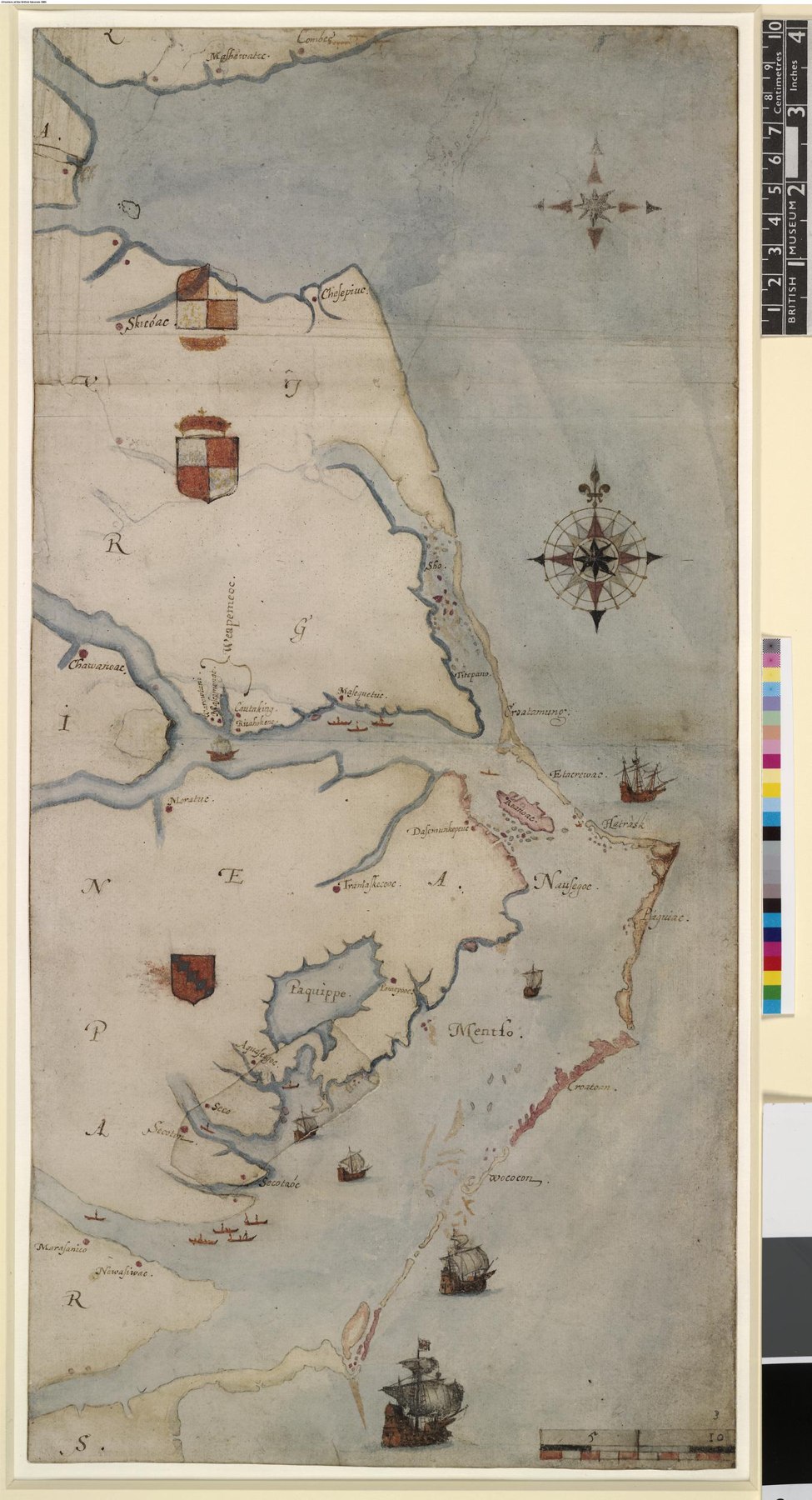
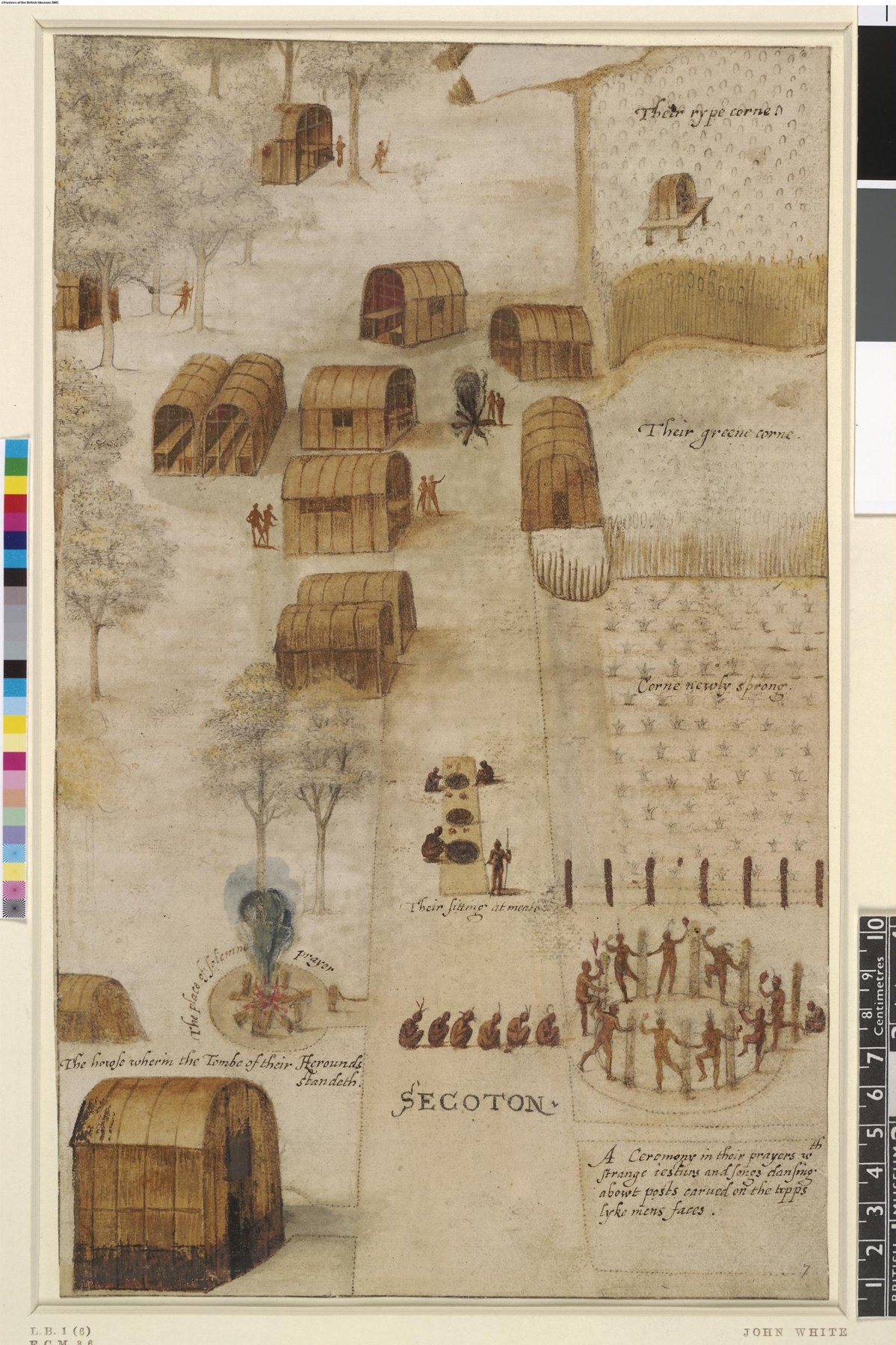
John White’s paintings from the 1580s help recover that setting, although they represent an outsider’s selection and interpretation. His view of Secoton shows houses, cultivated fields and areas of communal activity. Such images are valuable precisely because they depict organized societies rather than a wilderness awaiting settlement. They cannot supply the voices of the people represented or tell us how every community understood the newcomers. The British Museum’s collection record for White places the surviving drawings within the English voyages of exploration and colonization.
The first reconnaissance supported by Walter Raleigh in 1584 brought Manteo and Wanchese to England. They were individuals with different political relationships and subsequent choices, not interchangeable representatives of a single Indigenous population. Manteo maintained close connections with the English; Wanchese returned to the Roanoke community. The National Park Service’s account of Manteo makes the work of translation and mediation central to the expeditions. Those connections mattered later because Croatoan was Manteo’s home.
The violence inherited by the settlers
The famous colony of 1587 was not the first English occupation of Roanoke. In 1585, an expedition left a predominantly military settlement under Ralph Lane. It struggled with supplies and increasingly coercive relationships with neighboring people. Demands for food were a political problem as well as a logistical one: resources taken or promised to the English were resources unavailable for local households.
Lane’s men killed the Roanoke leader Wingina, also known as Pemisapan, in 1586. English accounts presented the killing through their own claims about danger and conspiracy. Whatever judgment is made about those claims, the act belongs near the center of the story. The settlers arriving the following year inherited the consequences of earlier English behavior. The National Park Service’s history of the military colony traces these deteriorating relations and Lane’s departure with Francis Drake’s fleet.
The next expedition included women and children and aimed at a more lasting settlement, intended for the Chesapeake Bay. It instead remained at Roanoke after a dispute involving pilot Simon Fernandes. White’s party encountered the aftermath of the earlier occupation and soon contributed further violence of its own. After colonist George Howe was killed, an English retaliatory attack mistakenly struck Croatoan people. Manteo helped stop it. The 1587 colony narrative summarized by the park service makes clear that possible refuge among Indigenous neighbors cannot be imagined independently of these damaged relationships.
White sailed for England in late August to obtain support. His daughter Eleanor Dare, son-in-law Ananias Dare and newly born granddaughter Virginia remained behind. Numbers vary slightly across accounts and reconstructions, so describing the stranded community as more than a hundred people is safer than treating a disputed headcount as an exact census of everyone present on a particular day.
Why the return took three years
White’s absence was prolonged by war, shipping priorities and failed opportunities. England’s conflict with Spain, including the Armada crisis in 1588, made vessels difficult to secure. A transatlantic settlement could be urgent to its inhabitants while remaining secondary to the goals of shipowners, privateers and the crown.
In 1590 White finally traveled west again with a privateering voyage. Reaching the colonists was not the voyage’s sole purpose. The ships approached the Outer Banks in August, almost three years after he had left. The delay is part of the explanation for the uncertainty: White did not observe the decisions made in the intervening years, and the surviving record supplies no continuous diary from those who stayed. The park service biography of John White follows his interrupted efforts to return.
Reading the message at the entrance
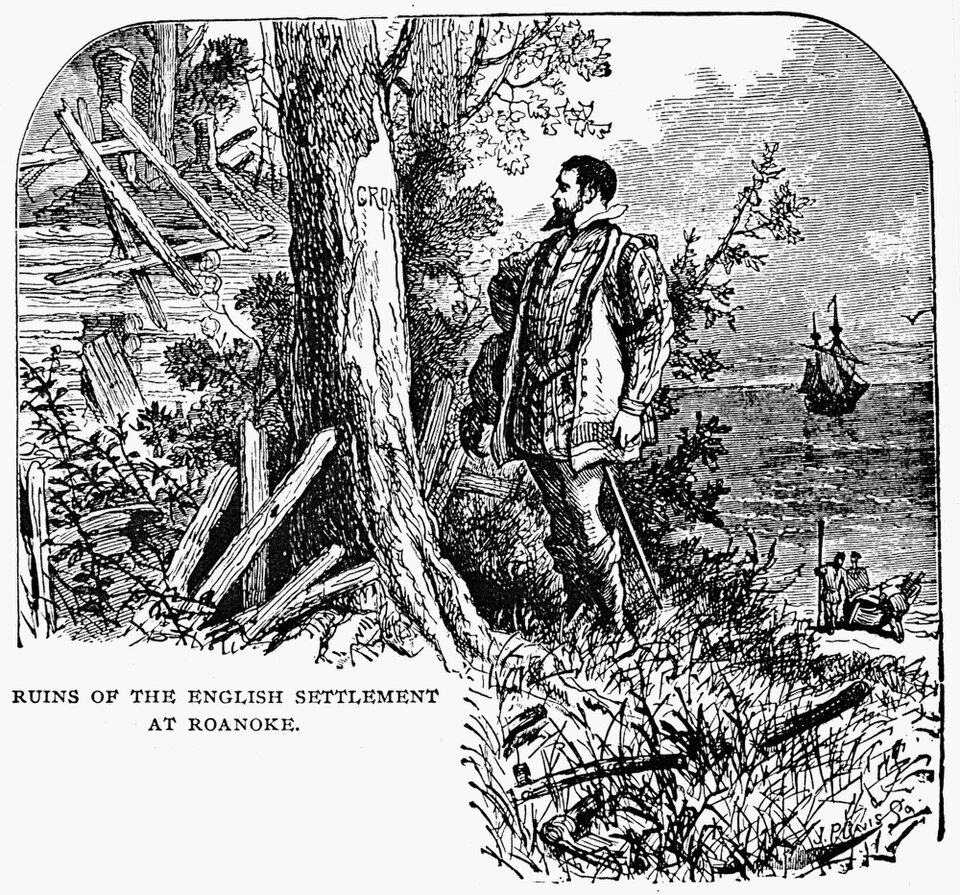
White’s own account remains the essential document. A transcript of his 1590 narrative, originally published in Richard Hakluyt’s collection, describes two inscriptions. The letters CRO appeared on a tree. The full name CROATOAN was cut into a post at the settlement’s entrance. Popular illustrations often merge them into one word on one tree.
According to White, the settlers had agreed to identify their new location if they moved. A cross above the name would indicate distress. He reported no such cross. He also described houses taken down, a substantial palisade, abandoned heavy equipment and buried chests that had been opened and damaged.
These observations favor an interpretation of deliberate departure. They do not demonstrate that every person left together, that nobody had died beforehand or that those who departed remained safe. A sign is evidence of communication at a particular moment. It cannot certify the entire history before and after that moment.
White himself made a stronger, hopeful inference: he believed the message showed that the settlers were at Croatoan, among people the English counted as friends. His personal stake is unmistakable, but historians do not need to invent his private thoughts. His stated interpretation is already in the document. So is his intention to sail to Croatoan.
Weather and the ships’ deteriorating situation prevented that search. White described lost anchors, a shortage of provisions and difficulty obtaining fresh water. The voyage left the region. The failure to inspect the most explicit destination named in the surviving evidence created a gap later storytelling could fill almost without limit.
What Croatoan can and cannot explain
Croatoan is the strongest named lead because it occurs in the contemporaneous account of the deserted settlement. The island is associated with present-day Hatteras. Movement there might have involved joining or seeking protection from local people, dividing into smaller groups or exchanging skills and goods for support. These are possibilities consistent with the setting, not a recovered account of negotiations.
Excavations on Hatteras have produced European objects that invite comparison with the Roanoke period. In a 2015 research announcement, the University of Bristol described finds including a counting token, copper, pottery, a rapier component and writing equipment. Some came from deposits substantially later than the 1580s. The excavators proposed that old possessions could have been kept for decades and that some colonists might have become part of an Indigenous community. They also explicitly acknowledged the lack of decisive proof.
That qualification matters. An object can travel through exchange, gifts, salvage or later contact. A European-made artifact in an Indigenous settlement does not automatically identify a resident English colonist. Its date of manufacture is different from its date of deposition. An assemblage of objects in a secure archaeological context can narrow the possibilities more effectively than a striking object by itself.
The National Park Service’s assessment of competing theories consequently treats the Hatteras evidence as suggestive rather than conclusive. No excavated household, burial or settlement has been definitively assigned to the missing 1587 community. The Croatoan hypothesis deserves serious consideration without being promoted into a solved case.

A hidden symbol and an inland search
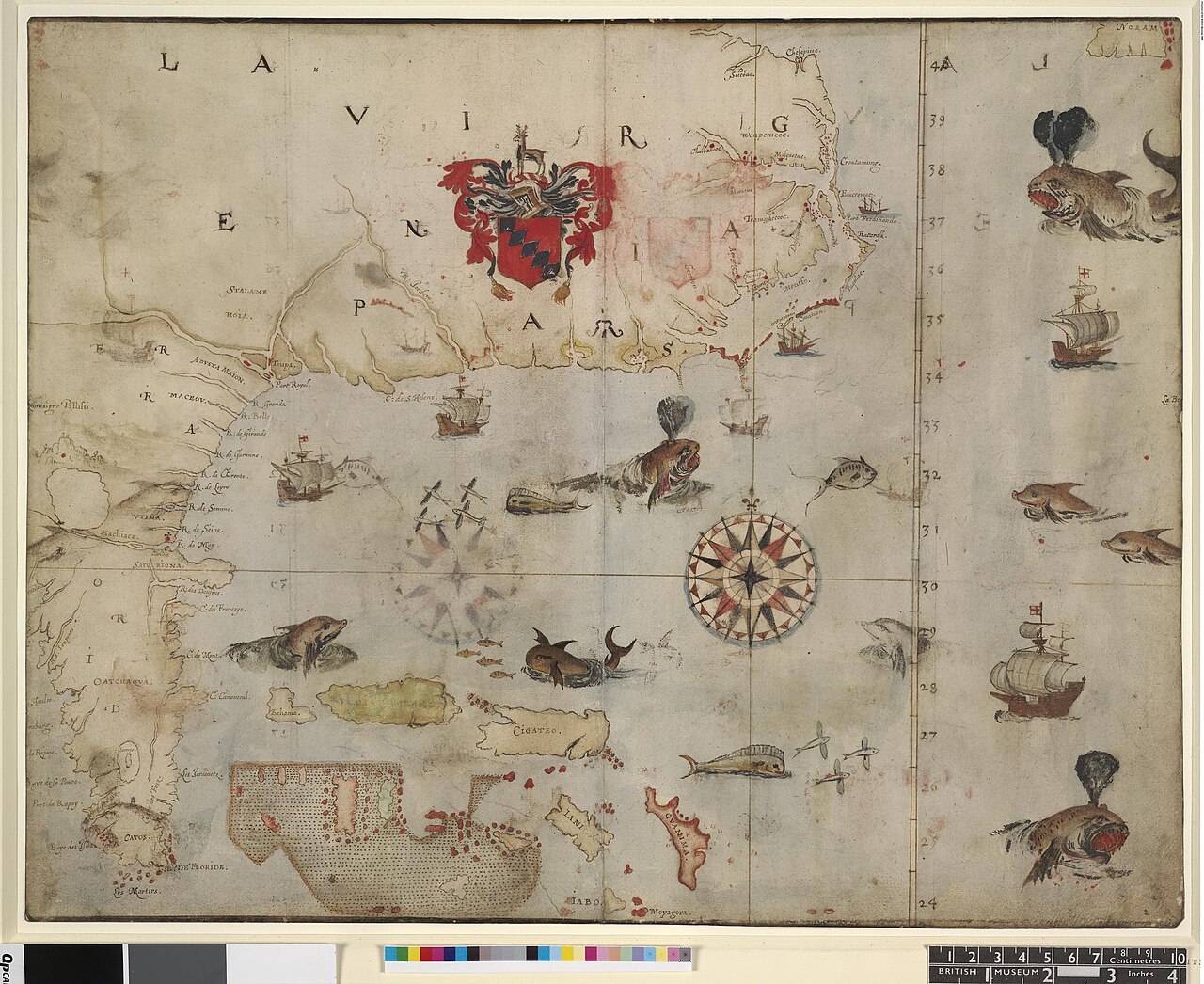
Another line of investigation concerns a small patch on White’s map of the region. In 2012 examination at the British Museum revealed a fort-like symbol beneath it, near the western end of Albemarle Sound. The result gave researchers an important geographic lead. It also demonstrated how much information can survive within an object long available for study.
The map itself predates any demonstrated record of the settlers’ final movements. A symbol might mark a planned location, an explored place or another cartographic intention. It cannot, without corroboration, prove that the missing people built a settlement there. The museum’s technical examination is evidence for what is on the paper; arguments about who later lived in that area require additional sources.
The First Colony Foundation’s work at sites in Bertie County has found English ceramics and other material alongside evidence of Indigenous occupation. Its research summary for Site X explains why the location drew attention after the map examination. The crucial issue remains association: whether the European material belongs to the 1587 colonists rather than earlier exchange or later activity. The distinction between a movable object and a securely identified occupation also matters in the archaeological evidence for Vinland, where structures and dated activity provide a firmer foundation. Inland movement and movement to Croatoan could also have involved different people. A search need not assume that one explanation must account for every member of the colony.
Drought is context rather than a verdict
Tree rings add a different kind of evidence. A 1998 study in Science reconstructed a severe regional drought in 1587–1589. Its timing overlaps the settlers’ unrecorded years. Poor harvests would have affected Indigenous communities as well as the newcomers, making dependence on food exchanges especially precarious.
Climate evidence cannot tell us who moved, who died or what an inscription meant. It identifies a pressure that historical explanations should consider. The drought might have encouraged relocation, intensified conflict or made absorption into another community more difficult. It does not select a single ending. Nor does it turn neighboring people into an unlimited food reserve whose failure to support the English needs special explanation.
Archaeology on Roanoke also has limits. The National Park Service’s archaeology overview describes a long research history while acknowledging that the precise location of the 1587 settlement remains uncertain. Remains associated with the earlier scientific workshop help establish activity during the 1585–1586 occupation. They are not automatically evidence for the missing colony’s last days. Erosion, later land use, excavation coverage and the difficulty of assigning objects to closely spaced visits all complicate the search.
How a gap became a legend
Later pictures, novels and performances made the empty settlement a dramatic national origin story. The familiar nineteenth-century image of White contemplating the word on a tree is a representation of memory, produced centuries afterward. Using it as if it documented the 1590 landing quietly changes evidence into scenery.
The Dare Stones offer a more pointed warning. Beginning in 1937, inscribed rocks appeared claiming to tell the colonists’ fate. Many were exposed as fraudulent. The first stone has continued to attract debate, but it lacks the demonstrated provenance required to treat its story as an authenticated message from Eleanor Dare. NCpedia’s account of the stones traces how excitement, rewards and questionable claims became entangled. A detailed story is not necessarily a well-supported one.
Roanoke remains unresolved at the level that matters most: the lives of particular people after 1587. That uncertainty does not place every explanation on equal footing. The written destination, evidence of dismantling, regional communities and archaeological finds support historically testable possibilities. Supernatural disappearance contributes no comparable evidence.
The colony was lost to the English people who attempted to find it and to the surviving English documentary record. The surrounding Indigenous world did not disappear with it. Keeping that distinction in view changes the question. Instead of asking only how an English community vanished, historians can ask how its members may have moved through a country whose people already possessed homes, political choices and histories of their own.
Sources and further reading
- British Museum's collection record for White
- National Park Service's account of Manteo
- National Park Service's history of the military colony
- 1587 colony narrative summarized by the park service
- park service biography of John White
- transcript of his 1590 narrative
- 2015 research announcement
- National Park Service's assessment of competing theories
- museum's technical examination
- research summary for Site X
- 1998 study in Science
- National Park Service's archaeology overview
- NCpedia's account of the stones