
The Battle of Algiers: A Victory That Could Not End the War
Gillo Pontecorvo’s 1966 film made a struggle over colonial power look like immediate news. Its historical force depends on understanding both the reality it reconstructs and the choices behind that appearance.
Destroying an organization and ending the political conditions that sustain a conflict are different achievements. The Battle of Algiers is built around the distance between them. French forces can break the urban resistance network at the center of the story, yet the history beyond that apparent victory continues toward Algerian independence.
The distinction helps explain why the film should be approached as more than a catalogue of violence. Its subject is a struggle over who can move through a city, speak for its inhabitants and claim legitimate authority. Its dramatic compression can make those questions unusually clear. It can also make a complex war look more unified and inevitable than it was.
Directed by Gillo Pontecorvo and written with Franco Solinas, the film appeared in 1966, only four years after independence. Criterion’s official title page identifies the Italian-Algerian production, its French and Arabic dialogue, black-and-white photography and 121-minute running time.
Viewing note: This is a historical and critical introduction based on official production information, archival programming notes and published scholarship. It is not a firsthand review based on viewing the complete film. Discussion includes major historical and narrative outcomes.
The battle was not the whole war
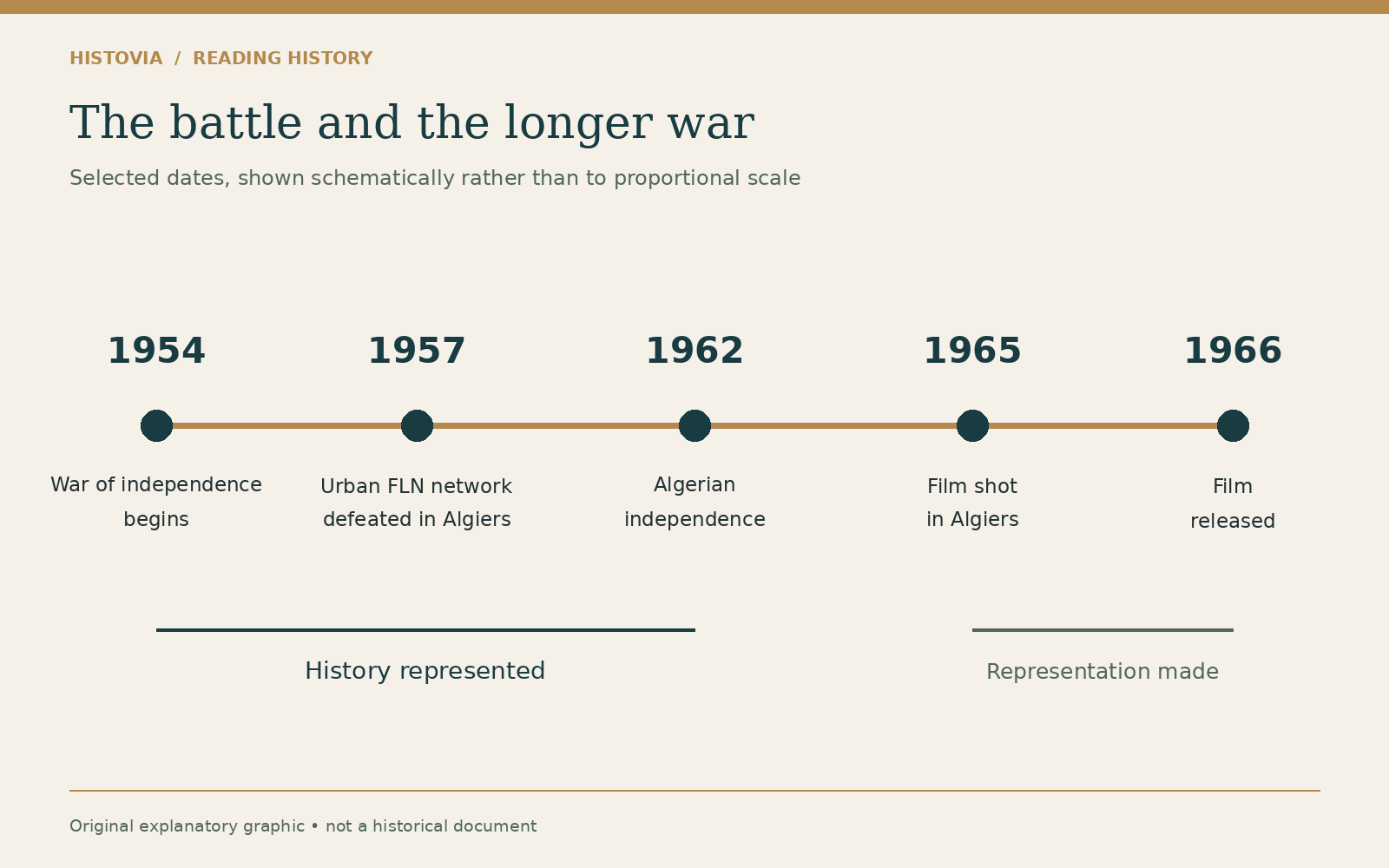
The Algerian War lasted from 1954 to 1962. The film concentrates on an urban campaign within that larger struggle. Yale Film Archive’s program notes describe its main focus as the years 1954–57 and identify Colonel Mathieu, played by Jean Martin, as a composite of French officers rather than a portrait of one historical commander.
Both choices matter. A limited time span gives a film narrative concentration; a composite character gives an institution a recognizable voice. Neither is automatically dishonest. Problems arise when a viewer carries the compression out of the cinema and treats it as a complete account of the conflict or a literal record of a named individual.
The later achievement of independence does not make the intervening years an empty corridor. A Musée de l’Armée exhibition on 1958–62 follows the changing relationship between Charles de Gaulle, the military and the future of Algeria, including the move toward self-determination. The political situation was contested and changing after the urban battle had been fought.
That longer perspective protects the film’s central insight from an overly simple lesson. It is reasonable to distinguish a battlefield result from a political settlement. It is much less reasonable to infer that a particular sequence of repression must always produce the same eventual outcome. Historical hindsight can turn a precarious process into a mechanism.
A city divided before the shooting starts
The Casbah is not merely an atmospheric setting. The Getty Research Institute’s exhibition Walls of Algiers explains how French occupation from 1830 transformed the city and sharpened a spatial division between the hillside Casbah and expanding European districts. Streets and buildings gave material form to unequal relationships.
A checkpoint consequently carries more meaning than an obstacle in a suspense sequence. It makes political authority visible in a routine encounter. Who is considered ordinary, who is inspected, and who must explain their presence are questions about a colonial social order as well as about a particular security measure.
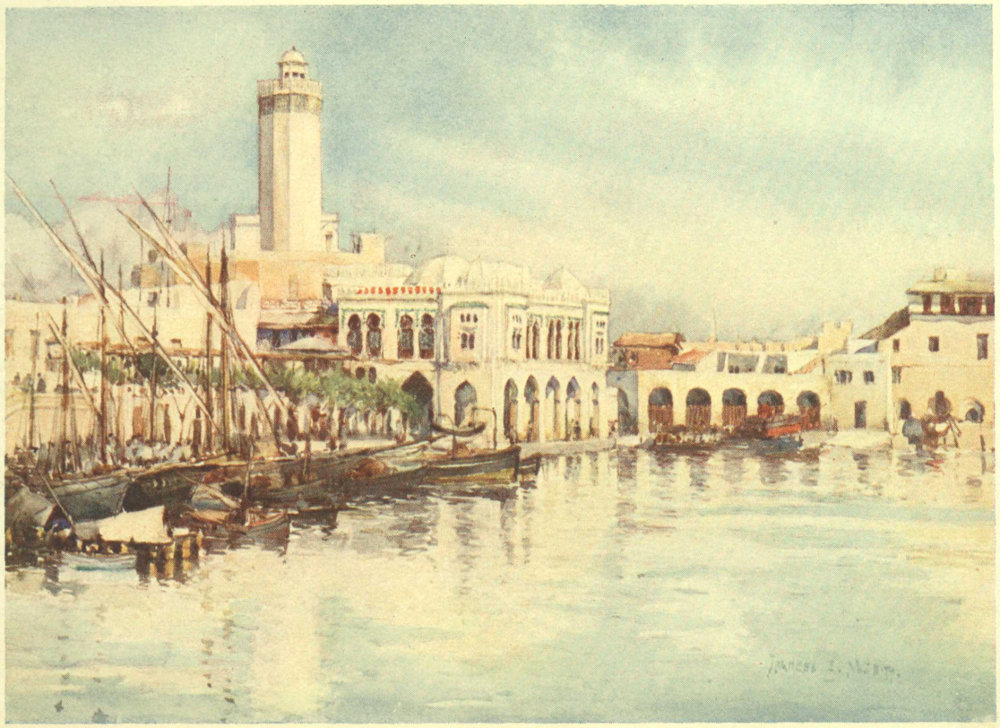
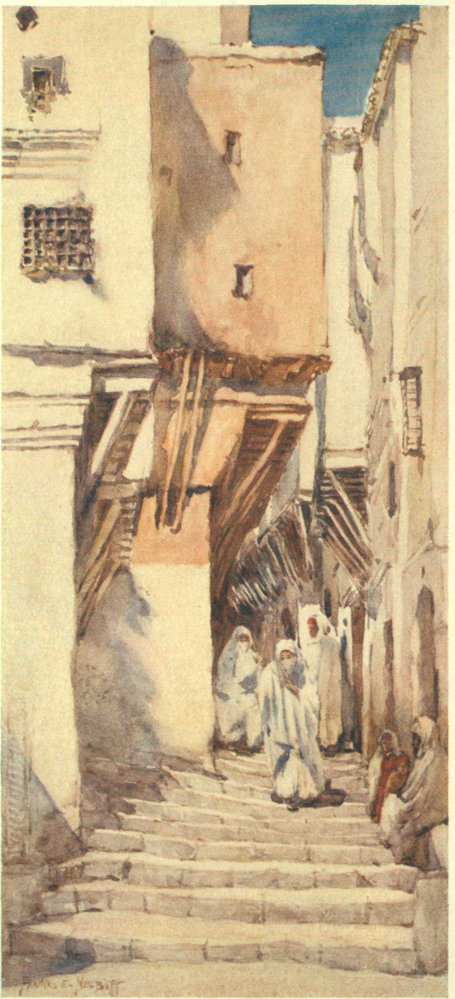
The older illustrations accompanying this article should be read with the same caution as the film. Frances E. Nesbitt’s paintings appeared in Algeria and Tunis in 1906, decades before the independence war. They offer views of the city under colonial rule, shaped by a visiting artist’s selection. They are not images of the 1957 battle or proof that the city remained unchanged.
That distance is useful. A picturesque lane can be rendered as scenery for an outsider while remaining someone else’s route to work, home or family. The historical question is not only what a picture contains, but which activities and relationships its way of looking makes easy to overlook.
The appearance of a documentary was a construction
Black-and-white images, crowded locations and nonprofessional performers can create a powerful impression of witnessing events rather than watching their reconstruction. Film scholar Nicholas Harrison’s introduction in Oxford Bibliographies stresses that the film’s historical effect also depends on fictionalization, narrative arrangement, music and montage. It was shot in Algiers in 1965, with support from the Algerian government.
Saadi Yacef occupied an especially consequential position. A former FLN leader, he supplied memoir material, helped produce the film and performed a role based on his own wartime experience. Harrison notes that other former combatants disputed aspects of the resulting representation. Participation by an eyewitness can enrich a film without making the participant a neutral authority over everyone else’s history.
These production circumstances are part of the evidence. The film is a retrospective account of an anticolonial struggle made in the early years of independent Algeria. Its proximity to events brought access to places and participants, but proximity also meant that reputations, political authority and national memory were still being actively contested.
In a discussion for the American Historical Association, Ron Briley notes that American publicity explicitly distinguished the film from newsreel footage. The need for that distinction is revealing. An image can look like a surviving record of an event while being a carefully staged representation of it.
There is no contradiction in saying that artifice can serve historical understanding. Choosing where to place a camera makes an argument. The useful test is whether the argument clarifies a relationship that other evidence supports, and whether the audience can recognize where staging, combination and selection have occurred.
Understanding violence without making it innocent
The film’s anticolonial commitment does not spare its audience the harm caused by attacks on civilians. Peter Matthews’s Criterion essay emphasizes the sequence in which Algerian women enter civilian spaces in the European quarter. The people who will be harmed become particular individuals rather than an anonymous category.
That is a demanding dramatic arrangement. Following a character’s perspective can make a decision intelligible without making the victims responsible for it. A serious discussion should preserve the difference. Explanation of colonial domination is necessary to understanding the conflict; it does not erase the moral status of civilians targeted within it.
Matthews also rejects the idea that showing violence by opposing sides automatically makes the film politically neutral. That distinction is important. An artist can condemn a colonial relationship while examining the suffering produced by people resisting it. Acknowledging asymmetry of power need not require indifference to particular deaths.
There is a corresponding danger in discussing the French army only through an unusually articulate fictional officer. A persuasive explanation offered by a character remains an explanation inside a drama. It cannot demonstrate that the measures he defends were necessary, effective or lawful in the historical world.
The record of torture must be approached independently. In a declaration dated 13 September 2018, the French presidency acknowledged that Maurice Audin had been tortured and then executed, or tortured to death, by soldiers who arrested him. It also recognized the institutional system of arrest and detention that made his death possible. This is a specific later acknowledgment, not a source for every incident represented in the film.
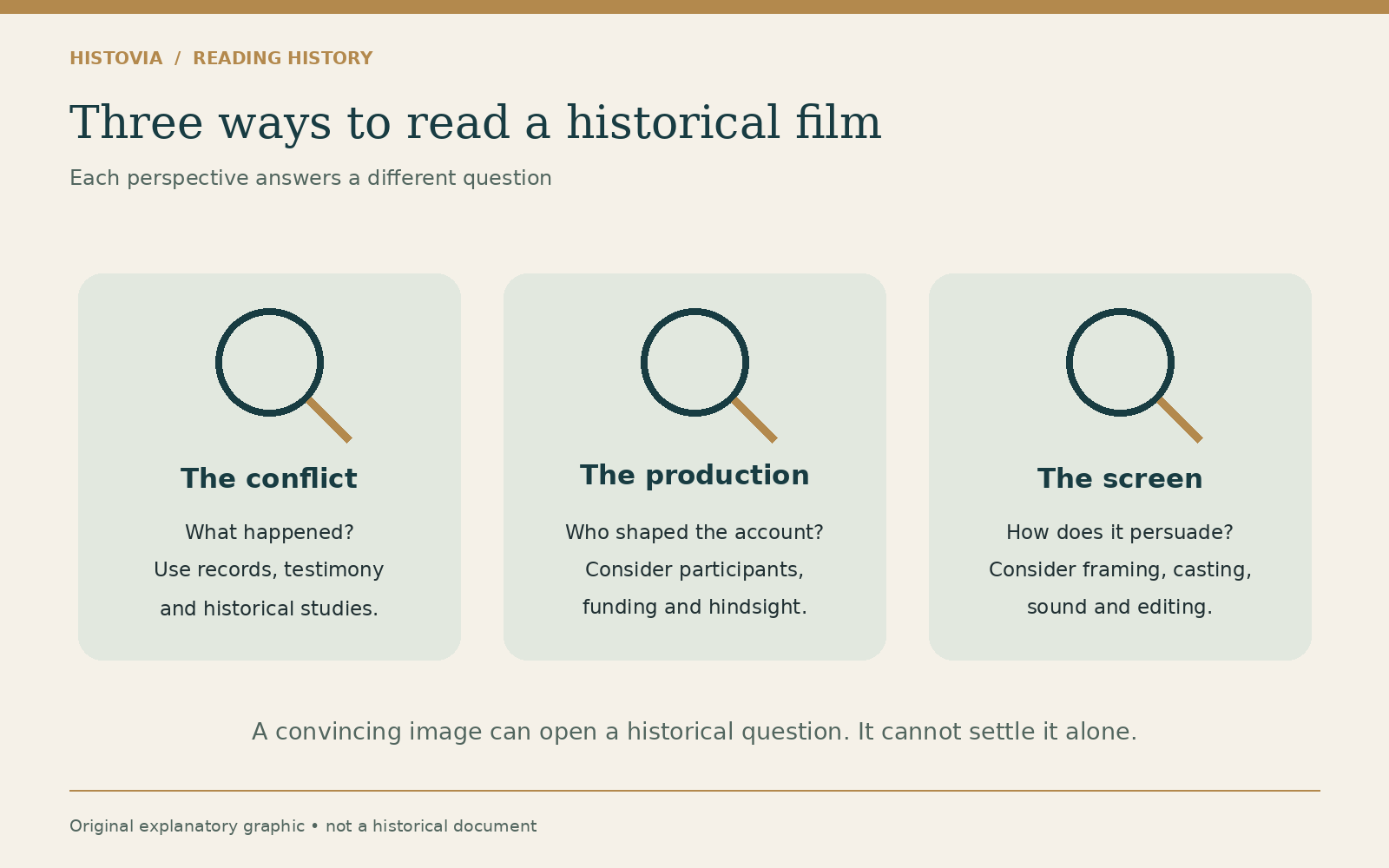
Placing such evidence alongside the drama changes the discussion. The issue is no longer whether a striking fictional scene seems convincing. It becomes how a film represents an institutional practice whose reality must be established through testimony, records and historical investigation.

The women extend beyond the remembered sequence
The women crossing between quarters are among the film’s most discussed figures. Their prominence can nevertheless obscure the limits of the representation. Annabel LaBrecque’s guide to scholarship on women and the Algerian War draws attention to Danièle Djamila Amrane-Minne’s criticism of how little screen time could convey their much wider involvement. It points readers toward interviews, memoirs and historical work beyond the film.
A memorable action sequence offers visibility of a particular kind. It may show a woman exercising judgment under pressure while leaving her political formation, other responsibilities and later life largely outside the frame. Visibility is valuable, but it should not be mistaken for a complete biography.
The same caution applies to appearance. Clothing can be central to the film’s account of how colonial assumptions worked. Reducing the women to the act of changing dress would repeat a different simplification, treating their bodies as symbols while overlooking their reasoning. Their historical agency requires more evidence than the dramatic effectiveness of a disguise.
Nor can participation in a liberation struggle be taken as a guarantee of equal power afterward. The questions raised by women’s wartime work continue beyond the declaration of independence. A film ending with national liberation necessarily leaves much of that subsequent negotiation to other histories.
What disappears when a film becomes a universal lesson
The film’s later use in political and military discussions is well documented, but the habit of treating it as a ready-made lesson can flatten its subject. Briley records the Pentagon screening in August 2003. That event shows that people sought contemporary meaning in the film; it does not demonstrate that their interpretation was correct or that they agreed about what it meant.
Algeria cannot be reduced to an interchangeable name for any conflict involving an army and an underground movement. Colonial settlement, citizenship, nationalism and the relationship with metropolitan France gave this war its particular structure. An analogy becomes useful only after those differences have been considered.
The film’s concentration on the FLN presents a related limitation. A strongly organized narrative needs a recognizable collective protagonist. Historical scholarship must also ask about other political currents, disagreements within the movement and people whose aims do not fit a single account of national unity. The coherence of a finished film is not evidence that every participant experienced the same struggle in the same way.
Watching the reconstruction and its edges
A rewarding way into The Battle of Algiers is to keep two timelines in view: the conflict it reconstructs and the moment when the reconstruction was made. In the first, the outcome was uncertain. In the second, independence had already been achieved and its history was being given a public form.
The strength of the project lies in making political relationships tangible through bodies, streets and institutions. Its limitation is the same compression that makes it legible. A few characters and sequences must carry a conflict whose social and political life extended well beyond them.
The question left by the defeated urban network is therefore larger than who controlled the streets on a particular day. What would make that control endure, and at what human cost? The film gives that question a memorable shape. Reading beyond it prevents the shape from becoming the whole history.
Film information: The Battle of Algiers (1966), official Criterion title page. The link identifies the film and edition materials; streaming availability varies by service and location.