
Dark History
Benin 1897 and the Paper Trail of a Looted Kingdom
The British invasion of Benin scattered royal and sacred objects through auctions and museums. Their provenance reveals the violence behind the paperwork and the Edo knowledge needed to understand what was lost.
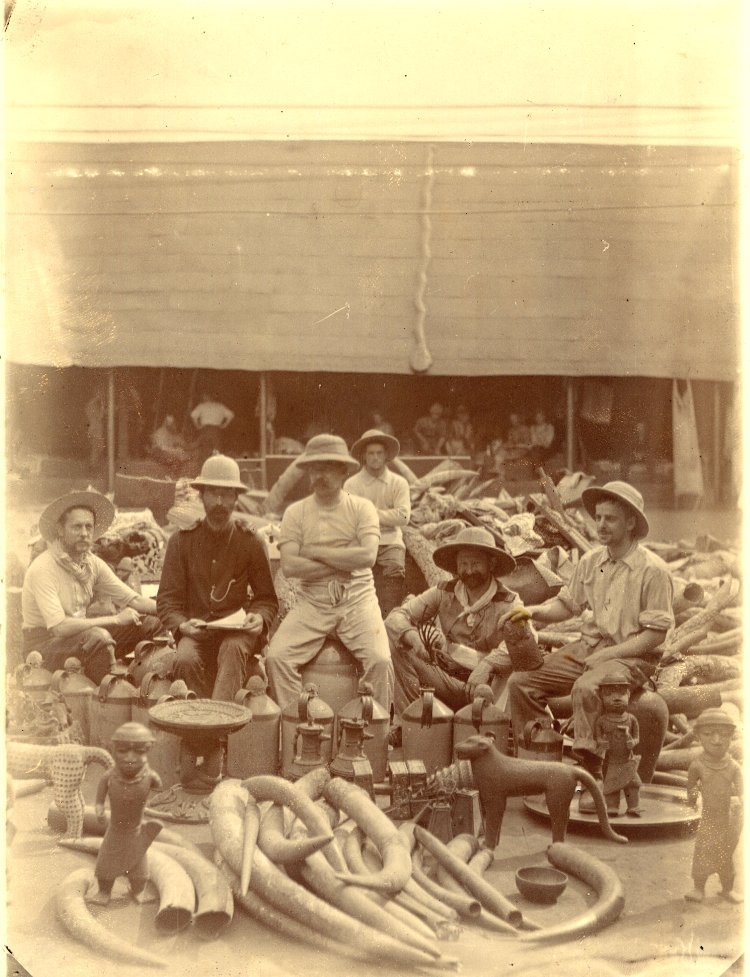
In a photograph taken after the British invasion of Benin in 1897, European men sit among carved tusks and other objects removed from the kingdom. The arrangement is revealing. Things made for palace ceremonies and ancestral remembrance have become the backdrop to the conquerors’ portrait. Their next journeys would pass through military hands, auction rooms, dealers’ catalogues and museum storerooms.
The objects now widely called the Benin Bronzes carry both histories: the history of the Edo artists and patrons who created them, and the history of their violent dispersal. Understanding their provenance requires following those journeys without allowing an auction receipt to obscure the earlier seizure. It also requires looking beyond European paperwork to the people whose knowledge explains what was taken.
Before the objects became a collection
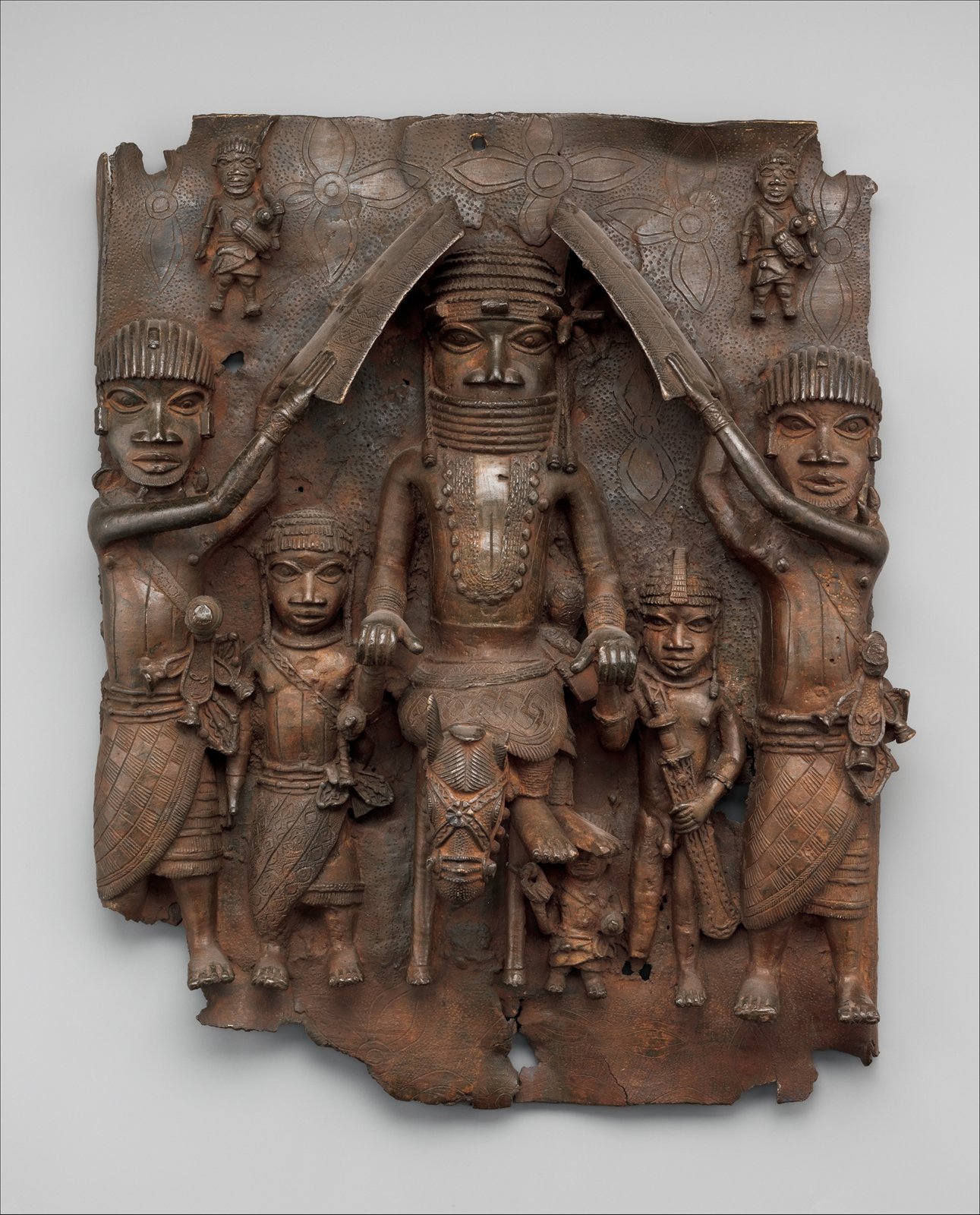
The historic Kingdom of Benin was centered on Benin City in present-day southern Nigeria. It should not be confused with the modern Republic of Benin farther west. Its ruler, the oba, presided over a court whose arts embodied authority, religious obligations and dynastic memory. The Metropolitan Museum’s equestrian plaque, dated about 1540–1570, shows the ruler larger than surrounding attendants. Differences of scale communicate political rank, making the image legible within the court’s own system of representation.
Specialist guilds supplied that world. The Pitt Rivers Museum’s account of Benin describes quarters associated with generations of metal casters, ivory carvers and other craftspeople. Brass casting used the lost-wax process: a modeled form provided the basis for a mould into which molten metal was poured. The surviving plaques and sculptures record accumulated technical knowledge as well as the decisions of individual makers.
Trade helped supply their materials. A plaque depicting Portuguese figures and manillas places foreign merchants alongside bracelet-shaped metal currency. The pairing associates the newcomers with wealth. It also reminds viewers that Edo artists observed and represented Europeans long before British soldiers treated Benin art as a discovery.
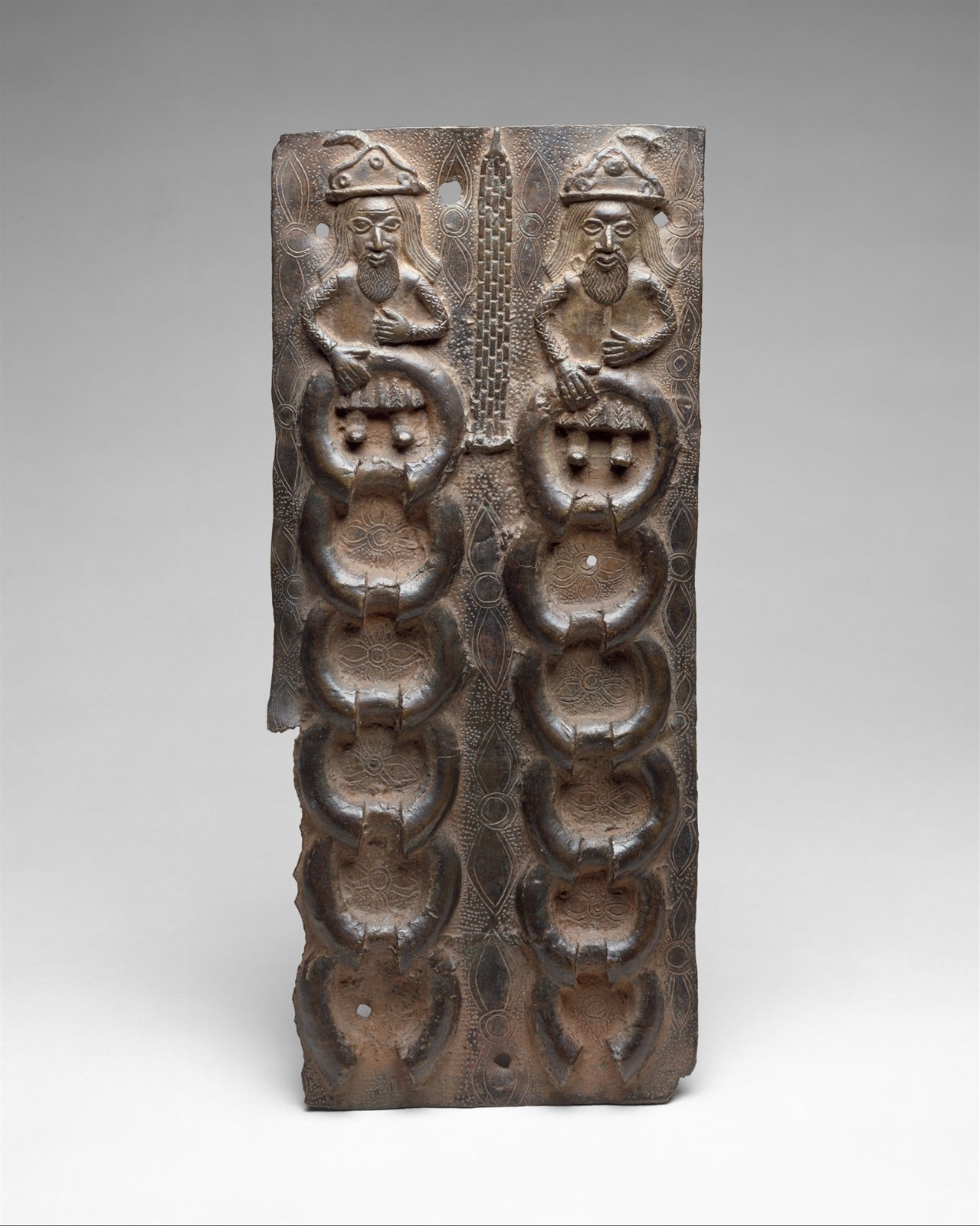
Scientific analysis adds another strand. A 2023 study of brass and manillas compared chemical composition and lead isotopes, linking much of the earlier metal supply to the German Rhineland. Those materials traveled through Atlantic commercial systems entangled with the slave trade. Metal provenance and object provenance answer different questions, however. Identifying where brass originated cannot establish who later took a particular plaque, or make its artistic conception European.
Commerce and the road to invasion
By the late nineteenth century, British commercial and territorial ambitions threatened Benin’s independence. Disputes concerned control over access, trade and political authority. National Museums Scotland describes the pressure surrounding the 1892 protection treaty and the determination to force the kingdom open to British firms and missionaries. The palace’s restrictions became obstacles to an expanding colonial system.
In January 1897, acting consul-general James Phillips led a party toward Benin City despite requests to postpone the visit. Edo forces ambushed it on 4 January. Phillips, six other British members and many African carriers were killed. The British Museum’s historical account emphasizes both the provocative circumstances of the mission and the African deaths, which disappear when the episode is described simply as the murder of British officials.
The mission’s purpose and the decisions inside Benin deserve careful treatment. Nigerian historian Osarhieme Benson Osadolor’s study of Benin’s military system examines Phillips’s earlier advocacy of military action, the warnings he received and divisions among the oba and military chiefs. Osadolor interprets the journey as reconnaissance connected with imperial expansion. That is a historical argument grounded in documents and local testimony, rather than a reason to invent Phillips’s private thoughts or assume every Edo leader held the same position.
It is equally misleading to make the ambush erase everything that preceded it. The killing supplied an immediate justification for intervention, but British ambitions in the region were already established. Explaining those ambitions does not require minimizing the deaths of the expedition’s African laborers or its British members.
The invasion and its human cost
A British force commanded by Admiral Harry Rawson captured Benin City on 18 February 1897. Its designation as a punitive expedition presented conquest as punishment. The force also depended on African auxiliary troops and carriers. Imperial warfare drew different African communities into different roles; an account divided neatly between Europeans and Africans misses that coercive and political complexity.
The Pitt Rivers exhibition history describes villages burned during the advance, inhabitants fleeing and the seizure of royal possessions. The number of people killed cannot be established precisely. Surviving British documentation is much better at counting its own personnel and recording trophies than at reconstructing the losses of households displaced by the attack.
British troops reported evidence of human sacrifice. That evidence belongs in the history of the kingdom, alongside the history of slavery and royal violence. It does not settle the separate question of whether invading troops were entitled to destroy communities and carry away their property. Colonial publicity made selective descriptions of African cruelty serve the case for imperial rule.
Osadolor’s military history restores the significance of Edo resistance. It examines an organized political and military system facing an invading power, rather than treating Benin as a passive stage on which British officers acted. The imbalance in surviving casualty figures should encourage caution, not turn the people whose deaths went uncounted into a negligible part of the story.
How seizure became a museum accession
The looting separated objects from palace compounds and from the relationships that had given them meaning. Brass plaques, commemorative heads, ivory carvings, wooden works and regalia entered different channels. The collective name “Bronzes” disguises this range of materials. It also encourages an image of a single bounded collection, when the dispersal involved many hands and many transactions.
Some objects passed into official British custody; others went to expedition members and the commercial market. The British Museum records that it displayed 304 plaques borrowed from the Foreign Secretary in autumn 1897 and subsequently received 203 of them as a donation. Those numbers describe a particular institutional transaction, rather than a complete inventory of everything removed from Benin.
Dealers made the distribution international. National Museums Scotland identifies William Downing Webster as a major supplier, selling it 34 Benin works and donating another between 1897 and 1903. His stock came through military participants and auctions. A museum purchase could therefore be financially ordinary at its final stage while depending on violence at the beginning of the chain.
A surviving letter makes the transformation especially concrete. Cambridge’s presentation of Tony Phillips’s work on the Benin Bronzes reproduces Webster’s correspondence of 7 August 1897, offering four brass and bronze pieces taken during the expedition for £50. The reference to the invasion functioned as sales information. The circumstances of removal were not necessarily secret to the buyers.
Cambridge’s archival record Doc.511 identifies acquisition correspondence involving Webster, W. O. Oldman and museum staff from 1897 to 1923. Its modern cataloguing history adds another lesson: letters formerly dispersed among incoming correspondence and acquisition files were gathered under a single reference in 2023. Evidence can become newly visible without being newly discovered. How an institution organizes its own papers affects the questions outsiders can ask.
What a provenance record can prove
Provenance research reconstructs an object’s movements and custodians over time. For Benin material, that might mean connecting a museum accession number with a dealer’s photograph, a sale catalogue, a military officer’s name and an expedition diary. Each link needs its own evidence. A donor’s name answers who transferred an object to a museum; by itself, it does not answer how the donor’s predecessor obtained it.
Dan Hicks’s interim report on Oxford’s Benin collections distinguishes objects tied to the 1897 expedition from those whose connection remains uncertain, as well as later material requiring separate investigation. The distinction is essential. Benin’s artists continued making works after the conquest, and a modern Benin sculpture cannot be assigned an 1897 removal merely because of its style or place of origin.
The same caution must work in both directions. A missing receipt from the moment of seizure does not establish a voluntary sale. Military plunder rarely produces a record signed by its dispossessed owner. Researchers have to weigh the dates, the known activities of collectors and dealers, and the wider pattern of dispersal while stating where an individual chain remains incomplete.
Digital Benin’s provenance research helps by connecting names and roles across institutional records. Someone appearing as a donor in one museum can emerge as a dealer or intermediary elsewhere. Such connections make it possible to examine the network through which objects traveled instead of treating each museum’s accession as an isolated beginning.
The loss that a catalogue cannot repair
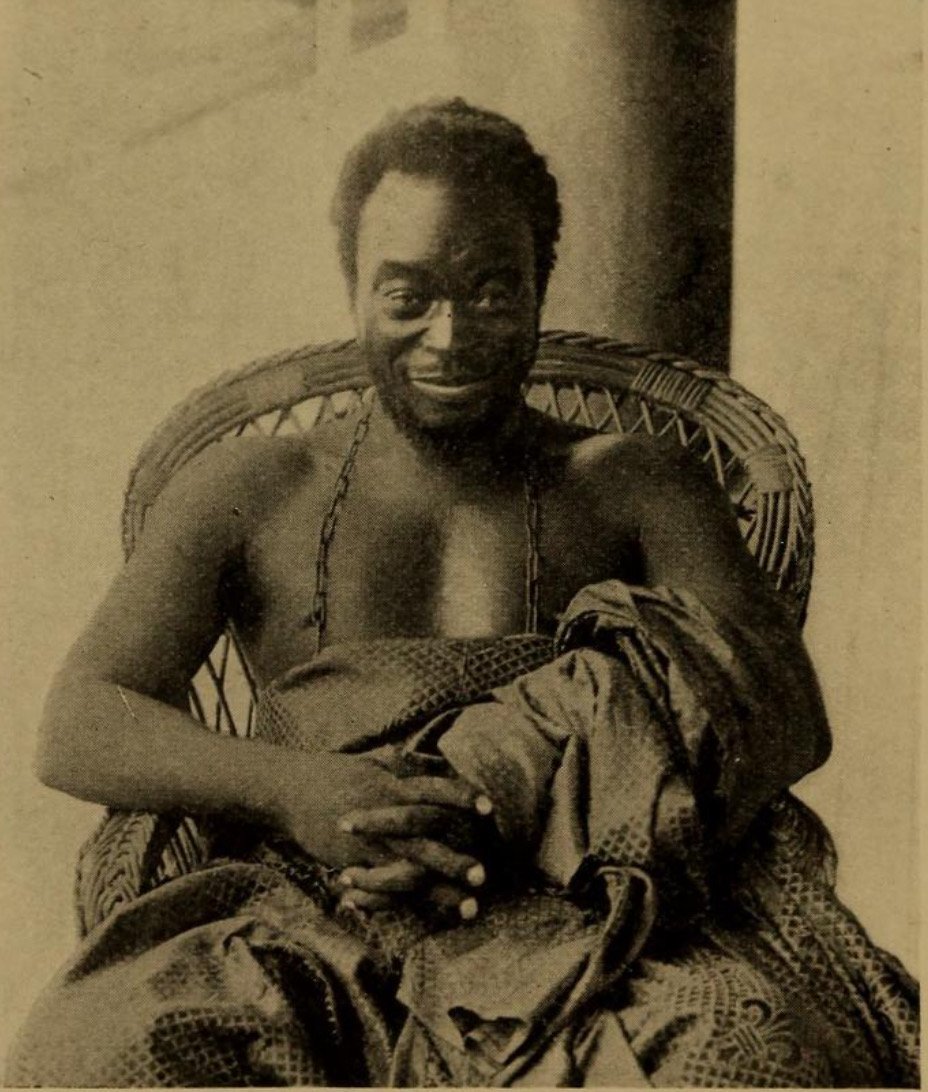
Ovonramwen was removed from power and exiled to Calabar. An 1897 portrait reproduced in H. Ling Roth’s Great Benin shows him aboard the yacht Ivy during that journey. The image is attributed to the Nigerian photographer Jonathan Adagogo Green, whose authorship is recorded by the Weltmuseum Wien. Even the visual archive of conquest includes African makers whose work can disappear behind a generic colonial caption.
The separation of palace objects had consequences beyond their market value. Commemorative heads belonged to ancestral altars maintained through royal succession. The Metropolitan Museum’s account of a royal head explains the relationship between a new oba, the commemoration of his predecessor and the continuing influence of ancestors. An isolated head in a showcase preserves craftsmanship while revealing only part of that relationship.
The removal also damaged historical knowledge. A work can retain its carved features while losing its documented association with a particular altar, ruler or ceremony. Later stylistic dating may suggest a period of manufacture without recovering that original placement. Conservation can stabilize brass and ivory; it cannot recreate every connection broken when the palace was emptied.

Edo knowledge and the continuing kingdom
European acquisition documents are indispensable evidence of dispersal, but they cannot supply the whole account. Digital Benin’s Itan Edo explicitly presents the kingdom’s history through Benin-authored sources. Its scope includes rulers, guilds, women, festivals and local institutions. That changes the organizing question from who collected an object to the society within which it mattered.
The project’s oral-history collection includes testimony about the 1897 sack, military history, songs and demonstrations of artistic techniques. Contributors include Osadolor and practicing craftspeople. These accounts require the same attention to date, speaker and purpose as written documents. They also preserve forms of knowledge that an officer’s inventory was never designed to record.
Language matters too. Ẹyo Otọ supplies Edo names and explanations rather than relying exclusively on imported museum categories. Its account of the ada sword, for example, places it within the display and delegation of royal authority. Calling such an object merely a weapon or a decorative implement would omit the political relationship expressed by carrying it. Better descriptions restore specificity even when an object remains far from home.
The monarchy and its arts survived the destruction in altered circumstances. The Art Institute of Chicago’s historical exhibition account describes Eweka II’s restoration in 1914 under colonial constraints and his renewal of patronage. He established an altar for Ovonramwen and a collective altar for earlier rulers. Those commissions demonstrate active rebuilding by people who had to live with the consequences of 1897.
Return and the history still attached to an object
Restitution has a history longer than recent headlines. In 1938, pieces of Ovonramwen’s coral regalia returned to his grandson Akenzua II. More recently, the Smithsonian’s announcement of 11 October 2022 recorded the transfer of ownership of 29 works to Nigeria’s National Commission for Museums and Monuments. That is a dated example, not a current total of all returns worldwide.
Ownership transfer, physical return and an agreement to lend a work are distinct events. Clear reporting has to say which occurred, when, and between whom. Those distinctions prevent the language of restitution from becoming as vague as an old accession label.
The history of Benin’s dispersed objects begins with makers, patrons and communities. It passes through conquest and commerce, then through research, claims and decisions about return. A responsible account preserves that sequence. The paperwork matters because it reveals how dispossession was carried forward, and because it can help reconnect surviving objects with the histories and people from whom they were taken.
Sources and further reading
- equestrian plaque
- Pitt Rivers Museum’s account of Benin
- plaque depicting Portuguese figures and manillas
- 2023 study of brass and manillas
- National Museums Scotland
- British Museum’s historical account
- study of Benin’s military system
- Pitt Rivers exhibition history
- presentation of Tony Phillips’s work on the Benin Bronzes
- archival record Doc.511
- interim report on Oxford’s Benin collections
- Digital Benin’s provenance research
- Weltmuseum Wien
- account of a royal head
- Digital Benin’s Itan Edo
- oral-history collection
- Ẹyo Otọ
- historical exhibition account
- Smithsonian’s announcement of 11 October 2022