
Qin’s Terracotta Army: The Workshops Behind an Emperor’s Afterlife
Individual faces and ordered ranks conceal a second army: the craftspeople, supply networks and administrative systems that made imperial power out of clay and bronze.
The empty hands of a terracotta soldier can be misleading. The clay figure survives, while the wood that once completed his equipment may not. In the burial pits near Xi’an, archaeologists have recovered bronze weapon parts alongside the warriors: evidence that an apparently silent sculpture once belonged to a carefully equipped formation. The army was an image of military power, but much of its equipment was more than an image.
That distinction opens a different way of looking at the First Emperor’s famous burial complex. Instead of asking only how many soldiers there are, we can ask how their makers supplied, assembled and positioned them. Clay recipes, tool marks and small differences in bronze can expose a system of production which the finished spectacle was intended to conceal.
The familiar view is a mass of human faces. The less familiar story concerns coordination. Someone had to provide raw materials, maintain standards, move fragile objects and decide where each finished item belonged. The army’s scale made these problems inseparable from the power of the state that commissioned it. The joint Imperial Logistics project treats the mausoleum as evidence of that organisation, not simply as a collection of masterpieces.
A burial project larger than its soldiers
Ying Zheng became king of Qin in 246 BCE. In 221 BCE, after the conquest of the other major rival states, he adopted the title by which he is remembered: First Emperor. He died in 210 BCE. The UNESCO account of his mausoleum places the army within a much larger funerary landscape, with the tomb mound, walls, structures and numerous accompanying pits. The soldiers are not the emperor’s burial chamber.
This matters because the army’s purpose cannot be read from military equipment alone. The entire complex projected an imperial world into death. Its arrangement and contents made authority seem capable of continuing beyond the ruler’s lifetime. The surviving burial landscape is therefore both an extraordinary construction project and a political claim made in material form.
Difference inside the ranks
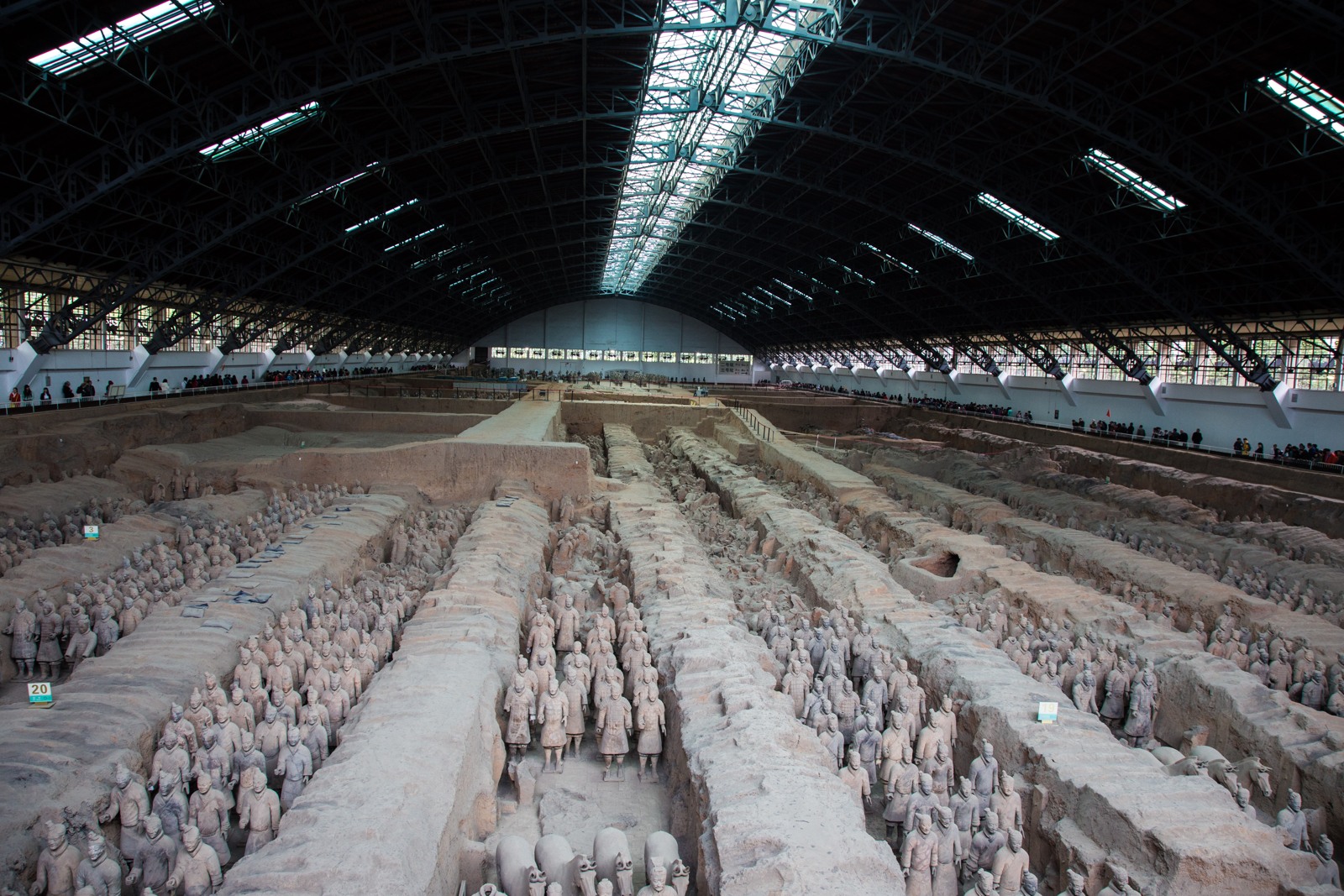
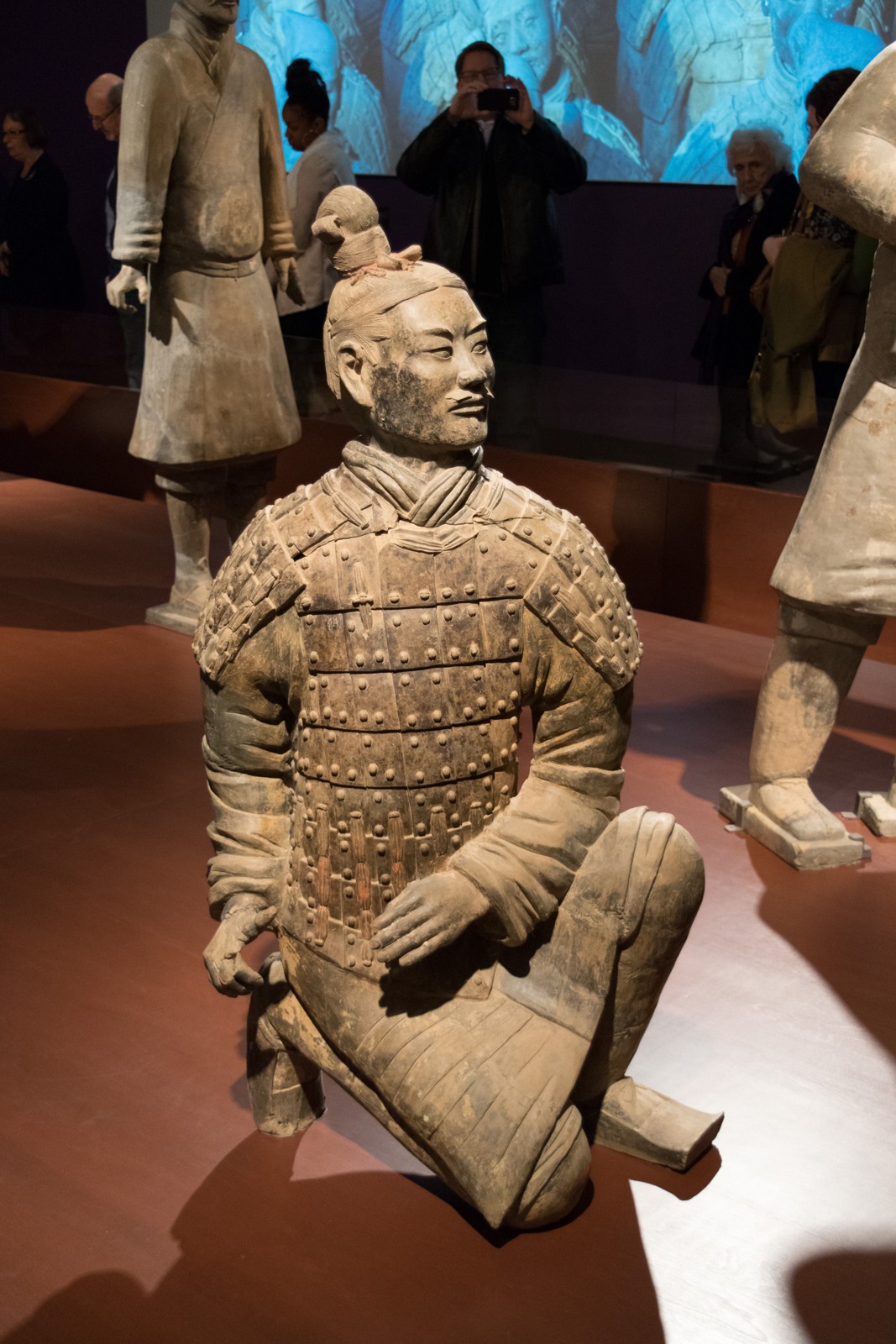
The discovery of warrior fragments by farmers digging a well in 1974 led to excavations that transformed knowledge of Qin burial practice. Yet the first impression of endless repetition does not survive close inspection. Armour, posture and headgear distinguish different kinds of figures. Kneeling archers do not perform the same visual role as standing officers. A formation is made legible through differences as well as similarities.
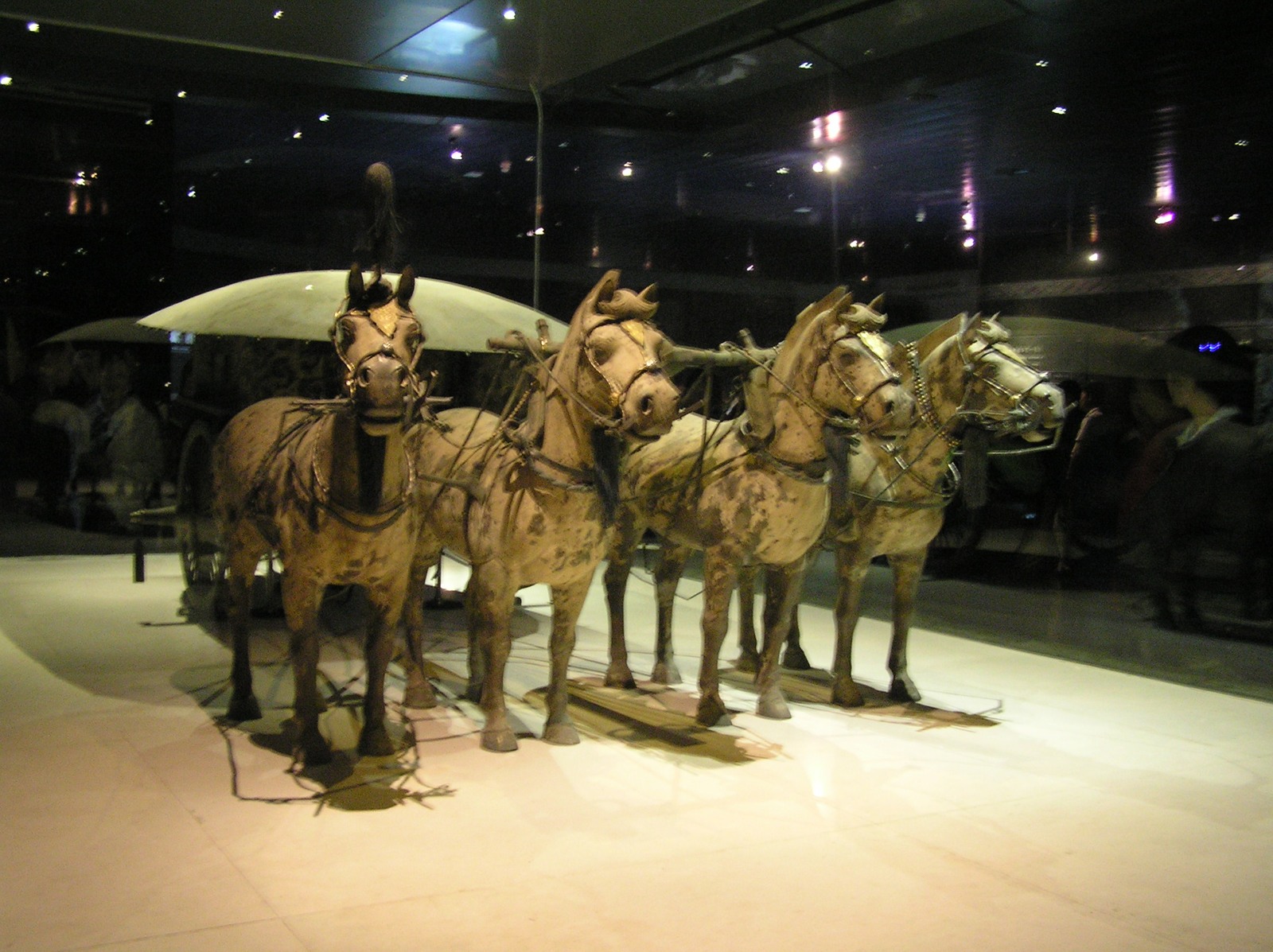
The Cincinnati Art Museum’s exhibition guide identifies infantry, cavalrymen, charioteers and officers among the pit assemblages. It also places officials, entertainers, stables and other installations elsewhere in the funerary complex. These are not interchangeable accessories. Together they suggest a court and its supporting activities, rather than a battlefield reproduced in isolation.
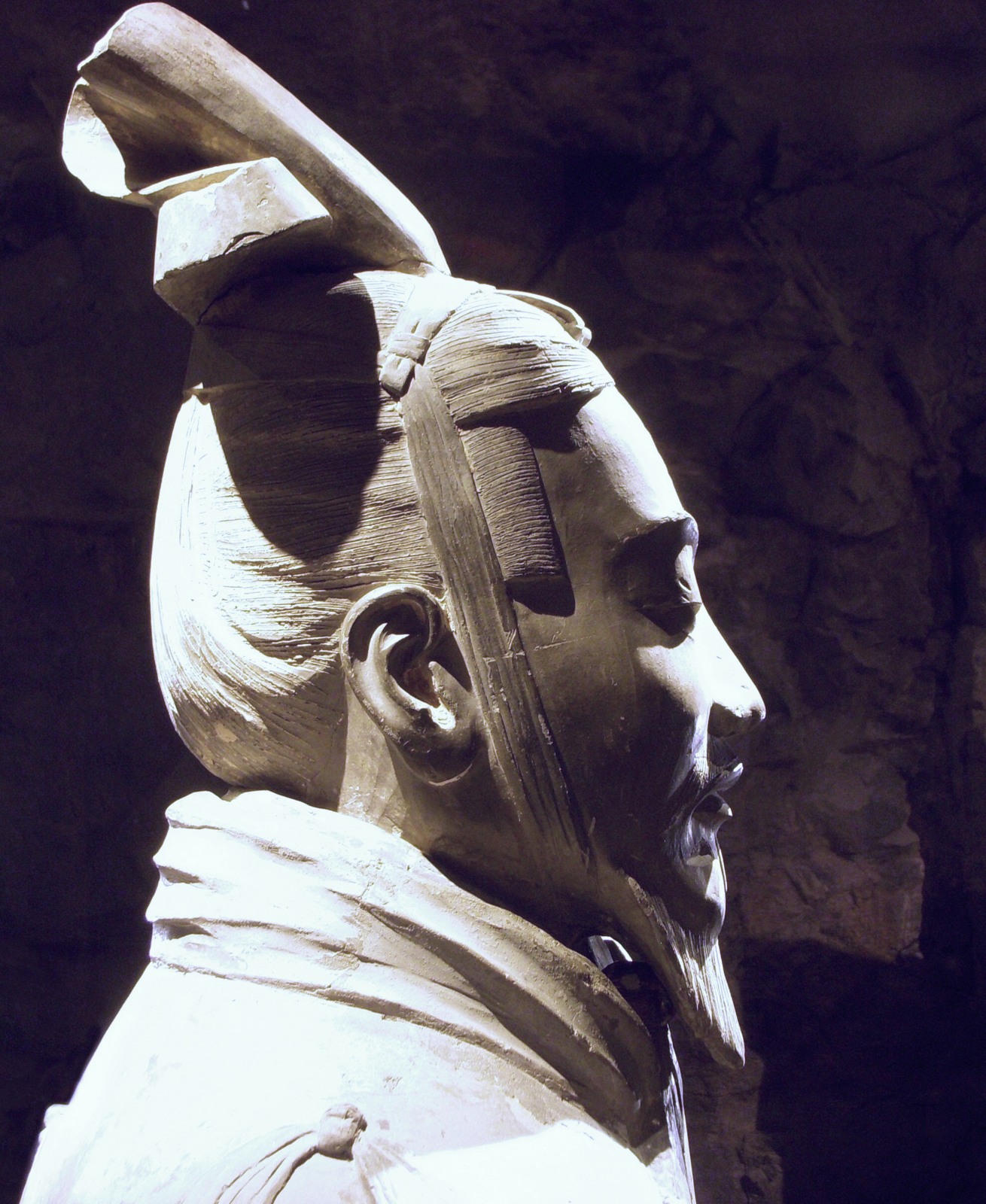
Nor should expressive faces automatically become biographies. A carefully finished face is not proof that a named living soldier sat as its model. The Metropolitan Museum’s discussion of manufacture makes the distinction explicit: individual-looking features and large-scale production can coexist. The opposing labels “unique artwork” and “mass-produced object” describe the evidence poorly when treated as mutually exclusive.
Reading the figures as a hierarchy is more secure than inventing personalities for them. Clothing and placement identify relationships which a viewer can compare across the group. We can see differentiation without knowing the thoughts of the person represented—or even whether a particular person was represented at all. That restraint leaves the craftsmanship more interesting, not less: makers had to produce convincing human variation within a commissioned order.
What the clay remembers
Large hollow figures create practical difficulties. Their weight must be supported while the clay is wet; drying and firing must avoid destructive stresses. The finished surfaces do not supply a complete instruction manual. Scholars have disagreed about how much was moulded, how much was hand-built, and when different parts were joined. Experimental reconstructions test possibilities, but a successful modern reconstruction does not by itself establish one universal ancient method.
The 2017 ceramic study by Patrick Sean Quinn and colleagues approached production through microscopic analysis of clay materials. Its results support manufacture near the mausoleum and suggest centrally processed clay supplied to local workshops. A coordinated supply system could therefore exist without every operation taking place in one room or under one pair of hands.
There is a useful distinction here between central control and a single production line. Preparing comparable materials for several workshops could help maintain standards while allowing different teams to work in parallel. The clay provides evidence for connections among tasks, not a surviving roster of the workers who carried them out. Organisation has to be reconstructed from patterned material differences.
A later geochemical investigation added another qualification. Patterns within the statues did not fit a simple picture of prefabricated parts arriving from multiple workshops with different clay preparations. The research instead sharpened questions about where materials were prepared and how objects were built. Such findings caution against using “assembly line” as a convenient modern explanation for every impressive ancient output.
The contrast is not between clever individuals and an impersonal state. Skill and organisation operated together. Administrative demands could specify what was needed; potters still had to make the clay behave. A ruler’s command could initiate the work, but it could not substitute for knowledge of materials.
Bronze weapons and the importance of a batch
Bronze offers a second route into the workshops. The study of the army’s arrowheads combined chemical composition, measurement and find location. Its authors argued for production in flexible, multi-skilled units rather than one vast linear sequence. A group could make a batch of complete items while other groups worked alongside it. Similar end products did not require the disappearance of all local variation.
This interpretation depends on combinations of evidence. Two objects can look alike yet differ chemically; two objects with similar metal can have different manufacturing histories. The strongest argument comes when chemical groupings, shape and archaeological position reinforce one another. “The batch” becomes a way to connect a finished weapon to the process that produced and delivered it.
Research on crossbow triggers asks related questions of complex mechanisms assembled from several bronze components. Tiny variations can help identify related groups of parts. The result is not simply admiration for a sophisticated weapon. It is a way to investigate whether coordinated teams supplied complete mechanisms and how their output entered the burial formation.
These findings should not be stretched into a complete economic constitution for Qin China. The mausoleum was an exceptional commission, supported by exceptional demands. Evidence of its workshop arrangements demonstrates what could be organised for this project. Whether the same arrangement governed every ordinary workshop is a different question, requiring other sites and other evidence.
Still, the army makes an important historical point visible. Standardisation need not mean absolute uniformity. A shared specification can be achieved by several teams whose products retain measurable differences. Archaeology can recover those differences even when the finished display was meant to communicate a single overwhelming authority.
Why location and survival change the story
An arrowhead without a find location is a different kind of evidence from an arrowhead recorded beside a particular group of figures. As Andrew Bevan explains in the Imperial Logistics project’s account of spatial research, small variations become more informative when mapped across the pits. They can help distinguish production groups and deliveries within a larger military arrangement.
The pits also constrained the sequence of work. Placing and equipping heavy figures in confined corridors required an order of operations. Researchers can investigate that order through distributions rather than imagining a fully finished army lowered into place at once. The setting is not a neutral container; it helped determine how labour was organised.
Survival introduces a further complication. The bronze weapons’ condition once encouraged an influential claim that Qin craftspeople had applied an advanced chromium-based anti-corrosion treatment. Research published in 2019 found that chromium was associated with lacquer from nearby organic components rather than an intentional protective coating on the metal. The surrounding soil’s characteristics offered a stronger explanation for much of the preservation.
The revision does not make Qin metalworking unimpressive. It separates two different achievements: making a weapon and preserving it underground for centuries. A surviving surface can be the result of manufacture, burial conditions and later alteration together. Giving the ancient craftsmen credit for the wrong process obscures the genuine technical questions their work can answer.
Names, marks and an unfinished reconstruction
Production marks offer a rare bridge between objects and administration. Research on marking practices interprets repeated marks on warriors and weapons as part of the control of people, materials and finished goods. Such evidence can make a workshop visible without recovering the life story of everyone employed in it. A recorded name or sign belongs to a system of responsibility before it becomes a ready-made biography.
That system is one of the army’s most revealing features. The emperor is the best-known person attached to the site, but he did not shape its clay or cast its bronze. The material evidence directs attention towards the many stages between a political decision and a completed object. Studying those stages does not require replacing one heroic story with another story of anonymous ingenuity. It requires asking which relationships the surviving marks actually establish.
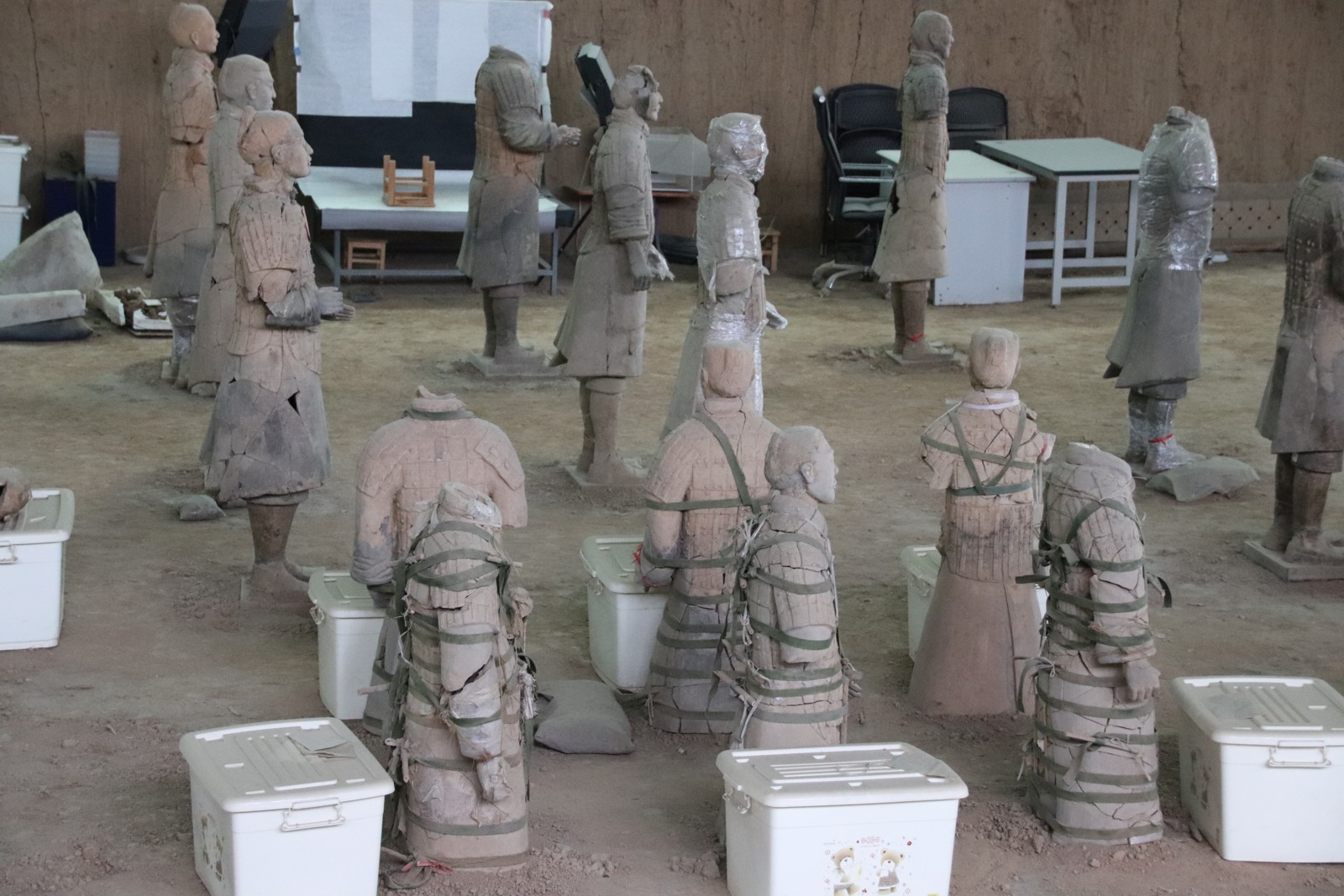
Modern displays can make the ranks appear complete and stable. Excavation, reconstruction and conservation are themselves continuing interventions, however. Reassembled figures are the result of joining ancient fragments; gaps and damage remain part of the record. The photographs of restoration work belong to the modern history of learning about the army, not to the emperor’s original arrangement.
The next important discovery need not be another spectacular face. It may be a relationship between a clay mixture and a workshop, a cluster of weapon parts, or a mark that connects objects previously studied separately. Those small links bring the machinery of imperial production into focus. Behind the ordered ranks was a network of specialised work, and it is that network—not an imagined procession of identical factory-made soldiers—that the evidence increasingly allows us to examine.