
Peterloo, 1819: The Assembly, the Sabres and the Battle over Evidence
The cavalry attack in Manchester lasted minutes. The struggle to establish what happened—and who could speak for the injured—continued through letters, trials, prints and household objects.
At half past two on 16 August 1819, a correspondent signing himself J. Allen recorded what had just happened in Manchester. Henry Hunt had chaired a vast meeting; cavalry had broken into it; flags had been seized; Hunt and his companions were under arrest. People had been killed and wounded. The brief note, now in the Home Office papers at The National Archives, catches the event before it had acquired its enduring name: Peterloo.
The name joined St Peter’s Field to Waterloo, the allied victory over Napoleon four years earlier. It was an accusation, not a geographical confusion. Celebrated instruments of national defence had been used against people demanding a voice in their own country’s government. As historian Robert Poole notes, Waterloo veterans were present on both sides. One, the Oldham cotton spinner John Lees, subsequently died of injuries received at Manchester. His death became the subject of a prolonged inquest. Poole’s account places the incident within a struggle over both political rights and the authority to describe violence.
That second struggle matters. Peterloo survives in official correspondence, testimony, casualty lists, partisan newspapers and images made to provoke anger or ridicule. These sources do not become useless because their makers had commitments. They become more informative when those commitments are identified. The central historical problem is not to average the magistrates’ account with the reformers’ account and call the midpoint impartial. It is to test what each can establish, against evidence produced for other purposes.
A great manufacturing town without its own MPs
Manchester’s political position was striking. The expanding industrial town did not elect its own parliamentary representatives. People with the appropriate county qualification could participate in Lancashire elections, but that was not equivalent to representation for the manufacturing population. Parliamentary geography still privileged many older boroughs while much of the new urban economy remained outside it. The National Portrait Gallery’s historical account connects the demand for reform to this mismatch between population, economic activity and political power.
The grievance was not merely that an electoral map looked untidy. In a period of precarious employment and strained household budgets, laws made by an inaccessible legislature could seem inseparable from daily hardship. The People’s History Museum emphasises the place of handloom weavers in the movement and their anxiety about falling standards of living. Reform offered a political explanation for difficulties that could otherwise appear to be private misfortunes. The same families who negotiated wages, food and rent could ask why they had so little influence over public decisions. The museum’s account of the preparations also shows that the meeting drew organised contingents from surrounding towns, not an accidental crowd assembled on a single impulse.
Hunt supplied a recognisable public voice, but the movement was not created by his arrival. Marching, collecting subscriptions, arranging banners and bringing neighbours together required local organisation. Orderly movement had a double purpose: it enabled large numbers to reach the meeting, and it represented the participants as people capable of collective self-government. This was part of the argument for inclusion.
The same discipline could be read by opponents as a warning. To reformers, a well-ordered procession demonstrated responsibility. To officials anticipating revolution, organised bodies and emphatic banners could look like preparations for coercion. That difference did not make violence inevitable. It helps explain how authorities could interpret the visible success of a political meeting as evidence against its organisers.
The women were political participants, not scenery
The phrase “universal suffrage” must be handled carefully here. Much of the movement’s immediate programme sought the vote for men. Women nevertheless established reform societies, raised funds and appeared publicly in the cause. The Manchester Female Reformers’ address of July 1819 connected political exclusion to the suffering of children, parents and working households. Domestic experience was not outside politics in this argument; it supplied reasons for intervening in it.
Female organisation attracted hostility of its own. George Cruikshank’s caricature of the Blackburn female reformers, made before Peterloo, turned their public activity into an object of sexual and social ridicule. Parliament’s collection description identifies the meeting and demands behind the print. It is valuable evidence of hostility to organised women, not a reliable visual description of what those women looked like or how they behaved.
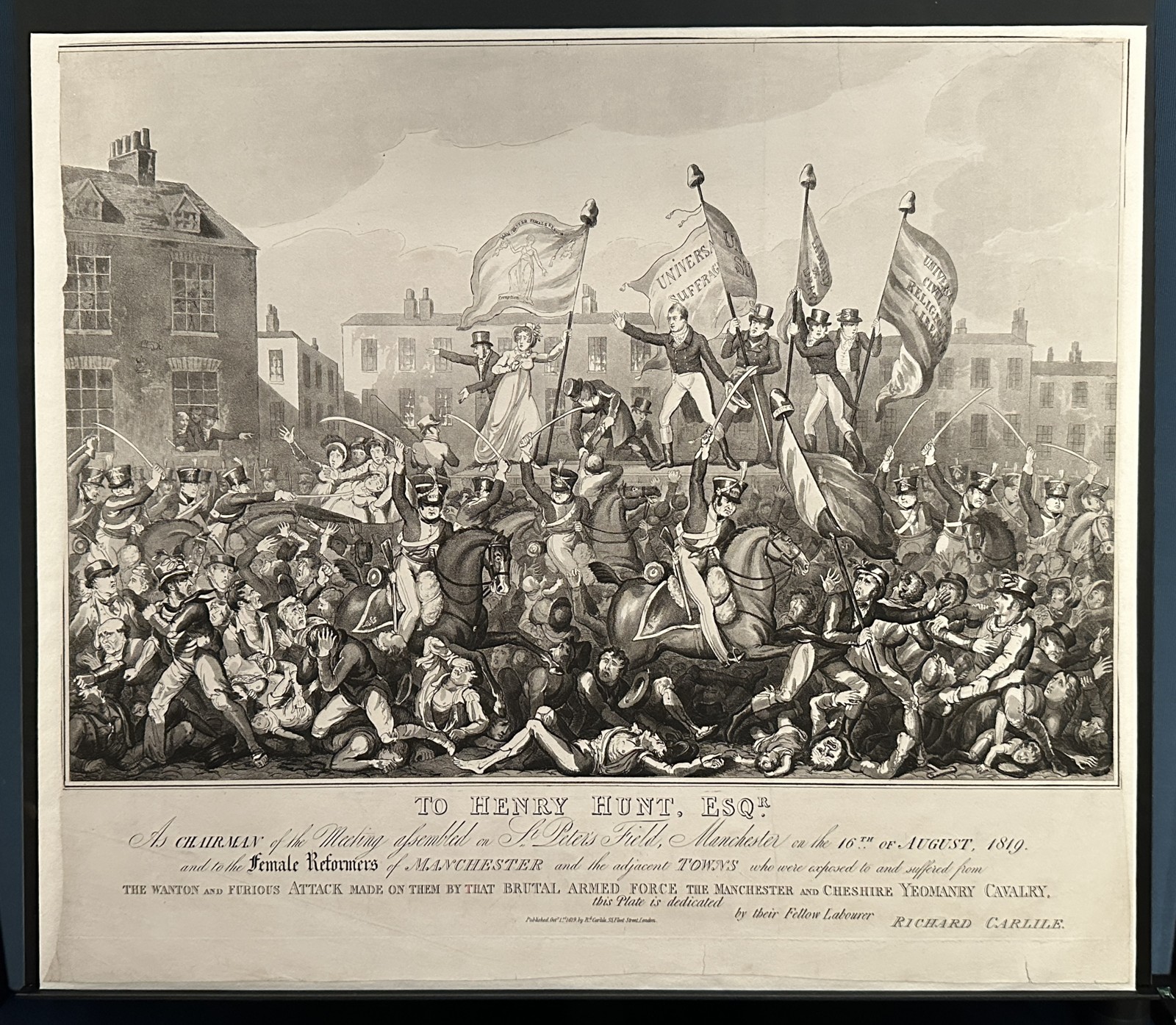
Mary Fildes, president of the Manchester Female Reform Society, stood with the speakers at Peterloo, holding a banner whose pole carried a liberty cap. Other women came in organised groups. Their presence makes it misleading to describe the gathering simply as male workers accompanied by families: some women were active organisers in their own right. Equally, it would be anachronistic to give every participant the programme of a later women’s suffrage organisation.
The People’s History Museum’s research on women at Peterloo estimates that women formed roughly one in eight participants but about one in four casualties. Those proportions are reconstructions, not a census taken at the field. They nevertheless support witness accounts that women experienced disproportionate violence. A history that treats them only as incidental victims misses both their agency before the attack and why their presence disturbed opponents of reform.
What cavalry could do to a packed meeting
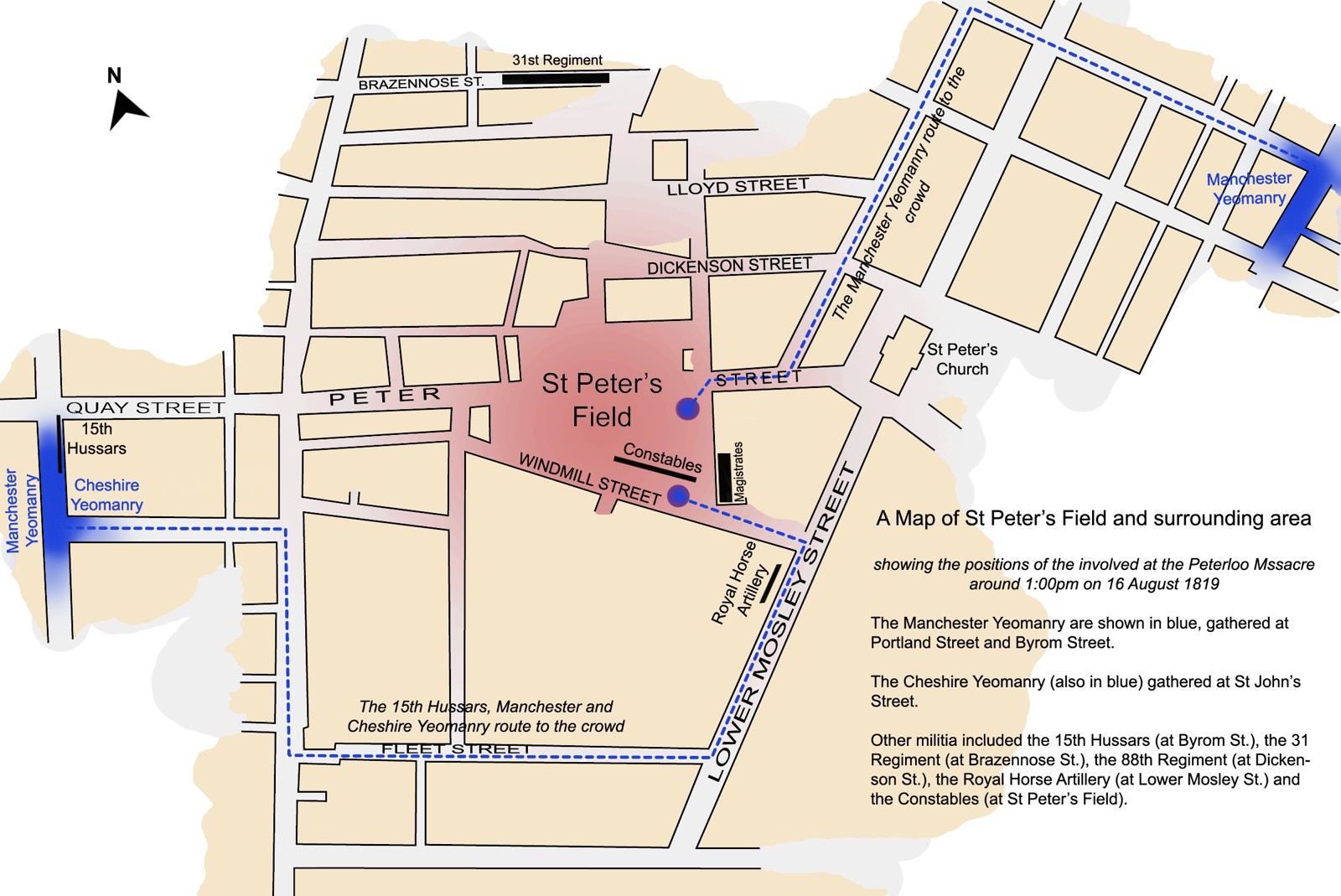
Modern estimates commonly put the assembly at around 50,000 to 60,000. Exact counting was impossible, and the largest contemporary numbers should not be mistaken for turnstile records. What matters operationally is that a densely packed political gathering filled a confined urban space. Sending mounted men towards a platform through that crowd was not a neutral means of delivering a warrant.
The magistrates ordered Hunt’s arrest. The Manchester and Salford Yeomanry, a locally recruited volunteer cavalry force, entered with drawn sabres; regular cavalry also took part in dispersing the assembly. The National Army Museum’s account and contemporary satirical print distinguish the forces present and the official attempt to end the meeting. The sequence matters: the central issue is the decision to use armed cavalry against an assembly, not simply the fact that disorder existed once horses and weapons were among the people.
Some details remain contested, and individual recollections cannot reconstruct every movement across the field. But uncertainty at that scale does not erase the larger evidential pattern of a peaceful gathering being violently dispersed. Poole’s modern estimate is eighteen dead or mortally wounded and roughly 650 injured. Other museum accounts give nearly 700 injuries; older summaries sometimes list fewer deaths. The numbers reflect different reconstructions and the difficulty of tracing people who died later, rather than a single stable register from the afternoon itself.
Casualty evidence also has a history. Manchester’s John Rylands collection preserves a military casualty summary, including a list of injuries to horses supplied to the magistrates. Its survival reminds us that official record-making had its own priorities. Such a document can answer questions about the forces deployed without becoming a complete account of civilian suffering. Neither its existence nor the existence of injuries among troops establishes that a planned insurrection was under way.
A child’s death and an official defence
The death of two-year-old William Fildes shows how the argument moved from physical events to responsibility. In a November statement printed in a paper intended to rebut allegations against the military, his mother Ann described being knocked down by a cavalryman’s horse while crossing a street. The child fell from her arms and died. Another witness, the solicitor Robert Henry Wilson, characterised the collision as accidental and placed the blame on her sudden crossing. Both statements are reproduced in the National Archives source pack.
The distinction is revealing. A defence could acknowledge the fatal collision while denying culpability. Historians must therefore separate several questions: whether the collision happened, what each witness saw, how the statement was elicited and published, and what inference its editors wanted readers to draw. The title of a defensive pamphlet is not the conclusion of an independent inquiry. Nor does the tragedy license an invented account of the mother’s thoughts or a dramatic scene beyond the testimony.
Visual sources require the same discipline. Richard Carlile’s October 1819 print placed cavalry, wounded people and the speakers’ platform in a single crowded composition. The National Portrait Gallery identifies its publication date and political setting. It made an argument about the violence, with women prominent in the image. It was not a photograph, and its arrangement cannot by itself prove where every person stood.
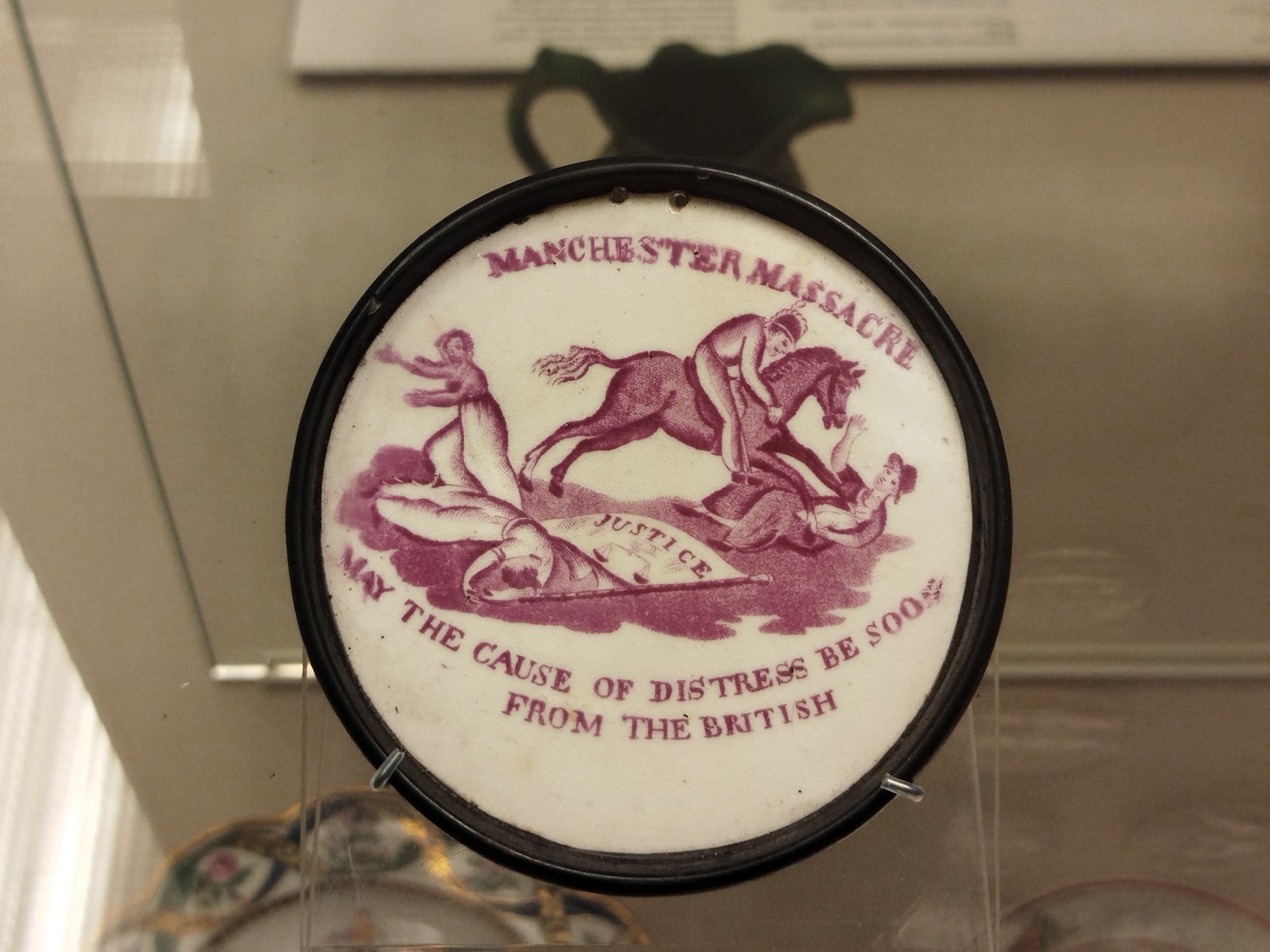
Prints and objects nevertheless reveal something that official letters alone cannot: the ways an event became portable. A picture could be displayed; a ceramic plaque could give the massacre a place in a household. These were material forms of political memory. They kept the attack available for discussion after the field had emptied, while also selecting particular meanings from it. The struggle over evidence was therefore not confined to a courtroom. It took place wherever people read, looked, remembered and argued.
Repression first, reform later
The government’s immediate response was not to concede the demonstrators’ programme. Home Office correspondence conveyed approval of the magistrates’ conduct. Hunt and other organisers faced prosecution. In 1820, five of the ten defendants were convicted on one charge, rather than on the much wider allegations originally attached to the meeting. That narrower outcome matters: the presence of convictions does not retrospectively validate every official claim about a revolutionary conspiracy.
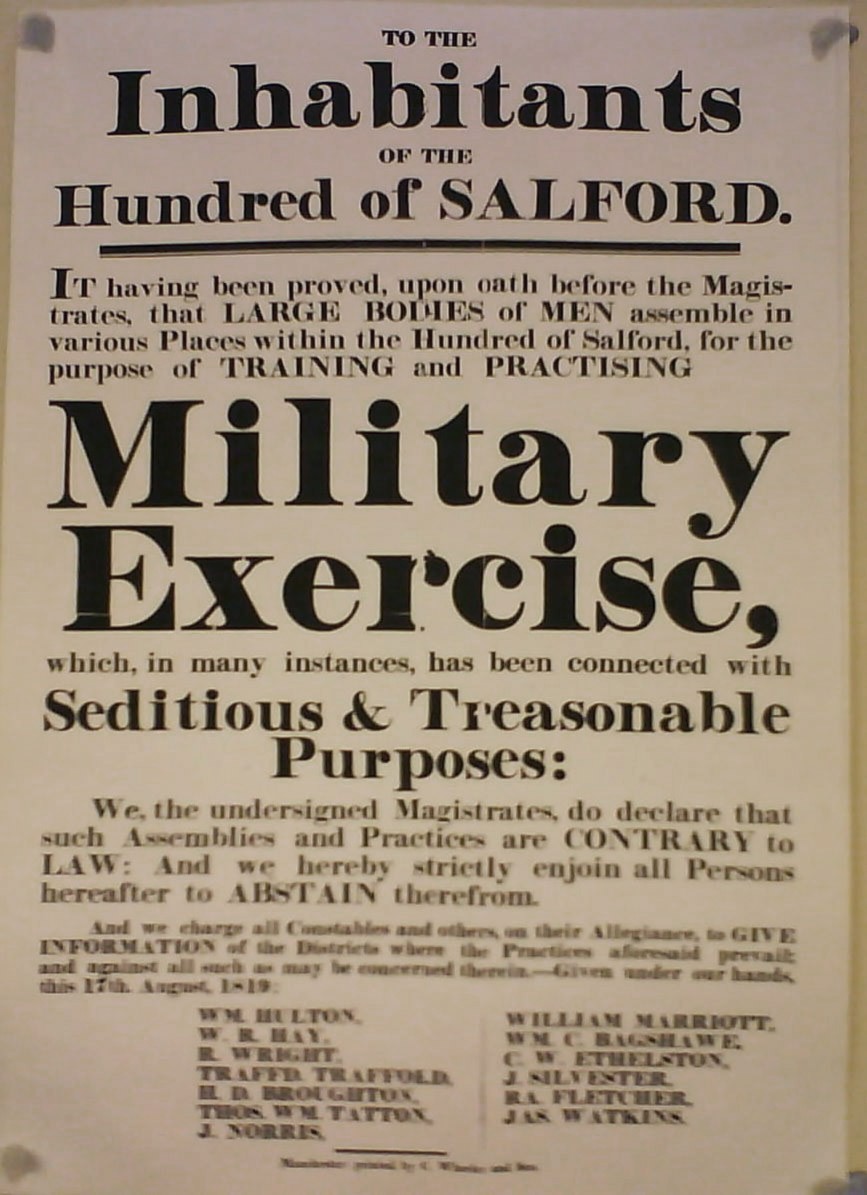
The legislative response was restrictive. The measures known as the Six Acts attacked several conditions that made radical mobilisation possible. The Seditious Meetings Act of 1819 imposed controls on political gatherings; other legislation addressed drilling, weapons and the radical press. These were attempts to constrain the movement’s capacity to assemble and circulate arguments. Outrage at Peterloo and the state’s ability to punish its opponents existed at the same time.
It is tempting to finish the story with the Reform Act of 1832, as if the massacre had purchased a predetermined democratic victory thirteen years later. That makes the intervening political struggles disappear. The 1832 settlement redistributed seats and expanded a property-based male electorate, but excluded most working men and explicitly defined the parliamentary voter as male. It did not grant the broad suffrage sought by the reform movement at Peterloo. The later Chartist movement arose partly from that unfinished business.
Peterloo’s importance lies neither in a claim that nothing changed nor in a comforting story that violence automatically produces progress. The surviving record shows an organised demand for representation, a coercive response and a sustained contest over what that response meant. It also preserves the labour of people who refused to let official reassurance be the final account. Their letters, testimony, images and lists did not all say the same thing. Read together, and with attention to their purposes, they make the event more—not less—intelligible.