
Books & Movies
Nuremberg (2025): The Psychiatrist’s Duel and the Court Beyond It
A research-based critical introduction to a historical drama, and to the records that keep its central confrontation from becoming the whole story.
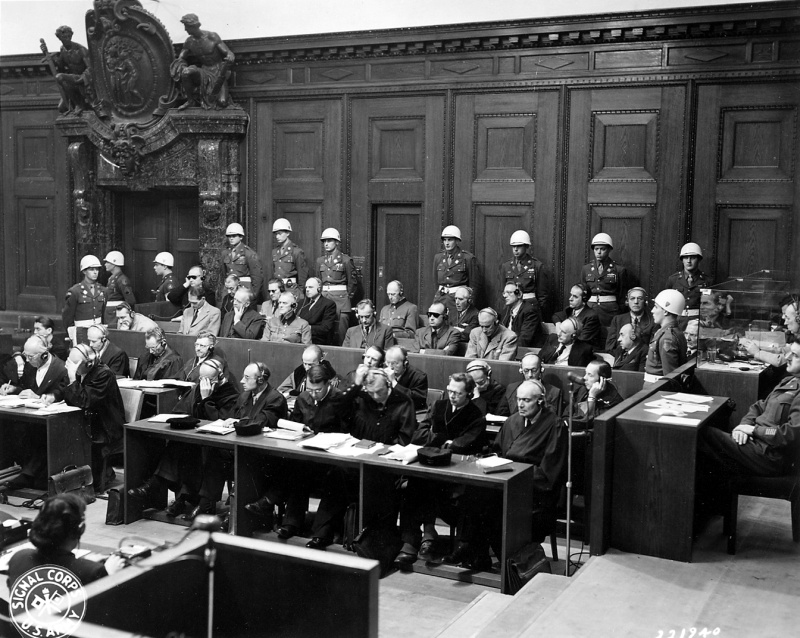
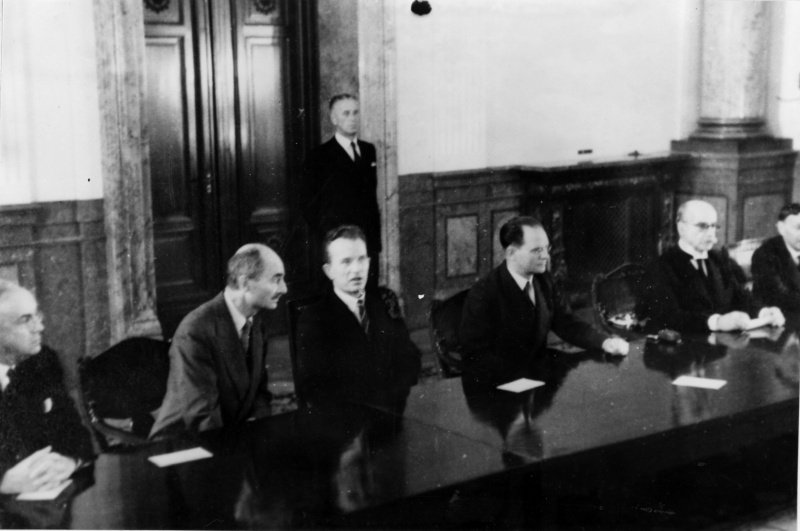
A courtroom photograph from November 1945 places Hermann Göring at one end of a long row of defendants. The men sit behind a wooden barrier, watched by military police; elsewhere in the room, interpreters turn speech into the languages of four prosecuting powers. The composition makes a useful counterweight to the premise of Nuremberg, James Vanderbilt’s 2025 film. Cinema offers a confrontation between a psychiatrist and a prisoner. The photograph shows a much larger apparatus built to prevent the prisoner from controlling the terms of the encounter.
That tension—not simply whether an actor resembles a historical figure—is the most interesting way into the film. Its official synopsis pairs Robert H. Jackson’s prosecution with the psychological contest between US Army psychiatrist Douglas Kelley, played by Rami Malek, and Göring, played by Russell Crowe. Michael Shannon plays Jackson. The attraction is clear: an immense historical problem becomes a relationship that an audience can follow. The danger is equally clear. The question of how a man explains himself can displace the question of how institutions establish what he did.
A note on scope: this is a research-based critical introduction, using the distributor’s description, published assessments, historical documents and museum scholarship. It is not a claim to have watched the complete film. The images are authentic historical context, not production stills. The film remains a subject of substantive discussion in 2026, including John Griswold’s May essay in Washington University’s Common Reader; that is a dated critical signal, not a claim about audience consensus or commercial success.
The attraction of the private encounter
A psychiatrist has a reason to ask questions that a prosecutor may not. Kelley’s official responsibility was to assess and help maintain the prisoners’ fitness for trial. His broader interest was whether their conduct could be explained through a recognizable psychiatric pattern. Those are different inquiries. A defendant can be competent to understand a trial without being admirable, truthful or free of psychological disturbance. Nor does competence establish guilt: that requires evidence about acts and responsibility.
The National WWII Museum’s account of the film usefully preserves this distinction between Kelley’s professional duty and his personal investigation. It also illustrates why the encounter offers a strong dramatic structure. The examiner must listen closely to a person whose self-presentation is itself strategic. Attention is necessary to the work, but attention can become the very reward an ambitious prisoner seeks. A film can make that predicament accessible without requiring viewers to master the tribunal’s entire legal architecture.
There is a further complication in the source trail. The film adapts Jack El-Hai’s work on Kelley and Göring. In an Associated Press interview, El-Hai described gaining access through Kelley’s family to a substantial private archive. Such material can open a perspective unavailable in courtroom transcripts. It cannot, by itself, turn a particular relationship into a complete explanation of Nazi power. Private papers and public proceedings answer overlapping but different questions.
That is not an objection to choosing a narrow subject. A two-person story can be historically revealing precisely because it is narrow. The test is whether the surrounding world retains enough weight to resist being absorbed into the duel. Does an official document remain independent evidence, or become merely a prop in a battle of personalities? Does the audience encounter the prisoner’s explanations as explanations offered by an interested party, or as privileged access to the secret of a whole regime?

A trial had to be made, not simply announced
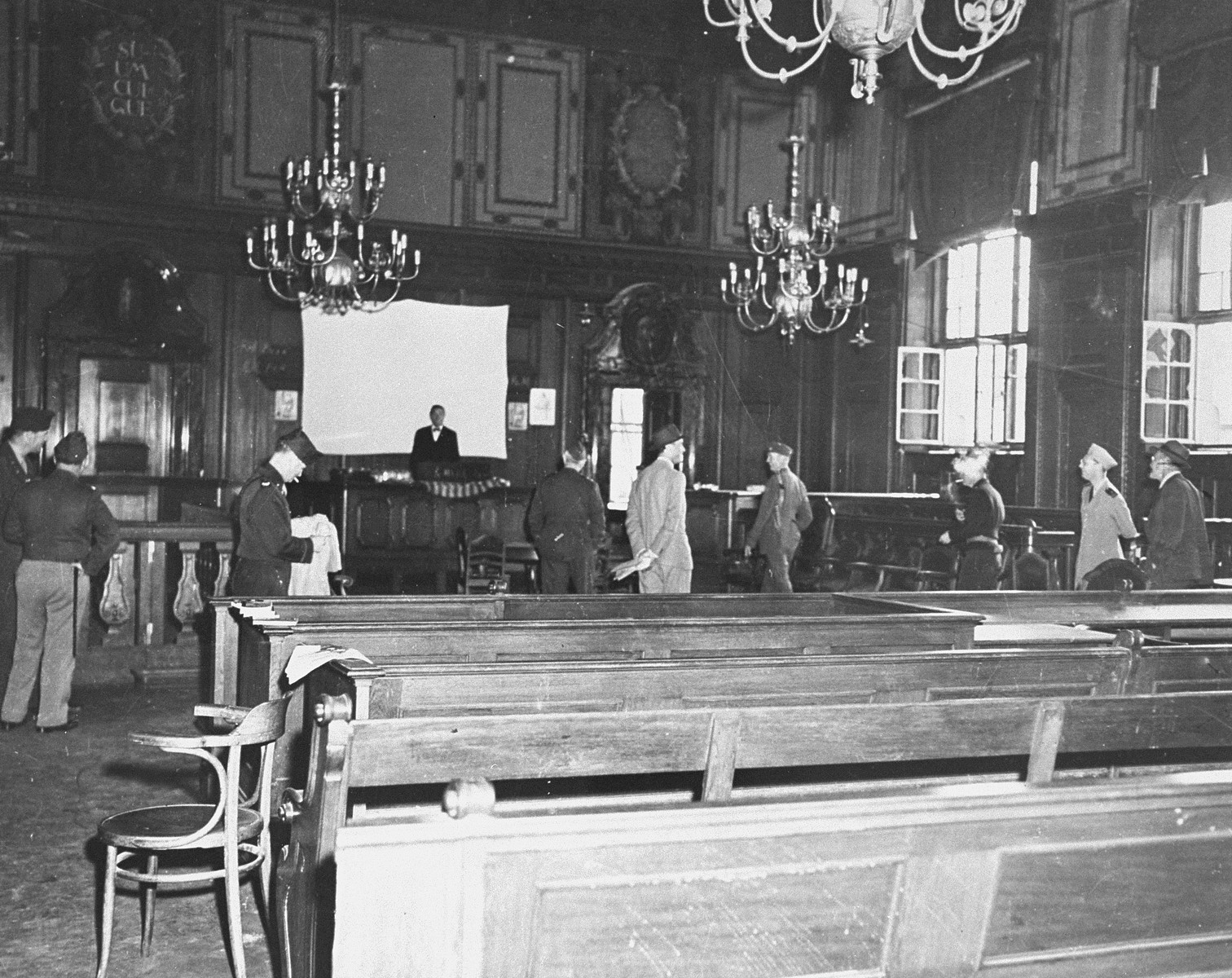
Before there could be a contest in court, the Allies had to decide what kind of proceeding to construct. A September 1944 memorandum by US Secretary of War Henry Stimson is revealing because it belongs to that unsettled period. Opposing execution merely on identification, he argued for charges, an opportunity to be heard and a limited ability to call witnesses. This was not a suggestion that the Nazi leadership should escape punishment. It was an argument about the method through which punishment would acquire authority.
Stimson’s document also resists a tidy retrospective story in which legal process arrived fully formed as the inevitable conclusion of victory. The memorandum discusses punishment alongside the future of German industry and the reconstruction of Europe. Accountability was being negotiated within a wider argument about security, occupation and the postwar order. The courtroom was one part of that political settlement, not a space outside it.
The International Military Tribunal’s Charter, agreed in August 1945, specified crimes against peace, war crimes and crimes against humanity. Its provisions addressed individual responsibility, official position and superior orders. It also defined a tribunal for major European Axis offenders, not an impartial global inquiry into every belligerent’s conduct. Those limits do not make the evidence against the defendants disappear. They do matter to an assessment of what this court could claim to represent.
For a historical drama, the distinction is productive. A trial conducted by victorious powers could still establish facts and responsibility through a record rather than a firing squad. Yet it did not cease to be shaped by victory. The strongest account would hold both propositions in view, rather than requiring the audience to choose between a flawless birth of justice and a proceeding devoid of legal significance. Neither extreme explains the institution that actually existed.
What a charismatic defendant cannot explain away
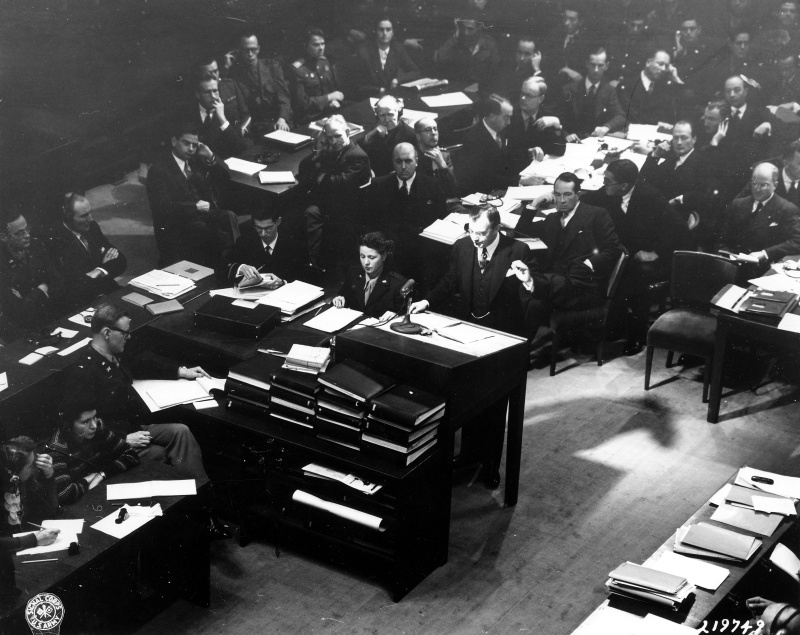
The prosecution’s archive supplies a corrective to a narrative organized around an exceptional personality. The US Holocaust Memorial Museum describes how investigators collected captured German records and used the Nazi state’s own documentation to establish policy and action. Photographs and films formed another part of the evidentiary record. This was not simply a contest in which the more commanding speaker could decide which account of the past prevailed.
One concrete example is the documentation of cultural plunder. The National Archives’ account of the Einsatzstab Reichsleiter Rosenberg albums shows how inventories and photographs of stolen art entered the prosecution’s case. Records originally assembled to administer and celebrate appropriation could be turned against the officials responsible. An inventory did not need to disclose its maker’s deepest emotions to show a system at work.
This is where the psychiatrist story and the trial story can illuminate one another, provided neither is mistaken for the other. A person’s manner may unsettle an examiner; a paper trail can disclose responsibilities that manner obscures. Administrative evidence connects an individual to decisions, offices, transfers and consequences. It is less immediately cinematic than an exchange of looks, but it changes what the audience should expect an encounter to prove.
A history film need not read out files for hours to make that point. The critical question is how it distributes authority. Giving a prisoner eloquent dialogue is not inherently endorsement. Making eloquence the principal measure of historical power is more troubling. If every confrontation is framed as a struggle to outwit him, even a scene intended to condemn the defendant can enlarge his importance. The archive offers another scale: a speaker is one participant in a system whose surviving traces do not depend on his willingness to confess.
The people outside the duel
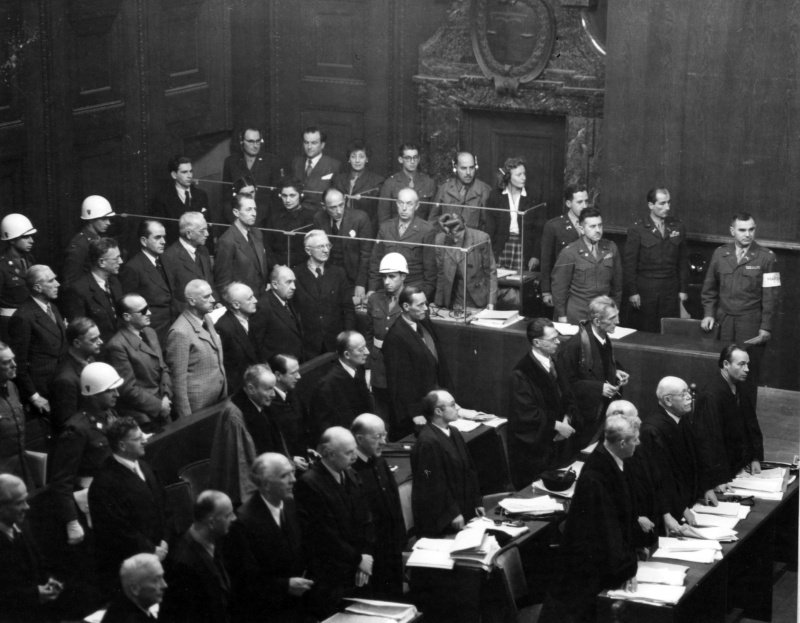
Consider the interpreters visible in the archival photographs. The tribunal worked in English, French, Russian and German. The National WWII Museum’s history of this work distinguishes written translation from spoken interpretation and explains the importance of near-simultaneous interpretation to the proceedings. Language was not a decorative feature of an international court. It was part of the machinery by which a statement could be heard, challenged and entered into a usable record.
That machinery changes the meaning of a courtroom speech. In a drama, an uninterrupted line can seem to pass directly from one formidable mind to another. In the tribunal, communication depended on teams, equipment and the management of pace and meaning. The apparent immediacy of public confrontation rested on labor that is easy to leave outside the frame. A photograph of interpreters therefore does more than add local color: it reveals an institution carrying out work that no charismatic protagonist could accomplish alone.
There is a similar issue with victims and witnesses. A perpetrator-centered narrative may be a legitimate choice, but the choice has a cost. People targeted by the regime can become evidence in someone else’s psychological journey rather than historical subjects in their own right. An introduction to the film should make that risk visible without pretending that any single feature can represent every experience. Viewers can ask whose account supplies knowledge, whose suffering supplies atmosphere, and whether those roles ever become confused.
These are questions about construction, not a demand for a checklist of virtuous scenes. Historical cinema inevitably selects. What matters is whether its selection helps us understand the relationship between a person and a larger process—or quietly substitutes the person for the process. The court’s translators, clerks, investigators and documentary collections are a useful discipline against that substitution.
Why the critical disagreement matters
Published assessments point toward different expectations of the film. The National WWII Museum emphasizes its ability to introduce the choice of legal proceedings rather than vengeance. Griswold’s Common Reader essay, by contrast, objects to melodrama and argues that the film’s inventions grant Göring excessive narrative power. These are attributed judgments, not a consensus to be averaged into a score. One asks what historical doorway the drama opens; the other asks what the drama distorts while opening it.
Both questions are worth keeping. A compelling entry point is a real achievement, particularly for audiences who know the name Nuremberg but little about the proceedings. Yet accessibility is not a blanket defense of invention. A fabricated exchange can change more than a detail if it implies that justice depended on a particular verbal victory, or that an atrocity can be explained by discovering the hidden essence of one exceptional man. The effect of an invention matters as much as its visibility.
Conversely, identifying an invented line does not, on its own, settle a film’s historical value. It is necessary to ask what the line replaces and what inference it encourages. Is it compressing a documented dispute, creating an unsupported motive, or supplying a satisfying ending that the record resists? This research-based introduction does not pronounce on every scene. It offers the court’s documents as a way to test the explanatory burden placed on the central relationship.
Harvard Law School Library’s Nuremberg Trials Project makes that comparison unusually practicable. Its digitized documents include Jackson’s opening statement, transcripts and evidence, allowing readers to move from a remembered scene toward the record of a proceeding. The value of that access is not merely catching filmmakers out. It permits a change of scale—from a close-up of the man in the dock to the work through which assertions became evidence, evidence became argument, and argument became a judgment that could itself be examined.
Nuremberg is best approached here as an invitation to that change of scale, not a substitute for it. The private encounter gives the story its dramatic promise. The crowded courtroom photograph supplies the necessary second image: many people, different responsibilities, and a record larger than the most imposing person in the room.