
Dark History
Ludlow, 1914: The Tent City Behind the Massacre
The coal strike was sustained by households as well as miners. Its destruction exposed the reach of company power, the duties of public authority and the limits of reform.
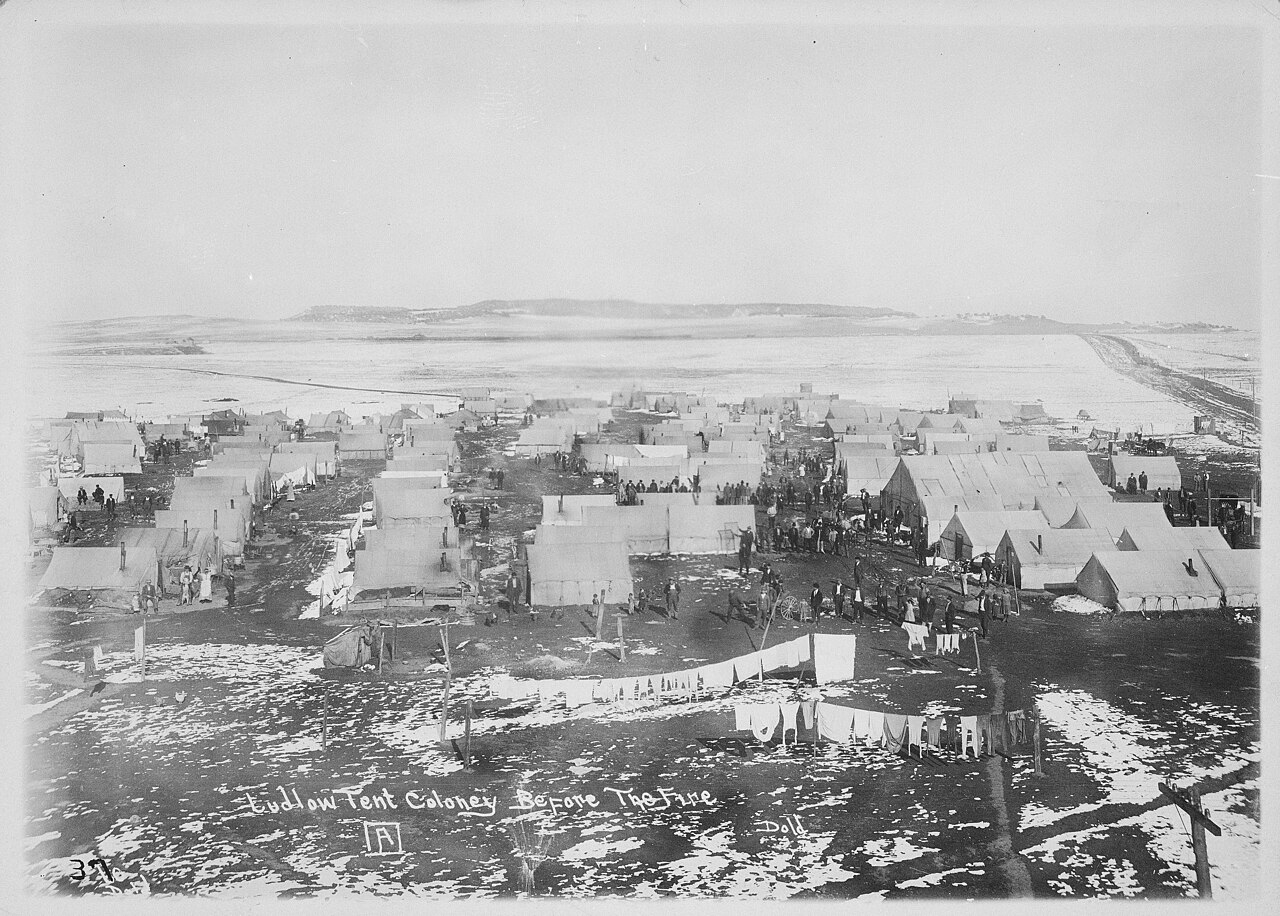
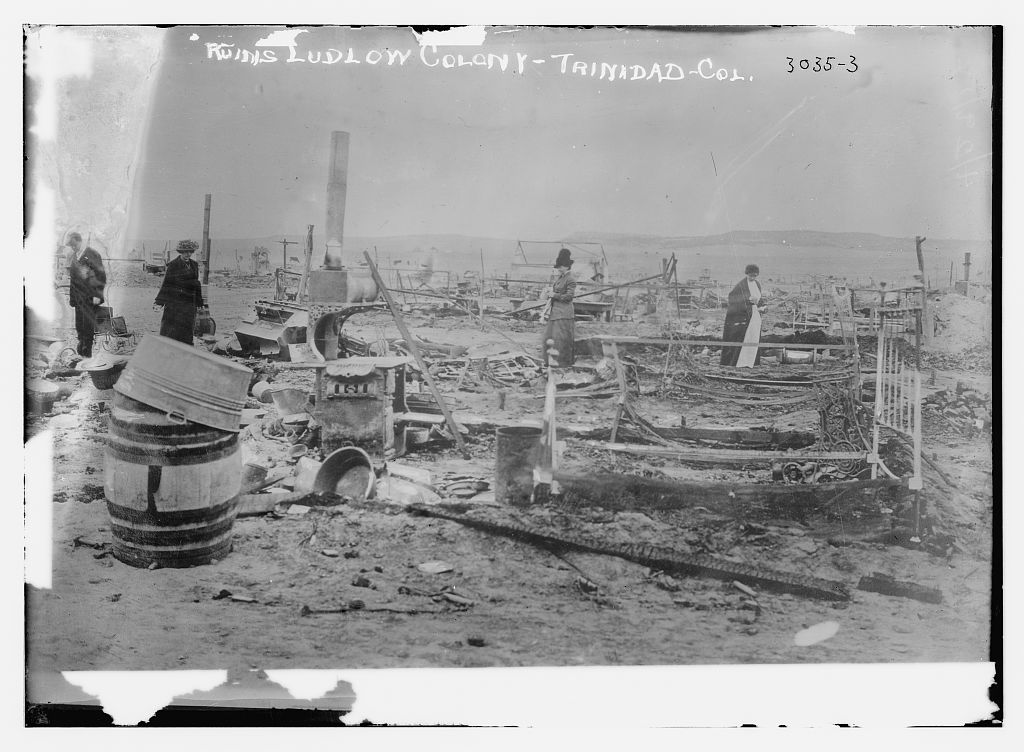
Look at photographs of Ludlow before April 1914 and you’ll see rows, streets and canvas roofs. People stand beside their homes; the tents form an organised settlement rather than a crowd gathered for a demonstration. After 20 April, other photographs show stove pipes and wreckage where those homes had stood.
The difference between the two landscapes is the centre of the Ludlow Massacre. It’s worth staying with the earlier photograph for a moment. The people attacked were sustaining a community during a strike. Why were they living in tents at all? The answer takes us beyond wages, into company housing, shops, medical care and the relationship between employers and public authority.
The destruction of that community became one of the most notorious episodes in American labour history. It did not immediately secure the union’s demands. What came next was messy: military intervention, a defeated strike, corporate reform and a long effort to recover the lives behind the ruins.
Work did not end at the mine entrance
Southern Colorado’s coal industry supplied an industrial economy in which fuel and steel production were closely connected. Colorado Fuel and Iron, whose interests included the steelworks at Pueblo, was one of the region’s dominant employers. Its power reached beyond the work performed underground.
The House Committee on Mines and Mining’s 1915 report describes a dispute over the practical meaning of rights that already existed in law. Miners wanted better pay, payment for additional work, checkweighmen to scrutinise the weighing of coal, freedom to trade where they chose and recognition of their union. Operators argued that several of these rights were already available. They refused recognition of the United Mine Workers of America.
This wasn’t just an argument over a wage scale. If earnings depended on the quantity of coal credited to a worker, the person checking the scales mattered. If a man could legally shop elsewhere but lived in an isolated camp with no alternative shop, formal freedom offered limited choice. The congressional report noted that company stores operated and that scrip remained in use in some places. It did not claim that every miner everywhere faced an identical arrangement.
Mining itself was dangerous. The National Park Service’s account records a Colorado fatality rate in 1912 roughly twice the national rate. The miners’ demands included enforcement of the eight-hour day and greater choice over housing and doctors. The practical question was who could make those protections count when an employer controlled so much of daily life.
In this respect, Ludlow belongs beside the Triangle Shirtwaist fire and the struggle over workplace safety. The industries and events were different, but both histories turn on the distance between an acknowledged danger and institutions capable of changing it.
A strike required another place to live
When the strike began in September 1913, eviction from company housing forced many miners and their families to move. The union prepared tent colonies across the coalfield. Ludlow became a major settlement and organising centre, with a population commonly estimated at about 1,200.
The Colorado Coalfield War Archaeological Project’s digital atlas treats the colony as a planned community. Union organisers laid out streets and public spaces. Residents spoke many languages, and maintaining collective action required work across differences of origin, custom and household circumstances.
Moving into tents didn’t make the work of running a household go away. Food had to be obtained and prepared, clothes washed, children cared for and illness managed. Women and children were participants in the material endurance of the strike, even when the formal negotiations concerned men employed as miners. The ability to remain out of work depended on the ability to keep families alive outside company accommodation.
Historical photographs preserve something of that organisation. In the project’s analysis of Front Street, the row facing the county road offered a public face while the arrangement of tents screened some domestic activity. Another study uses numbered tents and photographic viewpoints to reconstruct streets that no longer exist. The photographs give us an address system and a neighbourhood, not just the setting of a later tragedy.
When a mine guard wore a state uniform
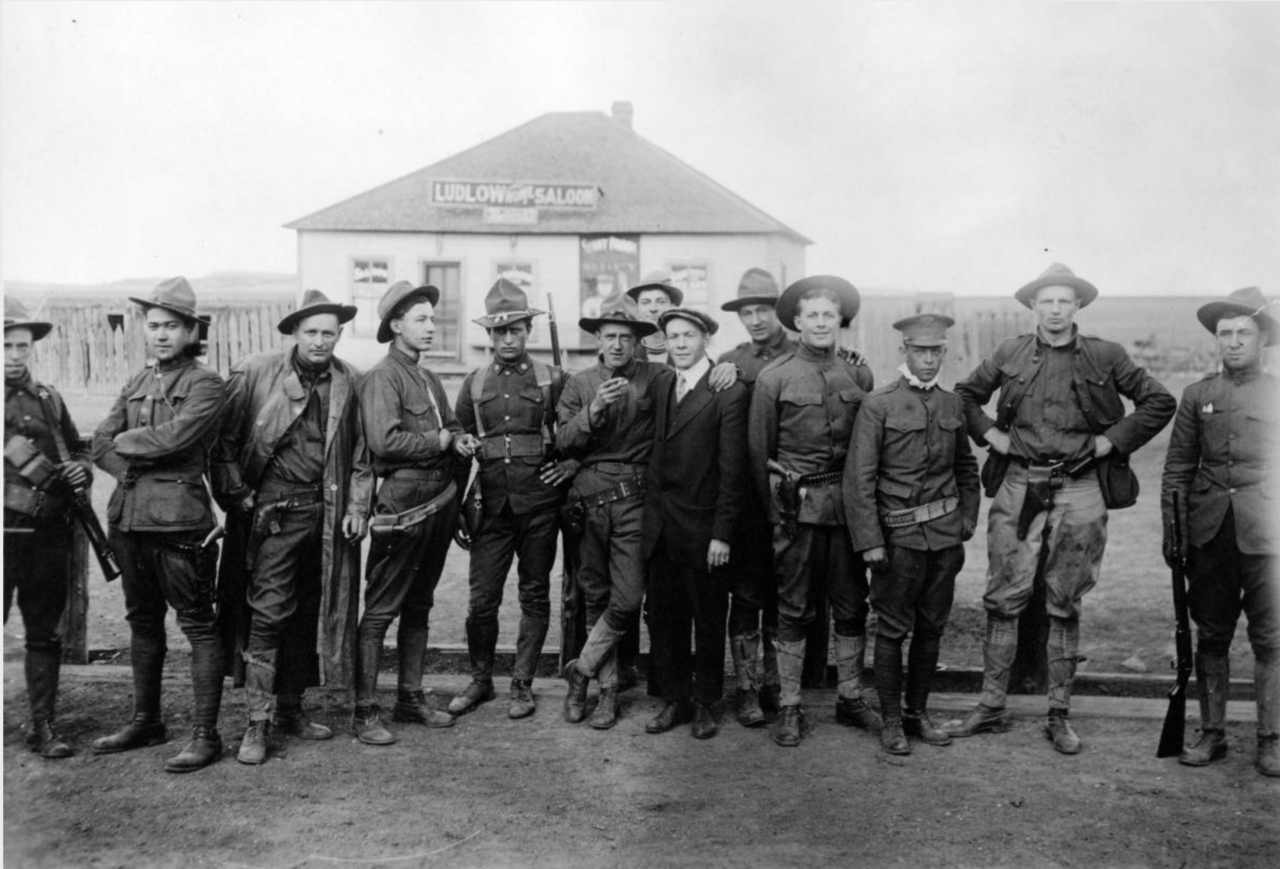
Violence accompanied the strike well before the destruction at Ludlow. Companies employed armed guards, and strikers also acquired weapons. Governor Elias Ammons sent the Colorado National Guard into the coalfield with the stated purpose of restoring order. Could the miners trust that force to act independently of their employers?
The congressional investigation found a serious problem with that independence. Some men who had served as mine guards or deputy sheriffs entered the militia. A witness, Montgomery Massingale, testified that he had been a company guard and was receiving pay from the company as well as the state while serving in uniform. The committee criticised the recruitment of guards into a force expected to preserve peace between opposing parties.
The report also condemned violence associated with strikers. Recognising that armed men existed on both sides does not erase the different responsibilities attached to public office. A state force claiming to protect order had an obligation toward the families in the colony, not simply toward the property of mine operators.
This distinction helps explain why Ludlow cannot be reduced to an encounter between two interchangeable private armies. The authority to arrest, restrict movement and deploy force came with a public claim. When personnel and loyalties overlapped with company security, that claim became part of the dispute itself.
20 April: the colony became a battlefield
On 20 April 1914, fighting broke out between armed strikers and the National Guard. The archaeological project’s account of troop positions identifies machine-gun fire from Water Tank Hill and another position across the railway. Fighting continued through much of the day. Strikers moved away from the tents in an effort to draw fire from their families.
The colony contained people who could not simply become combatants or leave at will. Women and children sought protection in cellars beneath tents. Later in the day, guardsmen set tents alight. In one underground shelter, two women and eleven children suffocated. Their deaths became the most enduring evidence of what the destruction of the colony had meant.
The death toll needs care. Published totals differ, and some accounts count deaths across the wider conflict alongside those at Ludlow. The thirteen people in that cellar should not be mistaken for a complete casualty count. Equally, a large total for the entire coalfield war should not be presented as the number killed in the tent colony on one day.
The ruins photographed afterward show the loss of a settlement as well as the site of deaths. A stove had been part of a household’s cooking and heating. A collapsed tent had held possessions and a place to sleep. The photographs make the scale of destruction visible without supplying a complete sequence of every shot or the experience of each person who fled.
Federal intervention stopped neither the dispute nor its consequences
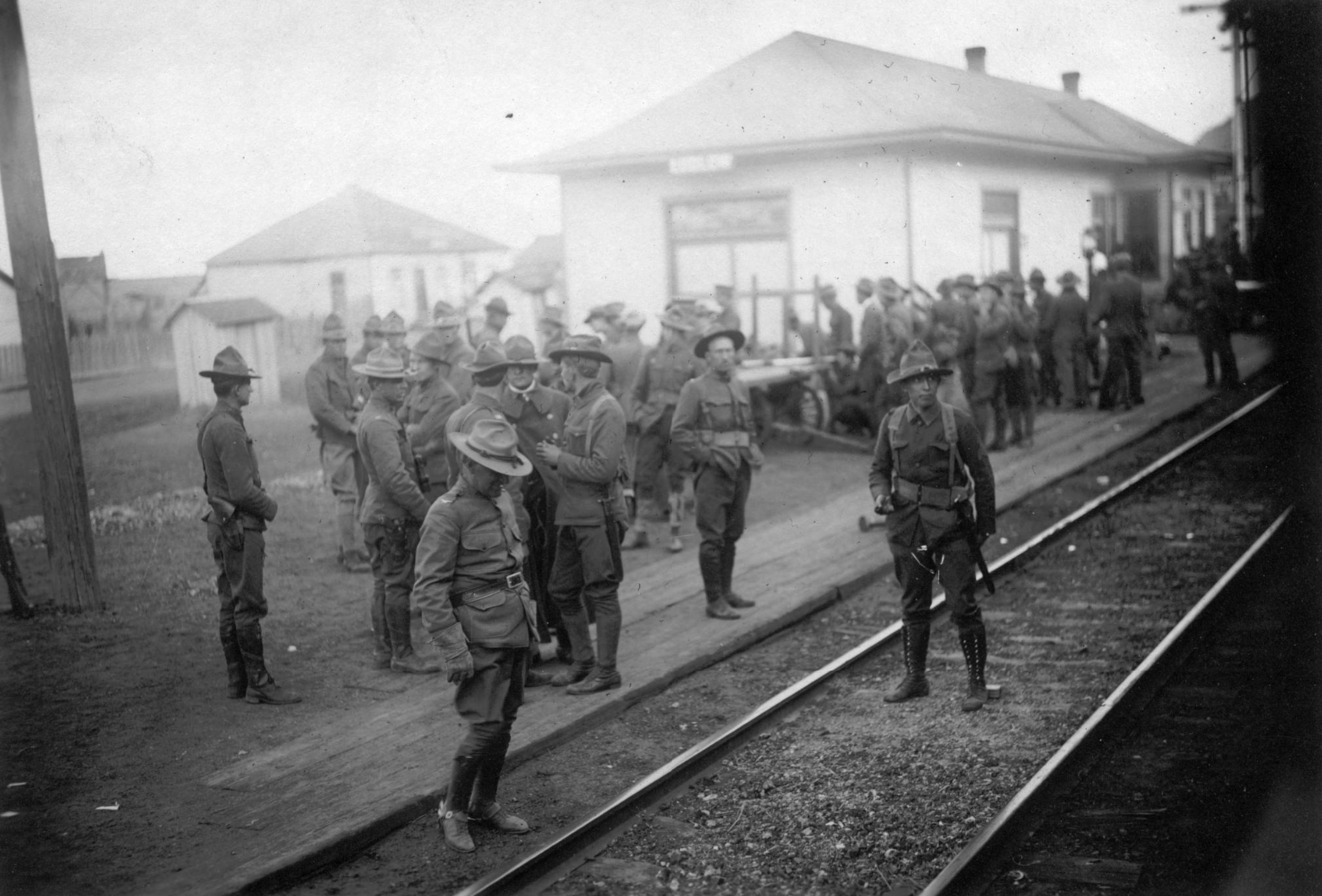
The massacre provoked wider armed conflict in the coalfields. For roughly ten days, attacks and counterattacks spread beyond Ludlow. President Woodrow Wilson then sent federal troops to disarm the opposing forces and restore order. The distinction between the Colorado National Guard and the federal army is important: the arrival of the latter was a response to the escalation, not another name for the force involved in the destruction of the tents.
Photographs of federal soldiers arriving by rail belong to this later phase. They should not be used as though they show the beginning of the 20 April attack. The railway could carry coal, strikebreakers, troops, journalists and news; it connected the local dispute to institutions far beyond the camp.
Sending in the army didn’t win the miners their demands. As historian Scott Ward’s account emphasises, the strike was broken by the end of 1914 despite the outrage the massacre generated. Public sympathy, coercive power and bargaining power were different things. A national scandal could expose conditions without immediately compelling the operators to recognise the union.
An investigation was already under way
There’s an easily missed detail in the congressional inquiry’s timeline. House Resolution 387, reproduced at the beginning of the 1915 report, was adopted on 27 January 1914, months before the massacre. Congress had already authorised an investigation into conditions in Colorado’s coalfields and Michigan’s copper district. Ludlow intensified an existing national question rather than creating federal interest from nothing.
The report gathered testimony about mine safety, company stores, guards, arrests, access to post offices and violence. Its authors were not unanimous. James F. Byrnes submitted separate views challenging the majority’s treatment of the evidence and the scope of federal responsibility. Richard W. Austin offered his own recommendations. Reading only one paragraph as “what Congress found” can conceal disagreement within the document.
The CSU Pueblo Library’s source guide places this report beside the Colorado officers’ inquiry and a pamphlet by union publicity director Walter H. Fink. These documents came from different institutions and advocates, each with interests at stake. They preserve claims, testimony and efforts to shape public understanding. Age alone doesn’t make them neutral.
That contest over the record has parallels with the evidence assembled after Peterloo. Photographs, official reports and participants’ accounts can be checked against one another, but none should be treated as a substitute for all the rest.
Reform without independent union recognition
John D. Rockefeller Jr.’s association with Colorado Fuel and Iron made him a central target of criticism. The company’s response included the Colorado Industrial Plan, often called the Rockefeller Plan. The project’s account of the post-strike years describes grievance procedures, employee representation and expanded social services under a company-sponsored system.
Such changes could affect daily life while leaving the central question of independent representation unresolved. A mechanism supported by the employer was not the same institution as the United Mine Workers. Later strikes in 1919, 1921–22 and 1927–28 demonstrate that conflict did not end with the announcement of a new industrial policy.
There’s no neat ending in which sacrifice brought immediate reform. The strike failed in crucial respects; some management practices changed; organised labour continued to contest the terms of employment. Those outcomes belong together.
What remained beneath the tents
The union acquired the colony site and preserved it as a memorial. Archaeological work added another way to understand the place. A 1999 report by Dean Saitta, Randall McGuire and Philip Duke describes investigation of the colony alongside company camps occupied before and after the strike. Their questions concerned households, food, ethnic relationships and the work of women and children as well as the battle.
Glass, ceramics, nails, food containers and traces of tent platforms are part of the story too. Their distribution helps recover the routines that made the settlement function. Comparing those finds with photographs can reveal where people lived and how they arranged spaces whose canvas walls have disappeared.
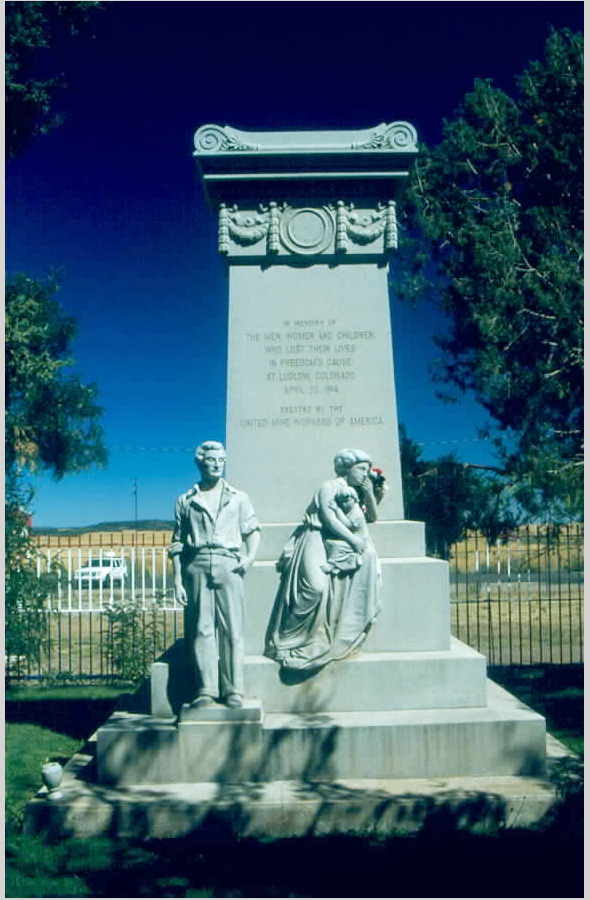
Ludlow is remembered because a state force destroyed a community and noncombatants died in the shelter intended to protect them. Understanding that violence also requires remembering what the community had been trying to sustain. The photographs before the fire, the testimony about company life and the objects beneath the ground restore the strike to the households that carried it.