
Power & Politics
The Golden Bull of 1356: Rules for Choosing a King in a Divided Empire
Safe passage, majority voting and carefully ranked ceremonies helped turn royal succession into a procedure, while protecting the princes authorised to choose.
Before the Golden Bull explained how to count the votes, it explained how the voters should reach the meeting. Princes travelling to a royal election were to receive protection on the road. Other rulers were required to help them pass safely through their territories. A constitutional procedure began with a problem of transport, armed escorts and trust.
That opening makes sense in the Holy Roman Empire of the fourteenth century. The election of a ruler depended on powerful men who already possessed territories, courts and followers. They did not become harmless private individuals when summoned to choose a king. Getting them to the same place, limiting the forces they brought and protecting them from one another were part of making an election possible.
Charles IV’s Golden Bull of 1356 tried to give this process a durable form. It specified the electors, the sequence of voting, the treatment of a majority decision and the privileges attached to electoral rank. It also devoted considerable attention to processions, seats and meals. To its makers, the ordering of public ceremony belonged to the same work as the ordering of political power.
A law with two centres of gravity
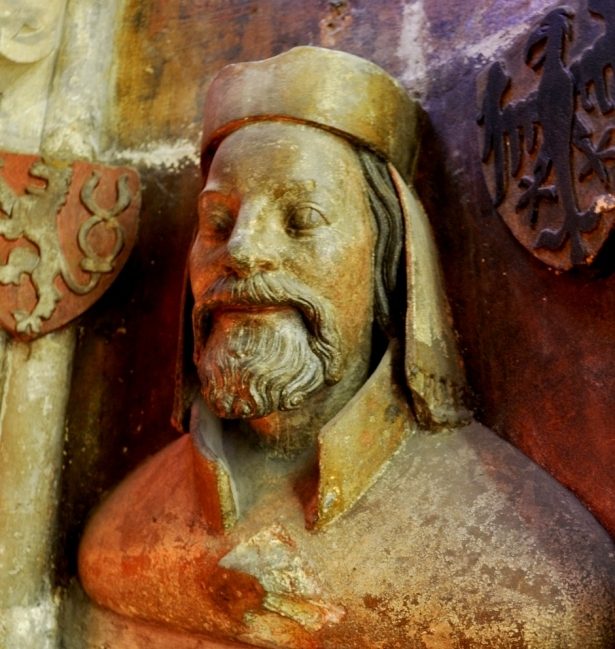
Charles was both emperor and king of Bohemia. He therefore wrote about an electoral college in which he himself held a place. The preamble explicitly recognised this double position. The settlement was not the detached design of someone standing outside the system: it was a ruler’s attempt to stabilise arrangements in which his own dynasty had an important stake.
The Frankfurt Institute for the History of the City dates the first twenty-three chapters to their promulgation at Nuremberg on 10 January 1356, and chapters twenty-four to thirty-one to Metz on 25 December. The document emerged from assemblies and negotiations, rather than a single moment in which an emperor simply announced an entire constitution.
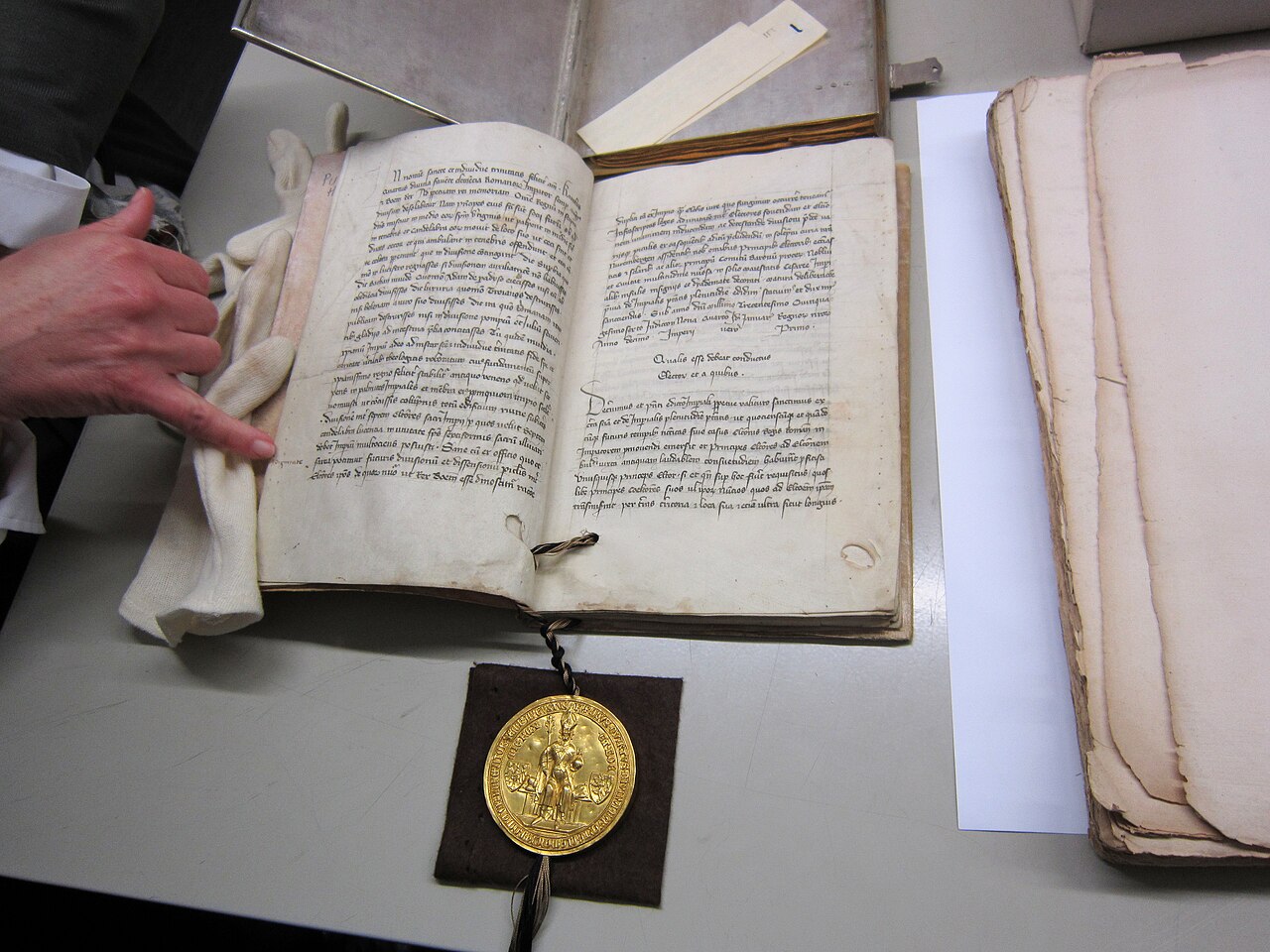
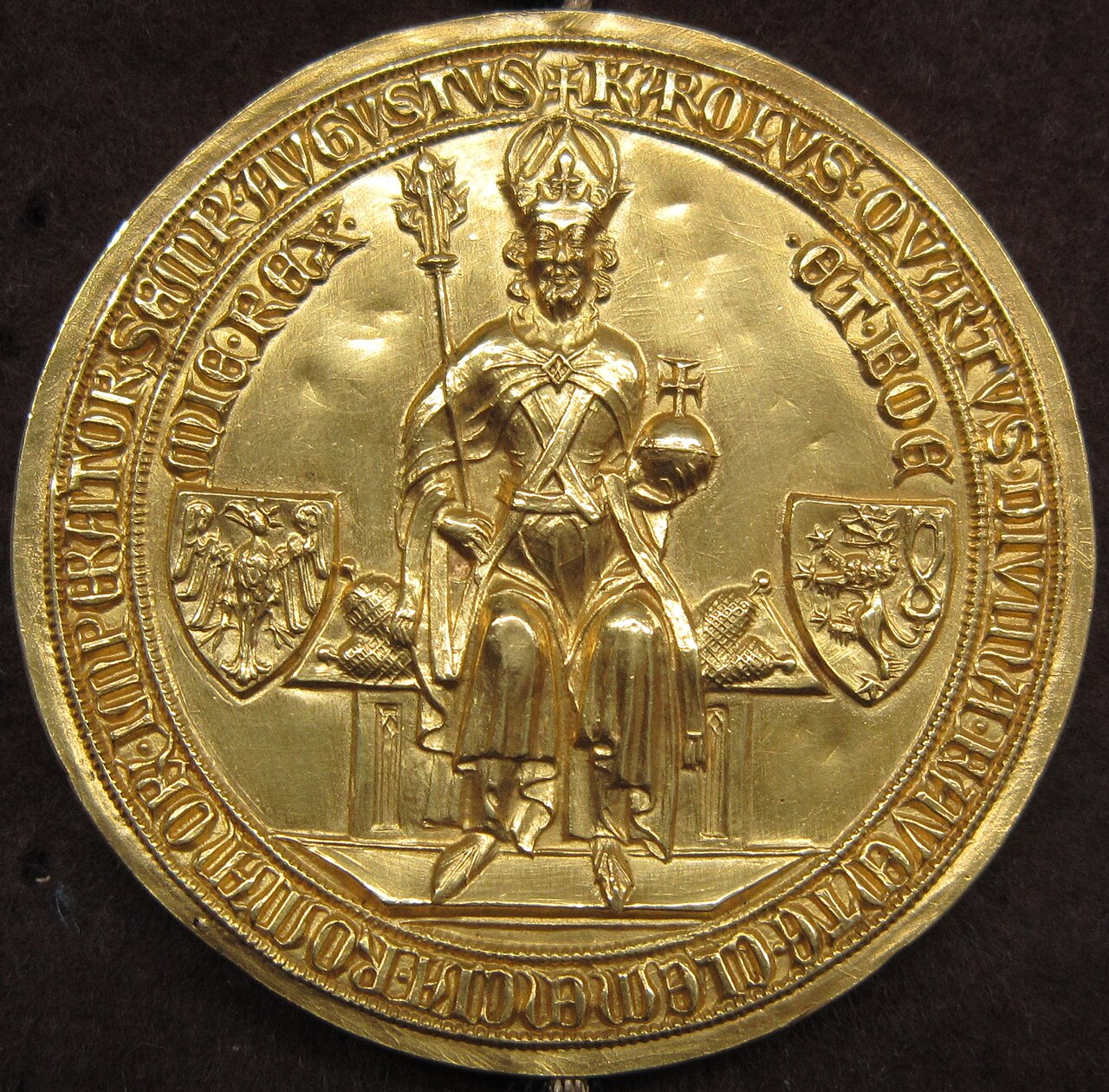
Its familiar name came from a gold seal, or bulla. The surviving copies are material records as well as legal texts: their parchment, script and seals show how authority was authenticated. “Golden Bull” does not mean that every page was made of gold, and it was not the only medieval document to receive such a name.
Who possessed a vote?
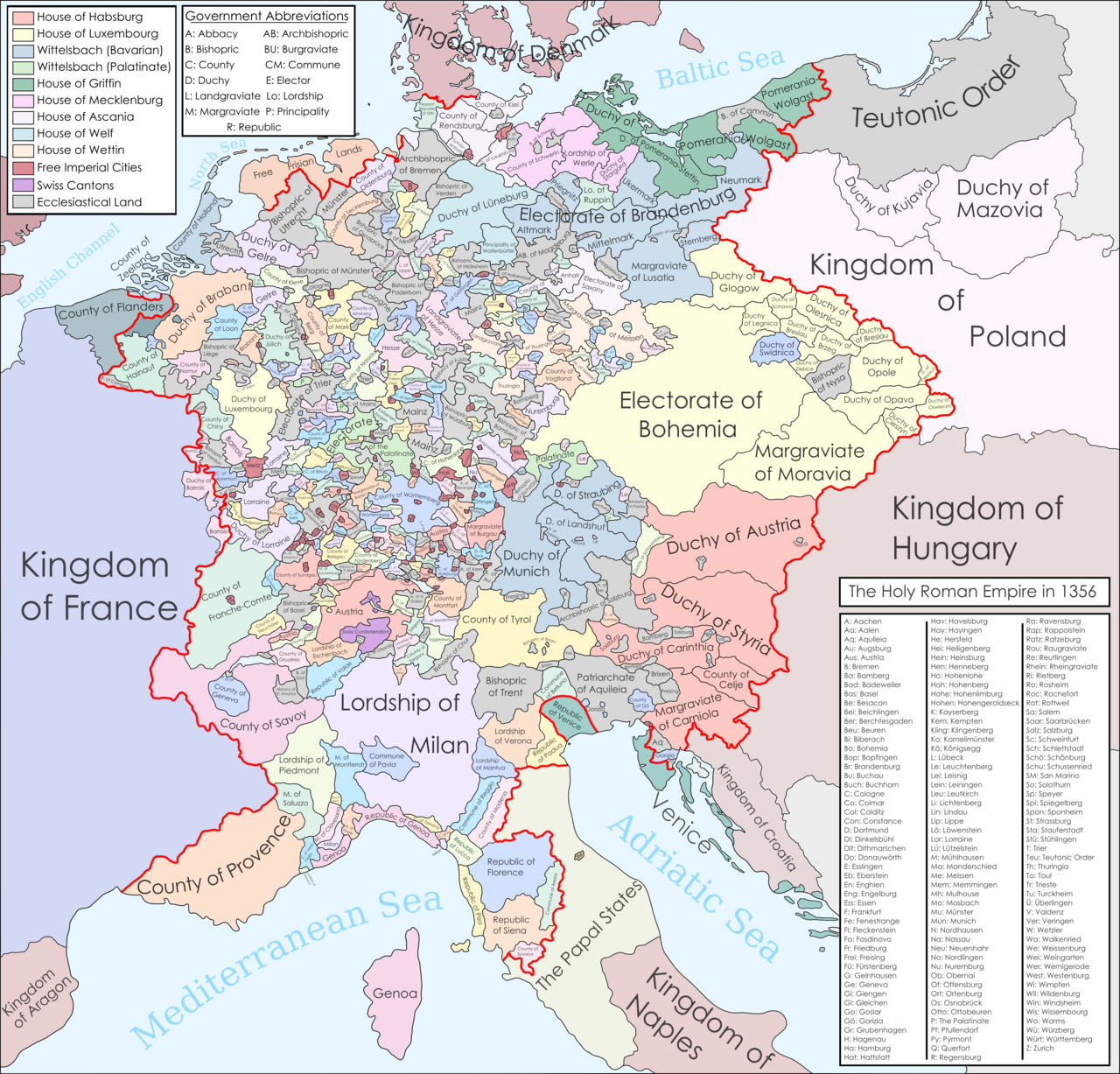
The seven electors comprised three archbishops and four secular rulers. The ecclesiastical electors were the archbishops of Mainz, Trier and Cologne. The others were the king of Bohemia, the count palatine of the Rhine, the duke of Saxony and the margrave of Brandenburg. Their vote belonged to a recognised office and territorial dignity, not to a constituency of ordinary inhabitants.
The distinction between king and emperor also matters. The text repeatedly described the person elected as king of the Romans and prospective emperor. Election, royal coronation and imperial coronation were related but distinguishable acts. Saying that seven men simply elected an emperor compresses the legal language and ceremonial sequence into something too neat.
Nor did the law invent royal election from nothing. As the Historisches Lexikon Bayerns explains, it drew on earlier provisions and established practices while defining disputed rights. The importance of a written rule often lies precisely in selecting among competing understandings of custom. A practice can be old without its application being uncontested.
This was an electoral monarchy, but election should not be confused with modern democracy. Most of the empire’s people had no vote in the process. Even most princes were excluded from this small college. The law gave a narrow group an exclusive role in choosing the monarch and reinforced the difference between those electors and other powerful rulers.
A useful comparison is Venice’s election of its doge, another system in which choosing a ruler did not imply broad popular participation. The procedures were very different. In each case, however, the question is who had the right to choose and what that choice permitted the officeholder to do.
The road to Frankfurt
Chapter I of the Golden Bull, available in Ernest F. Henderson’s historical translation through Yale’s Avalon Project, made safe passage a legal obligation. A prince could not legitimately use control of a route to keep another elector away. The prescribed protection covered the return journey as well as the journey to the election.
The archbishop of Mainz was assigned the work of sending notice. After learning with certainty of a ruler’s death, he was to act within a specified period; the electors or their properly empowered representatives were then to assemble at Frankfurt. The text even supplied forms for the documents used in summoning and representation. Political order depended on letters reaching their destinations and delegates carrying demonstrable authority.
It also anticipated failure. If Mainz neglected the summons, the other electors were not to wait indefinitely. They were to assemble without it. An elector who failed to appear or send an authorised representative, or who abandoned the gathering without a substitute, could lose his vote for that election. The procedure tried to prevent absence from becoming a permanent veto.
Within Frankfurt, each elector’s following was capped at two hundred mounted men, including no more than fifty armed men. The city was required to protect the participants against outside attack and against each other. These details expose the physical setting behind the legal abstraction of a vote. An election could be distorted before anyone announced a preference, simply by changing who could safely enter the room.
The citizens responsible for security faced severe penalties if they failed. Hosting the assembly therefore brought obligations alongside prestige. A city entrusted with a royal election was being made part of the machinery of succession, not merely renting rooms to distinguished visitors.
Making four votes stand for seven
The electors were to begin with a mass to the Holy Spirit at St. Bartholomew’s in Frankfurt, followed by an oath. They were to choose a suitable ruler and reject payment or promises as the basis of their decision. These provisions tell us what the law required. They cannot be used as proof that political bargaining ceased.
The decisive provision was majority rule. Once a majority had chosen, the election was to be treated as though all had agreed. This turned a divided decision into a legally united result. A minority could disagree, but its disagreement was not supposed to produce a second valid outcome within the same procedure.
The law addressed a particularly practical possibility: an elector could be a candidate. If three others voted for him, his own vote could complete the majority. The candidate was not automatically disqualified from taking part in the decision merely because he stood to gain the crown.
The famous bread-and-water clause added pressure to decide. If thirty days passed after the oath without a choice, the electors were to remain in Frankfurt on that restricted diet until an election had been completed. It is an unusually memorable rule, but its purpose was straightforward: delay should become uncomfortable rather than profitable.
The privilege attached to the decision
Immediately after election, the new king was required to confirm the electors’ privileges and rights. Confirmation was to be renewed after imperial coronation. The sequence mattered. Before using his office to deal with other business, the chosen ruler was to acknowledge the standing of the men who had helped make him king.
Electoral dignity also involved jurisdiction and resources. The Golden Bull protected important judicial privileges and recognised rights involving mines, coinage and other sources of income. These provisions supported the electors’ position within their territories. The document’s concern with a reliable election cannot be separated from its concern with powerful territorial princes.
To describe these rights as complete modern sovereignty would nevertheless be misleading. The electors remained participants in an imperial order, with duties, relationships and limits shaped by that order. The empire was not simply dissolved into seven independent states by the act of regulating its royal succession.
The law also sought to stop the secular electoral principalities from being divided through inheritance. It linked the vote to an undivided territorial dignity and prescribed succession through the eldest legitimate male line, with provisions for minors and exceptions. A disputed inheritance could otherwise become a disputed electorate and, in turn, a disputed royal election.
Bohemia’s established rights received particular protection. That was consistent with Charles’s position as its king. The document’s general language about peace and unity coexisted with careful attention to specific privileges. A settlement could serve a common purpose while also strengthening those best placed to negotiate it.
Why the seating plan was political
The Golden Bull specified where electors should sit, how they should walk in procession and who should carry the imperial insignia. The duke of Saxony carried the sword; the count palatine carried the orb; the margrave of Brandenburg carried the sceptre. Placement turned hierarchy into something an assembled audience could see.
Such detail can look trivial beside a rule about majority voting. In a political world in which honour and precedence expressed rank, however, an unresolved seating dispute could become a dispute about rights. The text attempted to keep these contests from reopening whenever the court assembled.
Service at a ceremonial meal also represented office. The margrave of Brandenburg brought water for washing; the count palatine presented food; the king of Bohemia offered a cup. These acts did not mean that the electors were ordinary household servants. Their public performance displayed privileged proximity to the ruler and the distinctive duties of their rank.
The regulations extended to the officials who performed substitute roles and received associated rewards. Behind the most splendid ceremony stood an organised household with practical claims on objects, payments and equipment. The law dealt with these details because public order was made through repeated performances, not preserved by a constitutional sentence alone.
What the settlement left unresolved
The Golden Bull did not give the pope a part in the electoral procedure it prescribed. This omission was consequential in a long history of arguments about imperial authority. It should not be inflated into a declaration that religion had been removed from politics. The prescribed mass, oath and Christian language make the opposite plain.
Nor was the document a comprehensive settlement of every problem facing the empire. It did not create a uniform administration, abolish territorial disputes or guarantee that all later political conflicts could be solved by opening the same book. The election rules supplied a framework within which power continued to be exercised and contested.
Its provisions concerning peace and political associations also reveal who was expected to defer to whom. The ideal of unity was hierarchical. Protecting an elector against conspiracy and protecting an ordinary inhabitant against an arbitrary lord were not treated as equivalent constitutional questions.
Reading the text this way avoids two opposite exaggerations. It was neither a modern democratic constitution centuries ahead of its time nor merely an admission that the emperor had no power. It was a negotiated arrangement through which imperial and princely authority could support, constrain and sometimes compete with one another.
A multilingual political education
The final chapter turned from ceremony to the education of future secular electors. It recognised that the empire contained people with different languages and customs, and called for heirs to learn languages useful in imperial business. It envisaged instruction beginning in childhood, either through teachers at home or by sending young people elsewhere.
This requirement placed communication among the duties of rule. A prince who inherited a vote would need to understand more than the speech of his immediate household. The provision is especially revealing beside the forms for diplomatic letters: the system required both written instruments and people able to operate across linguistic boundaries.
The chapter states an educational expectation, not evidence that every heir fulfilled it. As elsewhere in the document, the distance between a rule and its practice remains a question for further records. A prescription shows what lawmakers considered useful or necessary; it does not supply the school record of every future elector.
A text that outlived its makers
The Golden Bull remained a central component of imperial constitutional life until the Holy Roman Empire ended in 1806. Its survival did not mean that the empire stood still. The importance of a durable document lies partly in its ability to be consulted, interpreted and fitted into circumstances that its original makers could not have foreseen.
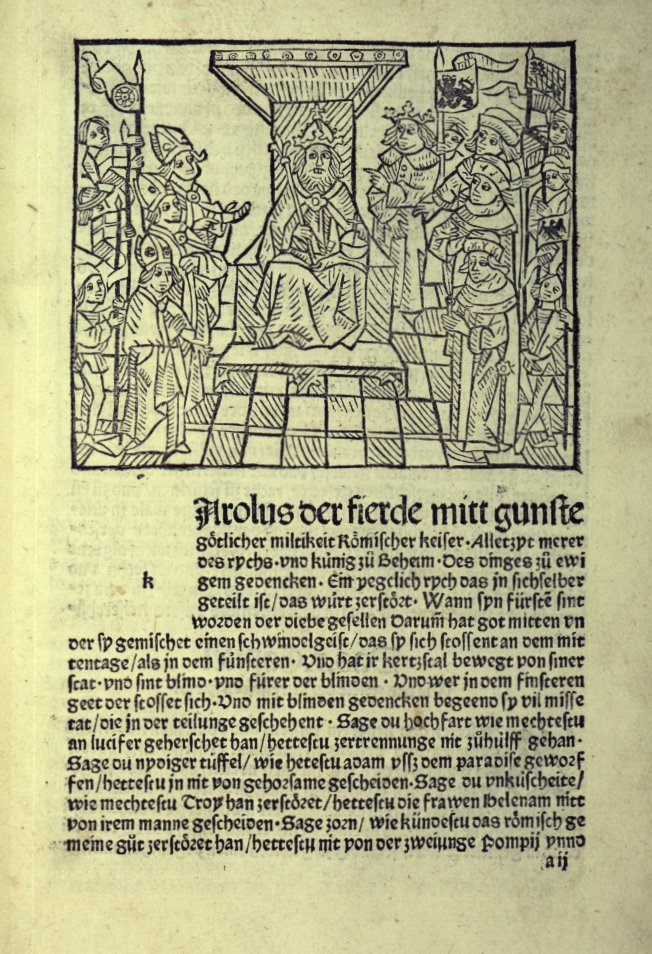
Later manuscript and printed copies extended its life beyond the original sealed instruments. A fifteenth-century German printed edition belongs to that history of circulation. It is evidence of a text being reproduced for later readers, rather than a page from the assembly at Nuremberg.
For the law’s practical ambitions, the opening rules remain an excellent guide. Protect the travellers, recognise their representatives, contain their armed followings, establish a majority and make the result binding. The Golden Bull tried to turn a dangerous transition into a repeatable procedure while preserving the exceptional standing of those authorised to carry it out.