
Books & Movies · Critical introduction
The First Ghetto: A Venetian History Beyond the Gates
Alexander Lee’s 2026 Cundill finalist asks how a place of compulsory residence could also become a rich, divided and enduring center of Jewish life.
On 29 March 1516, the Venetian Senate ordered Jews living in different parts of the city to move into a designated enclosure near San Girolamo. The decree survives in the Republic’s deliberations, now held by the State Archives of Venice. It did not merely describe a neighborhood. It made residence in that neighborhood compulsory. A part of the city became an instrument for deciding who could belong, where, and on whose terms.
Alexander Lee’s The First Ghetto follows the history that unfolded around that decision. Published in 2026, it became one of the three Cundill History Prize finalists announced on 30 September. It did not win the grand prize, awarded to Beth Lew-Williams on 23 October. Its place among the finalists nevertheless provides a precise, current reason to examine a book concerned with a much longer problem: the coexistence of cultural achievement and enforced exclusion.
Reading scope: This critical introduction draws on Lee’s authorized public excerpt, the publishers’ edition records and descriptions, the prize announcement, and independently consulted archival, museum and scholarly sources. The complete book has not been accessed. The discussion distinguishes what the excerpt demonstrates from questions that require a full reading.
What does “first” mean?
The title is memorable, but it needs care. Venice did not invent anti-Jewish prejudice or residential separation. In his authorized excerpt, Lee recognizes earlier segregation and the contingent circumstances of Venice’s decision. He proposes to connect political context, buildings and individual lives. He also acknowledges scarce early Jewish first-person evidence and the resulting dependence on non-Jewish records. His introduction moves from his own encounter with the neighborhood toward those evidentiary problems. These are features of the pages available here, not a description of every chapter.
Historian Benjamin Ravid has addressed the definitional problem directly. His study of Jewish quarters and ghettos identifies compulsory residence, segregation and enclosure as crucial distinctions. A neighborhood with many Jewish inhabitants was not necessarily a ghetto in this institutional sense. A shared religious infrastructure, voluntary clustering or a name assigned by outsiders cannot by themselves establish compulsion.
This matters beyond a contest over priority. If every Jewish quarter is called a ghetto, then the difference between choosing to live near a synagogue and being forbidden to live elsewhere disappears. Conversely, concentrating only on walls can hide other restrictions. The historian must reconstruct the rules governing the space, the authorities enforcing them and the possibilities available to residents.
The word itself carries a complicated afterlife. The Jewish Community of Venice’s historical account associates it with the district’s former foundries, while noting uncertainty over its precise derivation. What can be said securely is that a local Venetian name became a term with a much wider history. That linguistic connection does not make every later place bearing the name identical to the enclosure created in 1516.
Useful to the city, unequal within it
The decree emerged from a period of war and displacement. The State Archives places it after the upheavals of the League of Cambrai, when Jews from the mainland had obtained refuge in Venice. Admission did not mean acceptance on equal terms. The same government that allowed residence could restrict it, concentrate it and supervise the economic activities associated with it.
The community’s account describes earlier limits on guild membership and property ownership, and the significance of lending, second-hand trade and medicine. It also records the higher rents imposed on residents of the new enclosure and the requirement that the Jewish community pay its guards. Gates closed in the evening and reopened at dawn. Exclusion was therefore not only a boundary on a map; it involved expenses, daily schedules and the allocation of authority.
Explaining the importance of credit requires particular caution. The fact that Jewish lenders supplied a service needed by the city should not be turned into a claim about an inherent connection between Jews and money. Occupational restrictions, legal permissions and demand helped produce the historical situation. A useful economic explanation follows those arrangements rather than repeating the stereotypes through which hostile contemporaries justified them.
There is a further trap in describing the arrangement as a compromise. The word can suggest a negotiation between equally empowered parties. In this case the state determined the conditions under which a vulnerable minority could remain. Jewish residents could negotiate, organize and pursue opportunities, but they did so within a framework they had not chosen. Economic usefulness offered leverage; it did not amount to an unconditional right.
The evidence is also above street level
Political decisions become easier to understand when connected to rooms, entrances, workplaces and places of worship. Buildings can reveal the practical consequences of a regulation without reducing history to a succession of decrees.
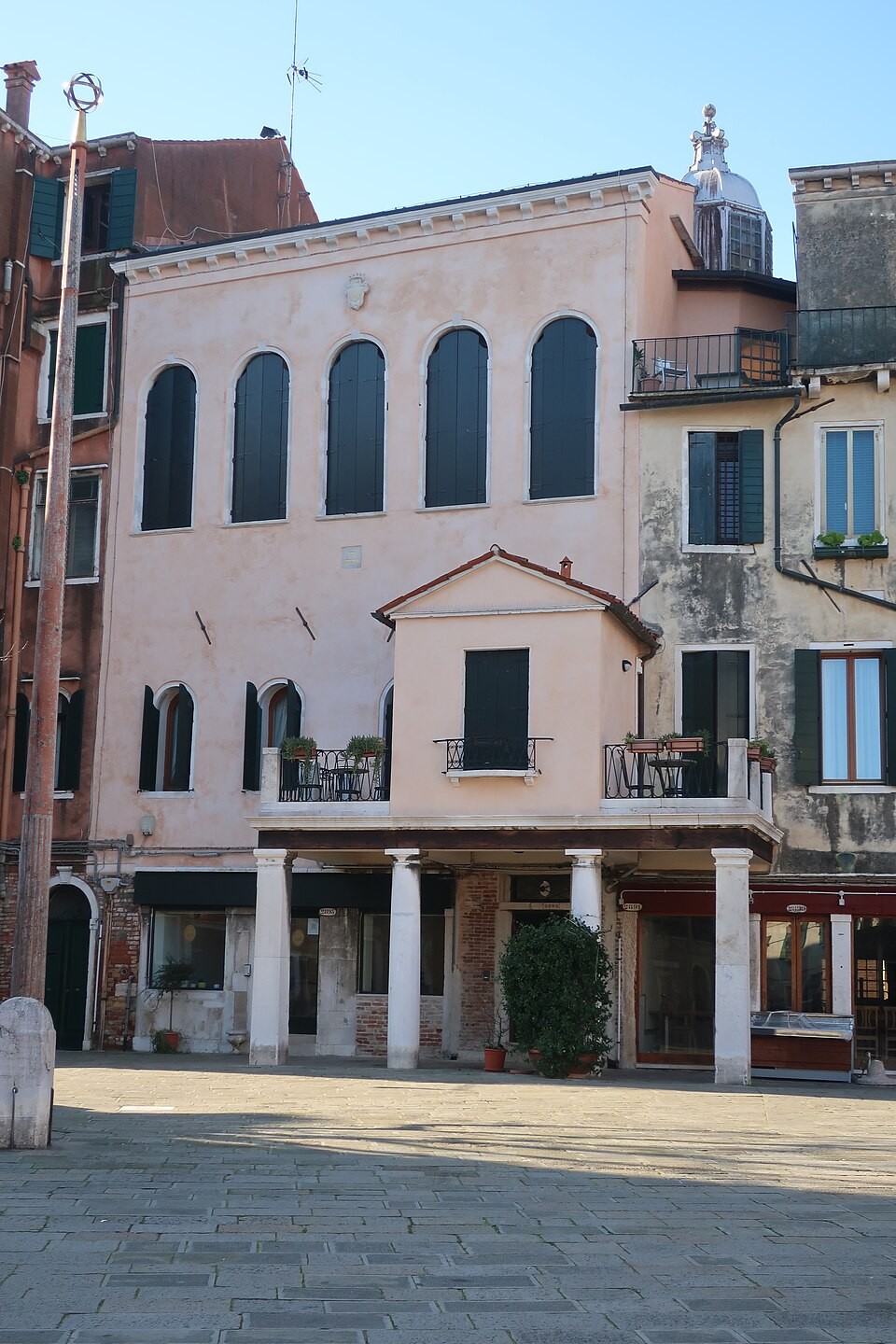
The Scuola Italiana illustrates the point. Founded in 1575, it is recognizable by five tall arched windows facing the Campo del Ghetto Nuovo. The community’s description of the synagogue records its architecture and furnishings. A College of Charleston exhibition explains the significance of placing worship space inside an existing multistory structure rather than giving it the separate, publicly dominant form of a Venetian church.
The distinction is not simply aesthetic. A room can be richly furnished and central to a community while remaining inconspicuous in the city’s public architecture. Looking only for monumental facades would underestimate religious life. Looking only at an interior’s beauty could underestimate the restrictions surrounding it.
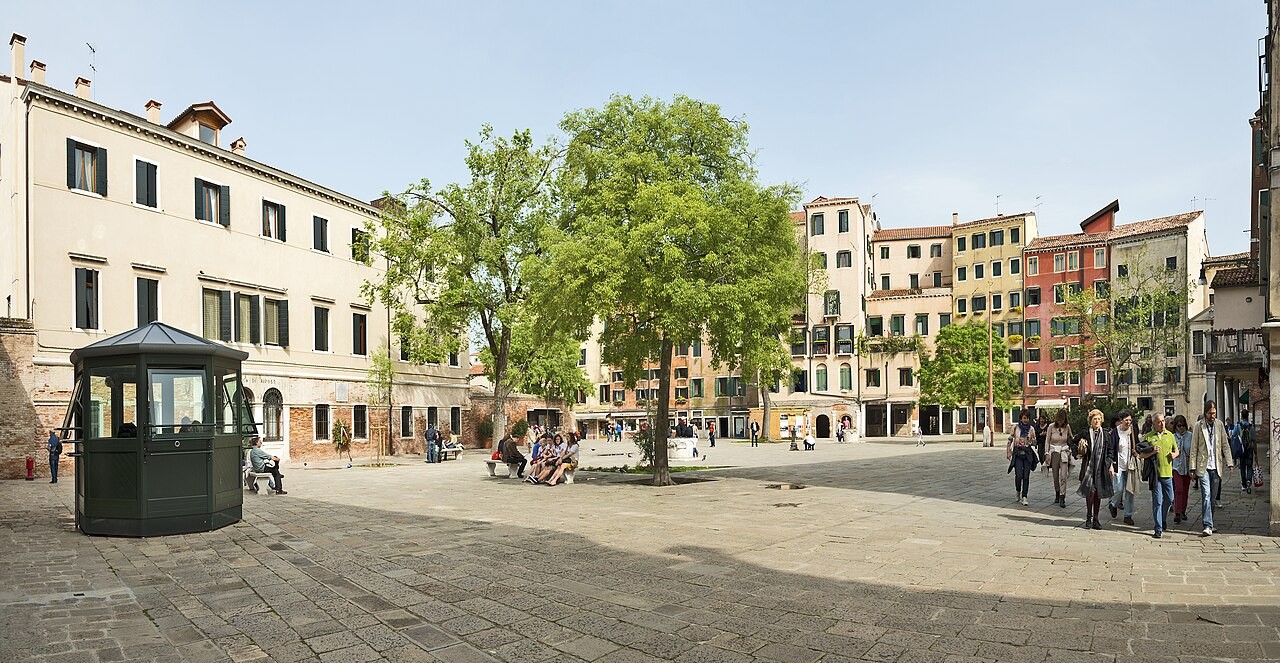
Modern photographs require the same discipline. The square visible today is evidence of surviving and altered fabric, not a transparent image of 1516. Restorations, changed uses and centuries of construction separate the photograph from the founding decree. Illustrations can help a reader orient themselves, provided captions do not silently turn a present-day view into an eyewitness record of the past.

One enclosure, more than one cultural world
A government category can make a population appear more uniform than it was. The Venice Haggadah of 1609 offers a compact corrective. Yale’s account of the edition describes versions with Judeo-Italian, Judeo-Spanish and Judeo-German translations. Israel ben Daniel Zifroni prepared the publication, printed at Giovanni da Gara’s press. Leone Modena supplied the Judeo-Italian translation. A ritual text circulated through different linguistic communities within and beyond Venice.
The page reproduced here is more than decoration. Its framed text and biblical scenes show a publisher organizing reading through image, language and layout. The object is evidence of skilled production and of readers for whom a shared ritual did not require a single everyday language. It makes diversity visible without asking one representative biography to stand for everyone.
Printing also complicates the image of an entirely sealed neighborhood. Books depended on materials, labor, expertise and markets. Collaboration could cross religious boundaries even while government imposed residential separation. The existence of such connections does not demonstrate that the surrounding society was tolerant in a modern sense. It demonstrates that coercion and exchange could operate at the same time.
Nor should a flourishing press be mistaken for secure intellectual freedom. The Library of Congress’s survey of its early Hebrew books notes the burning of Hebrew works in Venice’s Piazza San Marco in October 1553. Production and destruction belong to the same history. A successful cultural enterprise could remain exposed to decisions made by authorities outside the community that sustained it.
Individuals who cannot stand for everyone
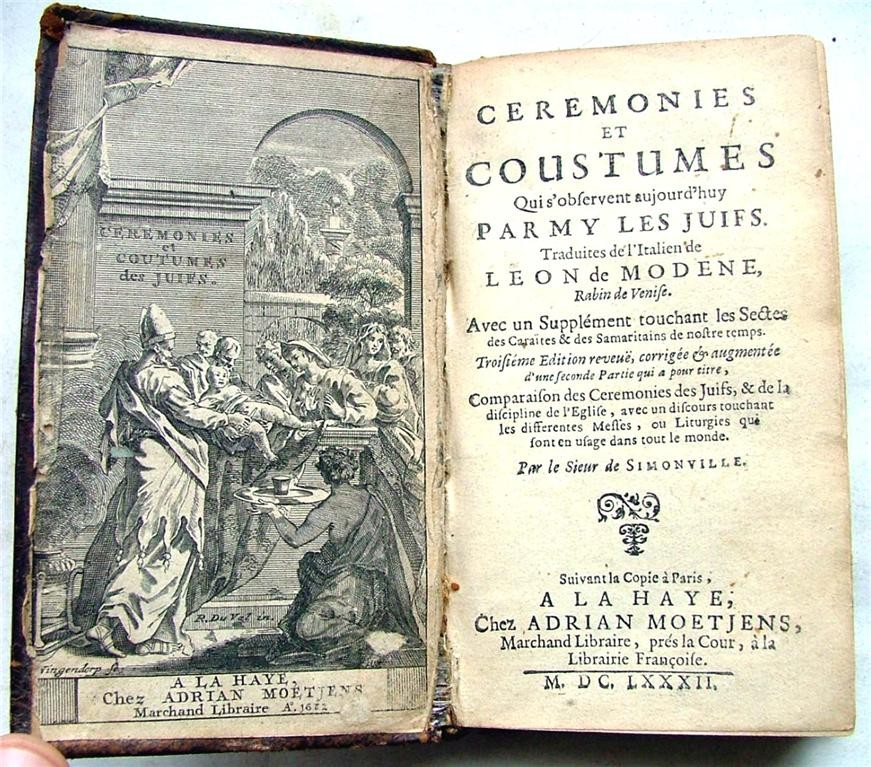
Leone Modena is one of the figures through whom the subject becomes more than an institutional history. A rabbi, author and translator, he also addressed audiences beyond his own congregation. The College of Charleston’s exhibition notes that Christian clerics and nobles attended his sermons. The later French edition of his account of Jewish ceremonies, pictured here, provides another material trace of religious knowledge crossing a boundary.
Such a figure is attractive to a narrative historian because his words and reputation survive. But exceptional visibility creates a problem of proportion. The life of a prolific writer cannot automatically explain the experience of people who left few documents. The challenge is not to exclude the famous; it is to avoid letting the accidents of preservation determine who seems to have mattered.
The remaining question is how the full book handles the unevenness. An official file, a memoir and a literary work give access to different kinds of knowledge. A memoir may disclose anxieties that a tax record cannot, but it is also an act of self-presentation. A state record may supply a date or a ruling while misrepresenting the people it categorizes. Rich narrative works best when it preserves these differences rather than smoothing them away.

Splendor is not a verdict on the system
A silver Torah crown made in Venice around 1740–50 by Andrea Zambelli offers an unusually tangible example of religious artistry. The Metropolitan Museum of Art’s record identifies motifs associated with Jewish ritual and notes that the silversmith also made objects for local churches. A later inscription records the crown’s donation to a congregation in Padua. Its history extends beyond a single neighborhood or moment.
It would be a mistake to make this beautiful survival a verdict on the conditions under which Jews lived. An expensive ceremonial object does not measure the wealth of every household. A shared craft vocabulary does not prove equality before the law. The crown demonstrates an achievement of patronage, skill and devotion; it does not redeem the restrictions surrounding the people who valued such objects.
This is the central critical balance the book’s advertised scope demands. A history told only through persecution can deprive people of all activity except suffering. A history told only through resilience can make coercion appear productive, as though remarkable culture justified the conditions that constrained it. Neither conclusion follows. People created institutions, art and relationships because they were living full lives, not because historians needed a consoling ending.
After the gates, a different history of danger
The ghetto regulations lasted until the Republic’s end in 1797. That endpoint matters: later persecution did not occur under an unchanged sixteenth-century legal order. The Jewish Community’s account of the twentieth century distinguishes the Italian racial laws of 1938 from the occupation, arrests and deportations that followed in 1943–45. Those developments require their own explanations.
A long history can reveal continuities of language, memory and hostility without making catastrophe inevitable from the first decree. The danger of an origins story is that its ending seems already present in its beginning. The opposite danger is to isolate each period so completely that inherited prejudices and institutions disappear. The useful middle course is to trace what changed, who changed it, and what remained available for reuse.
What the available pages promise—and what they cannot prove
The available introduction’s attention to the limits of its evidence is a strength. Yet an opening cannot establish how consistently a complete book handles those limits. Emotional engagement with a place and careful explanation of its history are compatible ambitions, but neither guarantees the other.
For a prospective reader, the key tests are therefore concrete. Do economic explanations remain accessible without becoming reductive? Do individual stories expose differences of status, language and experience? Are the boundaries between documented fact, inference and missing evidence kept visible? The excerpt gives good reasons to ask these questions of the complete work, but not grounds to announce that every chapter has answered them.
The First Ghetto is especially worth considering as a history of conditional residence: a place where permission to remain could coexist with rules designed to mark people as outsiders. The surviving evidence—decree, synagogue, printed page and ritual object—shows why neither confinement nor creativity can tell the story alone. The task is to hold them together without confusing survival with consent.
Edition reference: The UK edition is The First Ghetto: Venice and the Jews, Picador, 5 March 2026, ISBN 9781529066500. The US hardcover is titled The First Ghetto: Venice and the Origins of Modern Antisemitism, Basic Books, 19 May 2026, ISBN 9781541608771. UK publisher edition · US publisher edition · Amazon: matching US hardcover. The Amazon link is nonaffiliate; no price or availability is promised.