
Akbar’s House of Debate and the Politics of Religious Difference
At Fatehpur Sikri, religious argument became an imperial project. Akbar’s debates, Jesuit visitors, and Sanskrit translations reveal both the ambition and limits of Mughal pluralism.
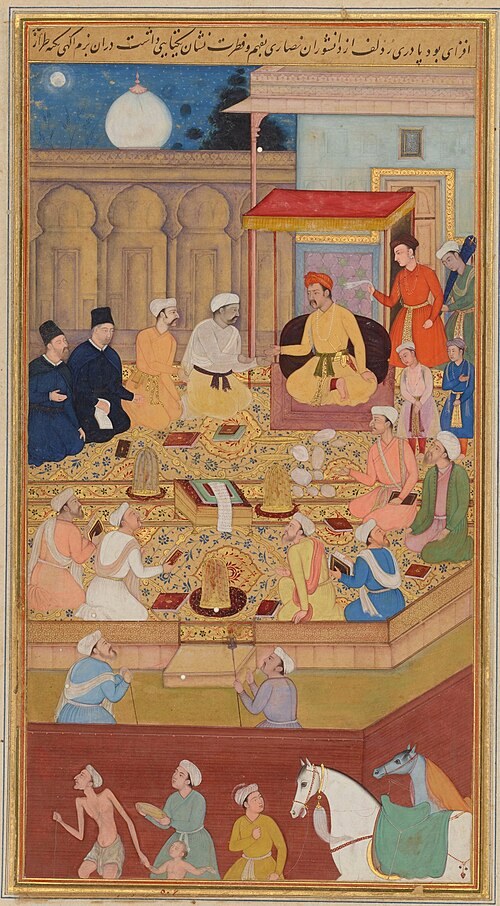
Two men in dark robes sit among the scholars gathered before Akbar. The emperor occupies a canopied seat, while attendants, books, and carefully ranked figures fill the painted enclosure. This miniature by Narsingh, made around 1600–03 for the Akbarnama, presents religious conversation as an event worthy of imperial history. The Jesuits are visibly distinctive, yet the composition gathers everyone around the sovereign. Chester Beatty’s record of the painting
The gatherings began among Muslim scholars and expanded into encounters across religious traditions. The picture’s orderly arrangement belonged to an official biography, illustrated decades after the earliest meetings. Behind it lay a history of quarrels, missionary disappointment, philosophical inquiry, and a struggle to decide who could speak with authority.
A court built for an expanding empire
Akbar ruled from 1556 to 1605. His empire grew through warfare, negotiation, marriage alliances, and the recruitment of men from different political and religious backgrounds. The incorporation of Rajput rulers into imperial service made the relationship between a Muslim sovereign and influential non-Muslim subjects a practical question of government. Religious policy developed within that changing political world. Fritz Lehmann’s account of Akbar’s reign
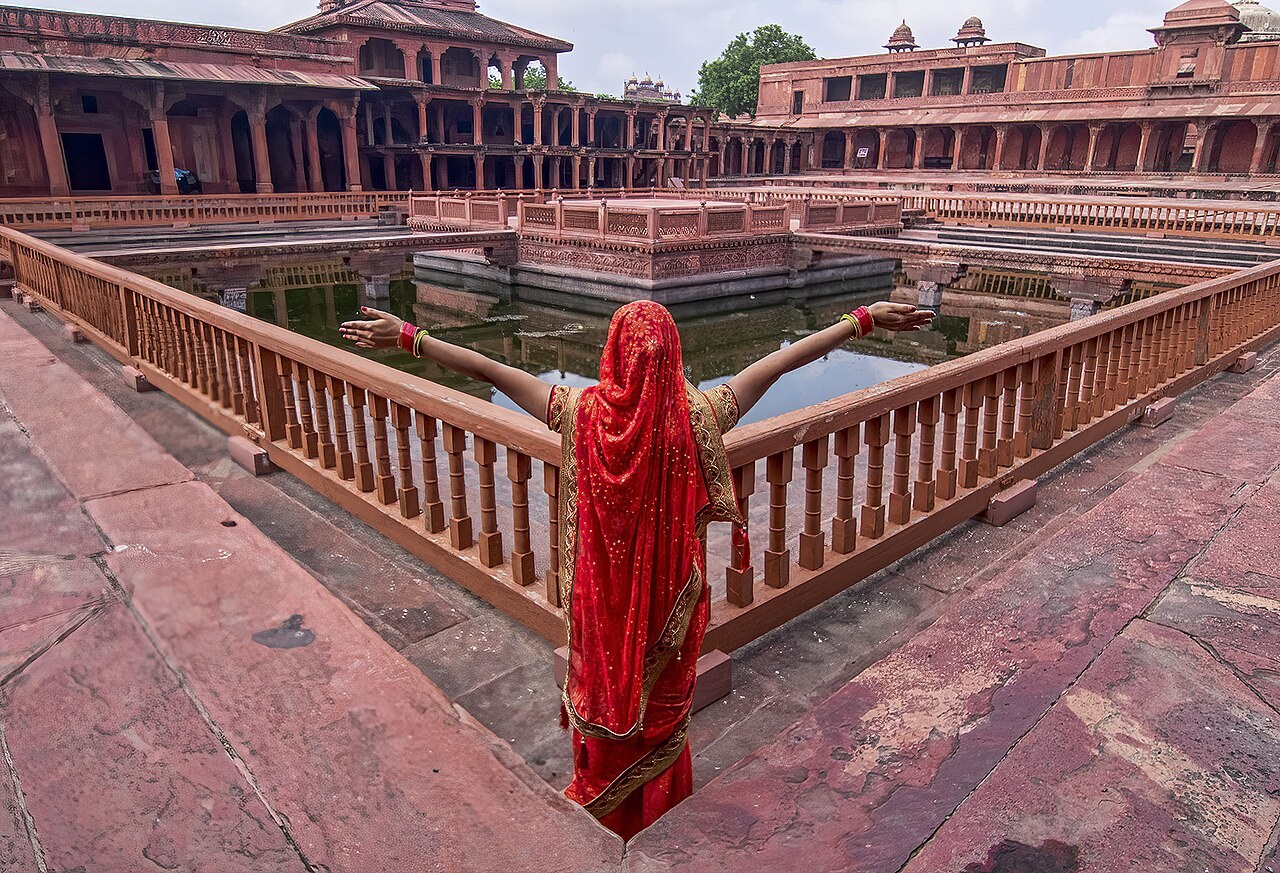
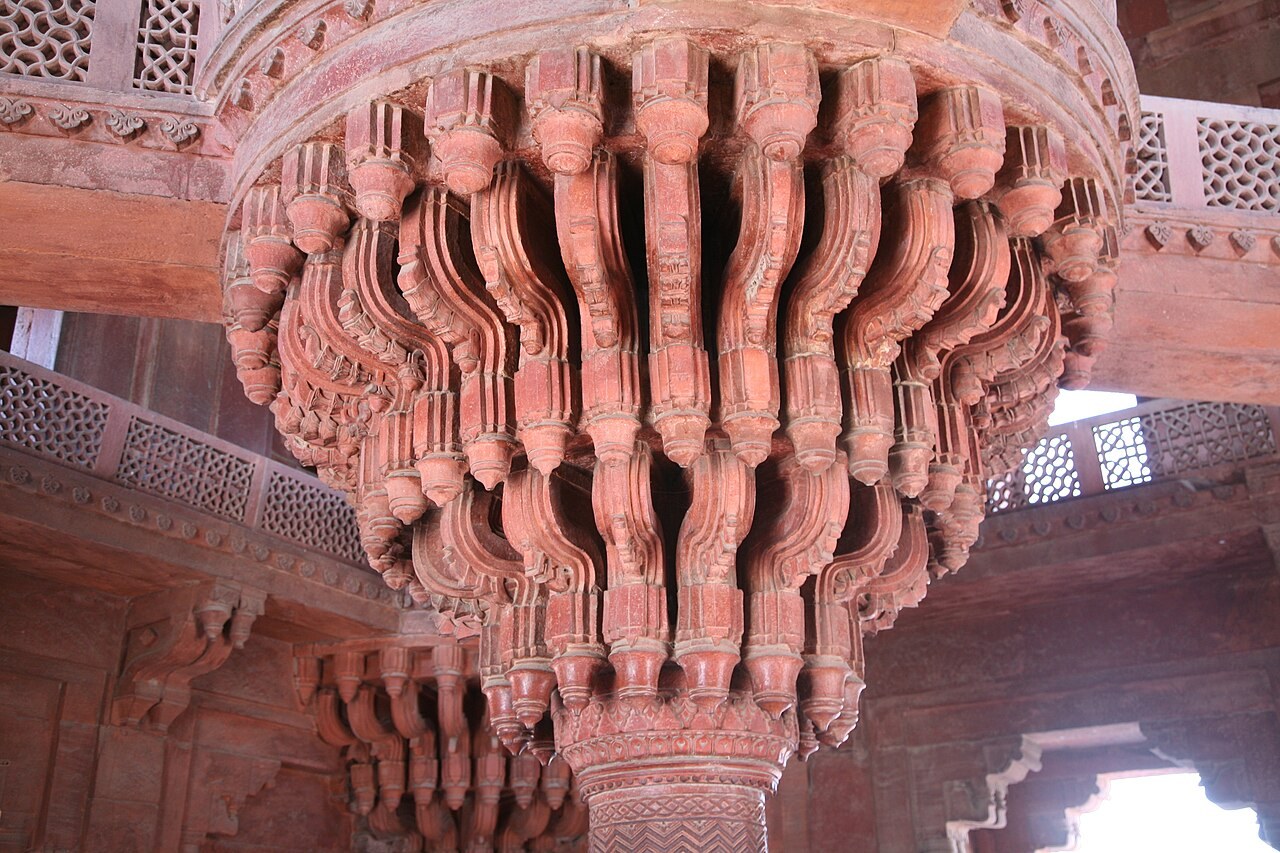
Fatehpur Sikri gave imperial ambition an architectural setting. Its surviving palaces, courtyards, mosque, and ceremonial spaces belong to the city Akbar developed in the later sixteenth century. Red sandstone connected buildings of strikingly varied forms. The artistic culture of his reign drew on Persian traditions while employing Indian artists and architectural practices. Patronage brought different skills into a shared project without dissolving their differences. UNESCO’s account of Fatehpur Sikri the Metropolitan Museum’s survey of Mughal art
The familiar story of a rigidly orthodox young ruler suddenly becoming tolerant can make these developments look too neat. Historian Iqtidar Alam Khan has explicitly reconsidered that division in his own earlier work, emphasizing the mixed political and personal factors at work before the later 1570s. Akbar’s religious thinking developed through experiments and disputes. A change in emphasis should not be mistaken for a single conversion from one complete worldview to another. Iqtidar Alam Khan’s reassessment
Inside the House of Worship
In 1575, Akbar established the Ibadat Khana, usually translated as the House of Worship. At first, its discussions centered on Muslim learning and religious questions. Abd al-Qadir Badauni, a scholar at court who became a sharp critic of the emperor’s policies, described meetings involving theologians, religious dignitaries, nobles, and selected companions. His account preserves both intellectual intensity and competition over status. Badauni’s hostile account
Badauni recalled disputes about seating precedence and exchanges that became angry. In his telling, participants challenged one another’s beliefs with such hostility that accusations of unbelief followed. Rank, learning, patronage, and doctrinal conviction all entered the discussion together. Akbar, Badauni recalled, responded to one dispute over precedence by assigning different groups to the chamber’s four sides. Badauni’s hostile account
Religious disputation itself had a history in South Asia. Syed Ali Nadeem Rezavi distinguishes Akbar’s experiment from earlier assemblies used to reinforce established religious authority. His interpretation emphasizes the emperor’s elevation of reason over unquestioned adherence to inherited opinion. Even the building’s precise location remains debated: Rezavi has proposed identifying it with the so-called daftarkhana. Visitors should therefore be cautious about treating an attractive surviving hall as the indisputable scene of every famous exchange. Syed Ali Nadeem Rezavi’s study
The circle of interlocutors widened. Hindu and Jain thinkers, Zoroastrians, and Christians joined a courtly world already containing differences among Muslims. The emperor encountered particular scholars and practitioners, with their own knowledge, ambitions, and disagreements. Their presence multiplied the questions that could be put before him. Fritz Lehmann’s account of Akbar’s reign
The Jesuits arrive with another purpose
The first Jesuit mission reached Akbar’s court in 1580. Its members had been invited from Goa, where Portuguese power and Catholic missionary institutions were closely connected. The missionaries hoped that access to a powerful ruler might lead to his conversion and, through him, a much wider Christian future. Akbar’s invitation to explain Christian teaching did not promise that outcome. João Vicente Melo’s study of the first mission
Their encounters formed part of a diplomatic relationship as well as a religious one. Mughal expansion into Gujarat brought imperial interests closer to Portuguese-controlled ports and the maritime routes used by pilgrims and merchants. João Vicente Melo’s study shows how theological conversation could help sustain communication between political powers whose interests overlapped and competed. Neither side approached the encounter as a purely disinterested seminar. João Vicente Melo’s study of the first mission
Books and images gave the visitors additional ways to communicate. Illustrated Christian works and devotional pictures entered a court already intensely interested in painting. Mughal artists could examine, select, and rework such material within their own visual language. Nandini Das’s discussion for the TIDE research project traces Christian imagery within a manuscript about Akbar’s childhood: the image had acquired a new narrative setting rather than simply retaining its original missionary purpose. the TIDE project’s discussion of Christian imagery
The emperor’s attention encouraged hopes that repeatedly outran the results. The Jesuits found him unwilling to accept central Christian doctrines on their terms. Melo’s account follows the gap between missionary expectation and imperial curiosity, including difficulties over the Trinity and Christ’s death. Akbar did not become a Christian. The mission’s significance lies partly in the sustained encounter that occurred despite the failure of its principal conversion goal. João Vicente Melo’s study of the first mission
The missionaries’ letters addressed readers with hopes of their own. Badauni judged the court against his understanding of Islamic fidelity; Abu’l-Fazl, Akbar’s close adviser and historian, celebrated its sovereign. Their competing accounts preserve the encounter’s unresolved tensions.
Who would judge the arguments?
A document issued in 1579 made the political stakes particularly clear. Known as the mahzar, it asserted the superior standing of a just ruler when qualified scholars disagreed, allowing Akbar to choose among conflicting legal opinions for the public good. It was an intervention in the distribution of authority within an Islamic political vocabulary. Describing it simply as a declaration that the emperor could never be wrong obscures its more specific argument. Fritz Lehmann’s account of Akbar’s reign
Badauni reproduced the declaration and described the circumstances of its signing with evident hostility. In his account, the emperor’s growing power threatened the authority of religious scholars and endangered the faith itself. His alarm shows how deeply the reform disturbed established claims to authority, though his accusation that Akbar had extinguished Islam at court was a polemical judgment. Badauni’s hostile account
Abu’l-Fazl supplied a different language for imperial authority. His writings associated Akbar with discernment, justice, spiritual insight, and an ability to bring diverse groups into a common order. The ideal usually called sulh-i kul, often translated as universal peace or peace with all, connected religious accommodation to allegiance to the emperor. In Richard Eaton’s account, this intellectual work was central to Abu’l-Fazl’s place at court. Richard Eaton’s account of Abu’l-Fazl
The sayings collected in the Ain-i Akbari repeatedly commend reason and criticize unthinking imitation. They also describe divine grace as extending broadly and urge humane conduct. These passages belong to a carefully assembled presentation of the sovereign. They show which qualities his official interpreter wanted royal wisdom to embody. the sayings collected in the Ain-i Akbari
Translation as an imperial experiment
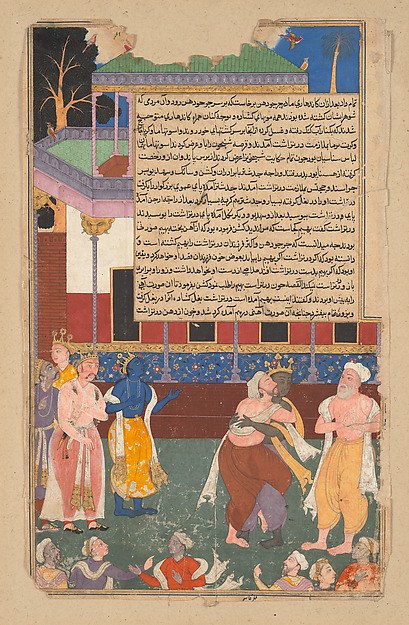
Discussion could end with the dispersal of an audience. A translated book could carry an encounter further. In 1582, Akbar commissioned a Persian version of the Mahabharata, known as the Razmnama, or Book of Wars. Rendering a Sanskrit epic into the language of the Mughal court created new possibilities for readers, patrons, and painters. Its later illustrated copies show that the project continued to matter beyond the original commission. the Met’s record of a later Razmnama folio
Brahman and Jain intellectuals were active contributors to this broader culture of exchange. Audrey Truschke’s Culture of Encounters examines their place within the Mughal court and the interaction of Sanskrit and Persian learning. Translation depended on expertise that the emperor could sponsor but could not replace. The resulting works emerged from collaboration across languages, shaped by the questions and purposes of those involved. Audrey Truschke’s Culture of Encounters
Abu’l-Fazl’s 1587 preface to the Razmnama made an ambitious claim for that work. As Christian Blake Pye explains, the preface set inquiry and verification, or tahqiq, against taqlid, unexamined adherence to inherited positions. Translation could challenge communal ignorance and religious authorities’ restrictive claims to knowledge. Christian Blake Pye’s reading of the Razmnama preface
Pye locates this argument within an intellectual inheritance associated with the Sufi thinker Ibn Arabi. On this reading, the search for truth beyond a single community’s customary formulations was itself rooted in Islamic philosophical and mystical traditions. Inquiry into other scriptures could be a spiritual discipline, revealing truths obscured by attachment to outward forms. Christian Blake Pye’s reading of the Razmnama preface
This was also a claim about sovereignty. In the preface, Akbar’s exceptional spiritual standing made the new age of inquiry possible. The argument challenged monopolies on truth while concentrating authority in a ruler represented as uniquely capable of recognizing it. The translated epic and the exalted emperor belonged to the same political vision. Universal accommodation and sacred monarchy could reinforce one another. Christian Blake Pye’s reading of the Razmnama preface
The limits of a royal peace
The small circle of disciples associated with Akbar is often discussed under the name Din-i Ilahi. Treating it as a fully organized replacement religion can impose more coherence and social reach than the evidence supports. Imperial discipleship drew on relationships between spiritual guide and follower while binding individuals closely to the sovereign. It should be distinguished from a program requiring the population to adopt a single new confession. Richard Eaton’s account of Abu’l-Fazl
The court’s own praise of reason also had boundaries. The Ain-i Akbari’s collection of sayings repeatedly returns to discipline, obedience, moral judgment, and the responsibilities of rulers. Akbar’s ideal government was personal and hierarchical. Welcoming a range of religious arguments did not establish an equal constitutional right for every subject to challenge imperial authority. The emperor remained the arbiter of the order he sponsored. the sayings collected in the Ain-i Akbari
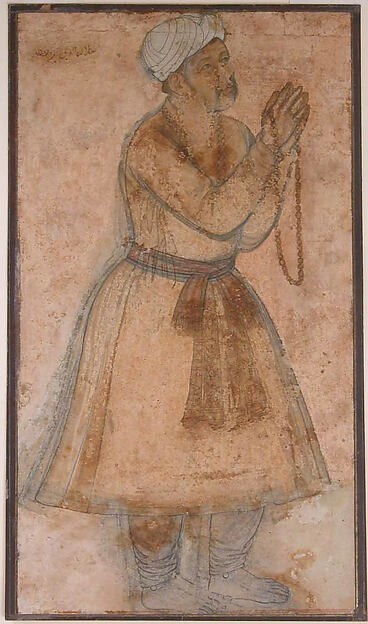
An early-seventeenth-century portrait shows an elderly Akbar holding prayer beads; the Met dates it shortly before or after his death in 1605. Its devotional emphasis complements the Narsingh miniature’s image of a sovereign listening to argument. Both belonged to a visual culture that made spiritual attention part of kingship. the Met’s portrait of Akbar praying
Akbar’s experiment left a more tangible record in arguments, translations, images, and relationships. Its participants did not agree about revelation, salvation, or the sovereign’s proper role. They helped create a courtly culture in which those disagreements could become objects of sustained inquiry. The enduring question is how that widening of intellectual possibility worked together with the power of the ruler who made it possible.
Sources and further reading
- Chester Beatty, Akbar and the Jesuits, by Narsingh, c. 1600–03 Object identification, date and imperial-biography context; a retrospective court image, not a transcript. Dating follows the museum rather than Commons’s approximate 1605.
- UNESCO World Heritage Centre, Fatehpur Sikri Sixteenth-century imperial city and surviving architectural ensemble. No surviving building is asserted to be the undisputed Ibadat Khana.
- The Metropolitan Museum of Art, The Art of the Mughals before 1600 Akbar’s patronage, Fatehpur Sikri, and combinations of Persian and Indian artistic traditions.
- Fritz Lehmann, Akbar I, Encyclopaedia Iranica Reign 1556–1605; territorial expansion, Rajput incorporation, changing religious participation, and 1579 mahzar. Dated evaluative language is not adopted.
- Iqtidar Alam Khan, Akbar’s religious policy in the early phase of his reign: A complex story (2019) Accessible abstract consulted. Revises an overly simple early-orthodox/later-tolerant division; varied political and personal factors.
- Abd al-Qadir Badauni, account of Akbar’s religious views, in History of India, vol. V, chapter 12 Older public-domain English translation selected in an early-twentieth-century anthology. Used as a partisan contemporary witness, with its polemics and uncertain missionary chronology explicitly not adopted as neutral fact.
- Syed Ali Nadeem Rezavi, Religious Disputations and Imperial Ideology: The Purpose and Location of Akbar’s Ibadatkhana (2008; online 2009) Accessible abstract consulted. Pre-Mughal debate traditions, reason and imperial purpose; proposed location remains an attribution rather than uncontested fact.
- João Vicente Melo, Meeting a New Constantine, in Jesuit and English Experiences at the Mughal Court, c. 1580–1615 (2022) Full open-access chapter consulted, CC BY 4.0. Jesuit arrival in 1580, hopes for conversion, theological disagreements, and diplomatic interests. Article paraphrases and synthesizes its findings.
- Creative Commons Attribution 4.0 International license Reuse terms for the cited open-access research by João Vicente Melo and Christian Blake Pye; no passages reproduced verbatim.
- Nandini Das, Striking up a conversation: A Christmas Encounter at the British Library (TIDE project, 2016) Jesuit books and images as diplomatic gifts; Christian iconography reworked in Mughal painting.
- Richard M. Eaton, ʿAllami, Abu’l-Fazl, Encyclopaedia Iranica Court historian’s role, universal peace and imperial discipleship. Avoids treating Din-i Ilahi as a mass religion with a standardized creed.
- Abu’l-Fazl, Ain-i Akbari, book V, chapter 12, The Happy Sayings of His Majesty H. S. Jarrett’s 1894 translation, edited online by Frances Pritchett. Sayings on reason, imitation, divine grace and royal conduct are court-curated testimony, not verbatim audio records.
- Christian Blake Pye, The Sufi method behind the Mughal “Peace with All” religions (Modern Asian Studies, 2022) Full open-access article consulted, CC BY 4.0. Tahqiq, Ibn Arabi, taqlid, 1587 preface and sacral sovereignty; interpretation attributed. Article paraphrases and synthesizes its argument.
- Audrey Truschke, Culture of Encounters: Sanskrit at the Mughal Court (2016), publisher’s account Publisher’s synopsis consulted, not a claim of full-book consultation. Brahman and Jain intellectuals as active participants in Indo-Persian court culture.
- The Metropolitan Museum of Art, Dhritarashtra Attacks the Statue of Bhima, c. 1616–17, object 2022.176 Akbar’s 1582 translation commission; later illustrated manuscript for Abd ur-Rahim Khan-i Khanan. The pictured folio is explicitly later than Akbar’s death.
- The Metropolitan Museum of Art, Portrait of Emperor Akbar Praying, early seventeenth century, object 29.160.20 Dated shortly before or after Akbar’s death in 1605; no inference of a precise confession from the image.