
Luther’s Ninety-Five Theses: How an Academic Dispute Found a Public
The letter of 31 October 1517 is firmer evidence than the famous hammer scene. The printed pages that followed reveal how theology, workshop labour and political protection transformed a dispute.
On 31 October 1517, Martin Luther addressed a letter to Albrecht, archbishop of Mainz and Magdeburg. The theology professor in Wittenberg was alarmed by what people appeared to believe about indulgences: that acquiring a document could guarantee salvation, or that a payment could secure a soul’s release from purgatory. He asked the archbishop to intervene. He also directed him to a set of propositions about indulgences—the text remembered as the Ninety-Five Theses.
The letter is a less spectacular starting point than a hammer striking a church door. It is also a more revealing one. Luther still appealed upward through the Church’s hierarchy. He distinguished between preaching he had not personally heard and beliefs he said had reached him. His complaint concerned the care of souls, and he presented it as a duty owed to his superior. The letter’s wording matters because it resists the temptation to make the mature Reformation appear fully formed on its first commemorated day.
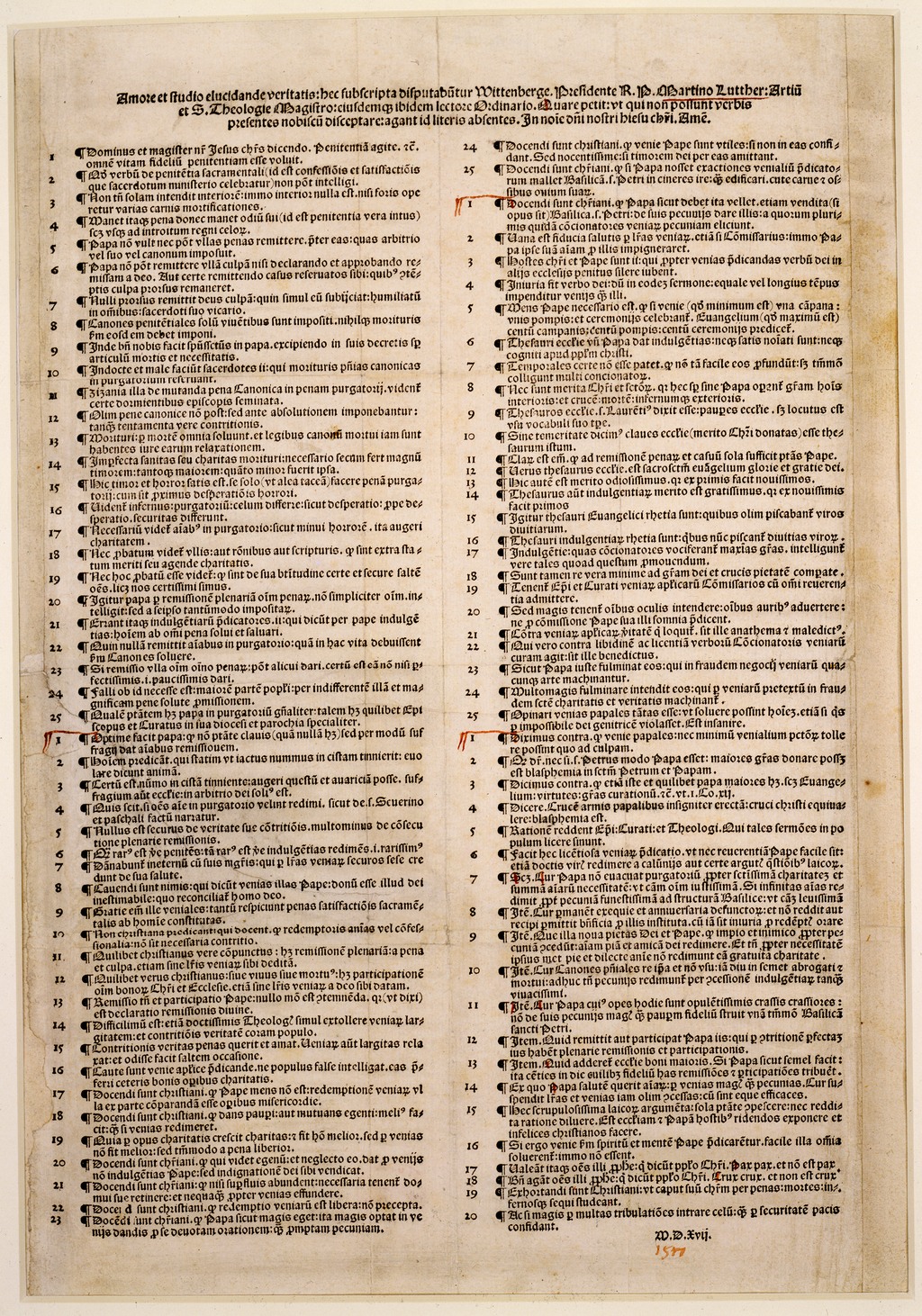
Within weeks, the dispute acquired a material life beyond that correspondence. Surviving editions of the theses testify to printing in Leipzig, Nuremberg and Basel before the end of 1517. The Nuremberg sheet attributed to Hieronymus Höltzel sets out a dense Latin argument in columns. Its opening invites debate and written responses from those unable to attend. This was recognizably university business. Yet printers could reproduce it for readers whom the university had not summoned.
The historical problem is therefore larger than whether a notice appeared on a particular door. How did an academic and pastoral challenge become a public conflict that neither its author nor his superiors could contain?
What an indulgence promised—and what Luther disputed
The shorthand “selling forgiveness” catches the commercial scandal but can obscure the theology. An indulgence concerned remission of temporal punishment associated with sin; it was not, in formal doctrine, permission to commit future sins or a replacement for repentance. The controversy arose partly in the distance between theological distinctions, fundraising practices and the assurances people believed they were receiving.
The campaign connected to St Peter’s Basilica also served financial interests closer to home. The Library of Congress account explains that proceeds were divided between the Roman building project and the repayment of debts incurred by Albrecht. Those arrangements helped turn a question about penitence into a dispute about ecclesiastical credibility. A purchaser could encounter the Church simultaneously as spiritual authority and as an institution seeking revenue.
Luther’s intervention did not begin as an argument that religion should disappear from public life. It assumed that salvation mattered profoundly and that misleading Christians endangered them. Nor did criticism of a particular campaign automatically entail every later Protestant position. Following the argument through its successive publications is more useful than reading backward from the churches eventually established in Luther’s name.
There is a further difficulty for the historian: theological terms themselves became contested. To describe the quarrel merely as an enlightened individual exposing a fraud is to decide its religious questions before examining them. To describe it only as institutional disobedience misses the genuine anxiety about what Christian teaching required. The documents preserve a conflict over both belief and the authority to define it.
The door is a question, not an eyewitness scene
The famous posting remains disputed. Philip Melanchthon described it in 1546, but he had not yet arrived in Wittenberg in October 1517. A note by Luther’s colleague Georg Rörer also mentions posting at church doors. Such testimony cannot simply be ignored; neither can it be turned into a contemporary report of the dramatic scene familiar from later pictures.
University regulations made public notices of disputations plausible. The precise sequence of private correspondence, circulation and posting is harder to establish. In a joint examination of the evidence, historians Volker Leppin and Timothy J. Wengert deliberately present arguments on opposite sides. Their disagreement is a useful warning against replacing one certainty with another. “Luther certainly hammered the theses up himself” and “nothing was ever posted” both claim more than a cautious account needs.
Whatever happened at the doors, the surviving printed texts allow us to study a consequential process without inventing its opening tableau.
A different public, and a different kind of publication
Latin could cross political borders, but it did not make a work accessible to every potential reader. In 1518 Luther’s German Sermon on Indulgences and Grace presented the subject in a short, direct form. The change was more than translation. An argument designed for trained disputants had become a text that could be bought, read aloud and discussed outside their circle.
Book historian Andrew Pettegree identifies this work as a decisive publishing development. In his Harvard Divinity School interview, he records fourteen reprintings in its first year. Short German works offered printers a different financial proposition from large learned volumes: less material and capital tied up in a single edition, faster production, and opportunities for several local shops rather than one distant supplier. These commercial incentives did not create Luther’s theology, but they helped determine which forms of it travelled.
A printed controversy is not simply an author speaking more loudly. Compositors had to set the words; presses had to be worked; paper had to be acquired; booksellers had to judge whether buyers would appear. Every new edition involved people deciding that a particular intervention was worth reproducing. The geographical spread of those decisions made it difficult to recover control by addressing a single workshop.
Nor was a pamphlet’s audience identical to its purchasers. A copy could be shared or heard. Oxford’s work on the print culture and soundscape of 1522 places pamphlets alongside contemporary hymn production. Reading, preaching and singing belonged to an overlapping religious environment. The press did not replace the spoken word; it supplied material that voices could carry further.
That matters when describing the Reformation as a communications revolution. A stack of surviving books shows what was printed, not exactly how every listener understood it. Circulation, assent and lasting institutional change are different things.
Arguments hardened; pictures took sides
The intervening years changed the dispute. At Leipzig in 1519, Luther’s confrontation with Johann Eck pressed questions of church authority beyond the original indulgence campaign. In 1520, writings such as The Babylonian Captivity of the Church challenged sacramental arrangements at a much deeper level. Pope Leo X’s bull Exsurge Domine, issued in June, threatened excommunication unless condemned positions were withdrawn. Luther publicly burned the bull in December; formal condemnation followed in January 1521. The Library of Congress collection makes the escalation visible through the publications themselves.
At the imperial assembly at Worms in 1521, the controversy also became a matter of imperial enforcement. Luther’s refusal to retract was followed by the edict against him. His protection at the Wartburg depended on political allies, not on the press alone. Printing could make a disputed writer widely known; it could not by itself keep him beyond the reach of an arrest order.
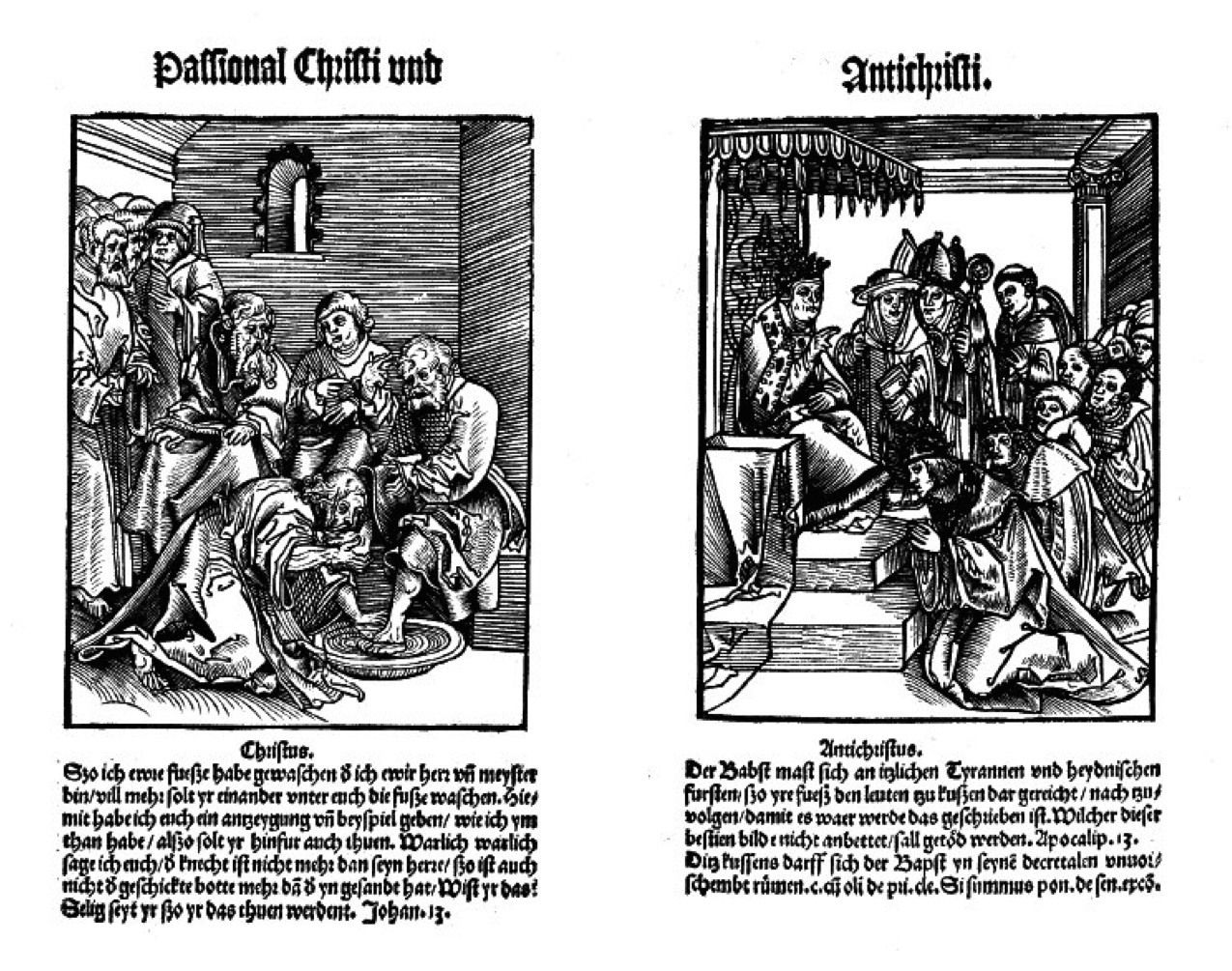
Images gave the controversy a particularly sharp form. Lucas Cranach’s Passional of Christ and Antichrist, published in 1521, set contrasting scenes side by side. Its thirteen pairs of woodcuts juxtaposed Christ’s conduct with the behaviour attributed to the papal Church. The Library of Congress describes the book’s visual argument; the pair reproduced here contrasts Christ washing his disciples’ feet with a pope receiving the kissing of his own.
The arrangement invites a verdict before a reader has worked through a theological treatise. It also illustrates why historical images require interpretation. This is evidence of anti-papal polemic, not an impartial survey of Catholic life. Its power lies in selection: one authority is made to embody service, the other its opposite. The woodcut’s simplicity is an achievement of persuasion, not a guarantee of fair description.
A German New Testament was also an interpretation
Luther began translating the New Testament at the Wartburg and revised it with colleagues after returning to Wittenberg. The September Testament appeared in 1522, followed by another edition in December. The scholarship on pre-Luther German Bibles establishes an important correction: this was not the first German Bible. Its historical significance cannot rest on the mistaken claim that Germans had never encountered Scripture in their own language before.
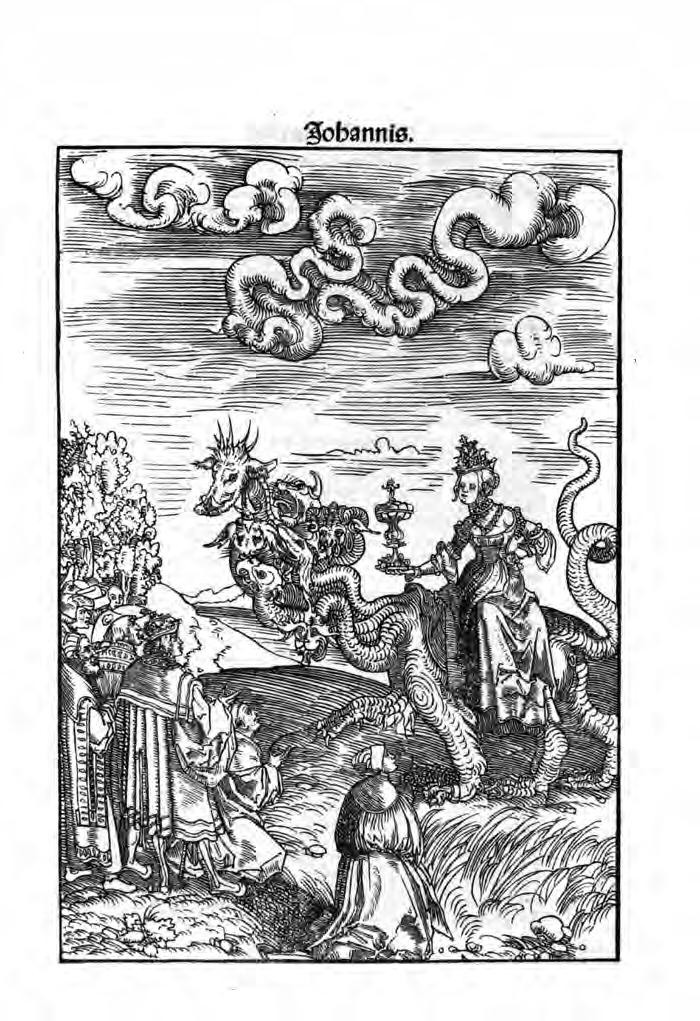
The work joined translation to a substantial publishing enterprise. The Gruber Rare Books Collection identifies Erasmus’s 1519 Greek edition as a textual basis and records the participation of Melanchthon and others in revision. It also draws attention to marginal commentary and twenty-one illustrations from the Cranach workshop. A reader received more than an otherwise unmediated sacred text. Word choice, ordering, notes and pictures offered guidance about its meaning.
The illustration of Revelation’s Babylon shown here makes the point unmistakable. The figure wears a papal tiara. A biblical image had become a weapon in a contemporary religious struggle. Its presence warns us against treating the passage from Latin to German as a simple removal of interpretation. Interpretation was being redistributed and made newly visible.
The market was impressive, but it had limits. In Printing, Propaganda, and Martin Luther, historian Mark U. Edwards Jr. traces repeated editions while stressing questions of audience. A substantial book remained expensive relative to many incomes. Ownership was not universal, literacy was uneven, and the responses of actual readers cannot be calculated merely by multiplying editions by estimated print runs.
Those qualifications do not make the achievement smaller. They make it intelligible. The New Testament reached people through households, congregations, booksellers and existing habits of hearing and reading. Its authority depended both on the scriptural text and on trust in the people presenting it.
What the hammer leaves out
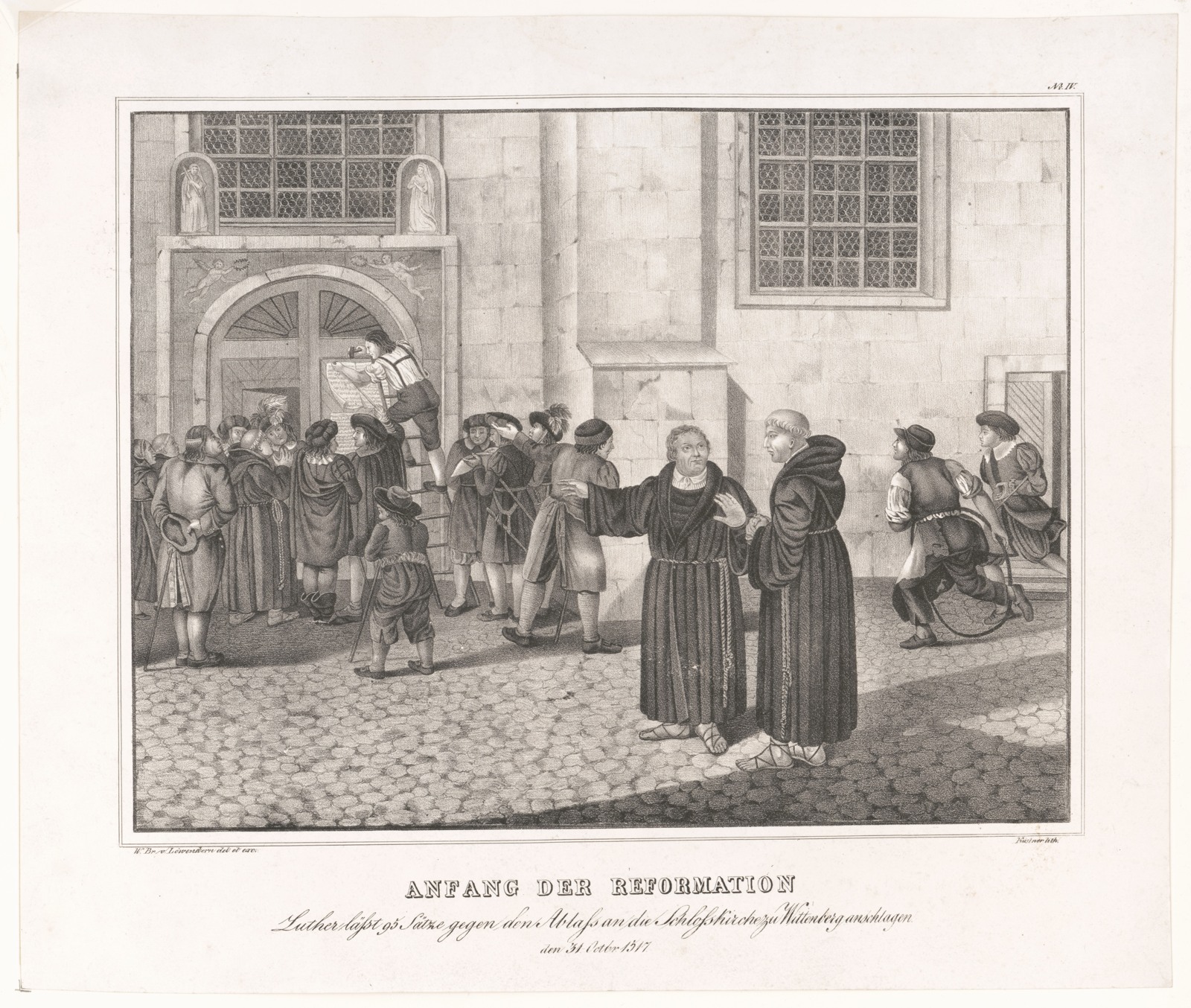
The 1830 lithograph reproduced above belongs to the history of remembering Luther. Its Library of Congress record dates it more than three centuries after the event it represents. The assembled spectators, the arrangement of bodies and the commanding central figure are choices made for later viewers. They should not quietly become evidence for who stood outside the Castle Church in 1517.
A founding scene gives a long transformation a convenient shape: one man, one gesture, one moment of rupture. The printed record suggests a less tidy sequence. A letter sought correction from within an institution. Latin propositions circulated. Short German arguments found a market. Opponents answered, religious positions developed, governments intervened, and images taught audiences how to identify friends and enemies.
This sequence also prevents technological determinism. A press could reproduce an indulgence as well as an attack on indulgences; it could carry a condemnation as readily as a defence. What mattered was how religious conviction, workshop labour, commercial judgement and political protection combined in particular places.
For that reason, the most revealing relic of 1517 may be the densely printed sheet rather than an imagined hammer. It preserves an argument made repeatable. Following that argument from one edition to another brings into view the many hands that turned a university dispute into a conflict over who could speak authoritatively about Christian life.