
Indus Seals: The Evidence Around an Undeciphered Script
Small stone seals preserve craft, exchange and authority in the Indus cities. Their unread signs also show what archaeology can establish, and what a claimed decipherment must still prove.
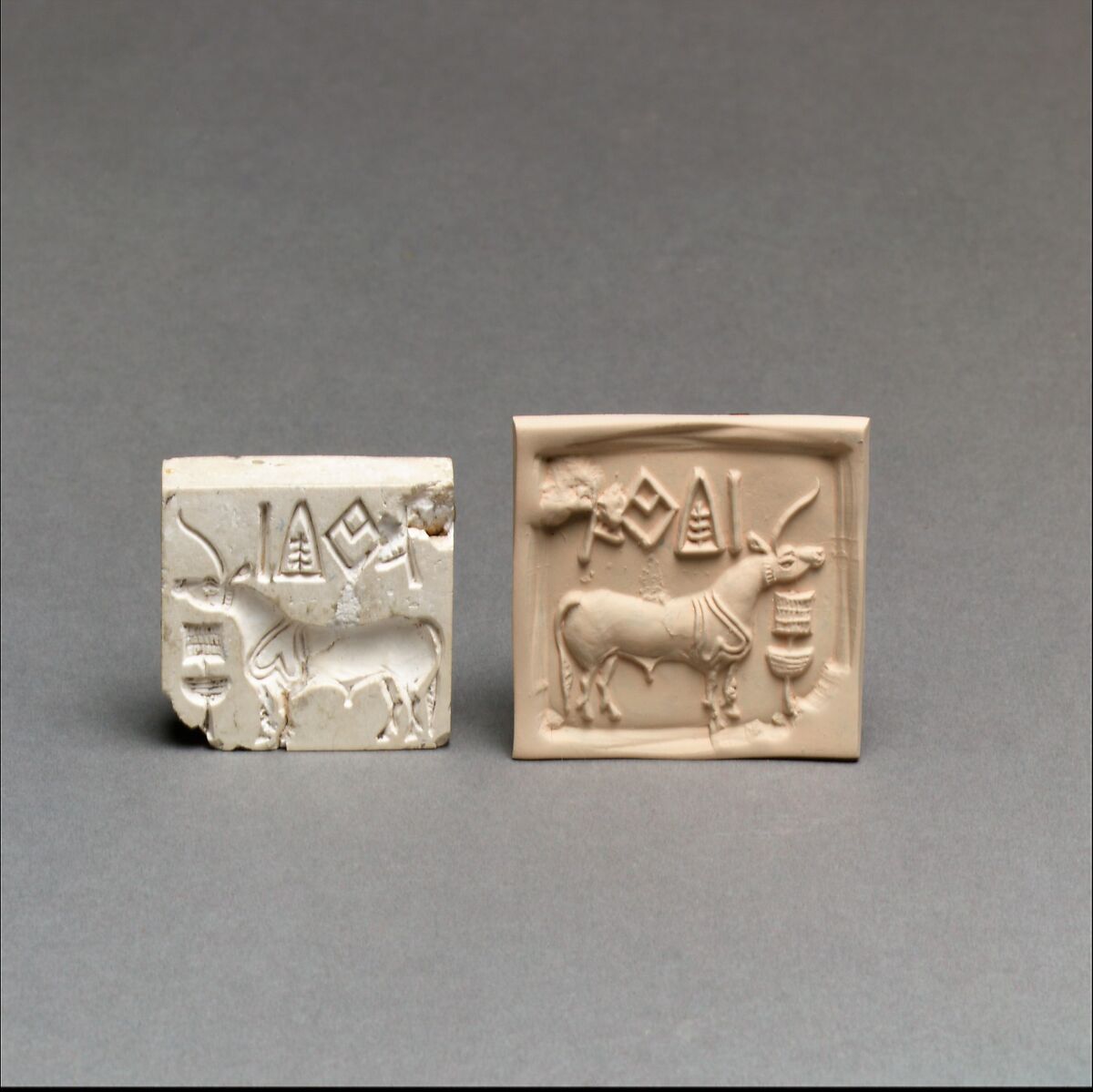
A small square of pale stone carries an animal, a device standing before it and a row of signs. Beside it in the Metropolitan Museum’s photograph is a modern impression: the same design raised from a tan surface, facing the other way. The pair demonstrates what the ancient object was made to do. A cut surface could reproduce an image when pressed into a softer material. The museum dates this seal to about 2600–1900 BCE.
The signs remain unread. That fact has made Indus seals famous, but it can also pull attention away from everything else they preserve. Someone obtained the stone, shaped it, cut a compact design and made an object that could be carried and used repeatedly. Archaeologists can investigate those actions without pretending to know the words, titles or identities that the signs may encode.
A find whose importance was missed
In his report published in 1875, Alexander Cunningham illustrated a seal associated with Harappa. He could not read its signs. The animal lacked the hump he expected of an Indian bull, and he considered the object foreign. The problem was larger than an unfamiliar inscription: he did not yet have the archaeological framework needed to place it in a Bronze Age urban civilization.
Gregory Possehl’s history of research at Harappa follows the long interval between early visits and systematic excavations. Daya Ram Sahni’s work at Harappa in 1920–1921 brought more seals from levels older than the periods previously expected there. Objects that had looked isolated could now be compared in excavated contexts. Recognition depended on repeated finds and the work of Indian archaeologists, rather than on a single European suddenly solving a mystery.
The British Museum’s record for Cunningham’s seal identifies six characters above the animal and a findspot at Harappa. Its recorded nineteenth-century ownership and eventual acquisition tell us how the object entered a museum. They are not a substitute for a modern excavation record showing its original room, deposit and associated objects. The history of collecting affects the questions a seal can answer.
Before a seal could make a mark
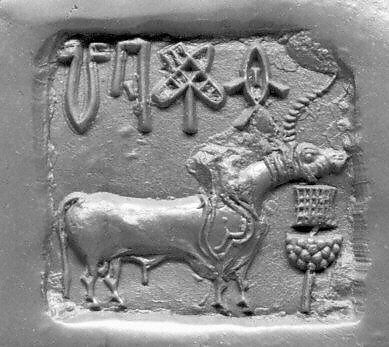
The material mattered. Steatite could be worked into a compact surface capable of holding fine cuts. The Met’s buffalo seal is catalogued as burnt and glazed, evidence of a production process beyond simply scratching a found stone. Its face measures only about four centimetres across. The craftsperson had to fit an animal, a device and signs into that restricted space while leaving them distinct enough to reproduce. The object record gives physical details more securely than any proposed reading can supply its owner’s name.
Excavation can take the investigation back toward manufacture. Jonathan Mark Kenoyer’s study of work along Harappa’s Mound E distinguishes successive occupation phases and craft activity. He interprets seals and tablets as objects through which elites reinforced economic, political and ritual authority. That is an archaeological argument about their social use, not a translated statement from an Indus official. The workshop evidence makes production, access to materials and control of skilled labour part of the inquiry.
The stamp and the clay
A seal is the tool; a sealing is the impression it leaves. The difference is easy to lose in photographs, especially when museums display a modern impression beside an ancient stone. Actual ancient clay impressions provide another class of evidence. Two examples from Harappa, dated to the urban period, preserve impressions from more than one seal. The accompanying description notes clay that appeared unlike local material, raising the possibility that the sealed object had arrived from elsewhere. Their published description presents that provenance as a possibility, not a demonstrated itinerary.
Such finds support a practical role in marking or securing things. They do not identify the contents of every vanished package, nor establish that every seal was used in exactly the same way. A repeated stamp might refer to a person, an office, a group or something else. Assigning one of those meanings requires evidence beyond the mere existence of an impression.
The broader setting was a connected economy. The Yale eHRAF account of the Early Indus tradition traces craft specialization, exchange and the use of cubical limestone weights before the mature cities. Seals therefore belong within a longer development of production and coordination. They were not mysterious devices that appeared without a social or technological background.
What kind of animal is a unicorn?
The name “unicorn” is a modern descriptive label, not a translated Indus name. Its identity has attracted zoological and religious interpretations. Asko Parpola, for example, has explored an association with the nilgai antelope and a larger religious setting. His study explicitly treats the creature’s identity and meaning as disputed. A proposed interpretation should retain its author and its uncertainty when it leaves an academic paper and enters a popular history.
The device before the animal is also easy to overname. “Altar” or “incense burner” can turn an interpretation into an apparent fact. The Met’s catalogue retains a question mark. Describing the visible form keeps an uncertain proposal from becoming a recovered ancient name or function.
Kenoyer’s study of Indus animal imagery also examines how motifs worked across different media and contexts. A motif on a seal need not have meant precisely the same thing on a vessel or ornament. Nor does resemblance to imagery from a much later religious tradition establish an uninterrupted meaning across the intervening centuries. Context has to do work that visual similarity alone cannot.
Signs did not live only above animals
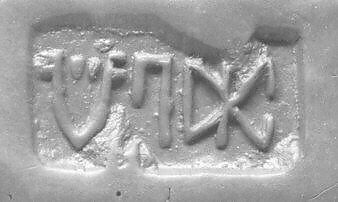
The familiar square seal is only one part of the evidence. Kenoyer’s work on the script’s contexts asks how the type of object and its archaeological setting affect interpretation. Cutting a stamp so that its impression appears correctly oriented poses a different task from writing directly on an object. Reversal between matrix and impression must therefore be considered before comparing photographs. His contextual analysis connects the signs to the objects that carried them. His discussion of excavated seals at Harappa places animal-free rectangular forms in Periods 3B and 3C, within the later urban sequence, rather than treating every format as timeless.
A rectangular plaque seal in the Met makes the difference visible. Its narrow face directs attention to a line of signs instead of a large central animal. The museum dates this particular object broadly to the third millennium BCE. That broad catalogue date should not be silently replaced by a more precise date drawn from another site’s stratigraphy. Typological comparison is useful, but it does not recover an undocumented find context.
A much larger message at Dholavira
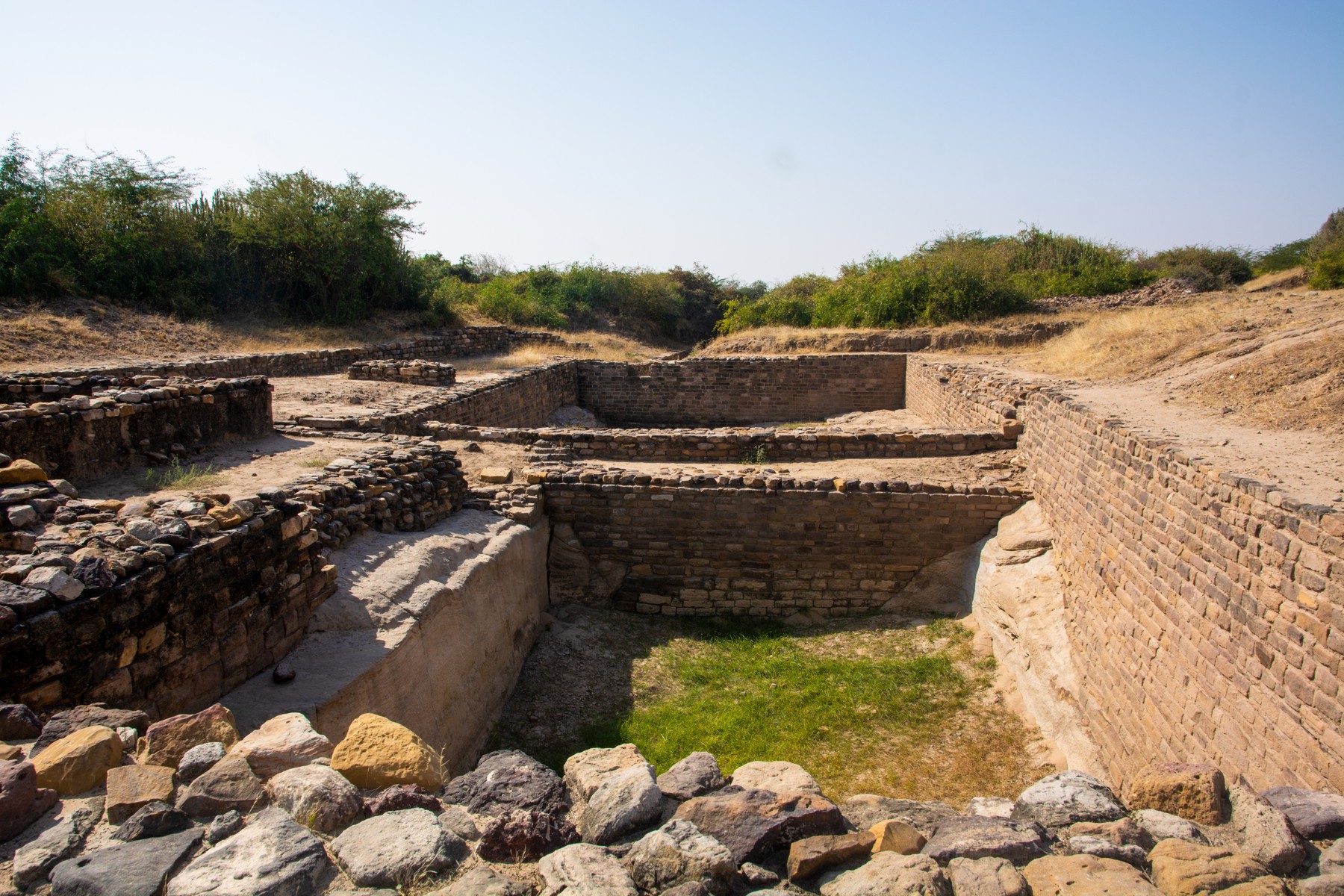
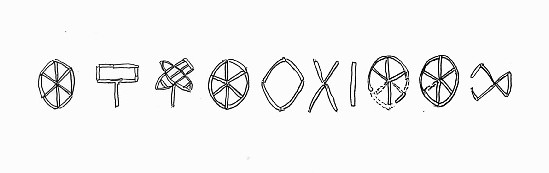
At Dholavira, signs appear at a scale far removed from a small portable stamp. Archaeologists found a sequence of ten in the western chamber of the castle’s northern gateway. One sign occurs four times. The Harappa.com description accompanying an Archaeological Survey of India photograph associates the group with the city’s Stage IV and dates it to about 2500–1900 BCE. Its position encouraged the interpretation of a display visible around a major entrance. The message itself remains unknown.
The city gives that discovery a setting. Dholavira stood on Khadir island in what is now Gujarat. Fortifications, internal divisions, reservoirs and workshops survive within an unusually legible urban plan. UNESCO’s archaeological account describes a settlement occupied over a long span, about 3000–1500 BCE. The ten-sign group belongs within that changing settlement history; it cannot stand for every phase of the site or every community across the Indus world.
A modern drawing can make the repeated forms easy to compare, but it removes much of the excavated object: material, scale, condition and spatial relations. The diagram below is useful for seeing a sequence. It is not an excavation photograph and cannot establish where the original display stood. Those are questions for recorded archaeological context.
Why pattern is easier to recover than meaning
The difficulties of decipherment are concrete. Most surviving sequences are short. No generally accepted bilingual inscription provides the same message in an already readable language. The underlying language, or languages, has not been securely identified. Even deciding when slightly different shapes count as separate signs affects the inventory on which a proposed reading depends.
Nisha Yadav and colleagues’ n-gram study examined recurring combinations and the positions signs occupy. A model can test which signs commonly begin or end a sequence and estimate what might fit a damaged position. Those are meaningful observations about structure. They do not supply pronunciation or translation. The authors explicitly say that their results cannot conclusively establish that the system encodes natural language. Predicting a damaged sign is therefore a useful analytical result, without yet identifying a word or its sound.
A statistical argument, and a dispute
In 2009, Rajesh Rao and colleagues published a short paper in Science arguing that conditional entropy, here measuring uncertainty about a sign given the preceding sign, provided evidence consistent with linguistic structure. Their reported comparison placed Indus patterns alongside those of known writing and other systems. It was an argument about the kind of system represented, not an announcement that the inscriptions had been read.
Richard Sproat challenged this approach. Using a broader collection of linguistic and nonlinguistic systems, his 2014 paper in Language argued that earlier measures did not discriminate successfully as published. His alternative measures classified the Indus material as nonlinguistic within that comparison. The classification depends on the measures and comparison sets; it is not a recovered ancient statement. Neither paper yields a translation. The disagreement concerns what statistical regularities can establish about the system, not competing readings of an already deciphered text.
Three questions need to remain separate: whether the marks encode language, which language they might encode, and what a particular sequence says. A statistical resemblance can contribute to the first question without answering the second or third. Even a convincing argument for language would leave the hard work of assigning and testing sign values still to be done.
A persuasive reading would need to work beyond a few selected examples. Its sign values and rules would have to remain consistent when applied to independent inscriptions, while explaining repeated sequences and fitting archaeological evidence. An attractive match to one personal name or a familiar religious phrase cannot carry that burden by itself. The shortness of the surviving texts makes it especially important to ask how many alternative readings could fit the same material.
The use of seals outlasted the familiar inscriptions
After about 1900 BCE, urban life across the Indus region changed substantially. Kenoyer’s overview of seal styles distinguishes the disappearance of the familiar inscribed urban seals from later continuities in sealing: uninscribed button forms occur in subsequent periods. The end of one distinctive combination of animal, sign sequence and stamp was not the disappearance of every community or every practice of making marks.
The unread signs leave major historical questions open. Excavation can still locate workshops, separate ancient sealings from modern impressions and trace changes in the objects people used. A seal without a secure find context and a sealing recovered from a recorded deposit do not carry the same information. Progress comes from preserving those differences and testing interpretations against them, one object and one context at a time.
Sources and further reading
- The Metropolitan Museum of Art: unicorn seal, 49.40.1
- Gregory L. Possehl: A Short History of Archaeological Discovery at Harappa
- British Museum: Cunningham seal, 1892,1210.1
- Jonathan Mark Kenoyer: Steatite and Faience Manufacturing at Harappa
- Jonathan Mark Kenoyer: The Origin, Context and Function of the Indus Script: Recent Insights from Harappa
- Harappa.com: Two Clay Sealings from Harappa
- The Metropolitan Museum of Art: buffalo seal, 49.40.2
- Asko Parpola: The Harappan Unicorn in Eurasian and South Asian Perspectives
- Jonathan Mark Kenoyer: Master of Animals and Animal Masters in the Iconography of the Indus Tradition
- The Metropolitan Museum of Art: rectangular plaque seal, 49.40.4
- Harappa.com / Archaeological Survey of India photograph: Dholavira Symbols
- UNESCO World Heritage Centre: Dholavira, a Harappan City
- Rajesh P. N. Rao and colleagues: Entropic Evidence for Linguistic Structure in the Indus Script
- Nisha Yadav and colleagues: Statistical Analysis of the Indus Script Using n-grams
- Richard Sproat: A Statistical Comparison of Written Language and Nonlinguistic Symbol Systems
- Jonathan Mark Kenoyer: The Indus Seals, an Overview of Iconography and Style
- Yale eHRAF Archaeology: Early Indus tradition
- Jonathan Mark Kenoyer: Three Inscribed Seals
Evidence note: no Indus signs are translated here. Proposed religious meanings, linguistic classifications and archaeological functions are identified as interpretations. Museum photographs of modern impressions are distinguished from ancient clay sealings.