
Aksum’s Coins: Trade, Faith, and Power on the Red Sea
How royal coins, port archaeology, and merchants’ accounts reveal the commerce and statecraft of ancient Aksum.
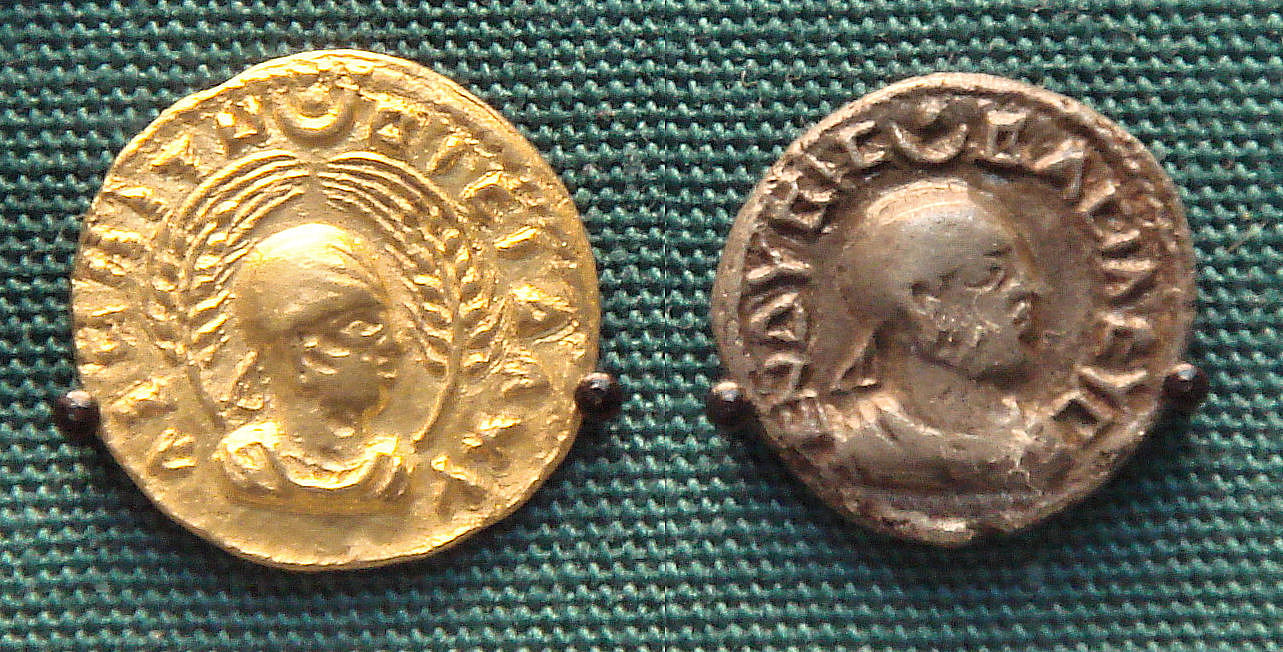
A silver coin less than two grams in weight carries a surprisingly forceful image of government. On both faces, King Endubis appears in profile, his headcloth carefully indicated. A crescent and a disk occupy the space above him. The British Museum dates this particular piece to approximately 270–300 CE. It is a small, surviving act of royal self-presentation, produced in the highland city of Aksum in what is now northern Ethiopia. The object record supplies a name and a weight where a continuous account of the king’s reign does not survive.
Following such a coin outward changes the geography of ancient history. Aksum’s commercial world crossed the highlands of present-day Ethiopia and Eritrea, reached the Red Sea port of Adulis, and connected with Arabia and the Mediterranean. Its rulers could advertise themselves in Greek while governing an African kingdom with its own language and traditions. Coinage helps explain how that combination worked, provided its testimony is kept separate from what modern historians would like it to prove.
The journey began before the mint
The commercial route was already established long before Endubis’s surviving issues. The anonymous, Greek-writing merchant who composed the first-century Periplus of the Erythraean Sea placed Adulis inland from its anchorage. From there, he described a three-day journey to Coloe, an ivory market, and another five days to the city of the Aksumites. Ivory moved down from the interior through this sequence of places. The account presents a chain of markets and journeys rather than a coast supplied effortlessly from an undifferentiated hinterland. Periplus, sections 4–6
Its list of imports is equally revealing: textiles, metal vessels, iron, tools, glass, some wine and olive oil, and Indian iron and cotton fabrics. Metal arrived in forms that could become ornaments, weapons, or utensils. The writer also mentions a little coin and brass used in pieces as a means of exchange. Commercial life therefore preceded the royal mint and employed more than one kind of payment. Aksumite coinage entered an existing economy; it did not create exchange from nothing.

Putting the king into circulation
The British Museum’s account identifies Endubis’s late-third-century issues as the beginning of Aksum’s surviving royal coinage and notes their relationship to Roman weight standards. That relationship made practical sense in a trading region where merchants encountered other currencies, but similarity should not be mistaken for political dependence. A coin carrying an Aksumite ruler’s name asserted a different issuing authority even when its metal and format were intelligible to foreigners. Aksumite coins
The Fitzwilliam Museum preserves a gold unit of Endubis weighing 2.66 grams. Placed beside the British Museum’s silver specimen, it makes the mint’s use of different precious metals tangible. Neither object tells us the price of a meal or the wage of a porter. There is no reliable conversion from these pieces to a modern sum of money. What they do establish is that Aksum’s court could acquire metal and organize its transformation into objects bearing a repeated royal design. Fitzwilliam Museum, CM.2-2000
That distinction matters. A coin is evidence of an organized issue, but the survival of a few handsome specimens cannot by itself reveal how much currency was struck, how uniformly it circulated, or how thoroughly ordinary households relied on it. Those questions require excavation contexts and comparisons across many finds.
Greek letters across the water
Language offered another way to make royal money recognizable. The British Museum’s Money Gallery explains that Aksumite gold coins were mostly inscribed in Greek, which could assist their acceptance beyond the kingdom. It also displays gold issues of Ebana and Kaleb found near Aden in present-day Yemen. These finds place Aksumite money on the Arabian side of the Red Sea, beyond an argument based solely on the appearance of the coins. Money Gallery guide, room 68
Even here, the inference has limits. A gold piece might cross the water through a sale, a military payment, a gift, or the movement of an individual. A findspot demonstrates travel more securely than it demonstrates one particular transaction. Greek lettering likewise identifies a chosen language of communication, not the ethnicity of every person who handled the coin. Aksum’s rulers were addressing a world larger than their immediate court without abandoning their position within the highlands.

A cross above the royal portrait
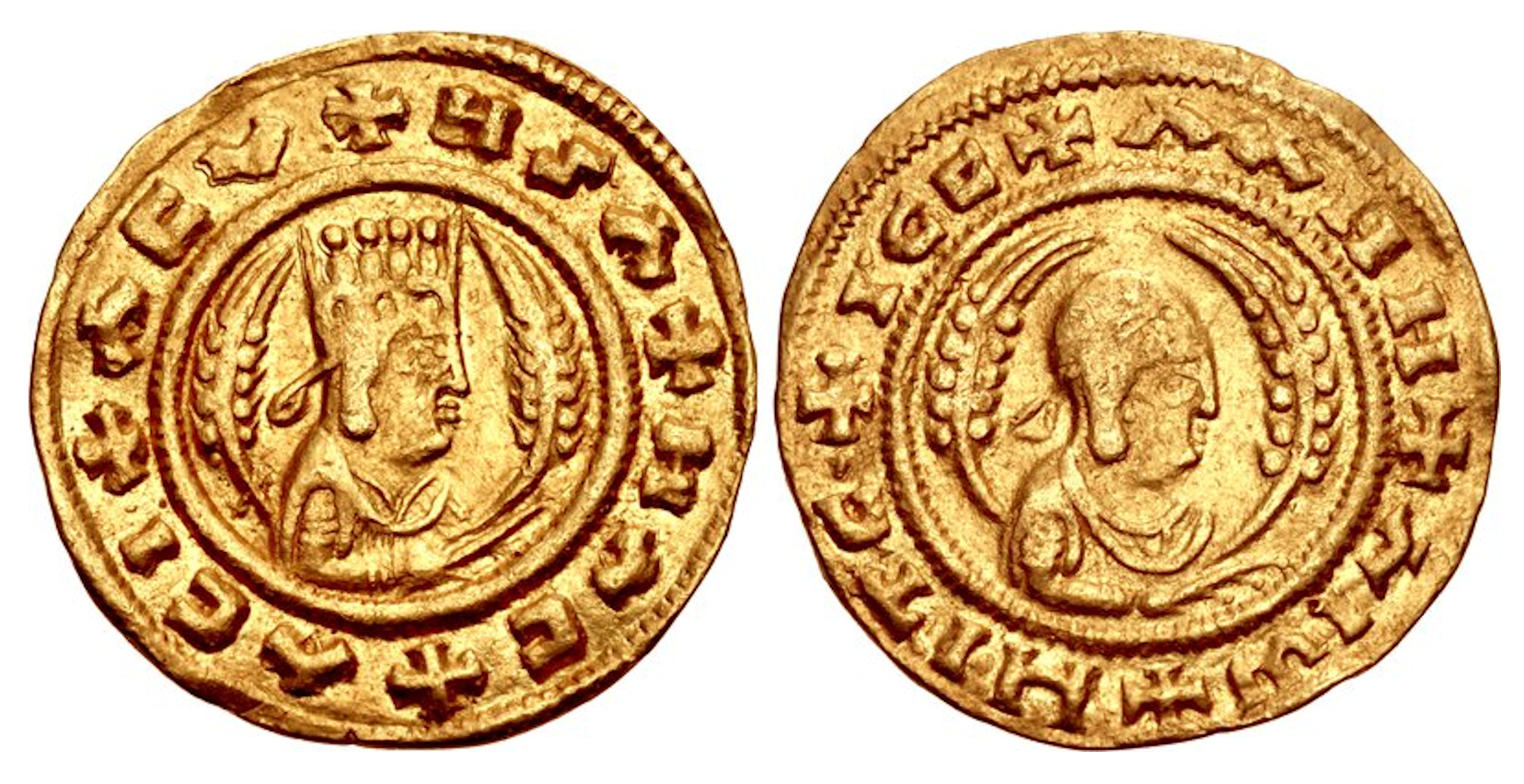
In the fourth century, royal coin imagery registered a major religious change. Under Ezana, the cross replaced the earlier crescent-and-disk motif. Museum summaries differ in their precise dating of his reign and conversion, so the safest general description is a fourth-century transition rather than an exact year claimed from the coin alone. The alteration is nevertheless unmistakable: the mint now gave Christian symbolism a recurring place in the presentation of kingship. The Met’s account of Aksum’s Christian legacy
The older crescent and disk should not be read as an Islamic emblem. They belonged to a pre-Christian religious vocabulary centuries before Islam emerged. The American Historical Association’s teaching guide also draws attention to crowns, headdresses, scepters, and grain imagery on Aksumite issues. These details allowed the king to be represented through several kinds of authority at once. The guide treats the association between grain and royal provision as an interpretation, appropriately distinguishing a plausible meaning from a label inscribed on the object. Reading Aksumite coin imagery
Changing an official symbol is easier to document than changing everyone’s belief. The coins show what the issuing court chose to proclaim. They cannot identify the religion of every purchaser, cultivator, or merchant, nor establish that older practices disappeared when the first Christian issue left the mint.
What buildings add to the metal
At Aksum, monumental remains supply a different scale of evidence. Elaborately carved stelae imitate architectural features, including doors, windows, and projecting beams. Large residential buildings stood on raised platforms, while tomb assemblages included both local objects and imported materials. These remains connect the wealth advertised by royal portraiture to a built environment requiring extensive labor and specialist skills. The Met’s study of Aksumite architecture
Multilingual inscriptions bring another useful comparison. Greek, Ge’ez, and South Arabian writing could appear in the same political landscape. The choice of language on a monument or coin belonged to the act of addressing an audience. It is therefore more illuminating to ask who might encounter a text, and what its maker wished to establish, than to force the kingdom into a single cultural category. Aksumite power was expressed locally in buildings and publicly through forms that travelers could also recognize.
A town between capital and coast
Excavations at Beta Samati complicate a story confined to kings and ports. The settlement lay near Yeha along connections between the highlands and the Red Sea. Researchers found evidence for cooking, storage, metalworking, and glassworking, together with coins and imported pottery. Amphorae associated with Aqaba indicate access to long-distance circulation; the excavators suggest that some may have carried wine. Their original contents remain an interpretation rather than something every broken jar can demonstrate. Harrower and colleagues, Beta Samati
Coins also help date these deposits. The excavation report combines issues attributed to Armah with pottery and radiocarbon results, while acknowledging a disagreement over the king’s chronology. This is the opposite of treating a ruler’s name as an automatic, perfectly dated timestamp. An older coin can remain in use, and a deposit has its own history. Used together, the evidence places exchange, manufacture, eating, and religious activity inside an inhabited town, beyond the monumental capital.
Conversion had a local history
Adulis supplies another warning against compressing centuries into a single royal decision. Gabriele Castiglia’s study of two churches uses new radiocarbon evidence to date them to the sixth and early seventh centuries. Their successive building phases reveal changes in architecture and liturgical arrangements. The published abstract emphasizes continuity as well as transformation and places the buildings within the port’s wider connections. Castiglia, An archaeology of conversion?
Ezana’s Christian coinage and these churches answer different questions. The first records an official message in the fourth century. The later buildings show communities investing in particular places of worship over time. The gap between those kinds of evidence is historically useful. It allows room for uneven adoption, rebuilding, and changing practices without inventing an undocumented moment when an entire population simultaneously converted.
Commerce accompanied coercion
The prosperity of the routes did not make their politics peaceful. In the sixth century, the traveler Cosmas copied an older royal inscription at Adulis. Its speaker describes conquering neighboring peoples, exacting tribute, and sending forces across the Red Sea. He also claims to have imposed duties concerning the safety of travel. The text makes the connection between movement and domination explicit: protecting a route and demanding submission could belong to the same royal program. Cosmas, Christian Topography, Book II
This is a boast of victory, not a neutral survey of territory. Its claims cannot simply be shaded onto a modern map as uniformly administered provinces. Yet its inclusion of tribute and captive people prevents a comfortable picture of ancient commerce as the free movement of luxury goods alone. Someone’s secure passage could depend on somebody else’s defeat.

Kaleb consulted the past
The circumstances of Cosmas’s copying are unusually revealing. The British Museum explains that he was in Adulis to purchase ivory when the local governor requested copies for King Kaleb. The ruler was preparing the campaign against Himyar in southern Arabia that took place in 525. The inscriptions offered a record of earlier imperial claims as well as a monument worth reading. British Museum, Far from home
Modern scholars distinguish the Ptolemaic inscription from the later Aksumite royal text, although Cosmas treated them as connected. His mistake is part of the source’s history, not a reason to discard everything he preserved. The episode brings a merchant, a provincial official, a king, and a written claim to conquest into the same documented exchange. It shows one practical use of literacy in the port and helps explain why commerce, diplomatic language, religion, and war cannot be assigned to separate compartments of Aksumite history.
The reach and limits of the evidence
Objects besides coins continue to widen this picture. An academic discussion at New York University’s Institute for the Study of the Ancient World examines a fragmentary terracotta torso from Adulis whose style invites comparison with South Asian material. It was found with local and imported pottery in a possible domestic setting. The comparison opens questions about movement and reception; it does not identify the ancestry of the household that possessed it. ISAW’s discussion of the Adulis figurine
For numismatists, even the sequence of rulers remains a work of reconstruction. The Ashmolean’s catalog describes 600 coins spanning the coin-striking kings from the third to the seventh century. That body of evidence provides a chronology where narrative records are thin. Ashmolean catalog description After the ancient kingdom’s political power declined, Aksum retained an exceptional place in Ethiopian religious and royal life, including later coronations. UNESCO’s Aksum record
Endubis’s small silver portrait thus belongs to a much larger history: inland producers and transport routes, foreign goods and local workshops, shifting religious patronage, and rulers seeking revenue and recognition. Its value as evidence comes from keeping those connections visible while refusing to make the coin answer questions that only another inscription, excavation, or securely documented find can resolve.
Sources and further reading
- British Museum, silver coin of Endubis, 1989,0518.6
- The Periplus of the Erythraean Sea, §§4–6, trans. W. H. Schoff (1912), University of Washington
- The British Museum, Aksumite coins, Smarthistory
- Fitzwilliam Museum, gold unit of Endubis, CM.2-2000
- British Museum, Money Gallery large-print guide, room 68
- Metropolitan Museum of Art, Foundations of Aksumite Civilization and Its Christian Legacy
- American Historical Association, Numismatics: Coins, East Africa, and Religious Exchange
- Kristen Windmuller-Luna, Monumental Architecture of the Aksumite Empire, Metropolitan Museum of Art
- Michael J. Harrower et al., Beta Samati: discovery and excavation of an Aksumite town, Antiquity (2019)
- Gabriele Castiglia, An archaeology of conversion?, Antiquity (2022)
- Cosmas Indicopleustes, Christian Topography, Book II, trans. J. W. McCrindle (1897)
- British Museum, Far from home: travelling the Silk Roads
- Institute for the Study of the Ancient World, What Other Contexts? Liquescent Bodies and Coiffed Heads
- UNESCO World Heritage Centre, Aksum
- Wolfgang Hahn and Vincent West, Sylloge of Aksumite Coins in the Ashmolean Museum, catalog description