
How Achaemenid Persia Governed Distance
Roads, satraps, multilingual offices, and thousands of clay records reveal the practical work of keeping the Persian Empire connected.
At a way station in the Persian heartland, grain left a storehouse and a seal was pressed into clay. The transaction was small enough to fit in a hand. Its purpose belonged to an empire stretching from the eastern Mediterranean toward Central and South Asia: a traveler on official business had to eat, and someone had to account for the food.
Documents from Persepolis make this practical side of Achaemenid rule unusually visible. Conquest created claims over enormous territories. Keeping those territories connected required roads, provincial governors, interpreters, storehouses, and procedures that could survive the king’s absence. Distance was an administrative problem every day, even when no army was marching.
A road measured in months
In the fifth century BCE, the Greek historian Herodotus described the route from Sardis in western Anatolia to Susa in southwestern Iran. His itinerary listed stages, river crossings, and guarded passages. He calculated an ordinary journey of about ninety days. The familiar modern figure of roughly 2,600 kilometers is useful as an approximation, but ancient measures and disputed stages make excessive precision misleading. Herodotus’s account, especially chapters 52–54, conveys the essential scale.
Three months was a serious delay for a government. Orders could become outdated before an official reached his destination. Yet a message did not have to travel at the pace of one exhausted rider. Herodotus also described a relay: men and fresh horses waited along a route, passing a dispatch onward. This multiplied the speed of communication without requiring any individual to complete the whole journey. The evidence for Persian correspondence places these couriers within a wider system of official letters.
The famous Royal Road was one connection in a network linking the empire. Routes also linked the Mesopotamian centers, the Iranian plateau, and eastern territories. Neither a road nor a relay could function through royal instruction alone. Animals needed fodder, crossings needed supervision, and stations needed supplies. The infrastructure was partly a chain of local obligations.
What the clay recorded
In 1933, excavators found a large collection of clay tablets and fragments in the northeastern fortifications of Persepolis. The Fortification Archive chiefly documents transactions during Darius I’s reign, around 509–493 BCE. Most inscribed tablets use Elamite; others use Aramaic, while many bear seals without writing. Their contents concern the receipt, movement, storage, and distribution of agricultural goods. These were working records, rather than a king’s public account of his achievements. The archive’s editors explain its composition and scope.
Its regional character matters. A transaction near Persepolis cannot establish that an identical practice operated in every Egyptian village or Bactrian district. Nor does the archive cover the empire’s entire history. Its strength lies in showing how one important administrative system actually worked, across enough transactions to reveal repeated habits and exceptions.
A modern project report provides a particularly concrete example. At the station called Pirdatkaš, a granary staff’s seal appears on almost 120 documents, including Elamite, Aramaic, and uninscribed tablets. Some records concern travel rations. This small dossier connects a place, supplies, repeated transactions, and recognizable administrative authority. The travelers have gone; the institution that fed them has left its fingerprints.
Governors who could act without waiting
Communications reduced delay, but government could never depend on referring every decision to the king. Satraps exercised authority in the provinces, overseeing resources and local administration and helping provide military forces. Major centers often continued to occupy the capitals of earlier kingdoms. Provincial government therefore incorporated existing political geography rather than replacing it with a perfectly regular grid.
Even the map is less tidy than textbook diagrams suggest. Royal lists of subject countries, Greek accounts of revenue districts, and evidence for individual governors describe related but different things. They cannot simply be combined into one definitive list of twenty identical provinces. Bruno Jacobs’s reconstruction of the satrapal system stresses hierarchy and inherited structures, while acknowledging uneven evidence, especially farther east.
Delegation brought an obvious tension. A governor needed enough authority to collect resources and respond to trouble. Those same resources could make him difficult to control. Appointment, court connections, correspondence, and the king’s military power helped bind provincial elites to the center. None eliminated the possibility that a powerful subordinate would pursue interests of his own.
Many languages, connected offices
There was no requirement that every imperial document be written in Persian. Aramaic served widely in correspondence, making it possible for offices with different local languages to communicate. Surviving letters associated with the Egyptian satrap Arshama and officials in Bactria show its reach. Much correspondence was written on perishable materials, so the surviving record is a small fraction of what once circulated. Research on royal communication emphasizes both the network and this loss.
That helps explain an apparent paradox at Persepolis: the Persian king’s administration produced thousands of records in Elamite. Administrative competence did not require the ruler’s language to replace every established scribal tradition. A multilingual government could preserve local expertise while insisting that goods, orders, and reports passed through recognizable channels.
Translation also involved people. Scribes were not interchangeable writing machines. They understood formats, titles, quantities, and the expectations of particular offices. Roads carried messages; trained officials made the messages usable.
The resources behind royal movement
Taxes supplied the system, but the surviving evidence resists a single empire-wide balance sheet. Herodotus gives famous totals in silver talents; other sources show obligations in agricultural produce and other forms. His districts only partly match the royal country lists, and administrative arrangements changed. Studies of Achaemenid taxation therefore treat those figures as evidence to interpret, rather than a complete modern budget.
The Persepolis records also reveal unequal access to resources. Workers, supervisors, travelers, religious personnel, and elite households appear within a differentiated system of distributions. Classification by occupation, age, sex, or status helped determine how an individual appeared in an account. Receiving rations tells us something about institutional support; it does not, by itself, establish a person’s complete legal condition. The archive’s social and institutional evidence is richer than either a picture of universal enslavement or a claim of universal equality.
The empire seen from a storehouse
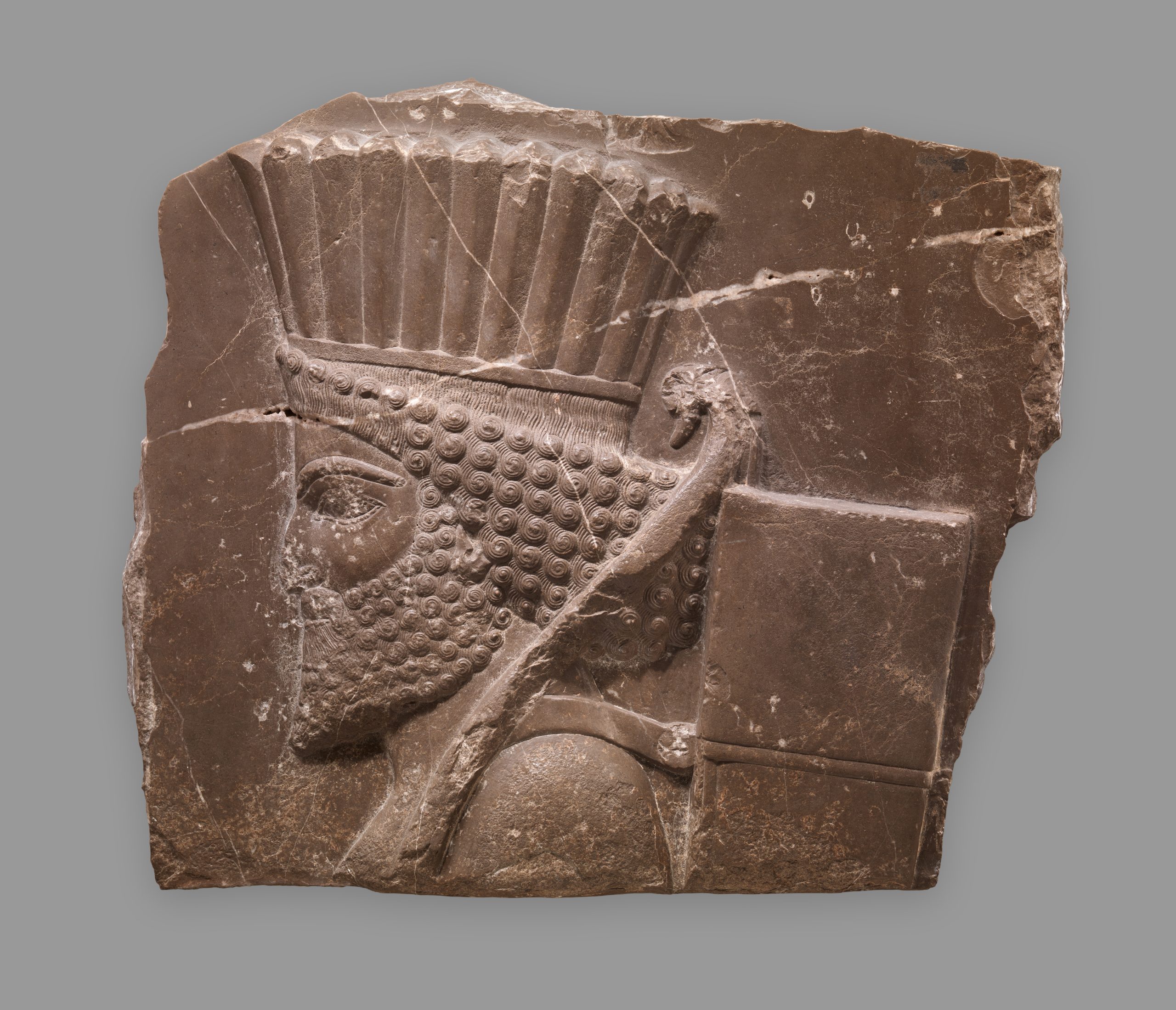
Persepolis presented royal power in limestone as well as clay. A surviving head of a Persian guard, dated to about 486–465 BCE, belongs to the monumental world in which orderly figures helped frame the court’s authority. Such images made empire appear composed and durable.
The accounts preserve a more demanding rhythm: goods coming in, rations going out, officials moving between places, and claims authenticated by seals. Imperial rule could accommodate different languages and institutions while still requiring obedience and resources. At the next station, another storekeeper had to recognize the traveler’s authority, open the supply, and record what had been taken.
Sources and further reading
- Herodotus, Histories 5.52–54, translated by A. D. Godley, LacusCurtius.
- Aḥmad Tafażżolī, Correspondence in pre-Islamic Persia, Encyclopaedia Iranica.
- Persepolis Fortification Archive, Encyclopaedia Iranica.
- Persepolis Fortification Archive Project report, 2019–2020, University of Chicago.
- Bruno Jacobs, Achaemenid Satrapies, Encyclopaedia Iranica.
- Bruno Jacobs, Achaemenid Royal Communication, Encyclopaedia Iranica.
- Achaemenid Taxation, Encyclopaedia Iranica.
- Persepolis Administrative Archives: Significance, Encyclopaedia Iranica.
- Head of a Persian guard, 55.121.3, Metropolitan Museum of Art.
- Achaemenid Dynasty: The Empire, Encyclopaedia Iranica.