
Yorktown, 1781: The Fleet, Roads and Trenches Behind the Surrender
Before Cornwallis’s army laid down its weapons, French ships had to hold a bay, allied soldiers had to travel hundreds of miles and siege guns had to reach the right ground.
On 19 October 1781, the British relief expedition finally sailed from New York. That same day, Charles Cornwallis’s army surrendered at Yorktown. The timing is almost too neat, but it captures the campaign’s central problem: armies and fleets had to arrive while their presence could still change events.
Yorktown is usually remembered through the surrender ceremony or the storming of two small forts. Those scenes came late in a much larger operation. French naval forces had closed the Chesapeake to British relief. American and French troops had shifted south from the New York area. Heavy guns, ammunition, food, money and transport had been brought together before Cornwallis could escape.
There was no single commander who controlled every moving part. Washington, Rochambeau, de Grasse, de Barras and Lafayette worked within different responsibilities and constraints. Their success depended on agreeing what to attempt, exchanging information quickly enough and adjusting when the original plan no longer fit.
The objective changed in August
Earlier in 1781, Washington had looked towards an operation against British-held New York. Rochambeau, commanding the French army in America, was more receptive to an opportunity in the Chesapeake. The arrival of a major French fleet would help determine which operation could actually happen.
On 14 August, news reached the allied commanders that Admiral François Joseph Paul de Grasse was heading from the Caribbean to the Chesapeake. The National Park Service chronology places this message at the decisive turn in allied planning. Cornwallis had established his army at Yorktown and Gloucester Point, on opposite sides of the York River. Lafayette’s smaller force was already operating in Virginia.
A position beside navigable water had obvious advantages for a British army expecting support from the sea. Its danger emerged when the allies gained local control of that water. Yorktown’s geography did not change. The forces able to use it did.
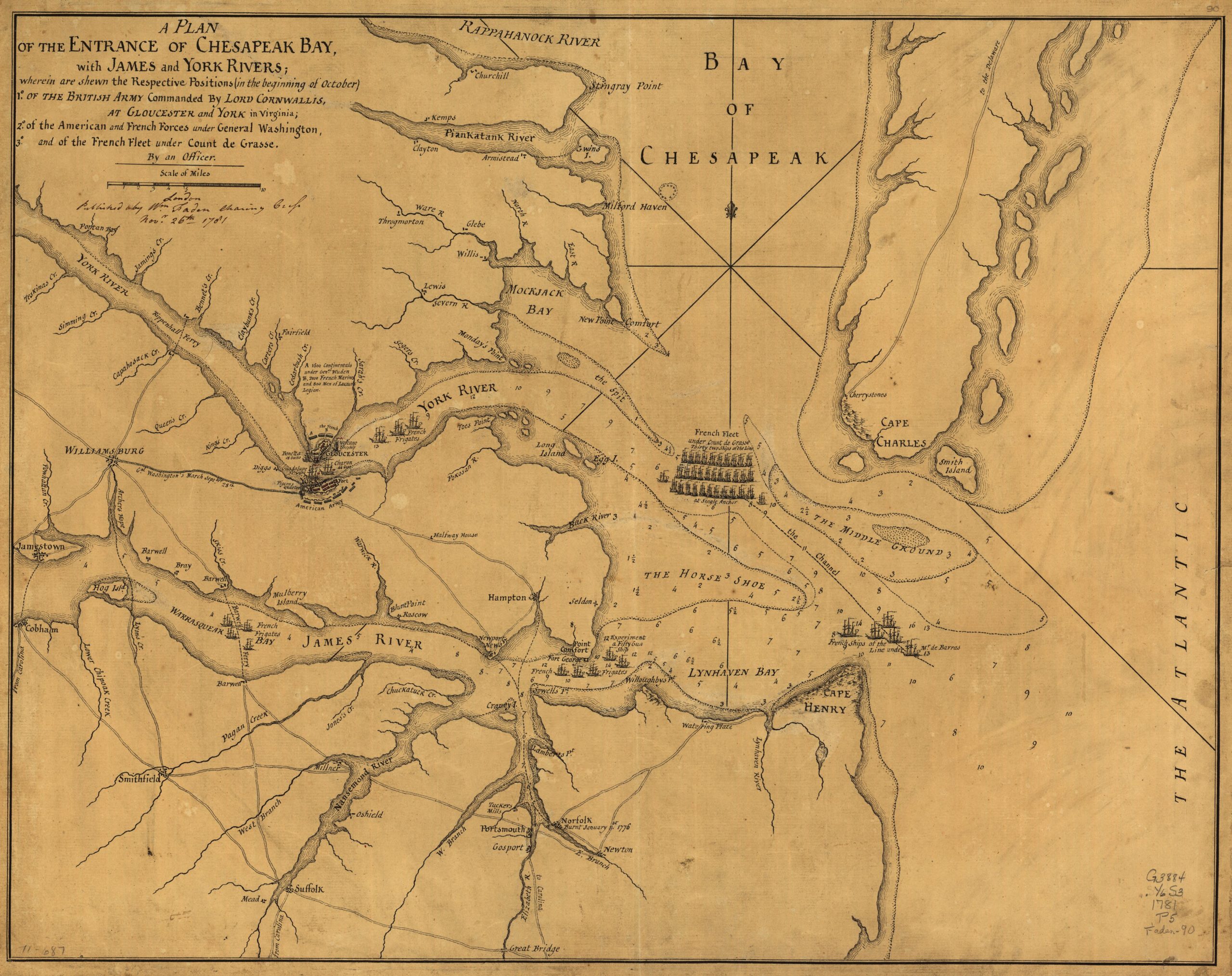
The naval battle that kept the opportunity open
De Grasse reached the Chesapeake at the end of August with ships and troops from the Caribbean. His presence connected the American campaign to a wider Atlantic war. France had its own strategic interests, and its fleet could not remain indefinitely wherever Washington most wanted it.
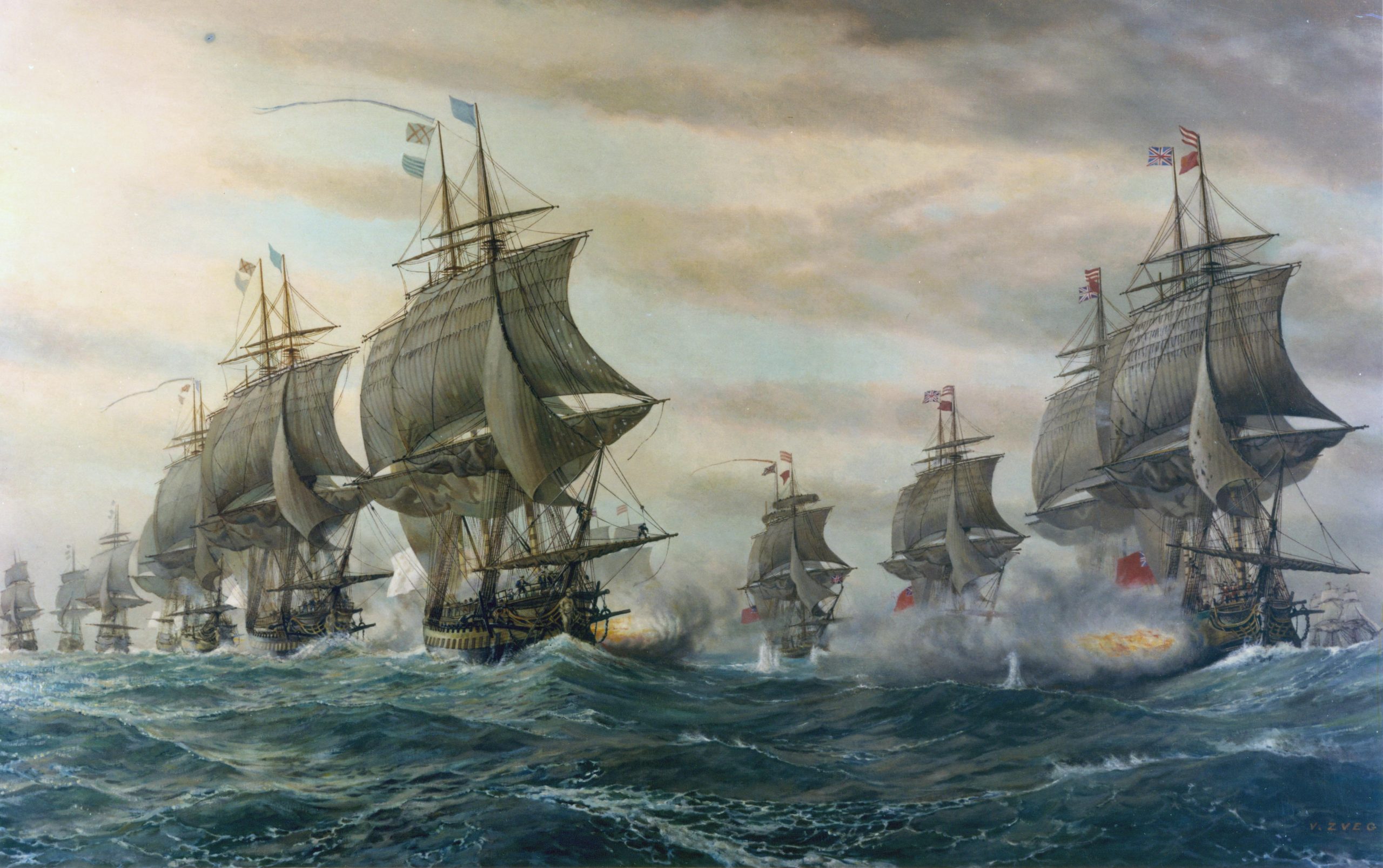
On 5 September, a British fleet under Thomas Graves appeared outside the bay. De Grasse took his ships out to meet it. The resulting Battle of the Chesapeake, also called the Battle of the Capes, involved French and British fleets. No American battle fleet fought in it.
The action damaged ships without producing the spectacular destruction sometimes associated with a decisive naval victory. Its importance emerged in what followed. Graves did not break into the bay and establish the conditions for relieving Cornwallis. De Grasse returned to the Chesapeake, while another French squadron under de Barras arrived with the equipment needed for the siege.
De Barras had sailed from Newport with heavy artillery and supplies. Protecting those transports mattered as much as the visible clash between warships. An army could surround Yorktown with infantry and still struggle to force a quick surrender if its siege guns were elsewhere at sea.
French control also allowed allied troops and supplies to move through the bay. It therefore served two connected purposes: it restricted British movement and supported the allied build-up. Cornwallis faced an opponent whose access to resources was improving while his own became less dependable.
That is a useful distinction when comparing Yorktown with Trafalgar. Naval success has to be connected to the operation it makes possible. At Yorktown, its immediate consequence was unusually clear: the land siege could proceed behind a protected maritime barrier.
Moving an army was a separate campaign
Knowing where to go did not supply the means to get there. The allied movement south required roads, ferries, wagons, provisions and places where troops could embark. It also required Washington to leave forces watching New York while selecting the troops that would accompany the French army.
The National Park Service’s study of the march describes the use of separate routes through New Jersey. Dividing columns reduced congestion and spread the demand for supplies across communities. The journey was an exercise in managing the carrying capacity of roads and settlements, as well as marching speed.
Deception helped conceal the destination during the opening phase. Preparations around New Jersey encouraged the British to continue considering a threat against New York. Such measures could buy time, though the southward movement eventually made the objective much clearer. Secrecy was useful for a limited period; it did not need to last through the entire campaign.
At Head of Elk, the allies found too few vessels to transport everyone as planned. Some troops embarked, while others continued towards Baltimore and Annapolis. The army’s route became a mixture of land and water travel, with equipment and personnel moving in different groups. Commanders arriving ahead could not begin a major siege merely because they themselves had reached Virginia.
Money was another practical condition. Washington used hard currency borrowed from Rochambeau to pay troops during the movement. De Grasse’s preparations had also involved obtaining funds in Havana. The coalition’s military cooperation included financial support at moments when promises alone would not meet immediate needs.
The earlier victory at Saratoga had helped bring about the formal French alliance. Yorktown showed what that relationship could accomplish when ships, troops, credit and supplies were coordinated in one operation. It also showed how much work lay between an alliance on paper and its battlefield effect.
The siege advanced through work in the ground
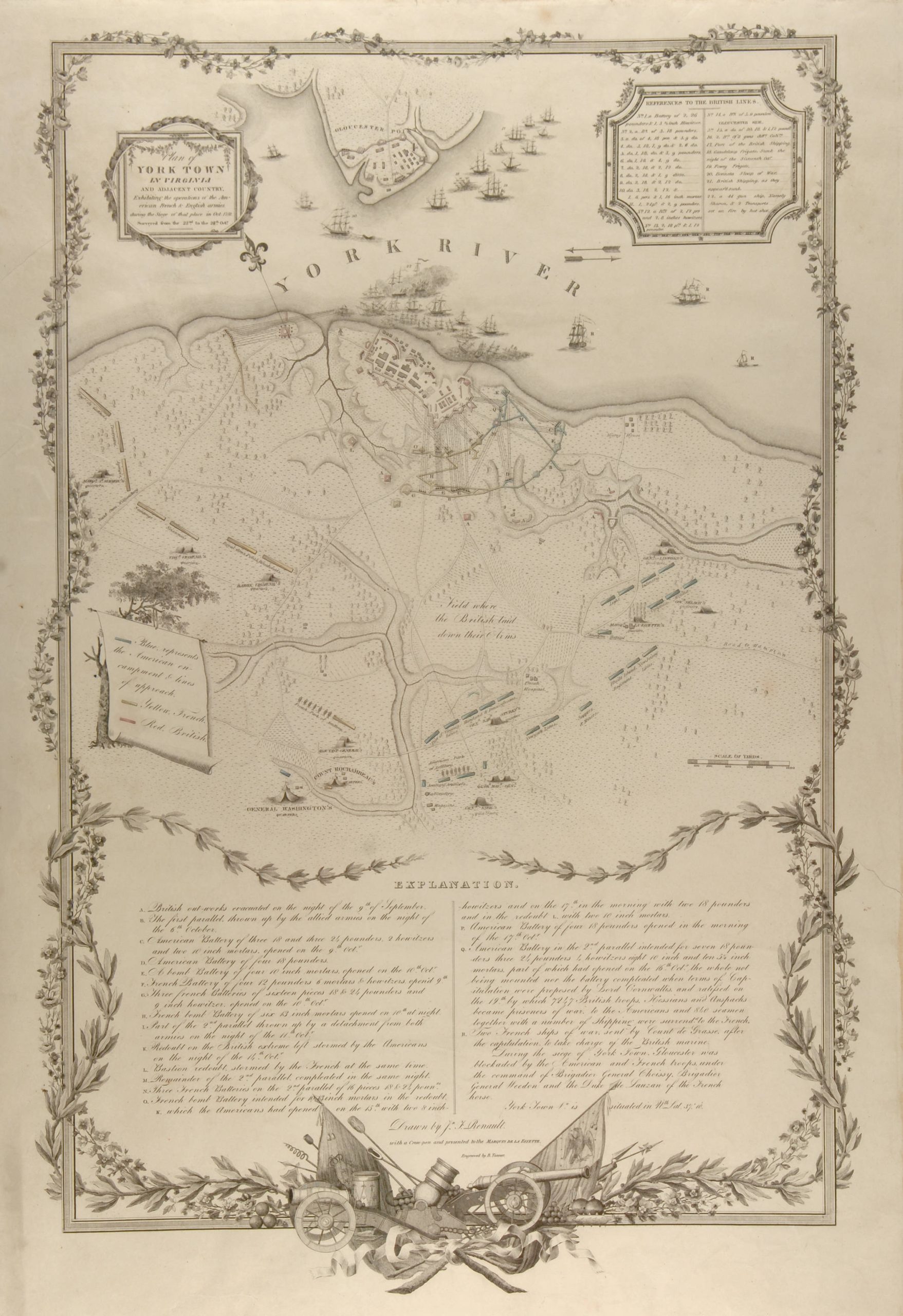
On 28 September, the allied army moved from Williamsburg towards Yorktown and began surrounding the British position. Cornwallis soon withdrew from much of his outer defensive line, trusting that relief would arrive. This allowed the besiegers to work closer to his main defences.
The siege chronology records preparations for gabions and fascines: baskets and bundles of branches used in constructing and strengthening fieldworks. Before the familiar artillery bombardment came collecting material, carrying it and arranging it under the direction of engineers.
On the night of 6 October, the allies began their first parallel, a trench broadly following the defenders’ front. Rain had softened the soil. Working under cover of darkness reduced exposure, but digging within range of an enemy remained dangerous. Infantry, engineers and artillery crews each had tasks that the others depended on.
The batteries opened fire on 9 October. Guns needed prepared positions and a continuing supply of ammunition. The damage they inflicted made it possible to advance, and a second parallel began on 11 October. A siege progressed through such linked stages: protection for working parties, positions for guns, bombardment and a further move forward.
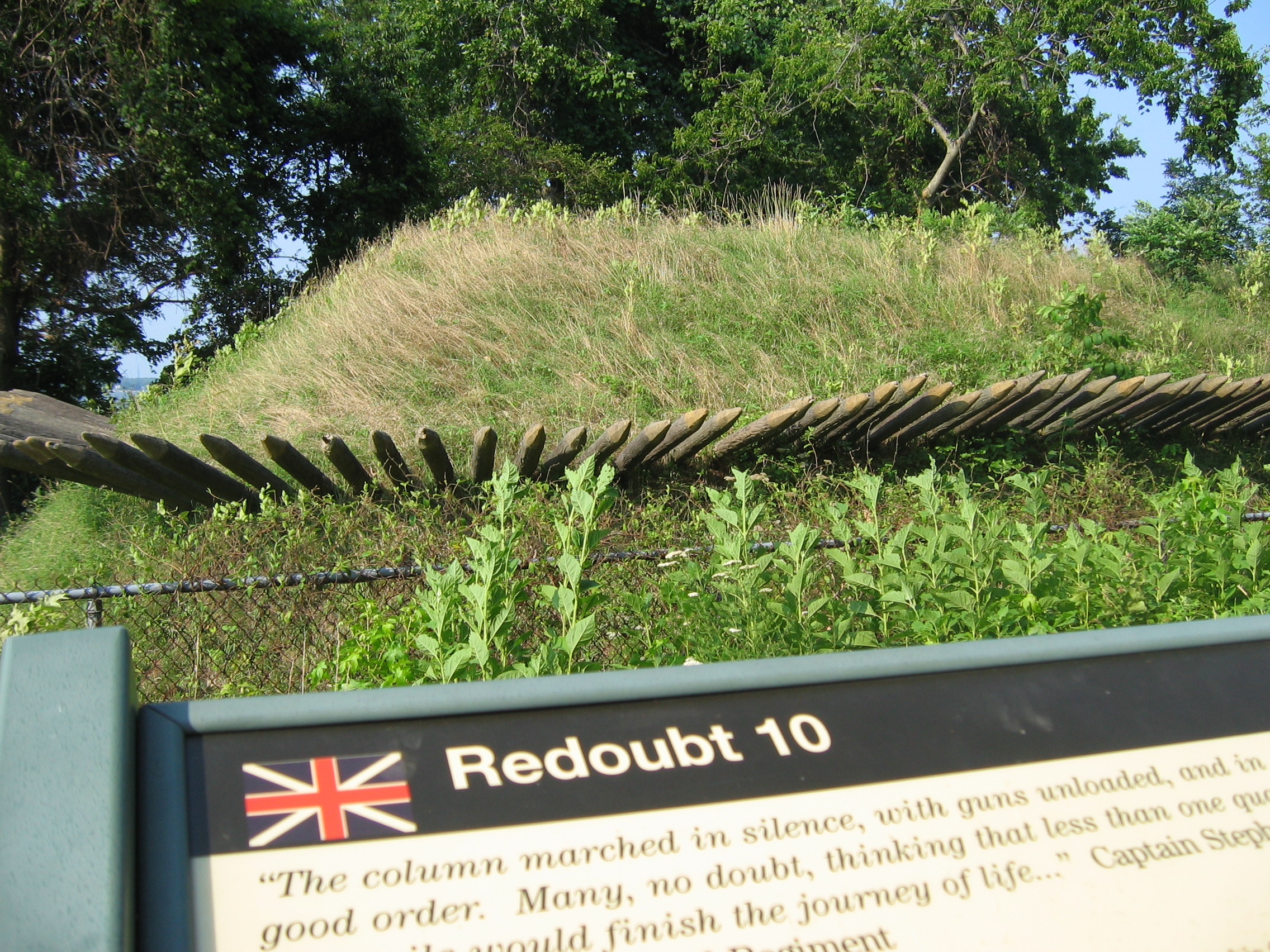
Two British outworks, Redoubts 9 and 10, obstructed completion of that closer line. On the evening of 14 October, French troops assaulted No. 9 while an American force under Alexander Hamilton took No. 10. Their capture allowed the allies to incorporate the positions into the advancing siege works.
The assaults were brief compared with the preparation around them, which helps explain why they dominate popular accounts. They were also tactical actions with a specific engineering purpose. Capturing the redoubts brought allied artillery into a more punishing relationship with the British inner defences. Courage mattered, and so did what the engineers could do with the captured ground the next morning.
Reading the siege map
The map reproduced above rewards a slower look. The river explains the position of Gloucester, the separate post that a picture focused only on Yorktown can easily leave out. The approaching lines show how the besiegers reduced the distance between their artillery and the British works. Troop positions also make the allied character of the operation visible.
Its publication date matters too. Renault’s plan, engraved by Tanner around 1825, presents a retrospectively organised view of the campaign. It is useful evidence for the mapped operation, but its tidy lines cannot reproduce smoke, confusion or the incomplete information available to people making decisions during the siege.
Inside the tightening position
Cornwallis still had choices, but their costs were rising. A British sortie on 16 October damaged some allied guns without permanently silencing the batteries. An attempted evacuation across the York River that night was disrupted by a storm. The intention was to move troops to Gloucester Point and attempt an escape from there. Moving an army out of a siege under pressure proved much harder than moving a few boats.
Food, sickness and ammunition now affected the same shrinking force. Dysentery and smallpox added to the damage caused by bombardment. Expectations of relief could influence how long Cornwallis held out, but a promise arriving by messenger did not bring the relieving troops with it.
There were also people inside and around the British lines for whom the campaign had a different meaning. Thousands of enslaved people had sought freedom by reaching British forces. The Smithsonian’s account of African Americans at Yorktown describes deaths from disease and artillery, the expulsion of people as provisions dwindled, and the return of recaptured survivors to slavery after the American victory.
Black soldiers also served on the American side. These experiences cannot be folded into one simple story about what independence meant. A military outcome celebrated as liberation could strengthen the authority of people who claimed others as property. The changing supply situation inside Yorktown was therefore a human crisis extending beyond uniformed troops.
The surrender had terms, and limits
Cornwallis requested negotiations on 17 October. Commissioners met at the Moore House the following day, and the Articles of Capitulation were agreed on 19 October. The document distinguishes land troops assigned to American custody from naval personnel assigned to French custody. Even in surrender, the coalition’s separate components remained visible.
The articles dealt with arms, stores, officers’ private property, hospitals, baggage and transport. They also recorded disagreement. Cornwallis sought protection for local people who had joined the British; the allies rejected that provision as a civil matter. The agreement ended the garrison’s resistance without resolving everyone’s political or legal position.
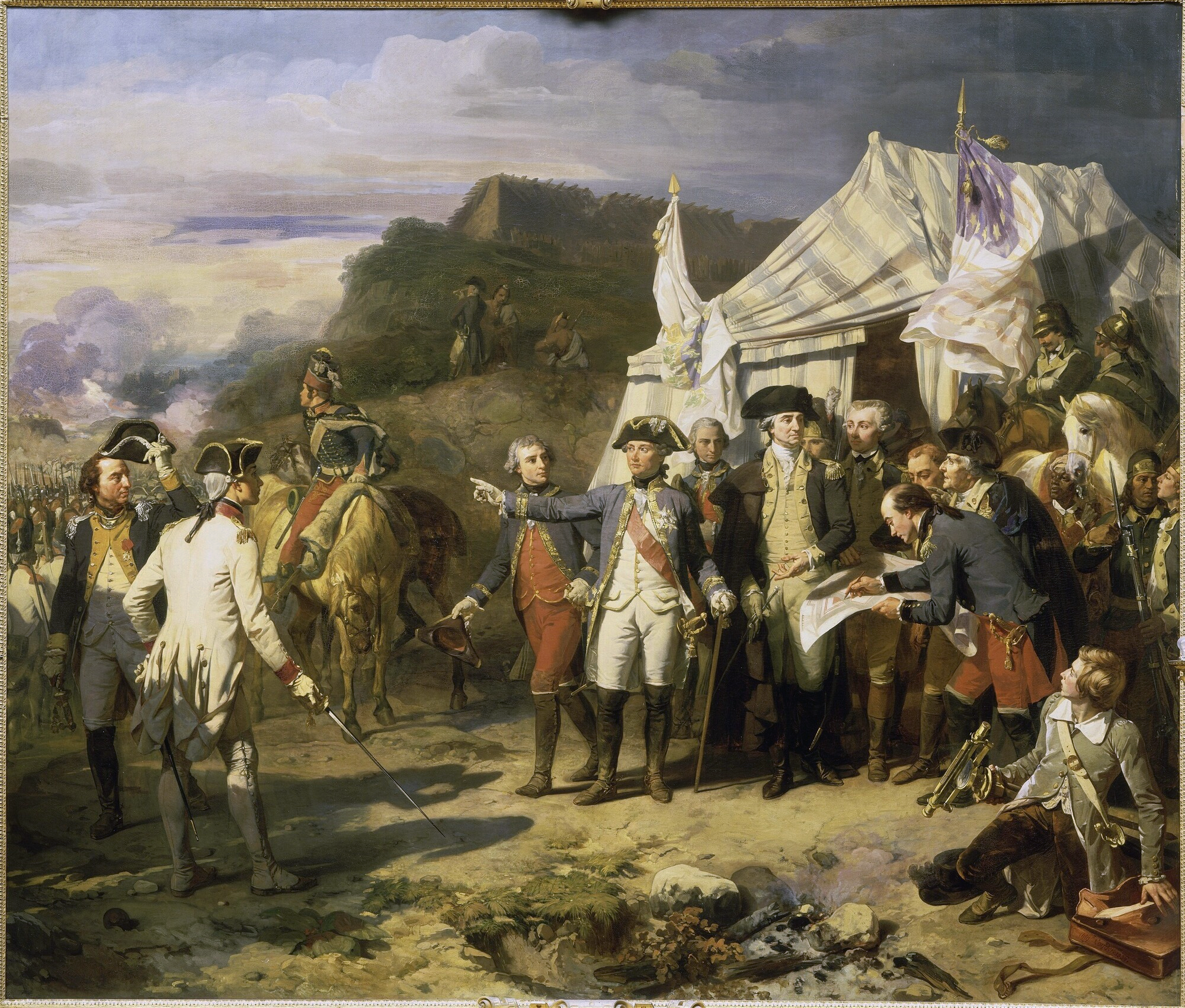
Why this surrender changed the war
The ceremonial scene produced powerful later images. Auguste Couder’s painting of the allied commanders, reproduced above, was made in 1836, more than half a century after the campaign. It helps explain how the alliance was remembered in France. It should not be mistaken for an eyewitness record of a particular meeting.
The immediate military result was the loss of a substantial British army and the failure of an expensive relief effort. The political consequences in Britain made another attempt to subdue the rebellious colonies much harder to sustain. Yet fighting continued elsewhere, British troops still occupied important American positions and the peace settlement lay ahead.
The Treaty of Paris recognised American independence in 1783. Between Yorktown and that settlement, soldiers still needed pay and provisions, and the United States still had to manage the army that had helped secure its position. The tensions described in Histovia’s account of Newburgh belong to that unfinished aftermath.
Yorktown was decisive because several operations reinforced one another at the right time. The fleet protected the bay; transports brought troops and guns; the march concentrated a superior land force; siege work converted that strength into pressure Cornwallis could no longer withstand. Each depended on choices and labour beyond the most celebrated commanders.
Follow those connections and the surrender becomes more understandable without becoming inevitable. A different naval outcome, a delayed transport or an earlier British withdrawal could have changed the opportunity. In the autumn of 1781, the allies made their separate efforts converge before the opportunity closed.