
Books & Movies
The American Revolution (2025): Making History Without a Camera at the Event
A research-based critical introduction to the Burns, Botstein and Schmidt documentary: reconstructed images, unequal freedoms and the limits of a national ending.
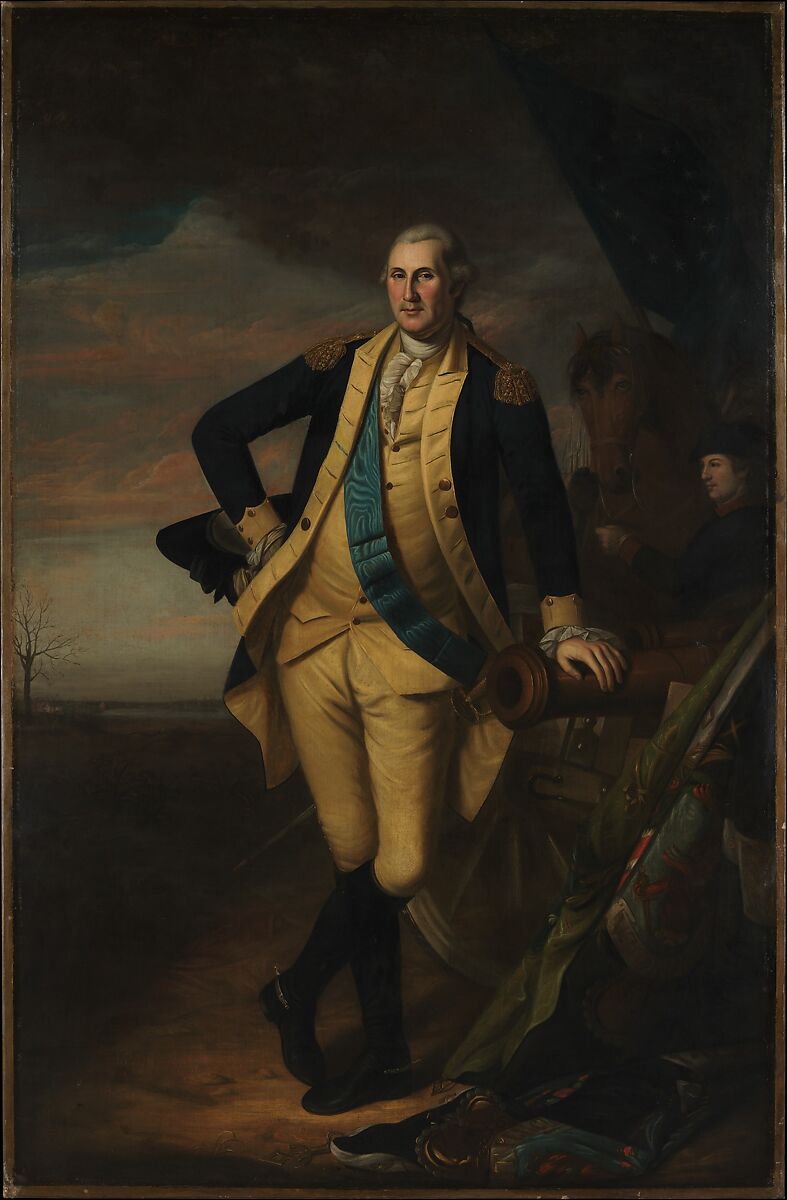
The portrait makes George Washington look composed. In Charles Willson Peale’s painting of about 1779–1781, the commander is already a figure to be preserved and contemplated. The war around him, however, had not yet produced a secure national future. That distance between an authoritative image and an uncertain event is a useful place to begin with The American Revolution.
The six-part, twelve-hour documentary, directed by Ken Burns, Sarah Botstein and David Schmidt and written by Geoffrey C. Ward, was released in 2025. It has remained part of the anniversary conversation: PBS announced on August 20, 2026 that it had won the Television Critics Association’s award for Outstanding Achievement in News and Information. That is a specific critical distinction, not evidence that every historian or viewer agrees with its interpretation.
This is a research-based critical introduction, drawing on the filmmakers’ published explanations, official production materials and historical sources—not a claim to have watched the complete series. Its most interesting stated ambition is not simply to make the familiar founders more vivid. It is to put several different kinds of revolution inside one account, while finding moving images for an age that left no film.
A documentary without a camera at the event
A photograph can be cropped, posed or miscaptioned, but at least some physical encounter with its subject lies behind it. A documentary about the eighteenth century must work with a different mixture. Portraits, maps, printed pages, surviving landscapes and objects provide evidence; actors’ voices, editing and reconstructed action supply much of the movement. Each element can help, provided that its authority is understood.
PBS’s account of the production describes reenactors, first-person writings, material drawn from hundreds of archives, aerial photography and three-dimensional mapping. This is a substantial toolkit, not a replacement for sources. A filmed musket drill can make coordination and physical effort intelligible. It cannot establish that a particular soldier moved in precisely that way at a particular moment. An actor’s reading can clarify a difficult sentence without recovering its author’s actual voice.
Burns made a related point in a November 2025 TIME interview, explaining that the team sought images of everyday processes as well as warfare, including printing and textile work. The value of that approach is material: it makes a revolution depend on labor rather than treating it as speeches interrupted by battles. Its risk is the ease with which convincing texture can be mistaken for direct observation.
That distinction is not an argument against reconstruction. It is a reason to look closely at transitions. When a document gives way to a moving landscape, are we being shown where something happened, what it might have felt like, or evidence of why it happened? Those are different claims. A documentary can make all three, but the answer should not be supplied merely by the confidence of the soundtrack.
The familiar picture is itself part of the history
The image of Burgoyne’s surrender reproduced here was completed decades after the event. John Trumbull’s painting presents the British general’s defeat at Saratoga in 1777 through a carefully arranged encounter with Horatio Gates. According to the Architect of the Capitol’s account, Gates declines the offered sword and welcomes Burgoyne toward his tent. The composition turns victory into an image of controlled, gentlemanly power.
That makes it useful evidence—but partly evidence for commemoration. Its ordering of bodies and gestures belongs to a later effort to give the new republic a public past. It should not be treated as a transparent visual transcript of the surrender. The painting asks viewers to admire a particular kind of victory; an account of the campaign must also explain provisioning, military decisions, exhaustion and the consequences for diplomacy.
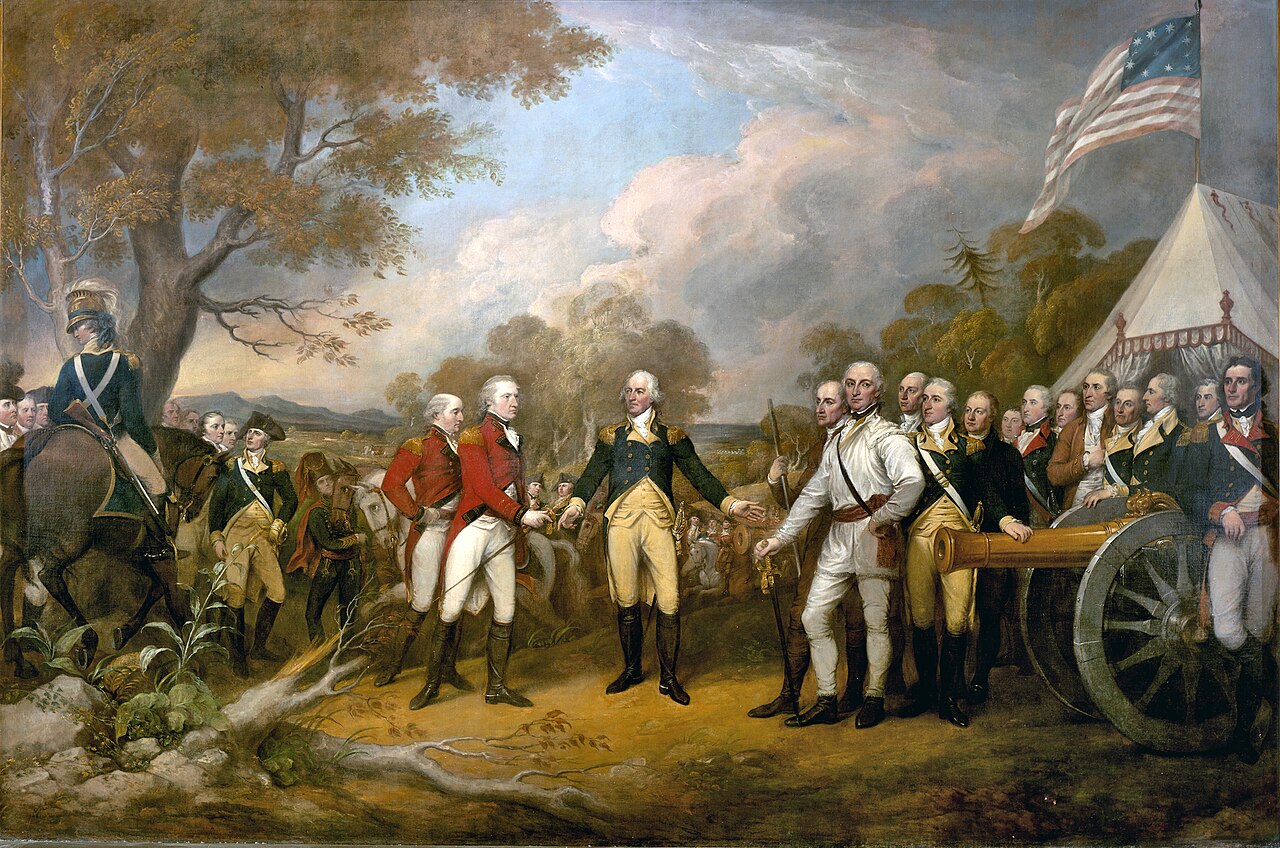

This is where an expansive documentary has an advantage over an anniversary montage. It can keep returning the polished image to the messy sequence that preceded it. A victory did not retroactively make every earlier decision wise, and an eventual alliance did not mean foreign assistance had always been inevitable. Historical uncertainty is not suspense artificially imposed on an outcome we know. It is the condition under which participants actually had to choose.
The filmmakers’ official description calls the Revolution simultaneously an independence struggle, a civil war, a war of conquest and a global conflict. That formulation is more productive than simply adding overlooked people to an unchanged national story. It suggests that the same campaign could have different purposes and consequences depending on who experienced it. The challenge is to preserve those differences rather than make each perspective a colorful illustration of the same destination.
Liberty was a claim, not a uniform experience
The Declaration of Independence is unusually powerful material for a documentary because it supplies both memorable language and a public act. Its argument moves from general propositions about rights and government to grievances against a king, and then to a declaration of political separation. Those steps mattered. The document was trying to justify a change in sovereignty, not merely record a mood.
But the universal reach of its language and the practical reach of the new governments were not identical. This is not an incidental contradiction that can be acknowledged once and left behind. It changes the questions asked of the war. Who could act on a promise of freedom? Who was authorized to interpret it? Who remained legally subject to another person even when political leaders described their own subordination as intolerable?
Phillis Wheatley’s published work offers a different kind of entry into that world. Her Poems on Various Subjects, Religious and Moral appeared in London in 1773 while she was enslaved. The portrait and title page belong to the history of authorship, print and the Atlantic world, not merely to a modern wish to diversify a gallery of faces. Boston Public Library’s collection-based account follows her work through books, manuscripts and correspondence, showing a writer whose historical presence survives through her own production as well as other people’s descriptions.
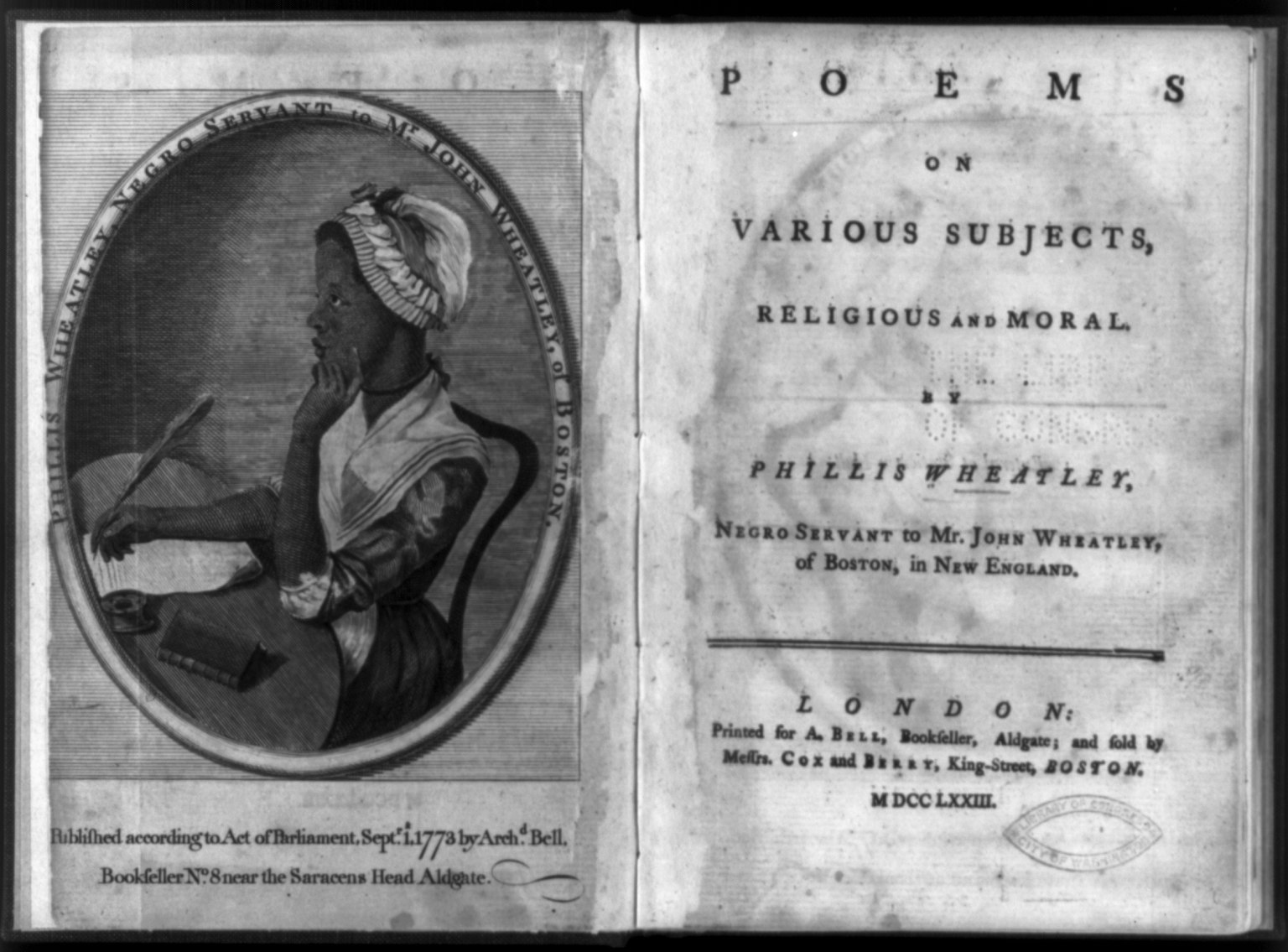

For a documentary, this distinction matters. Including a voice is not the same as explaining the conditions under which it became audible. A printed volume, an official declaration and a recollection preserved much later entered the archive by different routes. Giving them equal dramatic clarity should not make their circumstances interchangeable. The most useful question is not how many perspectives appear, but what those perspectives require the larger explanation to change.
Lord Dunmore’s proclamation of November 7, 1775 makes the competing stakes especially clear. Its offer of freedom applied to enslaved people belonging to rebels who were able and willing to join British forces. It was not a general abolition of slavery. The limitation is essential: a military policy could create an opportunity for escape without representing an equal or comprehensive commitment to emancipation.
The proclamation also resists a comforting division between one side’s ideals and the other side’s interests. For an enslaved person, a route away from a rebel owner could matter more immediately than the rival constitutional arguments of imperial and colonial elites. To explain that choice is not to reduce the person to a pawn in British strategy. It is to recognize agency operating within dangerous constraints that neither camp had designed primarily for the person’s benefit.
When the nation is not the only political community
A national documentary has a built-in organizing device: the nation whose emergence gives the story its title. That device becomes less reliable when the camera turns toward peoples who already possessed their own political communities. Indigenous nations were not simply waiting to become participants in someone else’s founding narrative.
The National Park Service’s account of the Six Nations during the Revolution describes an initially desired neutrality that could not be sustained. The Haudenosaunee Confederacy divided over the conflict, with disagreements extending within as well as between nations. Oneida and Tuscarora support for the Americans and the alignment of many others with Britain cannot be understood merely as a choice between progressive and backward versions of the same future. Land, alliances and survival were at stake.
The Smithsonian’s National Museum of the American Indian carries the story beyond the peace settlement. Its educational account emphasizes that Haudenosaunee people were excluded from the negotiations that ended the British-American war, even as those negotiations purported to dispose of lands they had not consented to surrender. It also follows the rekindling of the Confederacy’s council fire and continuing efforts to defend sovereignty. Destruction was real; disappearance was not the inevitable sequel.
That continuation provides a demanding test for the series’ expansive premise. An inclusive national history can still absorb Indigenous experience into a story that ends when the new state succeeds. A more consequential approach lets other political histories retain their own chronology. Peace between Britain and the United States did not settle every conflict on the continent, nor did it establish the legitimacy of every territorial claim made on paper.
Independence did not arrive with a finished government
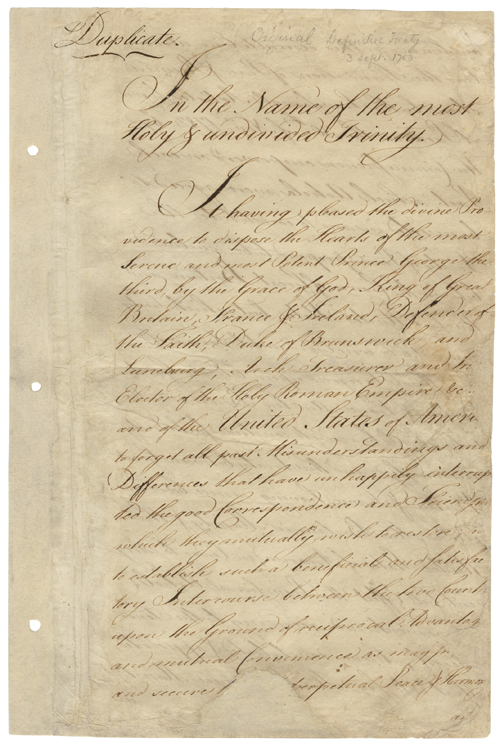
The Treaty of Paris, signed on September 3, 1783, recognized American independence and set boundaries in a diplomatic settlement. The document gives the war an ending, but not a complete answer to the problem of governing. Recognized sovereignty had to be made workable through institutions, obligations and arguments about authority.
The Articles of Confederation are a useful counterweight to an overly smooth ending. Adopted by Congress in 1777 and fully ratified in 1781, they embodied a union in which the states retained substantial authority. The National Archives’ presentation explains both the framework and its limitations. This was not simply a waiting room for the Constitution; it was an attempt to organize political cooperation amid a war and its aftermath.
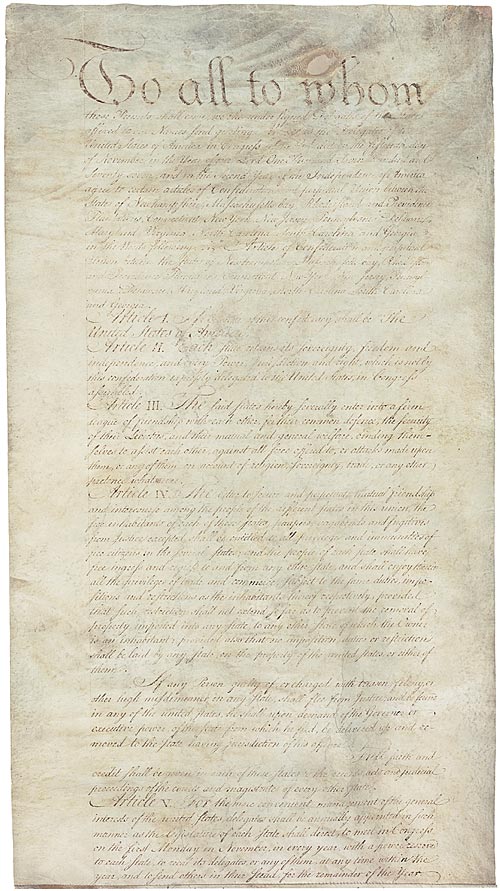
Seen this way, the series’ length is a genuine opportunity. Twelve hours can connect military survival to the institutions that paid, supplied and argued over the war, rather than treating government as a quiet epilogue after the fighting. Yet duration alone does not guarantee explanation. A succession of striking biographies may remain a succession unless the relationships among money, authority, labor and diplomacy are made clear.
The production materials suggest a strength in the combination of personal testimony and large geographical scale. The potential weakness is the familiar one of emotionally fluent historical television: a viewer may feel close to several people without understanding why their choices were unequal, or why one group’s success constrained another’s future. This is a question to carry into a full viewing, not a defect established here without one.
What to look for beyond the anniversary
The TCA award gives a concrete reason to revisit this 2025 release in 2026, but its lasting interest is not dependent on the calendar. The project confronts a difficult relationship between evidence and national memory. Familiar faces and famous phrases make the story accessible; they can also make its result seem preordained.
A useful way to approach the series is to keep three distinctions in view: a historical artifact versus its modern reconstruction; a participant’s declared purpose versus the policy that followed; and an ending for one political community versus an ending for everyone affected. None requires a documentary to become an academic lecture. Each makes the narrative more exacting, because it asks the movement of the story to carry an explanation rather than substitute for one.
Return, finally, to the portrait rather than to a verdict about the whole series. Washington’s composure is something the image produces. The conditions that made his authority possible—soldiers, suppliers, political assemblies, allies and opponents—must be recovered elsewhere. A documentary about the Revolution becomes most interesting when it allows the portrait to remain powerful without letting it stand in for the world around it.