Death by Lightning: Garfield, Patronage and the Long Crisis After the Shooting
A historical companion to Netflix’s 2025 series, following the political institutions, medical experiments and family archive beyond the encounter between a president and his assassin.
Start with two dates: James Garfield was shot on 2 July 1881, and he died on 19 September. A great deal happened in between. The familiar name-and-date version leaves out a long medical crisis, political uncertainty and a public vigil. The story moved between a railway station, a sickroom, the press and the machinery of government.
Netflix’s Death by Lightning, released on 6 November 2025, returns to that compressed presidency through a four-part historical drama. Michael Shannon plays Garfield and Matthew Macfadyen plays Charles Guiteau, the man who shot him. Mike Makowsky created the series, Matt Ross directed it, and Candice Millard’s 2011 book Destiny of the Republic provided the source for the adaptation.
On the first anniversary of its release, there’s plenty to explore beyond whether the costumes look convincing. What happens when a complicated political system becomes the setting for a story about two men? Patronage, medical authority and the work of preserving a president’s memory all deserve attention alongside the fatal encounter.
Use this as a historical companion to the series, built from its documented premise, official production information and the sources linked below. It isn’t a scene-by-scene review. The illustrations show the historical people and records, not actors or stills from the production.
The unexpected nominee had a long political career
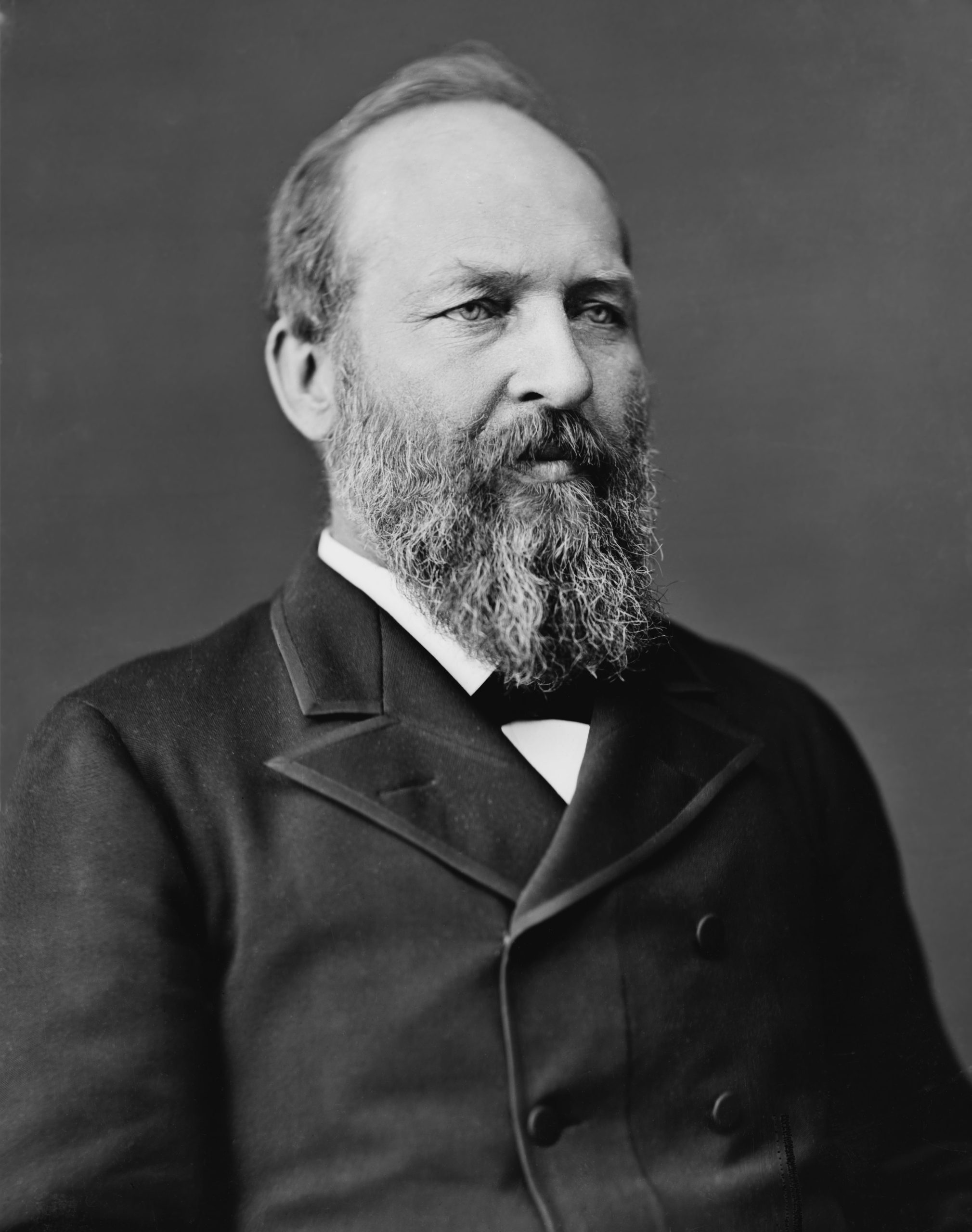
Garfield’s nomination in 1880 makes a compelling entrance into the story. He went to the Republican convention supporting Treasury Secretary John Sherman, then emerged as the nominee on the thirty-sixth ballot. A deadlock among better-established contenders created an opening. The nomination was a surprise. Garfield’s experience in politics was another matter.
The House of Representatives’ historical account, published on 27 October 2026, follows the congressional career behind the sudden elevation. Garfield had served in the House through the Civil War and Reconstruction. He worked on finance, appropriations and party leadership before becoming president. Behind the unexpected nominee was a legislator who already knew his way around national politics.
The National Park Service’s biography adds another dimension: the earlier teacher, college leader, preacher and Union officer. That’s quite a background to bring into the White House, and it helps explain the knowledge and loyalties he carried with him. They do not erase the compromises of a long career inside a party.
Historical drama often needs a clear moment when a protagonist is pulled into events. As you follow the story, it helps to keep two clocks running. A nomination can be unexpected in a particular week while depending on relationships and reputations accumulated over many years.
Why a customs appointment could threaten a presidency
The Republican factions known as Stalwarts and Half-Breeds were engaged in a struggle over influence, leadership and appointments. Roscoe Conkling’s New York organisation depended heavily on patronage. Federal jobs supplied income and helped sustain political loyalty; control of those appointments was a practical source of power.
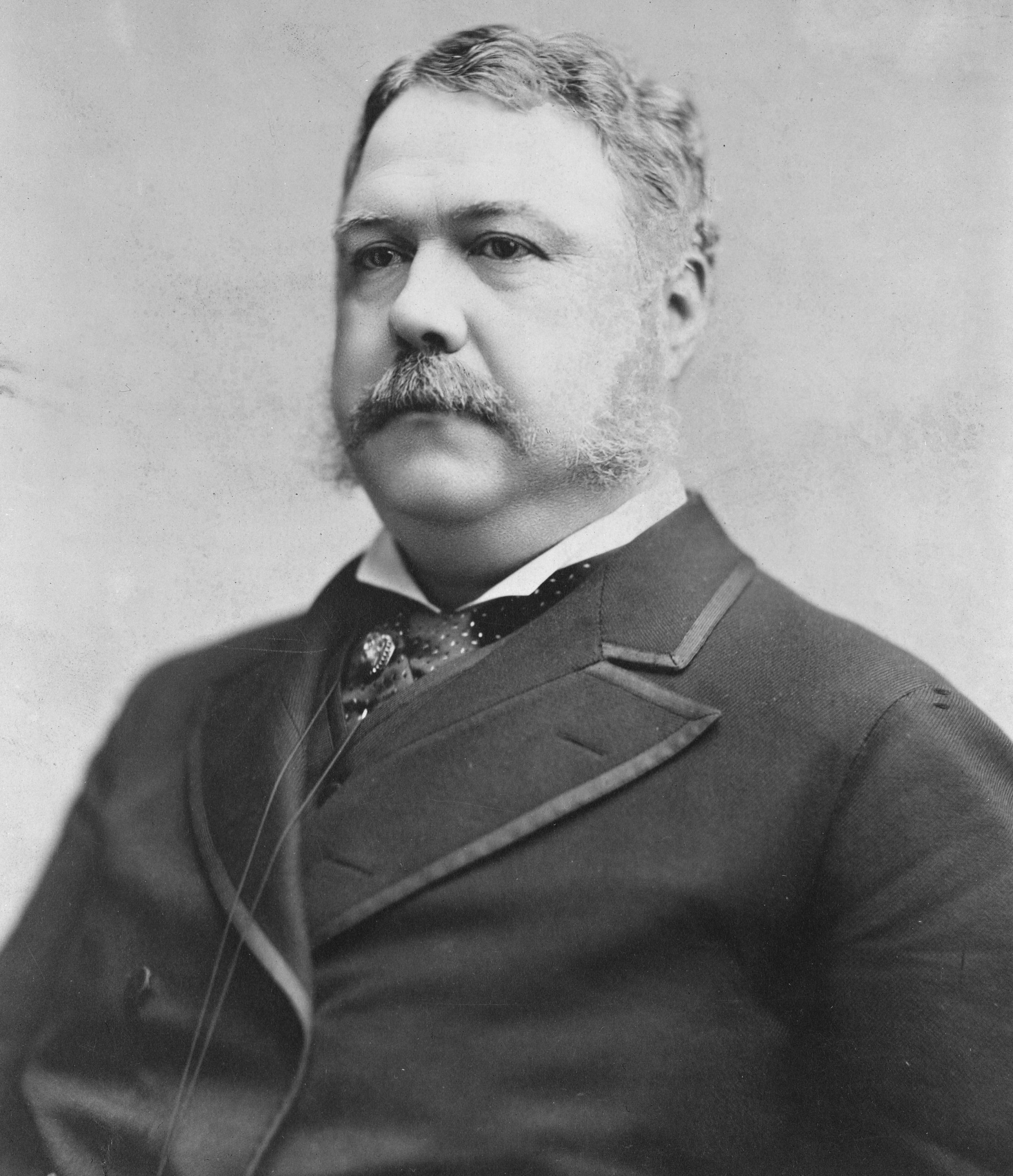
The National Park Service’s explanation of the factions puts the New York customs establishment at the centre of the dispute. Chester A. Arthur, Garfield’s vice president, had previously served as collector of the port. The vice-presidential nomination helped balance the ticket between competing Republican interests.
A quarrel over a job might seem small beside a president’s other responsibilities. Within the system, it concerned who could reward supporters, discipline rivals and claim authority over the party’s resources. The appointment was valuable because it linked government administration to political organisation.
Guiteau’s expectations were not the party’s instructions
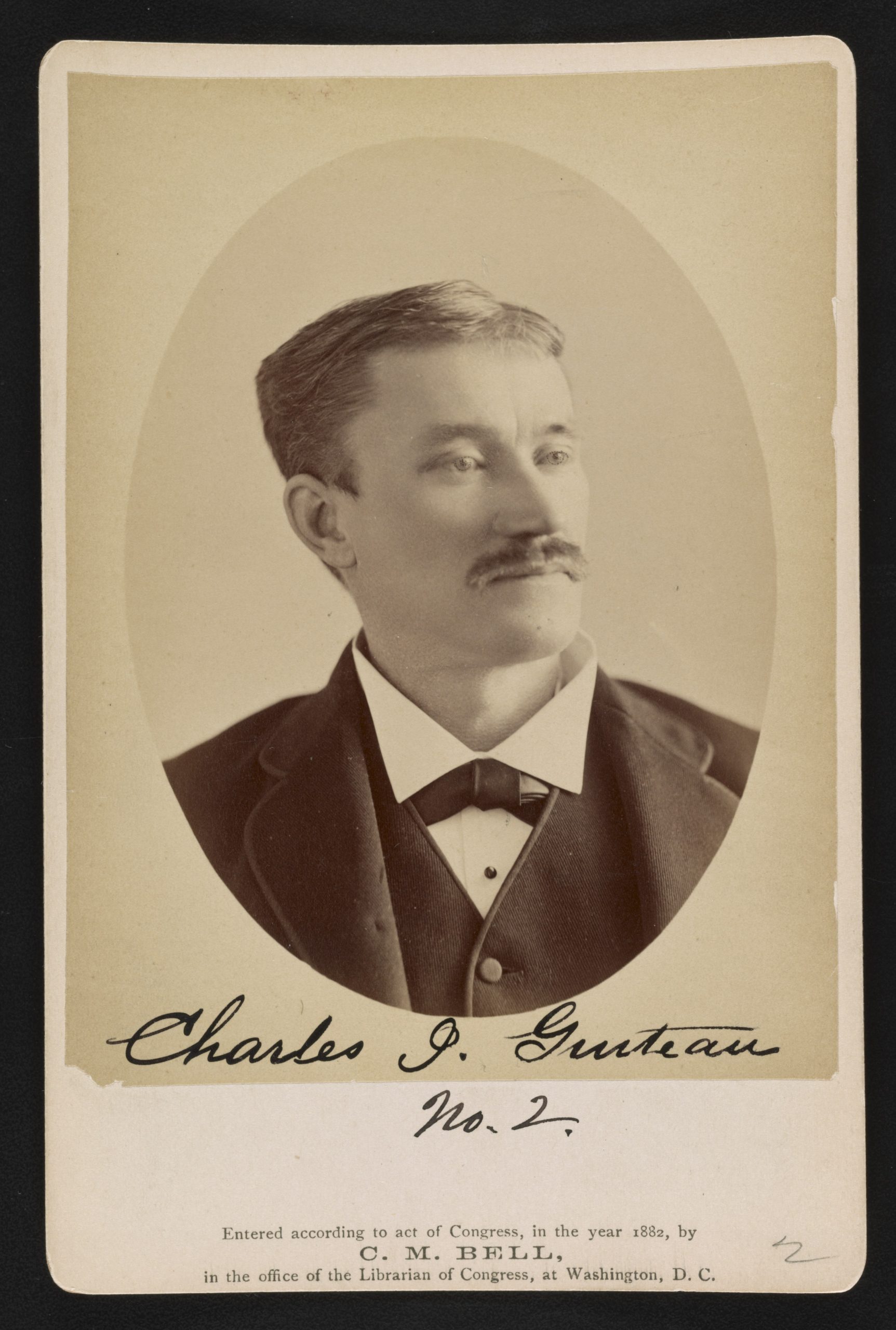
Guiteau believed his political activity entitled him to an appointment. He gave himself far more credit than his actual contribution warranted. The National Archives’ account of his case follows an office seeker whose ambitions, grievances and claims of divine direction became part of the explanation of the crime.
He invoked factional language after shooting Garfield. That language helps locate him in the political culture around him, but it does not prove that Conkling, Arthur or a party organisation ordered the attack. An assassin’s belief that others will welcome an act is evidence about his expectations, not evidence of their prior agreement.
Keep that distinction in mind when a story turns towards political corruption. A system can provide the vocabulary through which a person interprets his actions without being a conspiracy that directed every action. Treating those explanations as interchangeable makes the plot simpler and the history less reliable.
The trial is worth slowing down for, too. Guiteau’s lawyers argued insanity; the jury convicted him, and he was executed in June 1882. The Federal Judicial Center’s study treats the proceedings as a confrontation over criminal responsibility, medical expertise and the independence of a court under intense public pressure.
A performance or a handful of bizarre quotations won’t give us a reliable modern psychiatric diagnosis. Nor should the historical legal verdict be mistaken for a complete medical explanation. The trial shows how nineteenth-century institutions tried to decide responsibility using the categories and evidence available to them.
The long interval between a bullet and a death
Garfield’s wound did not kill him immediately. The subsequent treatment involved repeated attempts to locate the bullet, alongside infection and worsening illness. The National Library of Medicine’s presentation of the medical bulletins preserves the daily record through which the public encountered that decline.
Try reading a bulletin as news arriving that day, before anyone knew the ending. They tell us what doctors reported at a particular moment, in a form intended for circulation. A change in pulse or temperature could become national news while its full significance remained uncertain. Readers knew the patient was gravely ill without knowing how the story would end.
It is reasonable to ask how treatment contributed to the outcome. It is less responsible to turn that question into the certainty that one simple alternative would have guaranteed survival. The shooting, the medical interventions and the resulting complications belong to a chain of events, not a choice between blaming a gunman or blaming medicine.
Bell’s machine and the difficulty of testing a hopeful idea
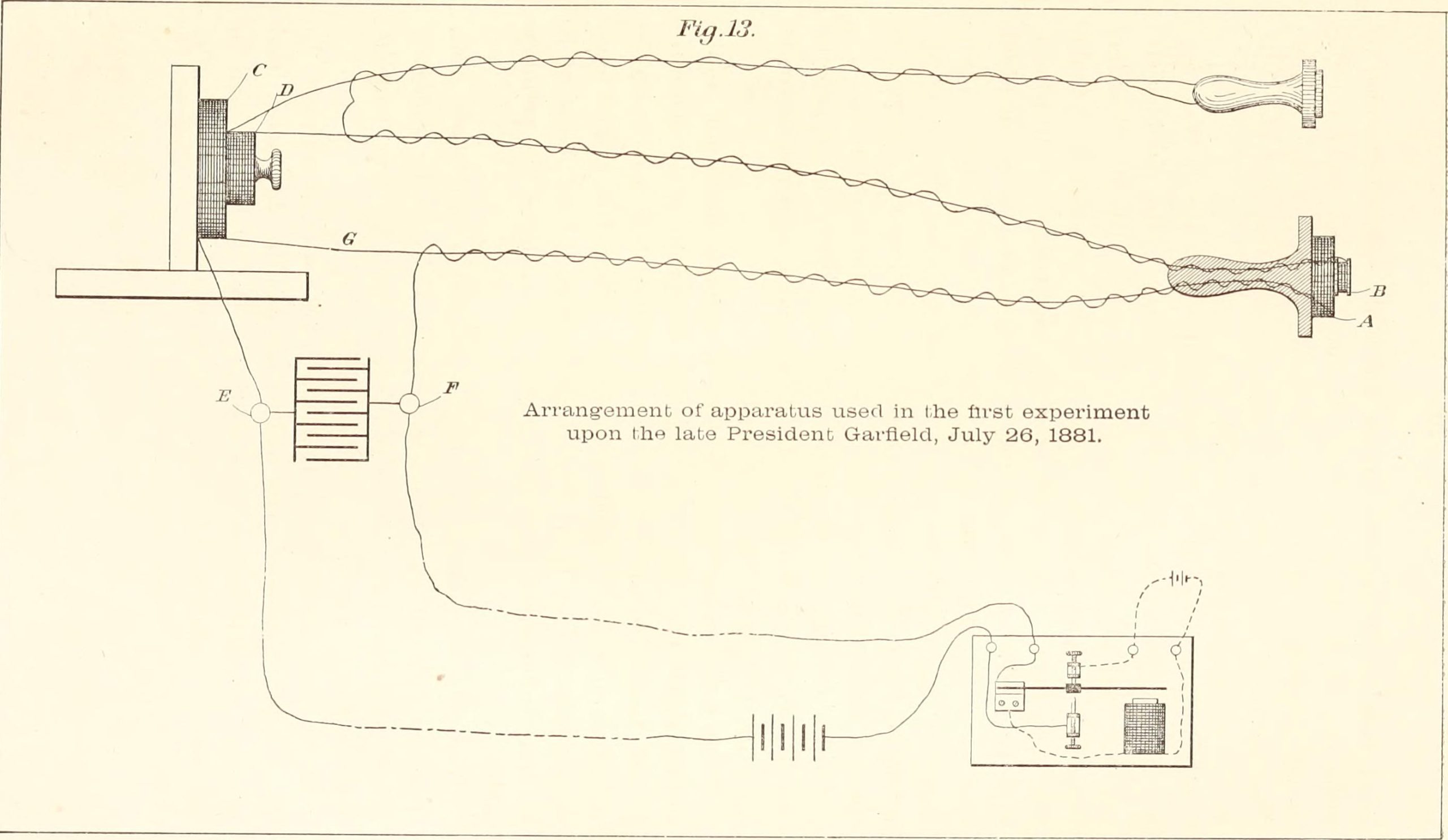
Alexander Graham Bell attempted to help locate the bullet using an electrical device. The project connected the crisis to experiments in detecting metal through changes in an electrical balance. It’s a vivid example of an inventor trying to make a laboratory idea useful at a bedside, with very little time to spare.
The National Park Service’s account describes experimental trials, difficulties during examination and the constraints imposed by the physicians’ understanding of the wound. The effort did not locate the bullet successfully in time to help Garfield. Bell continued working on the apparatus afterwards.
The diagram reproduced here comes from Bell’s 1882 publication on the experiments. It is a technical record, not an illustration made for the television series. The document gives you a chance to look past the bedside drama: how did the machine work, what did Bell try, and what counted as a useful result?
A convincing dramatic scene may join a machine, a doctor and a patient in a single decisive moment. An experimental history often consists of adjustments, unsuccessful tests and uncertainty over the meaning of a sound. Neither the inventor’s reputation nor the urgency of the case could make those problems disappear.
Histovia’s account of John Snow’s cholera investigation offers a related question: how does evidence become convincing enough to change what people do? The cases differ, but both resist the assumption that identifying a promising idea automatically ensures its effective use.
Lucretia Garfield helped determine what survived
In an assassination story, a spouse can easily become the person who waits beside the dying protagonist. Lucretia Garfield’s place in the historical record extends well beyond that role. Her work after her husband’s death helped preserve the materials from which later biographies and adaptations could be made.
The Library of Congress’s collection history traces the gathering of Garfield’s papers and their storage in a protected memorial room at the family home in Mentor, Ohio. The National Park Service’s account of Lucretia describes the memorial library and the work of family members and former secretary Joseph Stanley-Brown.
This work of keeping things safe matters more than it might first appear. It shapes the history we’re able to write. A letter retained, an account arranged and a diary kept safe provide different kinds of access to a political life. The care of relatives and archivists becomes part of the conditions under which a later writer can reconstruct it.
That does not make the family archive a neutral transcript of everything that happened. It gives researchers a rich body of material with a particular history of survival. That makes the archive’s own story worth exploring. The papers are rich evidence, but gaps in them still need to remain gaps.
Arthur’s reform was an outcome, not a complete resolution
Arthur succeeded Garfield. In January 1883 he signed the Pendleton Act, a major step towards a federal civil service selected through competitive examinations rather than only political favour. The National Archives’ text and introduction show both the significance of the law and its initial limits.
At first, the new hiring rules covered only about a tenth of federal employees. The act also established a Civil Service Commission and protected covered workers against certain forms of political pressure. The old appointment system didn’t disappear overnight.
For a drama, reform after tragedy can supply a satisfying shape: a broken system confronts its consequences and changes. The law gives that ending a historical basis, but the limited original coverage complicates it. Institutional change had to be extended, administered and defended after the event that made it urgent.
Keep the unfinished presidency in view
Garfield’s inaugural address of 4 March 1881 is a useful companion to the series. He discussed the citizenship of formerly enslaved people, the protection of voting rights, education and the obligations of public office. Those subjects place the presidency within the unresolved consequences of the Civil War and Reconstruction.
The address is also a reminder that 1881 was not a clean beginning. The formal end of slavery had not settled the exercise of citizenship. Garfield spoke to a country in which the constitutional settlement of the Civil War and the distribution of political power were still contested. Reading that public programme beside the story of office seeking keeps patronage in proportion: it was an important presidential problem, but not the only obligation the office carried. This wider setting is easily lost when the months before the shooting become only a countdown to an assassination.
An inaugural speech tells us what a president says he wants to do. It can’t tell us what he would actually have achieved. Garfield’s short time in office gives little basis for confidently describing the presidency he would have completed. The loss of possibility is part of the tragedy, but possibility should not be quietly rewritten as an established record of achievement.
The distinction also prevents the history from shrinking to a moral contest between a virtuous president and an irrational killer. Voting, education, appointment systems and medical practice involved many people whose lives did not turn on the same personal encounter. Their institutions continued after both men were dead.
A good way to follow a historical screen story is to let it send you looking for more. Histovia’s discussion of Nuremberg and the court beyond a central confrontation follows a similar problem: the human drama can attract attention while the surrounding institution requires a wider view.
Death by Lightning offers an entry into a presidency often remembered only for its assassination. Following it with the inaugural address, the medical bulletins, the civil-service law and the surviving family papers gives the story more dimensions. The railway station is still the turning point. There’s much more to discover on either side of it.
Watch the series
Death by Lightning on Netflix. Official programme page checked on 6 November 2026; availability and subscription requirements depend on your region.