Science, Invention & Exploration
The 1919 Eclipse: How a Few Star Images Put Einstein to the Test
The famous eclipse photographs took minutes to expose and months to interpret. Telescopes, clockmakers, local workers and a difficult set of plates all belong in the story.
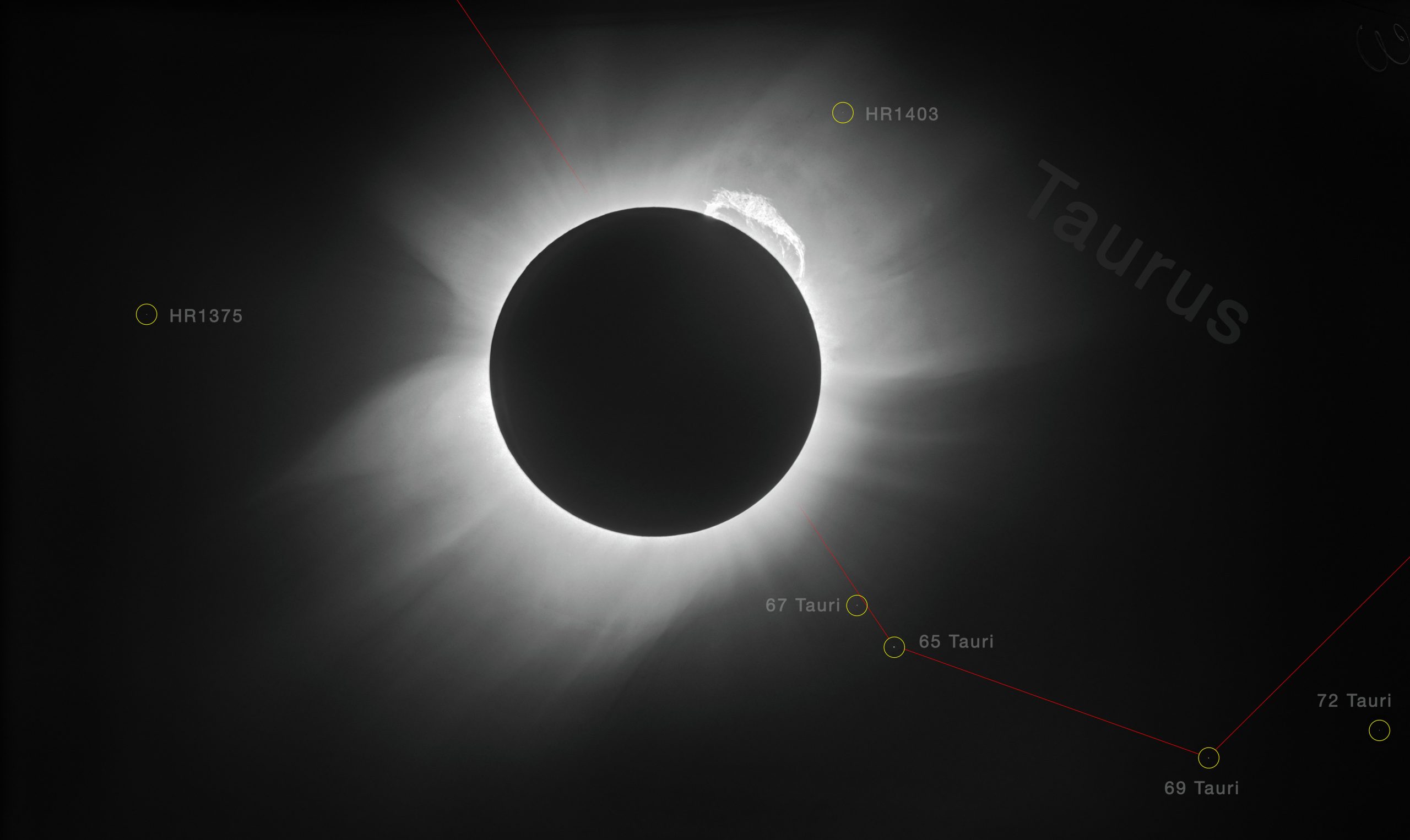
Look at a photograph of the total solar eclipse of 29 May 1919 and the Sun steals the show. Its brilliant outer atmosphere spreads around the dark Moon. The stars that made this eclipse famous are far less impressive: tiny marks scattered across a glass plate. Those marks carried a question that no amount of admiration for Einstein could answer on its own. Had light passing close to the Sun arrived from a slightly different direction than expected?
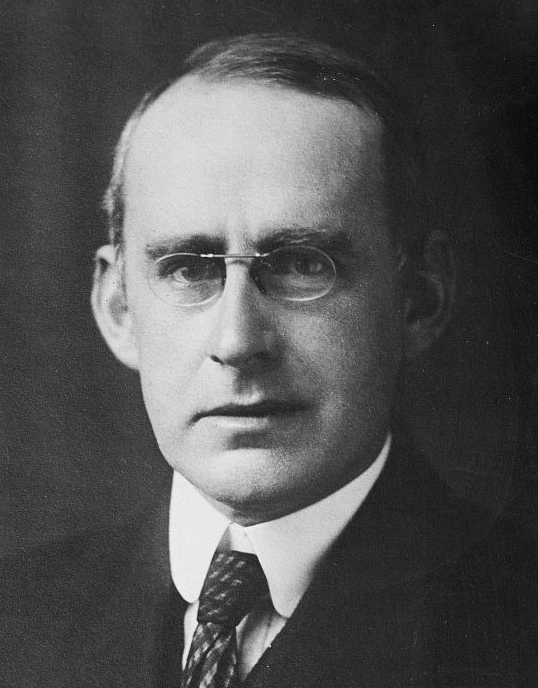
The short version of the story is familiar. Arthur Eddington photographed an eclipse, confirmed general relativity and helped turn Albert Einstein into a celebrity. Follow the work a little further and that sentence begins to fill up with other people, another observing station and several awkward decisions about instruments. The strongest observations came from Sobral in Brazil. Eddington was on Príncipe, an island off Africa, working through cloud.
There was a genuine achievement here. There was also a long interval between taking a photograph and deciding what it meant. Eddington’s own 1920 account gives us a useful way into that interval. Read alongside later archival research, it shows why a celebrated scientific test depended on much more than catching the Moon in the right place.
Why wait for an eclipse?
Einstein’s general theory of relativity, published in 1915, described gravity in terms of the geometry of spacetime. One consequence was a precise prediction about light passing a massive body. Near the apparent edge of the Sun, a distant star’s light should be deflected by roughly 1.75 seconds of arc. An arcsecond is one 3,600th of a degree. We are talking about a very small shift.
There was a competing value to test. A calculation treating light as particles influenced by Newtonian gravity gave about half that deflection. Calling these the “Einstein” and “Newtonian” predictions is convenient, provided we remember that Newton himself had never arranged a photographic eclipse test. The practical challenge in 1919 was to distinguish two small quantities, rather than simply notice that something unusual had happened.
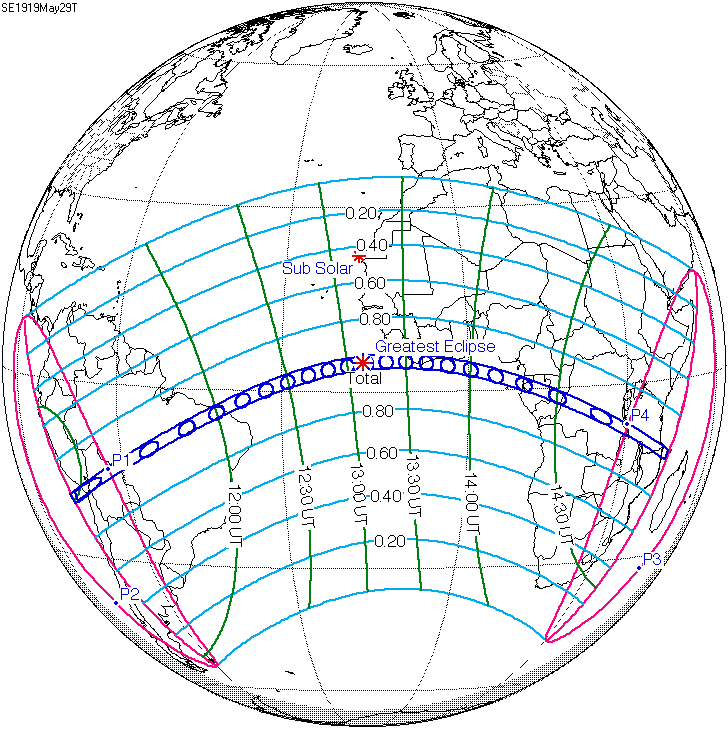
The stars were visible in roughly the same direction as the Sun, not physically beside it. With ordinary daylight overwhelming their light, astronomers needed the Moon to cover the bright solar disc. Totality offered a brief opportunity to photograph the surrounding star field. Later, those positions could be compared with photographs taken when the Sun was elsewhere in the sky.
The apparent shift has a slightly surprising direction. Although the light bends towards the Sun as it passes, we trace its arriving direction backwards and see the star farther out from the solar disc. On the eclipse plates, astronomers therefore looked for an outward pattern of displacements, decreasing with distance from the Sun.
May 1919 offered an especially helpful arrangement: the Sun lay against the rich field of the Hyades. Bright reference stars made a demanding measurement more manageable. The Astronomer Royal, Frank Watson Dyson, had drawn attention to the opportunity in 1917. British preparations were undertaken through the joint eclipse committee of the Royal Society and Royal Astronomical Society. Two observing sites reduced the chance that a single patch of bad weather would ruin the attempt. It was a recognisable version of the problem faced by the earlier expeditions to time the transit of Venus: a celestial event might be predictable, while everything needed to measure it remained stubbornly earthly.
A telescope needs a clockmaker
Dyson coordinated the enterprise from England. Andrew Crommelin and Charles Davidson travelled to Sobral, in northeastern Brazil. Eddington went to Príncipe with Edwin Turner Cottingham. Cottingham is often reduced to the word “assistant”, which misses the reason he was so valuable. He was an experienced clockmaker and scientific instrument maker, accustomed to keeping precision mechanisms working.
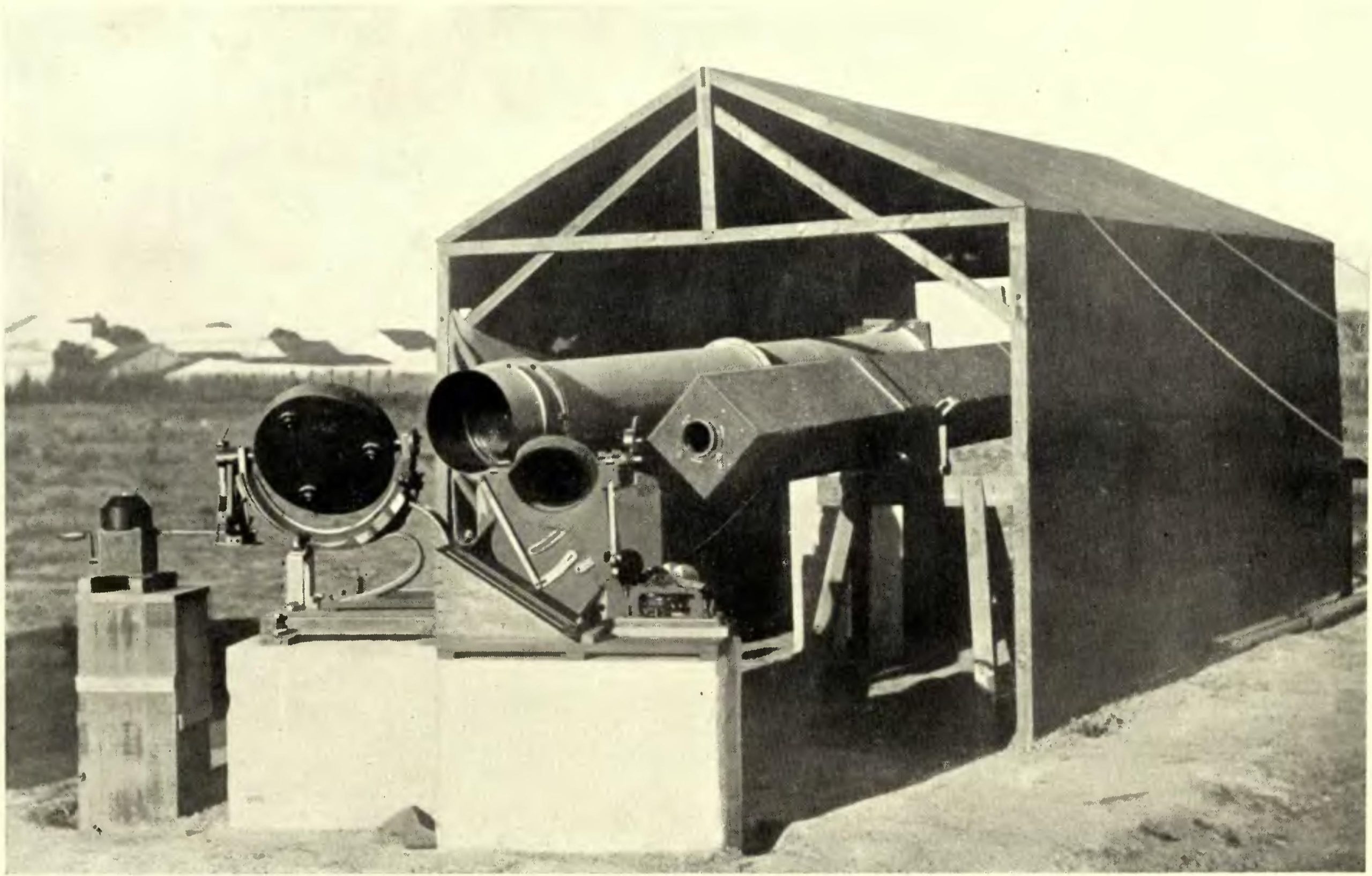
These were substantial instruments to transport and assemble. Rather than swing a long, heavy telescope smoothly across the sky at a temporary campsite, the observers could hold its tube still and direct light into it with a moving mirror called a coelostat. Clockwork turned the mirror at the required rate. A poor drive could smear a star image; a sharp photograph depended on the mechanism behaving throughout the exposure.
The larger lenses used for the expedition were thirteen inches across but were stopped down to eight inches to improve image quality. At Sobral, a second instrument used a four-inch lens with a longer focal length. That seemingly modest backup would become the most persuasive part of the experiment. Aperture alone did not decide which instrument produced the most useful evidence.
On Príncipe, heavy cloud made the day look unpromising. The observers went through their programme anyway. Eddington recalled one person changing the plates while another controlled exposures with a screen in front of the lens, avoiding a shake of the telescope. Sixteen photographs were taken. Clouds hid essential stars on most of them. Eventually, two plates supplied usable measurements, one assessed on the island and another developed after the return to England.
Ana Simões, Hugo Soares and Luís Miguel Carolino’s 2025 study helps restore Cottingham’s professional identity. His experience included observatory clocks and the fine adjustment of coelostat mechanisms. Wartime shortages had disrupted access to technicians, and Eddington’s first and second Cambridge assistants had been killed in the war. Cottingham’s participation brought particular expertise to a project shaped by those losses. Treating him as an anonymous pair of hands makes the successful observations harder, rather than easier, to understand.
The difficult part came after the photographs
A plate does not announce a deflection angle. Astronomers had to measure star positions, compare separate exposures and account for effects that could imitate a change in the sky. Rotate one plate slightly, change an instrument’s scale or let an image go out of focus, and the apparent relationship between stars changes too. The desired signal had to be separated from the behaviour of the equipment.
The Príncipe observations were compared with reference photographs taken in England before the expedition. Additional photographs of another star field, made both on the island and in England, helped check whether changes in the instrument or its conditions were generating spurious displacements. At Sobral, the party stayed until the same eclipse field could be photographed before dawn with the Sun out of the way.
Brazil’s clearer sky had produced more material, but one of its instruments had let the observers down. The large astrographic setup yielded blurred images. A reduction of those plates came out close to the half-deflection value. The four-inch instrument, by contrast, produced sharply defined images. Its seven useful plates gave a result of about 1.98 arcseconds at the solar limb. Príncipe’s result was about 1.61. These were estimates with uncertainties, not identical readings; both supported the larger deflection expected from general relativity.
Why give little weight to the awkward Sobral set? This later became the basis of a popular accusation that Eddington had discarded whatever disagreed with Einstein. Historian Daniel Kennefick’s examination of the surviving records challenges that account. The Sobral analysis was carried out at Greenwich under Dyson, rather than by Eddington. The poor focus had been noticed well before the final comparison of results. Different assumptions about the affected instrument’s scale also produced substantially different answers from the troublesome plates. The issue was whether they could support a reliable measurement.
That does not make every contemporary judgement beyond criticism. Eddington openly acknowledged his enthusiasm for the theory. It does mean that bias cannot be established simply by counting accepted and rejected plates. To evaluate the decision, we need the state of the instruments, the analysis methods and who actually did the work. Eddington’s own published explanation discussed the conflicting results rather than hiding the existence of the inferior series.
Who made the observing stations work?
Even a fuller list of astronomers leaves much of the expedition off the page. The telescopes had to stand somewhere stable. Equipment had to reach the site. Huts, supports, darkrooms and a supply of suitably cool water mattered. A measurement conducted thousands of miles from home depended on people who understood the place and could make things work there.
At Sobral, Henrique Morize, director of Brazil’s National Observatory, helped prepare the way for the British party while leading a Brazilian expedition with its own observational programme. Leocádio Araújo helped with translation and timing. Crommelin’s acknowledgements described porters, bricklayers and carpenters being made available, but did not record their individual names. In the 2025 labour-history study, Simões and her co-authors connect these omissions with distinctions between scientific, technical and manual work. Their research draws attention to the paid workers and local expertise that the familiar international-science story tends to pass over.
Príncipe requires a different, and more troubling, context. The observations were made at Sundy, a cocoa plantation in a Portuguese colony. Plantation production rested on coercive labour arrangements involving workers brought from elsewhere in Africa. The same study places the expedition within that system. Its authors identify the documented tasks of workers who moved roughly two tons of equipment through woods where rails had been damaged and built a stone support for the coelostat.
The record does not allow us to supply those workers with invented names or individual biographies. Nor should we assume that every person on the island occupied the same position. Two Sierra Leonean cable-station technicians, Wright and Lewis, appear by name in the expedition’s acknowledgements as interpreters. The historians suggest that Wright may also have helped during totality, but treat that as a possibility reconstructed from the surviving evidence, not an established fact.
These distinctions matter. The famous results emerged from cooperation between observatories and nations, while also relying on unequal relationships of power and labour. We can recognise the intellectual achievement and still ask whose contributions were documented, whose wages were paid and who had any choice about the work. Similar questions arise in the history of the Challenger expedition. Precision was produced by a working organisation, even when its eventual public face belonged to only a few men.
From a technical result to a public event
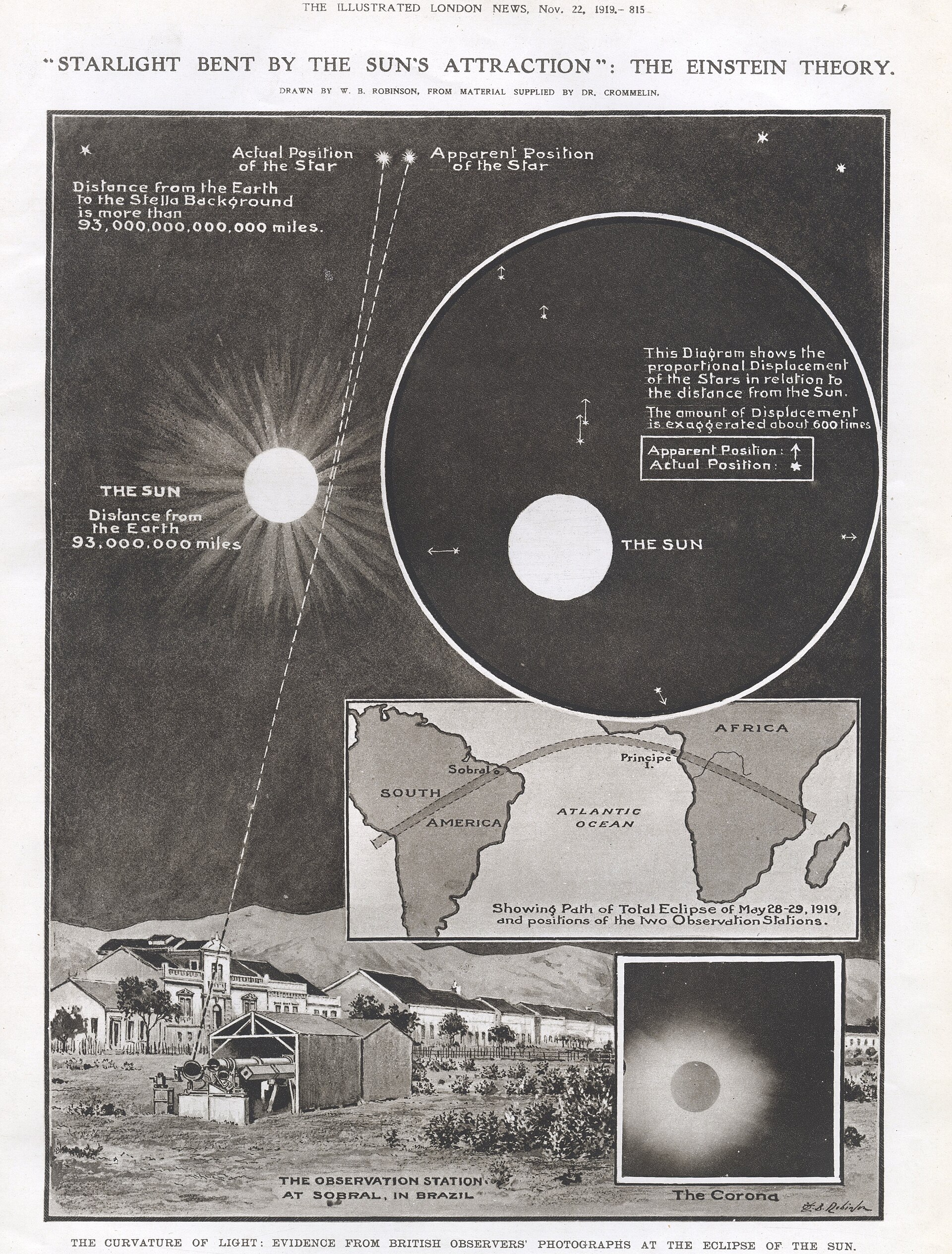
The results were presented at a joint meeting of the Royal Society and Royal Astronomical Society on 6 November 1919. Newspaper coverage quickly carried a difficult astronomical measurement to audiences who had never heard of a coelostat. Illustrated explanations followed. The Illustrated London News page reproduced here, published on 22 November, turned tiny stellar displacements into an intelligible visual story. Its diagrams are evidence of how the result was explained to readers, rather than another set of experimental observations.
After the First World War, British astronomers’ support for a theory associated with a German-based physicist also had an international significance. Yet the cooperative ideal should not flatten what actually happened at the observing sites. The science crossed borders through institutions, transport systems, colonial plantations and local working relationships, each with its own history.
The 1919 observations gave general relativity an important early success. They did not finish the testing of gravity or make Newtonian calculations useless for the many circumstances in which they remain excellent approximations. What changed was the strength of the evidence for a more comprehensive account. Further observations could refine the measurement and test the theory in other ways.
The best reason to return to these photographs is therefore more interesting than a simple triumph. We can see a prediction made vulnerable to the world: to rain, focus, calibration, incomplete evidence and other people’s judgement. The dark disc and bright corona make the picture memorable. The tiny stars, and the patient work needed to trust their positions, explain why it mattered.