
Science, Invention & Exploration
The Challenger Expedition: The Labor Behind a Global Ocean Survey
Between 1872 and 1876, Challenger transformed ocean science through repeated measurements, dangerous deck work and a worldwide network of sailors, local experts and specialists.
When HMS Challenger left Portsmouth on 21 December 1872, its scientific mission depended on something less glamorous than a dramatic discovery: repeating difficult operations reliably. Instruments had to reach the seabed, samples had to return, and each object needed a recorded position and depth. Between departure and the ship’s return in 1876, that routine created an unprecedented global collection of marine evidence. The voyage helped establish oceanography, but its achievement was distributed among naval crews, civilian specialists, local experts and the people who processed the results ashore. A map of the route shows where the ship travelled. It does not, by itself, show who made the knowledge possible. [1]
The deep sea was already being investigated
Challenger did not single-handedly prove that the deep ocean contained life. Before it sailed, Louis François de Pourtalès had dredged living organisms from deep water off the American coast. British expeditions aboard Lightning and Porcupine had also recovered animals far below the depths once associated with an allegedly lifeless zone. Charles Wyville Thomson, later Challenger’s scientific director, participated in this earlier work. NOAA’s history places the voyage within a wider period of international competition and improvements in sounding, dredging and ocean measurement. Its distinctive contribution was scale and integration: it sought to compare biological, geological, chemical and physical observations across widely separated seas. That ambition built on other investigators rather than erasing them. [2]
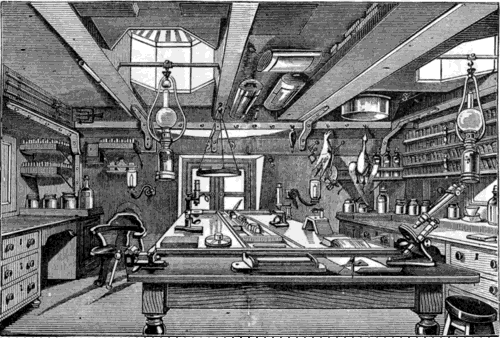
The ship itself embodied the partnership between science and the navy. A wooden corvette was refitted with laboratories and workrooms, while nearly all its guns were removed. Space had to be found for dredges, trawls, bottles and an accumulating collection. Sail remained the normal means of propulsion; the steam engine was especially useful when manoeuvring for scientific work and handling heavy equipment. Captain George Nares commanded the vessel at the start, while Thomson directed the civilian programme. Naturalists John Murray, Henry Nottidge Moseley and Rudolf von Willemoes-Suhm, chemist John Young Buchanan, and artist-secretary John James Wild formed the best-known scientific group. Officers, engineers, surgeons and roughly two hundred sailors supplied the much larger working organisation around them. [3]

Science, cables and a naval programme
The Royal Society’s Circumnavigation Committee shaped the scientific questions, but the voyage also served hydrographic priorities. The Hydrographic Office wanted information about ocean depth and the character of the bottom that could help submarine telegraph cables. Cable routes required more than the outline of a coastline: gradients, sediment and deep-water terrain mattered. The same observations could therefore support a biological inquiry, a navigation chart and an imperial communications network. This overlap helps explain why a government would commit a naval ship to such a prolonged voyage. It also prevents the misleading separation of disinterested scientists from the maritime infrastructure that carried them. The expedition’s purposes were multiple from the beginning. [4]
Its station programme turned that broad ambition into comparable records. The commonly cited total is 362 principal observation stations. Depth, temperatures, currents, bottom material and organisms were recorded as conditions allowed. These were not identical packets of perfect data: a broken line, weather or a failed haul could leave gaps. Nevertheless, repeated observations made it possible to compare one region with another. A label connecting a specimen to a station number was part of the scientific result, not mere clerical wrapping. Without such connections, thousands of animals and jars of sediment would have been a collection of curiosities rather than evidence about how the ocean varied. [5]
Lowering an instrument was an experiment
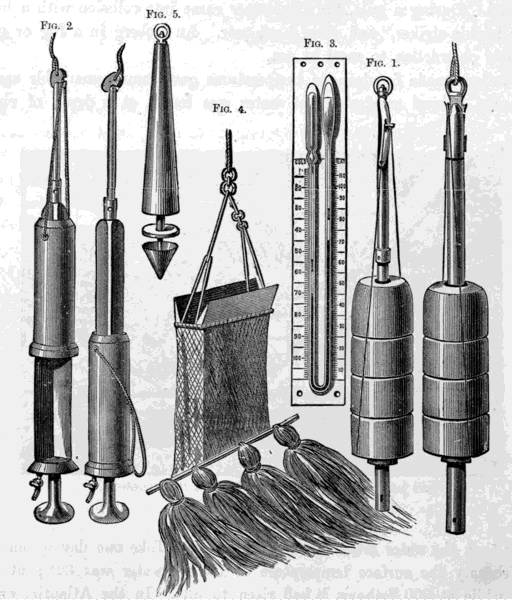
The instruments needed adaptation. Early in the voyage, the Hydra sounder recovered bottom material in a tube while releasing its heavy sinkers. Its mechanism was delicate: a change in line tension could release the weights too soon. The Baillie sounder, introduced later, used a different release arrangement and could recover a larger sample. These devices descended from practical surveying and shipboard invention. A blacksmith and sailors had helped develop the Hydra instrument before Challenger’s voyage. The operation aboard a high-sided warship also required a raised working platform, rigging and steam-assisted recovery. The sounding number that eventually appeared on a chart was the endpoint of this apparatus, the crew’s handling and their judgment about what the line was doing below the surface. [6]
Material could become useful surprisingly far from the main expedition office. During the ship’s visit to Halifax, Wyville Thomson gave natural-history curator David Honeyman a selection that included tiny shells, foraminifera, sponge spicules and crinoids. The material retained locality, depth and sediment information. Some specimens were so small that their recovery depended on sifting ocean mud, not simply recognising a conspicuous animal in a trawl. Preserved at the Nova Scotia Museum, this collection shows how the voyage’s evidence circulated while the ship was still travelling. It also shows why sampling required careful sorting: what looked like unremarkable mud could contain the organisms needed to distinguish one bottom environment from another. [7]
The people outside the standard group portrait
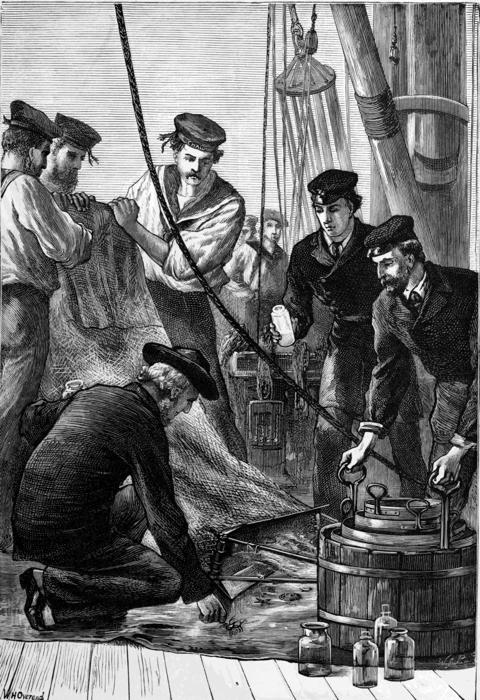
Much of the wet, strenuous dredging work fell to sailors. It could be dangerous: Royal Museums Greenwich records that the young crew member William Stokes died in a dredging accident on 25 March 1873. A published picture of naturalists inspecting a catch begins after much of that labor has already happened. Recovery, lifting and handling were essential scientific operations, even when the resulting species description carried someone else’s name. [8]
Laboratory assistants are easier to miss still. Historian Rebecca Martin has recovered William Pemba’s place in the expedition through photographs and naval records. He joined at the Cape of Good Hope in December 1873. His administrative rating placed him in “class 3 domestic staff”, but his recorded profession was “Naturalist”. He worked alongside the scientific personnel and appears in a group photograph, although captions often failed to name him. Pemba became ill in Hong Kong and died after leaving the ship in December 1874. The evidence restores his presence and role; it does not permit a confident list of particular discoveries attributable to him. Frederick Pearcey, another assistant, later helped prepare the reports in Edinburgh. Their careers expose the gap between the formal hierarchy and the actual work of producing science. [9]
Local expertise mattered as well. At Cebu, fishermen’s lighter dredging equipment helped the visitors collect fragile glass sponges that the ship’s iron apparatus damaged. In Tonga, a local boat crew helped guide Challenger through reefs to an anchorage near Nukuʻalofa. A surviving photograph preserves a pilot’s appearance but not his name. These examples are practical contributions: choosing appropriate gear and navigating hazardous water. They belong in the explanation of how the collections were obtained. [8]
These collaborations took place within unequal imperial relationships. The expedition also collected ethnographic material and ancestral remains, sometimes without permission, and used photography and bodily measurement to classify people racially. Those activities were part of its scientific programme, alongside the ocean research. [9]
What a deep sounding could reveal
On 23 March 1875, at Station 225 in the western Pacific, Challenger measured 4,475 fathoms, approximately 8,184 metres. That extraordinary sounding helped reveal the Mariana region’s enormous depths. It was not a measurement of the modern, nearly eleven-kilometre maximum now associated with Challenger Deep. Nor did one descent map the whole trench. Like the other observations, it supplied a point within a developing picture of submarine terrain. The distinction matters because the expedition’s importance is easily inflated into a claim that it already knew the ocean floor as modern sonar surveys do. Its equipment produced a sparse set of hard-won measurements from which larger patterns could be inferred and later tested. [10]
The biological collection likewise depended on later identification. Thousands of new species were eventually described, while the material also included familiar organisms from unfamiliar depths or locations. Specimens were preserved and dispatched to Britain during the voyage rather than all waiting aboard until the end. From Edinburgh, specialists received material for examination, and type specimens ultimately became part of museum collections. These transfers extended the expedition across institutions. The personnel did not all complete the journey: Willemoes-Suhm died during the Pacific crossing in 1875. The resulting publications can make the programme look seamless, but the voyage included illness, loss and changing responsibilities as well as discovery. [11]
The second expedition took place on desks
After the return, the work moved into an office at 32 Queen Street in Edinburgh. Specimens needed sorting, cataloguing and allocation before expert analysis could begin. John Murray became the central organiser of the publications. The eventual report comprised fifty volumes, and its final volume appeared in 1895, almost two decades after the ship came home. For the deep-sea deposits report, Murray worked with Belgian geologist Alphonse Renard to examine rocks and sediments microscopically. Their 1891 volume connected bottom samples to a global representation of the seabed. Illustrations also required an international production network: specialist drawing, lithography and printing were carried out in cities including Edinburgh, Brussels and Vienna. The polished plate was another collective artifact, built from a sample first hauled aboard at sea. [12]
Ernst Haeckel’s 1887 radiolarian report makes that process unusually visible. Its editorial notes identify W. E. Hoyle’s translation of the German introduction, while Haeckel’s preface credits Reinhold Teuscher’s measurements and Adolph Giltsch’s drawing and lithography. Preparation took about a decade. Haeckel also acknowledged uncertainties in his classification, including the possibility that some named forms represented developmental stages. The report therefore documents both extensive labor and the provisional character of taxonomic knowledge. An illustrated species was not simply an object discovered intact with its scientific identity attached. It emerged from comparison, measurement and decisions about which differences deserved names. [13]

Why old samples still matter
A small box of seabed samples now at Royal Museums Greenwich points to another afterlife. Its trays hold examples of bottom material collected during the expedition. The museum suggests that the box was probably used to train hydrographic officers to recognise and describe sediments. A specimen could move from research evidence into a teaching tool, helping someone else make consistent observations. That continuity depended on retaining the physical material as well as printing the report. The sea floor became legible through reference collections that observers could compare with their own findings. [15]
Recent research has asked questions the collectors did not design the voyage to answer. A 2020 study compared foraminifera from Challenger’s plankton tows with modern samples and found reduced shell thickness in the selected material. The authors examined the relationship to changing ocean chemistry while calling for further evidence about other influences and wider patterns. The historical samples were especially valuable because their collection dates were known: unlike a sediment sample mixing organisms from different ages, a tow captured living plankton at a particular time. This is a specific use of a historical baseline, not proof that every species everywhere has changed identically. [14]
The surviving archive preserves more than celebrated portraits and report titles. Equipment drawings, marine-life illustrations, photographs and statistical records can be read together with the specimens. Each documents a different stage in transforming a sea-going operation into a scientific claim. Challenger’s enduring achievement lies in those connected records. Recovering the sailors, assistants, local navigators, translators and illustrators within them makes the achievement more accurate, and more substantial, than the story of a single heroic discoverer. [16]
Sources and further reading
- Royal Museums Greenwich, The Challenger Expedition: History and Legacy
- NOAA Ocean Exploration, The breakthrough years, 1866–1922
- Challenger Society for Marine Science, History of the expedition
- Rupert Baker, A seabed selection, Royal Society
- National Oceanography Centre, The Challenger Expedition
- University of Edinburgh, Measuring the depths
- Nova Scotia Museum, The Challenger Expedition: a visit to Halifax
- Daisy Chamberlain, Telling the story of the Challenger Expedition, Royal Museums Greenwich
- Rebecca Martin, Challenger Expedition Photograph Albums: putting names to faces, Royal Museums Greenwich
- MARUM, University of Bremen, Die Challenger-Expedition 1872–1876
- James Ashworth, HMS Challenger and continuing discoveries, Natural History Museum
- University of Edinburgh, Making the deep sea visible
- Ernst Haeckel and John Murray, Report on the Radiolaria, 1887, editorial notes and preface
- Lyndsey Fox and colleagues, Quantifying the Effect of Anthropogenic Climate Change on Calcifying Plankton, Scientific Reports, 2020
- Royal Museums Greenwich, Sea-bed samples, NAV0843
- University of Edinburgh Library, Biological Sciences: HMS Challenger papers