
The Return of Martin Guerre: How Certain Can a History Be?
Natalie Zemon Davis turned a sixteenth-century imposture into an argument about marriage, memory and the limits of historical knowledge. The most difficult question concerns the woman whose thoughts the records cannot settle.
The stranger did not merely borrow a name. He entered a household, assumed a marriage and claimed a place in a family’s property arrangements. For several years, Arnaud du Tilh lived as Martin Guerre in the southern French village of Artigat. When the actual Martin appeared during proceedings at Toulouse in 1560, the imposture was exposed. Yet identifying the false husband did not resolve everything that had happened around him.
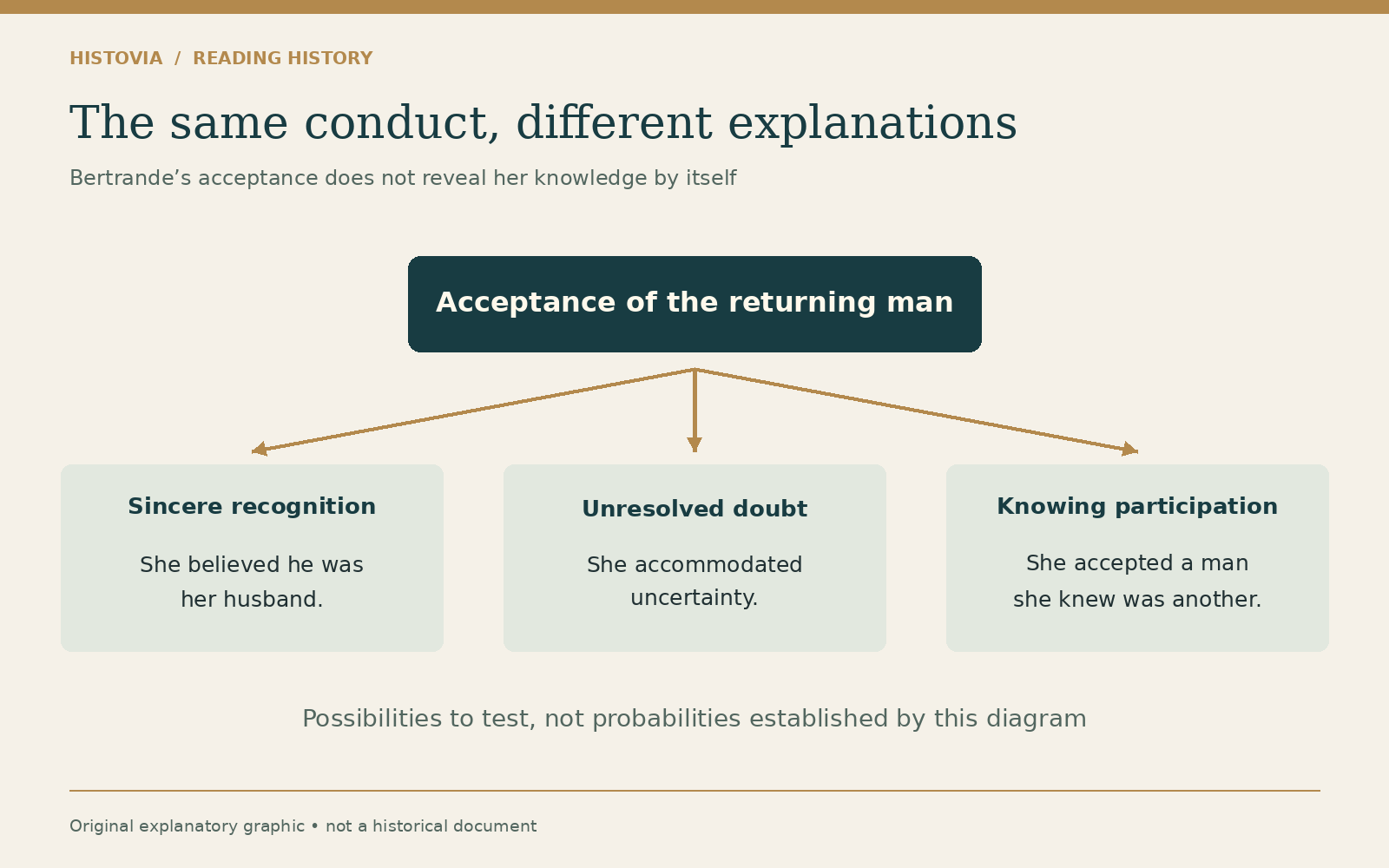
What had Martin’s wife, Bertrande de Rols, believed? Was she deceived, accommodating a suspicion, or participating in a relationship that could survive only under another man’s name? These possibilities have different consequences for the story. They also demand different kinds of proof.
Natalie Zemon Davis’s The Return of Martin Guerre, first published in 1983, places that uncertainty at the center of historical inquiry. The case supplies a dramatic ending; the historian’s problem begins when that ending is asked to explain the preceding years.
Reading note: This is a historical and critical introduction based on accessible book excerpts, Davis’s interviews, a translated contemporary account and published scholarship. It is not a firsthand review of the complete book.

A familiar person was also a social position
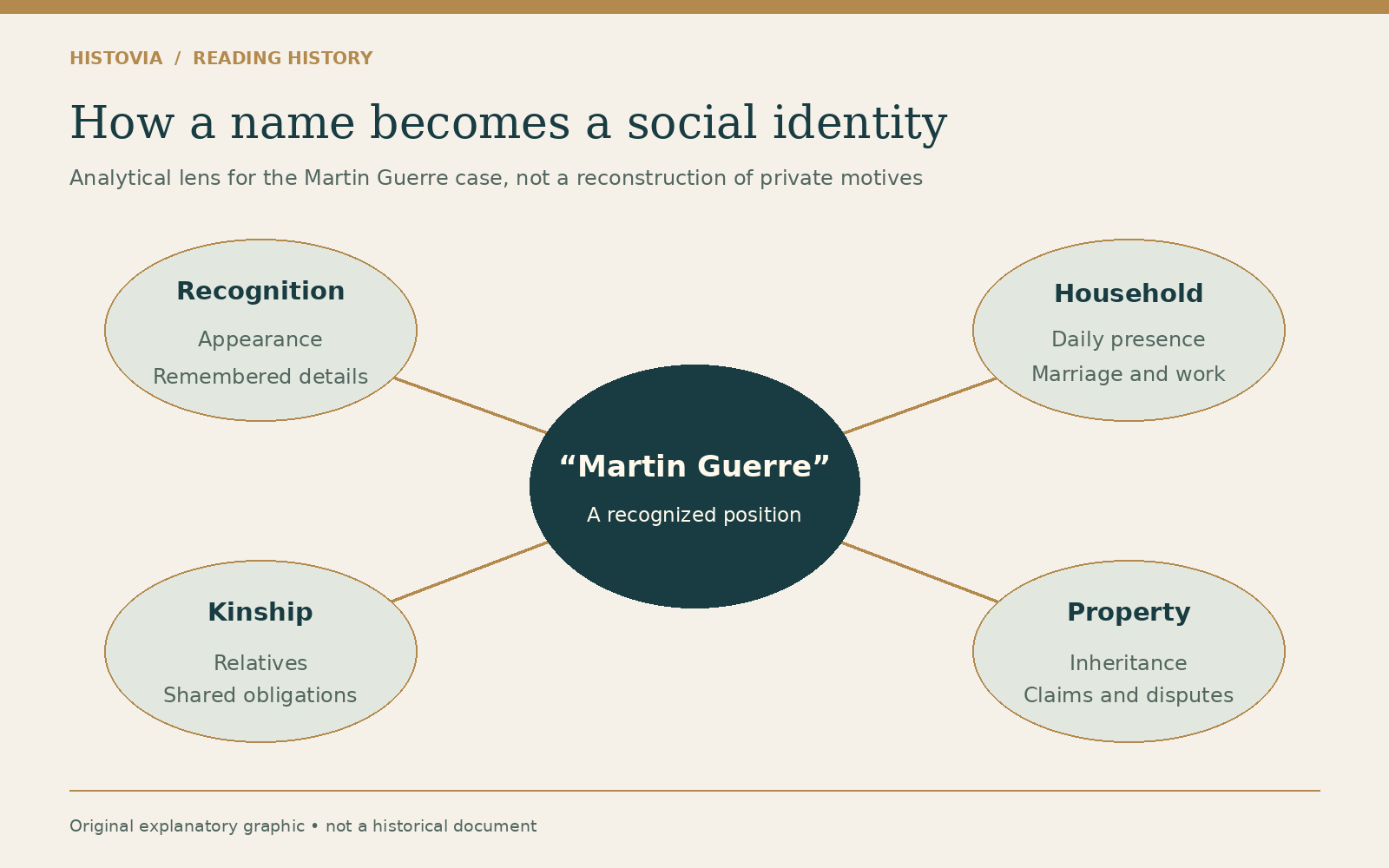
The publicly available chapter openings indicate how deliberately Davis broadens the case. Her subjects include the family’s movement from Hendaye to Artigat, Bertrande’s position, the impostor’s background and quarrels over property. The returning husband mattered because he was also an heir, a nephew and a proprietor. Recognition was entangled with obligations.
This changes the useful question. Asking how anybody could mistake one man for another assumes that identity was simply a visual comparison, performed once and then stored without revision. A household instead encounters someone repeatedly: at work, in conversation, in negotiations with relatives. Acceptance can accumulate through actions as well as through resemblance.
That does not establish that the villagers consciously tolerated a fraud. It makes their conduct less inexplicable without deciding their motives in advance. Someone might recognize a face sincerely, accept the judgment of a trusted relative, or postpone a troubling doubt. The surviving case does not give equal access to each person’s reasoning.
Property creates a further complication. A man may be welcomed while he fills an absent place and challenged when he presses a financial claim. The timing of a quarrel can reveal interests; it does not prove that the earlier welcome was dishonest. Davis’s subject rewards keeping those propositions separate.
A village was not a closed world
The family’s Basque origins and relocation in 1527 complicate the picture of an isolated community in which everyone had always known everyone else. Davis’s first chapter follows migration rather than starting at the courtroom. An inherited identity had already been carried into a different linguistic and social setting before anyone tried to steal it.
In a later study, Jean-François Courouau examines the languages surrounding the affair: Basque, different forms of Occitan, and the French and Latin associated with educated and legal contexts. He emphasizes the difficulties of reconstructing what these differences meant in practice. The language of the surviving account should not automatically be mistaken for the language of every original exchange.
That observation is especially useful for a modern reader. A smooth English narrative makes everyone seem to inhabit a single conversational world. Translation necessarily removes some of the friction. Questions about accent, remembered words and the ability to move between social settings may have mattered, even where the record leaves their exact operation uncertain.
The woman whose knowledge changes the story
Bertrande is where the book’s interpretive ambition meets its hardest test. Davis’s suggestion that she was more than an unsuspecting victim became the subject of a sustained scholarly dispute. Robert Finlay challenged that reconstruction in the 1988 American Historical Review; Davis answered in an essay called “On the Lame.”
Phyllis A. Hall’s account of teaching the exchange captures the disagreement. Finlay argued that Davis had transformed Bertrande into an accomplice beyond what the evidence warranted. Davis defended the use of contextual knowledge to interrogate the early narratives rather than merely repeat them. Hall describes students moving between the two positions as they reconsidered the same materials.
The dispute cannot be settled by choosing the more appealing Bertrande. A resourceful woman negotiating severe constraints is more satisfying to many modern readers than a woman successfully deceived. Satisfaction is not corroboration. Equally, treating a judicial account as transparent can reproduce its assumptions about what a respectable wife could admit, or what a court could acknowledge.
There are at least three separate questions. What options did Bertrande have? What might have made a new relationship desirable or necessary? What did she actually know about this particular man? Context can illuminate the first two while leaving the third unresolved. A historian overreaches if an explanation of opportunity becomes proof of intention.
The converse error is to make uncertainty so restrictive that a woman without a private diary becomes intellectually inaccessible. People who did not control the creation of records still made judgments. Their actions deserve questions, even when those questions produce several defensible answers rather than one recovered interior monologue.
This is the strongest way to approach the controversy: hold Davis’s interpretation open to challenge without assuming that the older version is interpretation-free. The reader need not decide that Bertrande was either a modern rebel or a credulous innocent. Those are unusually tidy roles for a person whose choices carried consequences for her household and reputation.
The court preserved the story and shaped it
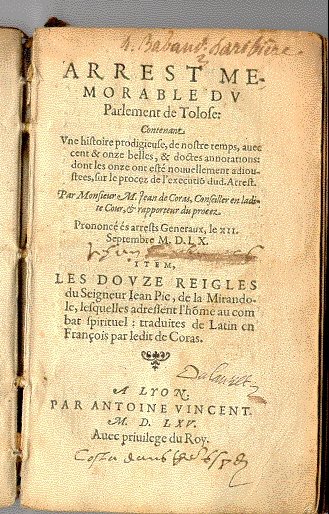
One of the principal witnesses for later readers is Jean de Coras, a judge involved in the case whose Arrest memorable turned proceedings into a published account. A translation of its main text by Jeannette K. Ringold makes the problem visible: an extraordinary case arrives through legal narration, organized around accusation, examination, judgment and punishment.
Coras’s account includes the impostor’s reported explanation of how he acquired knowledge about Martin. Information came from people who knew the absent man and, after his acceptance, from conversations within the household. Memory could be assembled. A convincing answer to a personal question was therefore evidence to weigh, not an infallible certificate of identity.
Even confession requires attention to circumstances and transmission. It is a reported statement from a condemned man, selected and arranged by someone else. The fact that it appears near the narrative’s resolution does not give a historian direct access to every earlier motive.
Legal scholar Leigh Buchanan Bienen’s 1984 discussion identifies the law’s double role: the case survives because law became a storyteller, while its survival carries the limitations of that storytelling. The courtroom brings ordinary people into written history, but on terms established by a dispute.
Those terms make some details unusually visible and others difficult to recover. Statements useful for identifying an accused person are preserved; years of unremarkable domestic conversation are not. A later historian therefore confronts an uneven archive. Its abundance around the trial should not be confused with an equally detailed record of the marriage.
The published account is also evidence about its author and audience. What made the case memorable? Which acts required explanation? Whose words received space? These questions allow the source to reveal more than the verdict without pretending that it can reveal everything.
The cinema made the historian ask different questions
The book followed Davis’s participation in Daniel Vigne’s 1982 film Le Retour de Martin Guerre. The University of Toronto’s account of her career treats that collaboration as an experiment in how historical representation could work, rather than a simple exercise in correcting costumes and dates. It also identifies the book as a major example of microhistory: a concentrated case used to explore larger historical problems.
A film has to put a person somewhere. An actor must decide how to enter a room, respond to a touch, or hesitate before answering. A written history can leave those details undecided. This difference is not a defect peculiar to cinema. It is a consequence of the medium, and a reason to distinguish a plausible performance from evidence of an actual gesture.
In her Holberg Prize interview, Davis described the importance of showing the evidentiary status of historical statements and asked how an equivalent responsibility might work in film or theater. That is a more productive standard than demanding that every historical drama become an illustrated footnote.
The question for readers of the book is related. Can they tell when the narrative moves from something documented to something reconstructed? Does a possibility remain visibly conditional after several pages of explanation? An interpretation can acquire the emotional solidity of a fact through repetition, even if its first appearance was carefully qualified.
Will Pooley’s essay on Davis’s historical imagination emphasizes the importance of her conditional language and her determination to recover people poorly represented in surviving records. It also brings forward a warning about excessive familiarity with the past. Empathy helps a historian formulate questions; it cannot guarantee the answers.
What a small history can and cannot represent
Artigat is compelling partly because the event was exceptional. That creates a useful limit. One spectacular imposture cannot tell us how frequently comparable arrangements occurred or how most marriages worked. A case is not a statistical sample merely because its participants were peasants.
Its broader value lies elsewhere. An unusual conflict can expose expectations that usually remained implicit. People have to explain who counts as a husband, which memories matter, and how possession and kinship should be recognized when those assumptions are challenged. The disruption makes parts of an ordinary social order visible.
This gives the book two audiences. Readers drawn by the imposture gain a route into early modern households and legal culture. Readers interested in historical method gain a case in which a compelling explanation can be tested against the limits of its sources. The second audience should read the debate alongside the narrative, rather than treating criticism as an optional appendix to a settled achievement.
The remaining uncertainty belongs to the subject. Martin’s return resolved a legal identity. It could not supply an unmediated record of Bertrande’s earlier thoughts. To preserve that distinction is to take her life seriously without claiming to possess it.
Edition link: Natalie Zemon Davis, The Return of Martin Guerre, Harvard University Press paperback, ISBN 9780674766914. Exact Amazon edition. This is a bibliographic link, not a claim about current price or availability.
