
WORLD WAR II · EASTERN FRONT
Stalingrad: The City Battle and the Trap Beyond Its Flanks
How a German advance to the Volga became a battle through ruined factories, a Soviet encirclement and the destruction of the Sixth Army.
In August 1942 the German Sixth Army reached the Volga. In November it still had not driven the last Soviet defenders from Stalingrad. Its troops had captured streets, factories and stretches of riverbank, but small Soviet footholds continued to receive men and ammunition from across the water.
Then the battle changed direction. Soviet armies struck the forces of Germany and its Axis allies guarding the approaches north and south of the city. Within days, the Germans fighting beside the Volga were cut off from the roads and railways that had supplied them.
The road to Stalingrad
The German summer offensive began in June 1942 with ambitions far beyond one city. Hitler wanted the oil of the Caucasus, which could help sustain Germany’s war effort while depriving the Soviet Union of a vital resource. Stalingrad, an industrial center on the Volga, stood on a major transport artery and on the northern side of that southern campaign.
Army Group South was divided. Army Group A pushed toward the Caucasus; Army Group B advanced toward the Volga. Across the growing distances, both needed fuel, ammunition, transport and reinforcements. German success lengthened the routes along which all of these had to travel.
The Red Army suffered repeated defeats on the approaches to Stalingrad. Its new tank formations often went into battle hurriedly, with weak coordination and inadequate support. But their counterattacks still cost the Germans time and strength. As historian Yan Mann explains, the Soviet armored forces were learning through these costly engagements. Some of the formations later used to encircle the Germans grew out of that experience.
23 August: the war reaches the city
On 23 August German troops reached the Volga north of Stalingrad. That day, heavy air raids devastated the city. Fires spread through residential districts as the German advance threatened the routes out.
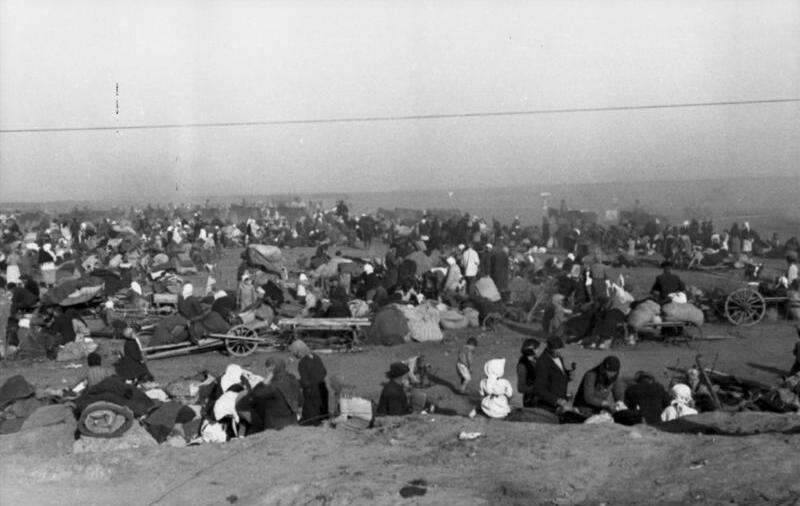
Stalingrad was still full of civilians. Officials had delayed evacuation, kept factories working and discouraged departure. Production demands, bureaucracy and inadequate preparations all contributed. Some residents escaped across the river; others remained with children, elderly relatives or family members unable to move.
For those left behind, food and water became dangerous to obtain. Cellars and improvised shelters offered only limited protection. People who crossed the Volga could find themselves without proper shelter on the opposite bank. The National WWII Museum’s account of civilian witnesses describes both the failures of evacuation and the struggle to survive afterward.
The exact civilian death toll remains disputed. Bombing, displacement and the destruction of records make confident totals difficult. What is certain is that a populated city had become a battlefield, and civilians continued living inside it as the fighting moved from district to district.
September: holding on beside the river
German attacks entered central Stalingrad in September. Vasily Chuikov, who took command of the Soviet 62nd Army that month, had little room to retreat. His soldiers fought around the railway station, apartment blocks and Mamayev Kurgan, the hill overlooking parts of the city and the river.
The Volga was both a barrier and a lifeline. Men, ammunition and food crossed from the eastern bank, often at night and under fire. Boats carried wounded soldiers back. Artillery positioned beyond the river could support troops in the city. The Germans reached the water in several places, but they never completely severed these connections.
Inside the ruins, the front could run through a building. Small infantry groups used cellars, broken walls and rubble for cover. An attacker might capture one position while remaining exposed to another nearby. Tanks and heavy guns could help, but infantry still had to occupy and search the ground.
For the Germans, each remaining Soviet foothold demanded another assault. For Chuikov, keeping even a narrow landing place open could allow fresh troops to enter the battle. The army’s survival rested on those dangerous crossings as much as on the buildings it held.
October: the factories become the front
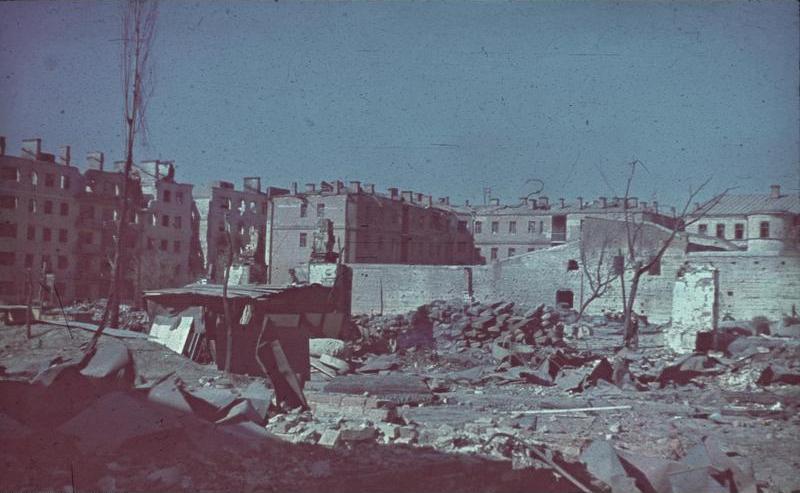
In October the struggle concentrated increasingly on the northern industrial districts: the tractor factory, the Barrikady gun works and the Red October steelworks. German engineers used explosives to open paths through strongpoints. Assault troops pushed forward, and infantry followed to clear the positions left behind.
The major attack beginning on 14 October broke into the tractor factory area and reached the Volga, splitting Soviet positions. It was a serious German success. Yet the defenders held on elsewhere, and reinforcements continued arriving. Capturing most of a factory complex did not necessarily remove every group sheltering in its wreckage.
Paulus, the Sixth Army’s commander, repeatedly gathered strength for another push. Divisions and weapons committed to the city were then unavailable for other duties. The fighting consumed experienced infantry, ammunition and the time needed to rest exhausted units.
By November the Germans had occupied most of Stalingrad, but the last Soviet bridgeheads remained. A bridgehead was a defended foothold beside a river crossing. Those small positions kept German forces tied to the city while a much larger Soviet operation took shape beyond its outskirts.
The exposed ground on either side
Northwest of Stalingrad, the Romanian Third Army held a long stretch of the Don front. Romanian forces also guarded the southern approaches. Farther west stood Italian and Hungarian armies. Germany depended on its allies to cover territory that its own forces could no longer adequately occupy.
The Romanian armies faced a particularly dangerous task. Their troops were spread across long sectors, with insufficient modern anti-tank weapons and weak mobile reserves behind them. Soviet troops held bridgeheads across the Don from which they could attack. German headquarters received warnings about the growing threat, but recognizing it did not produce enough reinforcements to remove it.
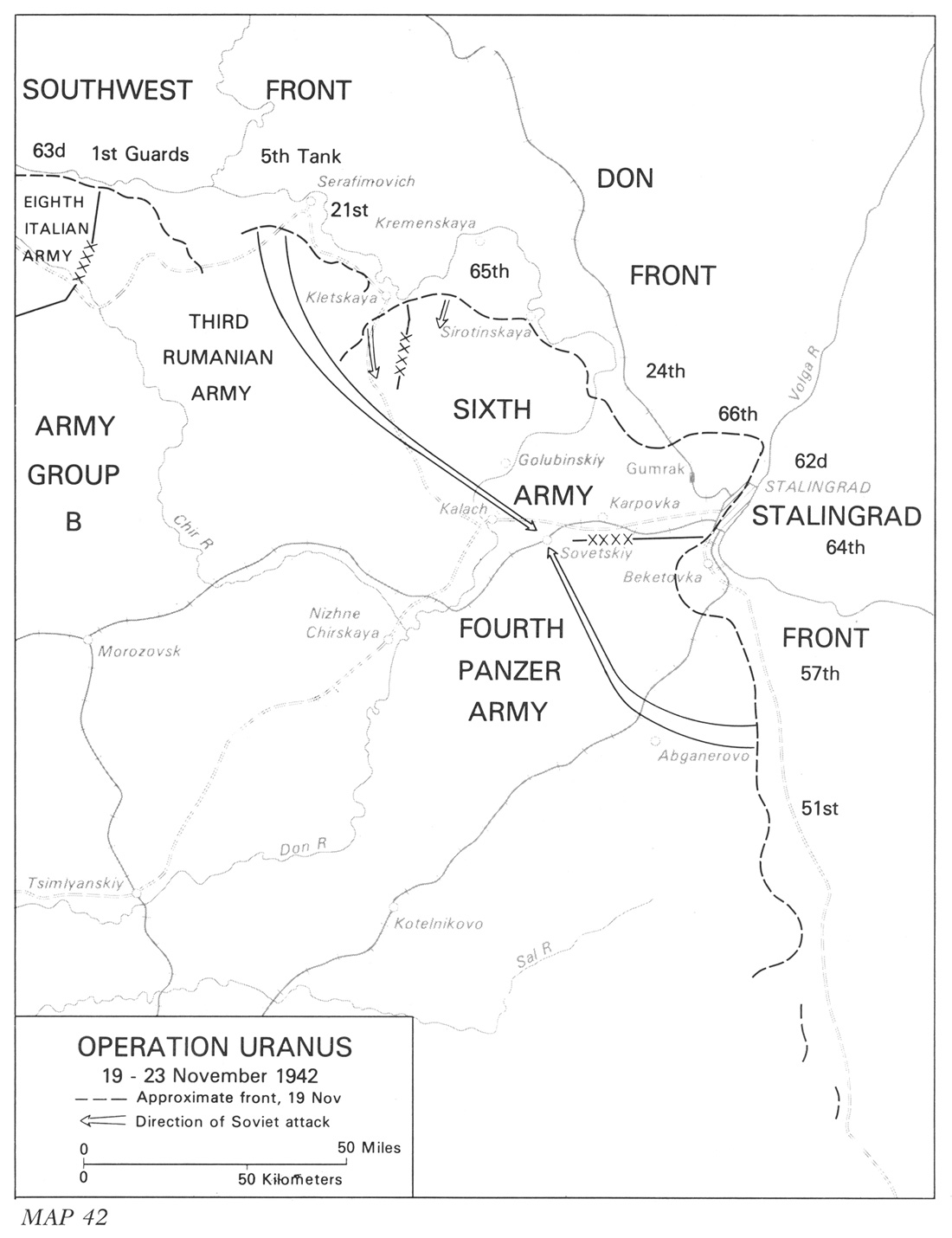
Soviet planning targeted these weaknesses. Operation Uranus would attack on both sides of the German concentration and close behind it. Infantry and artillery would break the defensive lines; tanks and other mobile formations would pass through toward the roads and crossings in the rear.
Several Soviet fronts, each commanding multiple armies, had to coordinate their movements. Unlike many hurried summer counterattacks, Uranus received weeks of preparation. Supplies and formations accumulated away from the city while Chuikov’s troops continued their desperate defense along the Volga.
19–23 November: the ring closes
The northern assault opened on 19 November. Soviet artillery struck the Romanian-held front, and attacking forces broke through toward the German rear. The southern attack began the following day. Local resistance continued, but the Axis reserves could not restore a continuous line quickly enough.
Soviet mobile formations pushed toward the Don crossings near Kalach. On 23 November the two arms of the offensive met in the Kalach–Sovetsky area. The Sixth Army, parts of the Fourth Panzer Army and other Axis troops were trapped in a large pocket that included Stalingrad and the surrounding country.
The encirclement did not end the battle. The surrounded troops still had guns, ammunition and organized formations. Soviet forces had to build two fronts: one facing inward to contain the pocket, and another facing outward to stop a German relief attack.
Inside the ring, the Germans now faced the same immediate question every day: how would food, fuel and ammunition get in? Their supply routes had been cut, and their surviving stocks would diminish even if they stayed where they were.
Waiting for aircraft and a relief force
Hitler ordered the encircled army to hold its ground. An airlift was supposed to sustain it until forces outside could reopen a route. Aircraft did bring supplies and take out some wounded, but deliveries fell far below the army’s needs.
The failure had several causes. Bad weather interrupted flights. Aircraft broke down or were lost. Airfields needed fuel, maintenance and protection, while Soviet fighters and anti-aircraft guns threatened the routes. The Army’s demands continued on days when aircraft could barely fly. Successful individual flights could not make the whole operation reliable.
On 12 December German forces launched Operation Winter Storm from the southwest. Their tanks advanced toward Stalingrad but never reached the pocket. Meanwhile, Operation Little Saturn began on 16 December, striking the Axis front farther west, including the Italian Eighth Army. Soviet advances threatened German communications and airfields, making the wider situation increasingly dangerous.
A breakout would have required the trapped army to leave its positions and move through Soviet lines. Hitler would not authorize abandoning Stalingrad. As the wait continued, dwindling fuel, weakening soldiers and worsening shortages reduced the practical chances of escape. By late December the relief attempt had failed.
January: the pocket is reduced
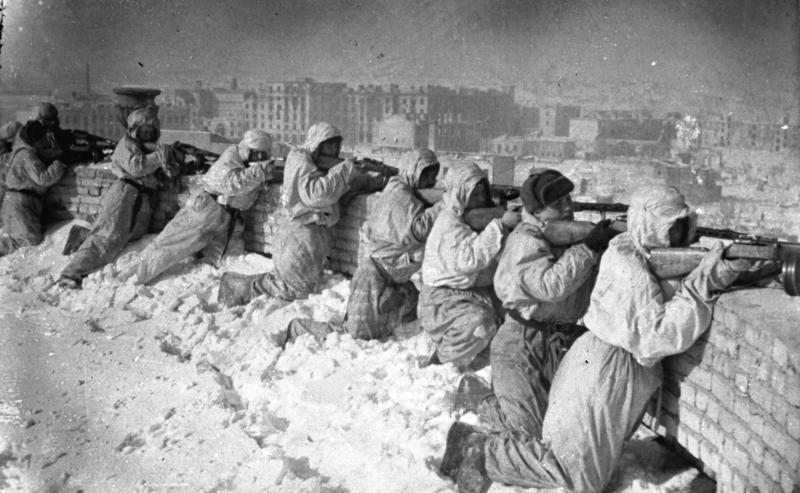
The Soviet final offensive, Operation Ring, began on 10 January 1943. Attacking troops drove the Germans into a shrinking area. Airfields fell, further reducing deliveries and evacuation. Wounded men crowded into shelters as hunger, cold and disease weakened the survivors.
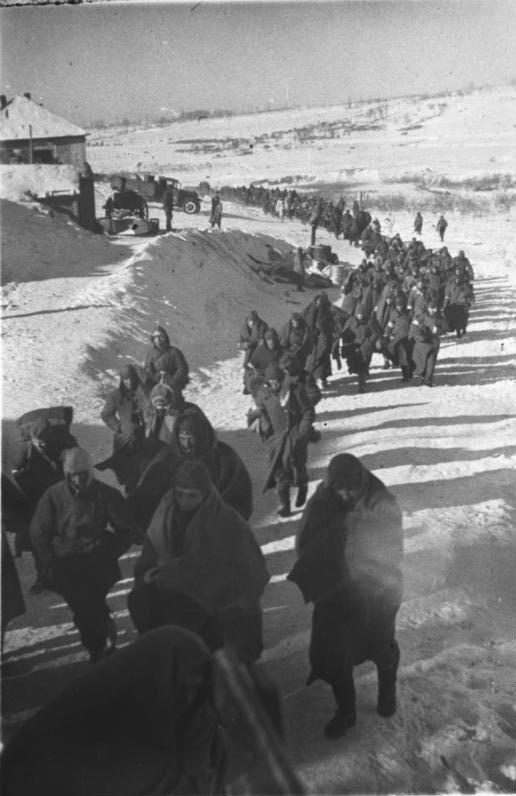
Soviet advances eventually divided the remaining German positions. Paulus and the southern pocket surrendered on 31 January. Fighting in the northern pocket ended on 2 February. Approximately 91,000 prisoners were taken in the final surrender. That familiar number describes the survivors captured at the end, not everyone originally surrounded or everyone who died during the campaign.
For many prisoners, survival of the battle did not mean survival of captivity. They entered it exhausted, malnourished and often sick or wounded. Only a small minority would eventually return home.
The war continued beyond Stalingrad for more than two years. German forces were still capable of powerful counterattacks, as they would demonstrate at Kharkov. But the Sixth Army that had fought its way to the Volga was destroyed as a field force. The Soviet victory had required both the stubborn defense of the city and the offensive that cut the army off beyond it.
Sources and further reading
- Earl F. Ziemke and Magna E. Bauer, Moscow to Stalingrad: Decision in the East, chapter XXII (U.S. Army Center of Military History, 1987)
- Yan Mann, Stalingrad: Experimentation, Adaptation, Implementation (National WWII Museum, 2022)
- National WWII Museum, Unsung Witnesses of the Battle of Stalingrad (2022)
- Roger J. Spiller, Sharp Corners: Urban Operations at Century’s End (Combat Studies Institute, 2001)
- William G. Robertson and Lawrence A. Yates, eds., Block by Block: The Challenges of Urban Operations (2003)
- Christopher M. Rein, ed., Weaving the Tangled Web (Army University Press, 2018)
- Derek M. Salmi, Behind the Light Switch: Toward a Theory of Air Mobility (Air University Press, 2020)
- Timothy A. Wray, Standing Fast: German Defensive Doctrine on the Russian Front During World War II (1986)
- Imperial War Museums, Second World War Galleries large-print guide
- Bundesarchiv, Ende der Schlacht von Stalingrad
- National Army Museum, Soviet mortar team advance at Stalingrad, 1942
- David M. Glantz with Jonathan M. House, Endgame at Stalingrad, Book One: November 1942 (University Press of Kansas, 2014)