
Imphal and Kohima: How Air Supply Changed the Meaning of Encirclement
In 1944, aircraft kept Allied troops supplied after Japanese forces cut their roads. The airlift worked because soldiers held the ground beneath it.
In the spring of 1944, Japanese troops cut the roads into Imphal and surrounded the defenders of Kohima. The maneuver had a familiar logic. Sever an army from its food and ammunition, force it to retreat, and seize what it left behind. Japanese infantry had repeatedly turned difficult country to their advantage this way. In northeastern India, however, the troops they isolated kept receiving supplies. Some of the roads belonged to the attackers; the skies did not.
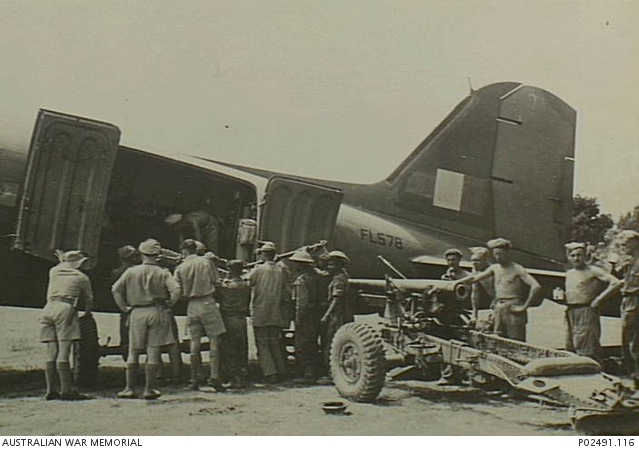
An Australian War Memorial photograph catches the less dramatic work that made this possible. At an airfield on the Imphal Plain, Indian soldiers load a 25-pounder gun into an RAF Dakota. The catalogue dates the photograph to about March 1944. Here was a practical change in warfare: aircraft could move fighting power, not merely messages or a few emergency rations. But the men handling that gun still needed an airfield to work on and soldiers to protect it. The campaign would turn on whether those connections could survive. [1]
The roads Japan needed to capture
The offensive began in March, when Lieutenant General Renya Mutaguchi sent his Fifteenth Army across the frontier from Burma. Operation U-Go aimed to destroy the Allied forces around Imphal and seize their supply bases. Another Japanese division advanced toward Kohima, on the road linking Imphal with the railhead at Dimapur. Closing that route would obstruct reinforcements coming from the north. Mutaguchi expected a victory rapid enough to provide captured stores before his own arrangements for feeding the army failed. [2]
Those objectives belonged to a much larger war. After the loss of Burma in 1942, the Allies had been trying to restore overland communications with China while sustaining it by air. An American wartime report identified the Japanese thrust toward Imphal and Dimapur as a threat to the railway supporting both the air route to China and operations in northern Burma. The struggle for a few roads in India therefore affected armies far beyond the immediate battlefield. [3]
A map makes the danger plain. Imphal occupied a basin surrounded by hills; the route through Kohima threaded its way toward the Assam supply system. Possession of a road junction or commanding ridge could interrupt movement over a much greater distance. Yet a roadblock was only the beginning of an encirclement. To destroy the trapped force, the Japanese also had to prevent it from obtaining supplies elsewhere, or overwhelm it before those supplies arrived.
Learning to remain in place
The Allied response grew out of defeat. In 1942, British and Indian forces had retreated from Burma with their communications repeatedly threatened. Under William Slim, the Fourteenth Army worked to rebuild confidence through jungle training and more aggressive tactics. Defensive positions were organized to resist attacks from different directions. These “boxes” could hold while aircraft supplied them, allowing commanders to treat enemy infiltration as a problem to fight through rather than an automatic order to withdraw. [4]
The approach had already been tested in the Arakan in February 1944. At the Admin Box, an isolated force continued fighting while receiving supplies by air. The RAF Museum places this battle and the subsequent defense of Imphal and Kohima within the same developing method. Soldiers could remain on ground the Japanese expected them to abandon because their commanders had another way of keeping them supplied. [5]
That confidence had to rest on something more substantial than an instruction to be brave. A defensive perimeter needed infantry, artillery, communications and medical care. Its occupants also needed reason to believe that help would continue arriving. Transport aircraft gave the promise credibility. They allowed men to hold their positions while relief forces fought toward them, although they could not guarantee that those positions would remain defensible.
Keeping the air route open
Air transport also let the Allies move reserves across their own front. During the crisis, the 5th Indian Division was transferred from the Arakan toward the threatened area. RAF Dakotas and American C-46 transports took part in the movement. Flying reinforcements shortened a journey that the available roads could not have accommodated nearly as quickly. Airlift consequently influenced the balance of troops, as well as the length of time existing units could hold out. [6]
The loading photograph shows why this achievement depended on work far below the clouds. A gun and its equipment had to fit an aircraft's weight and space limits. Supplies had to reach a departure base, be prepared for flight, and be moved onward after landing. Mechanics, loading parties and ground transport were as necessary as pilots. Flying bypassed the blocked stretch of road; it did not abolish the rest of the supply chain. [1]
Nor could the transports operate independently of the air battle. An official British despatch described the steady traffic into Imphal and the fighter patrols protecting it. Unarmed aircraft carrying essential cargo were an obvious target. Allied control of the air made the shuttle possible, while offensive aircraft attacked Japanese positions and communications. The same despatch stressed that air supply remained part of a larger transport effort rather than a replacement for every other means of movement. [7]
Around Imphal, the struggle to retain usable landing grounds made air supply a ground battle too. Palel was particularly important because its airfield could operate in wet weather. Nearby heights and approaches were fiercely contested. Rain and low cloud complicated flying, but losing the ground from which aircraft could work would have been more dangerous still. As Royal Armouries' account emphasizes, the transport effort depended on British and Indian units keeping the airfields in Allied hands. [8]
The traffic worked in both directions. Aircraft brought men and material forward and carried wounded people away. Evacuation relieved pressure on hospitals inside the defended area while offering casualties access to treatment farther from the fighting. Published totals differ by period and by which operations they include. The essential point is more secure than a combined headline figure: this was sustained support for an army, not an occasional delivery to a stranded outpost. [2]
Kohima was a different kind of siege
Kohima's defenders had much less room. Fighting contracted around Garrison Hill, where opposing positions came so close that the Deputy Commissioner's tennis court became a battlefield. Food arriving from outside did not remove the immediate danger of assault, nor the difficulty of maintaining access to water. The American official chronology records the loss of the garrison's main water supply on 7 April. A position could remain connected to an air-supply system and still be desperately vulnerable. [9]
This distinction matters when Imphal and Kohima are told as a single story. Imphal's basin contained airfields and substantial formations. The Kohima perimeter was a small, battered foothold in hill country. Both benefited from air power, but their receiving conditions and immediate needs differed. Calling both “supplied by air” should not make them seem interchangeable.
Relief reached the initial Kohima garrison on 18 April. It did not clear the surrounding heights or reopen the entire route to Imphal. Further attacks were needed to dislodge Japanese forces, restore movement and push south. The difference between relieving a perimeter and restoring a road explains why the campaign continued after the best-known episode of the siege. [2]; [9]
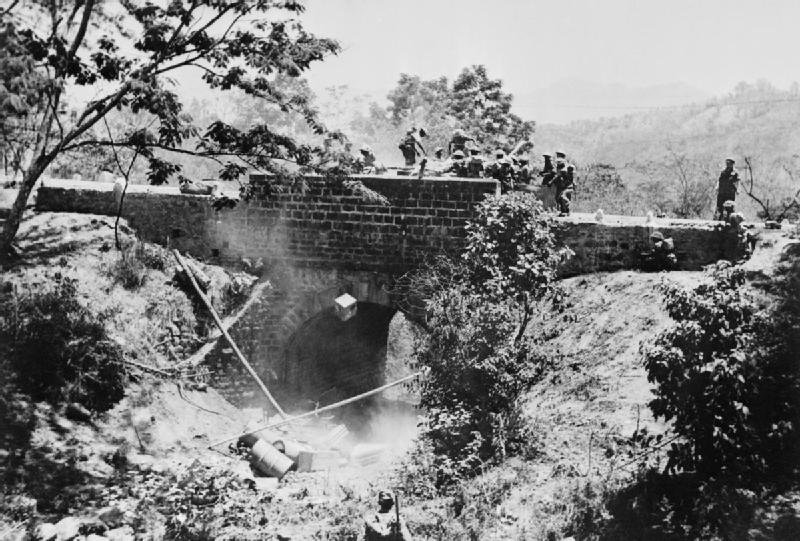
A wartime photograph of West Yorkshire Regiment soldiers clearing a roadblock preserves that continuing task. The obstacles that aircraft could bypass still had to be removed by troops on the ground. Armies needed roads for sustained movement, heavier loads and the freedom to concentrate forces. Every restored stretch reduced dependence on an aerial connection that weather or enemy action might interrupt. [10]
The army outside began to starve
As resistance continued, the Japanese timetable broke down. Mutaguchi had treated the capture of Allied stores as part of his supply plan. Every day those stores remained beyond his reach increased the burden on troops already operating at the end of difficult communications. The National Army Museum's study of Japanese forces in Burma describes the wider dependence on local resources and captured supplies. Such methods became increasingly inadequate for an offensive consuming men and ammunition without securing its objectives. [11]
Hunger and disease weakened the soldiers still expected to attack. Monsoon rain made an already punishing campaign worse. In the Royal Armouries account, the persistence of Japanese attacks appears alongside dwindling supplies, disputes in command and the inability to sustain the offensive. Courage could keep soldiers fighting, but it could not make the missing food arrive. Continuing the operation after its assumptions had failed deepened the disaster. [8]
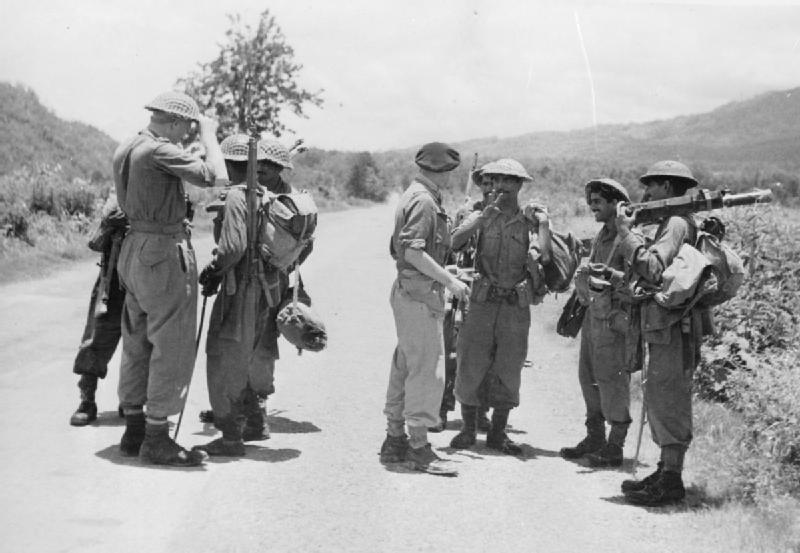
On 22 June, troops advancing from the north linked with the Imphal forces on the road at Milestone 109. The official photograph of the meeting marks a concrete achievement: a ground connection had been restored. Fighting did not cease everywhere that day, and the Japanese retreat continued to exact a terrible cost. Nevertheless, the offensive had lost the chance of obtaining the quick victory on which its logistics depended. [7]; [12]
Beyond the military map
The victory belonged to a multinational effort. Indian formations were central to Imphal's defense; British units and Gurkhas were also indispensable to the campaign. Americans contributed to the air effort. Japanese forces were accompanied by the Indian National Army, fighting British rule. Nationality alone therefore cannot explain the alignments of a war fought inside an empire. [8]; [11]
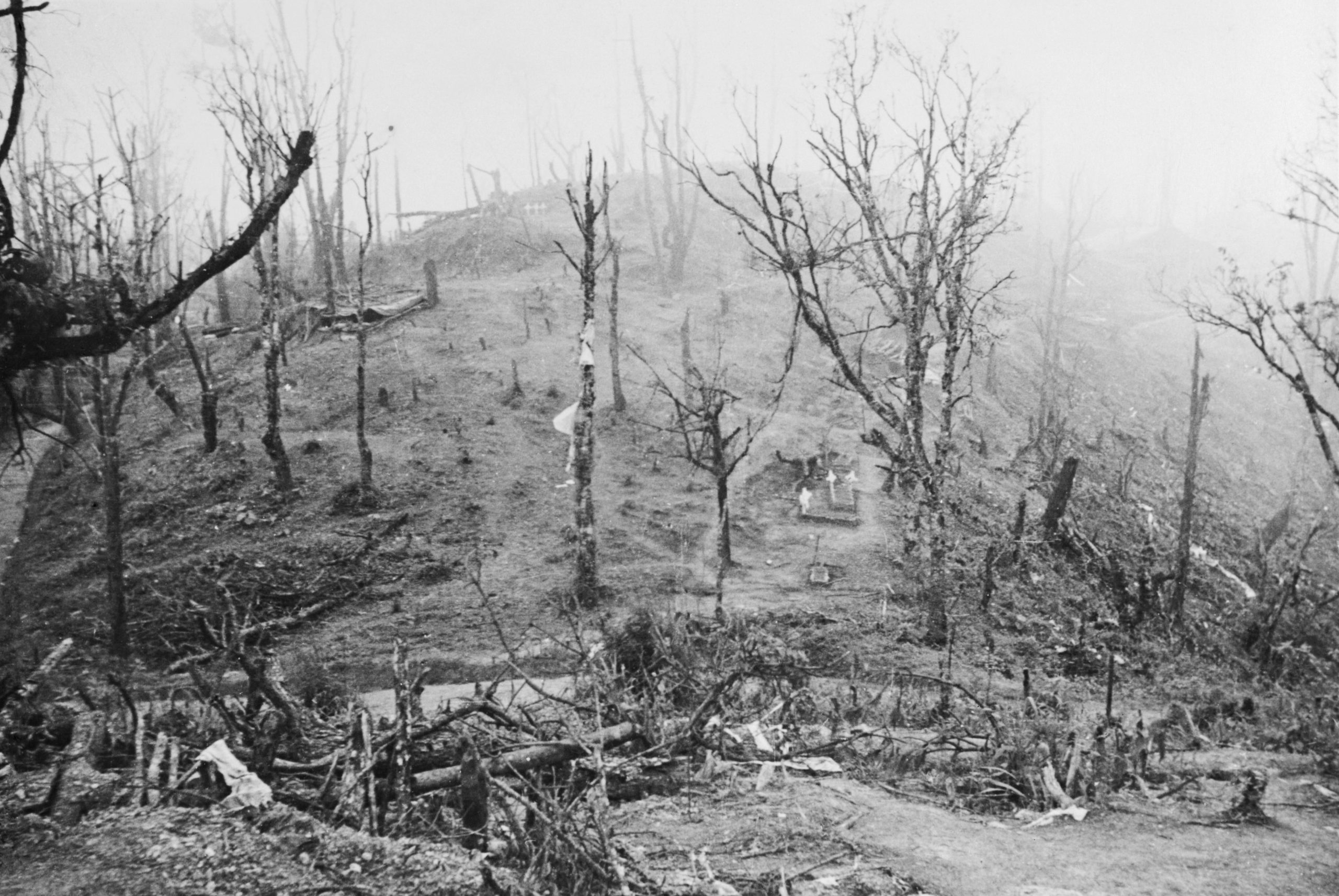
The hills also belonged to communities whose experience is easily lost beneath descriptions of military terrain. Visiting Kohima in August 1947, Mildred Archer recorded bullet-scarred buildings, damaged trees and the cemetery taking shape on the old battlefield. She also described Naga help for wounded soldiers and the carrying of a memorial stone. Her account preserves a British visitor's perspective, not the full range of Naga memories. It nonetheless reveals a landscape still living with the battle years after the armies had moved on. [13]
Imphal and Kohima helped prepare the Allied return to Burma. Their immediate lesson was that cutting roads no longer necessarily forced an army to abandon its position. The result depended on a defended destination, sufficient aircraft, protection in the air and a functioning organization behind every flight. Those conditions gave the ground troops time. They still had to win the fighting that made the airlift possible.