
WORLD WAR II · PACIFIC THEATER
Midway: How Intelligence Became a Battlefield Advantage
The American victory in June 1942 depended on a chain of decisions between the codebreaking room, the repair dock, and the carrier flight deck. Every link could fail.
On the morning of 4 June 1942, American aircraft flew toward a Japanese fleet whose arrival had been predicted weeks earlier. Some found it. Others searched the wrong stretch of ocean. Torpedo squadrons attacked and suffered devastating losses without scoring a hit. Only later did dive bombers cripple three Japanese carriers in a few minutes. A fourth remained dangerous enough to strike back.
This uneven sequence is the key to understanding Midway. American communications intelligence had created an extraordinary advantage, but it did not supply a live picture of the battlefield. Between identifying an enemy plan and destroying an enemy ship stood repair work, reconnaissance, command judgment, navigation, deck handling, and combat. Midway was won by getting enough of those things right before the opportunities disappeared.
The battle is often compressed into a contest between brilliant codebreakers and an unlucky Japanese admiral. That account leaves out the most revealing question: how did information become usable fighting power? Following that chain explains both the scale of the American victory and how uncertain it remained while people were fighting it.
_on_4_June_1942_(80-G-41686).jpg)
A Japanese plan that needed an American reaction
Admiral Isoroku Yamamoto wanted to bring the surviving American carriers into a battle on favorable terms. Midway, a small American-held atoll northwest of Hawaii, offered a target the United States had reason to defend. Japanese carrier aircraft would suppress its defenses; an invasion force would take the islands; the American fleet would then be defeated as it responded. Different formations had different roles, spread across a wide ocean.
That distribution made sense only if the enemy behaved roughly as expected. Battleships far from the carrier engagement could add impressive weight to an order of battle without adding useful force at the decisive moment. The Naval History and Heritage Command’s assessment emphasizes the forces that could actually influence the carrier fight: four Japanese fleet carriers against three American carriers and aircraft operating from Midway itself.
The Japanese force was also smaller than its planners had originally hoped. At the Battle of the Coral Sea in May, Shōkaku had been damaged and Zuikaku had suffered serious air-group losses. Neither joined the Midway striking force. As Jonathan Parshall explains in the National WWII Museum’s Coral Sea retrospective, the earlier battle shaped the next one. A carrier’s availability depended on its aircraft and trained crews as well as whether its hull remained afloat.
“AF” was the result of accumulated evidence
American analysts were reading portions of Japanese naval communications encoded in the JN-25 system. They combined these fragments with traffic patterns and earlier identifications to reconstruct the target, forces, and approximate timing of the coming operation. Work in Hawaii, Australia, and Washington contributed to the picture. It was a distributed intelligence effort, not one complete message suddenly translated by one gifted individual.
The famous water-shortage story belongs within that longer process. Midway transmitted an uncoded report that its water supply was in trouble; a Japanese message referring to a water problem at “AF” helped confirm the target’s identity. The National Security Agency’s account preserves the episode. Frederick Parker’s more detailed history of naval communications intelligence also shows that analysts in the Pacific had associated AF with Midway before the water message. The trick reinforced a developing conclusion and helped settle disagreement.
This distinction matters. If the story begins with a clever ruse, intelligence looks like inspiration. If it begins with the evidence already assembled, it looks like an organization learning to test a hypothesis and persuade commanders to act. Admiral Chester Nimitz still had to decide that the evidence justified concentrating scarce carriers in one place. Information acquired its strategic value when he committed ships to it.
The repair dock was part of the battlefield
Yorktown had been damaged at Coral Sea. Her return to Pearl Harbor created a practical question: could she be made useful quickly enough to fight again? Emergency repairs brought her back to sea in about three days. That achievement did not mean every defect had been eliminated or that normal refitting standards had been met. It meant that workers restored enough capability for the carrier to join Enterprise and Hornet in the coming operation.
The National WWII Museum’s Midway exhibition account rightly includes the shipyard workers alongside codebreakers and aircrews. Their work changed the force Nimitz could put to sea. An accurate forecast would have been less useful if the ships required to exploit it were still under repair.
The Americans organized their carriers into two task forces. Rear Admiral Frank Jack Fletcher, aboard Yorktown, was the senior officer at sea; Rear Admiral Raymond Spruance commanded Enterprise and Hornet. Their position northeast of Midway allowed them to threaten the Japanese approach. The operational advantage was already real before the first bombs fell: the supposed responder was waiting for the attacker.
Scouting had to turn a forecast into a location
Knowing that carriers were coming was different from knowing their position, course, and speed on a particular morning. Patrol aircraft from Midway supplied the sightings that translated strategic warning into targets. The National Park Service’s study of the atoll explains its role as a base for search aircraft and as an airfield that remained operational after the Japanese attack on 4 June.
Midway’s defenders absorbed that attack while land-based bombers and torpedo aircraft struck at the Japanese ships. Their attacks achieved little direct damage and suffered heavy losses. Yet the atoll could not simply be treated as neutralized. Vice Admiral Chūichi Nagumo faced competing requirements: another attack on the island, protection of his carriers, recovery of returning aircraft, and preparation for a newly reported American naval threat.
Those requirements shared the same physical machinery. A flight deck used for landing aircraft could not simultaneously be treated as an unlimited parking area for a fully assembled strike. Aircraft needed fuel and suitable weapons, and fighters had to keep cycling through the air. The speed of a command decision was therefore only one part of the problem. A decision also had to fit what the carrier force could physically do next.
The American attack was not a seamless plan
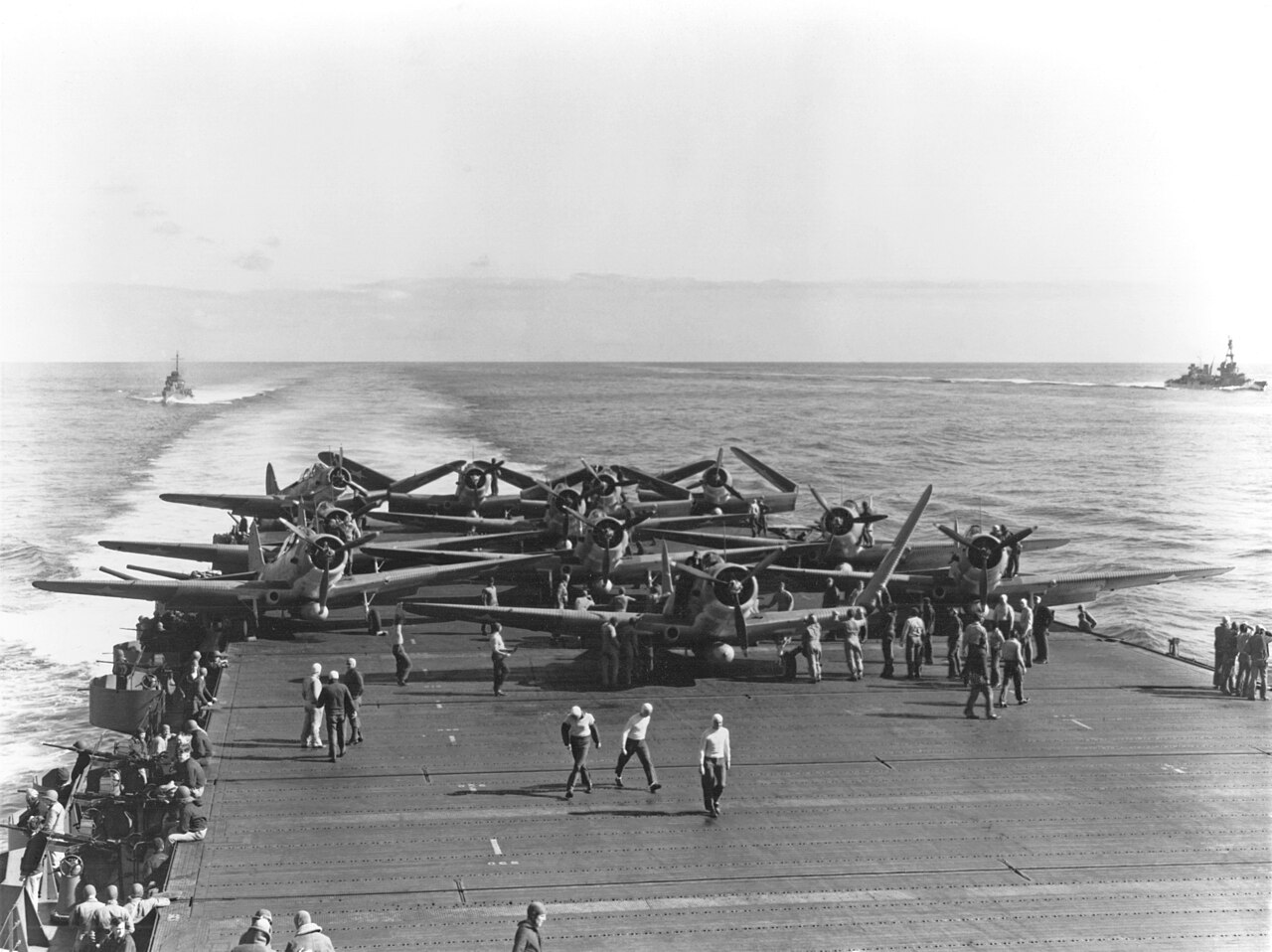
The carrier air groups did not arrive as a single coordinated blow. Hornet’s torpedo squadron found the Japanese carriers, but its dive bombers missed them. All fifteen of the squadron’s carrier-launched Devastators were lost; Ensign George Gay was the only survivor of their crews. Other torpedo attacks also failed to score hits. Such losses should not be turned into the impression that these men had been deliberately sent on a planned sacrifice.
Historian Craig Symonds’s examination of Hornet’s air group exposes the difficulty of reconstructing the flight. The carrier’s official report and later recollections disagree about its outbound course. Symonds also notes that American officers expected the Japanese carriers might be operating in separate groups. Their understanding contained important errors even after the intelligence success.
Meanwhile, Enterprise’s dive bombers had trouble finding their targets. The National WWII Museum’s account of the attack on Kaga describes air-group commander Wade McClusky continuing the search as fuel diminished and using the course of a Japanese destroyer as a clue. That was a decision made in flight, with incomplete information and consequences for every crew behind him.
Dive bombers from Enterprise and Yorktown reached the Japanese carriers at a devastating moment. Around 10:20–10:30, attacks left Akagi, Kaga, and Sōryū burning and unable to conduct useful flight operations. The timing was extraordinary. It emerged from imperfect, partly independent attacks rather than a precisely choreographed arrival.
Why the famous “five minutes” needs care
Mitsuo Fuchida’s influential postwar narrative depicted Japanese flight decks crowded with strike aircraft, almost ready to launch when the dive bombers arrived. That image has been challenged by later analysis of Japanese carrier operations. The Naval Institute’s discussion of Fuchida’s accounts identifies the claim as a major problem in the battle’s popular memory.
The distinction does not make the American attack less decisive. It changes the explanation. A near-miraculous interruption five minutes before a Japanese victory is a different argument from a carrier force caught struggling with reconnaissance, deck cycles, and competing missions. A vivid participant account can preserve the terror of a moment while providing an unreliable reconstruction of the machinery around it. It must be checked against other evidence.
_burning_and_listing_on_4_June_1942.jpg)
A turning point with fighting still ahead
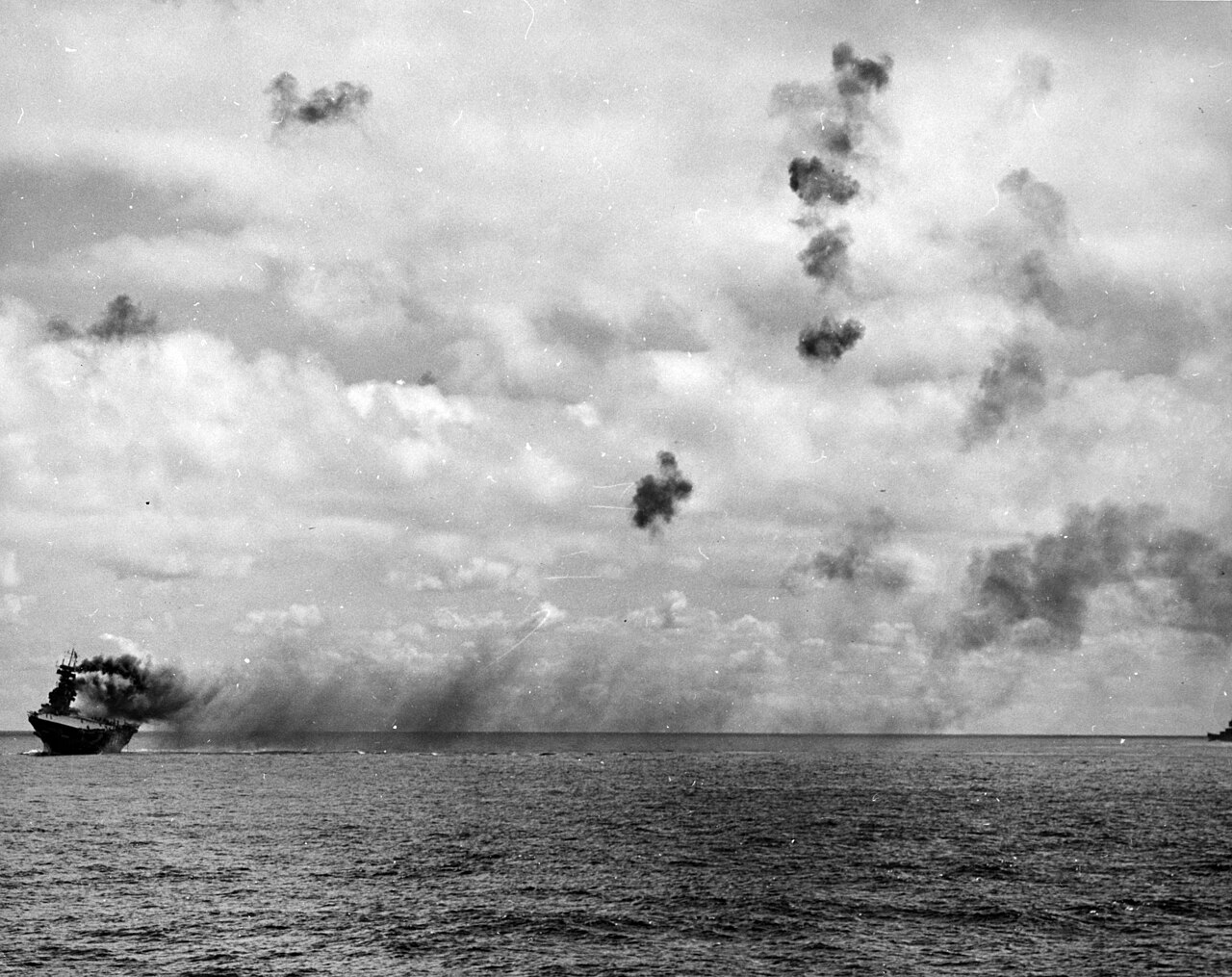
Hiryū survived the morning attack and launched strikes that badly damaged Yorktown. American aircraft then located and crippled Hiryū later on 4 June. Attempts to save Yorktown continued, but the submarine I-168 torpedoed her and the assisting destroyer Hammann on 6 June. Yorktown sank on 7 June. The Navy’s photographic record documents that final stage.
Japan lost four fleet carriers and abandoned the Midway invasion. The loss broke up the concentrated striking force that had driven so much of its early naval success. It did not destroy every experienced Japanese aviator or end Japan’s ability to fight major naval battles. Guadalcanal and the carrier engagements later in 1942 would make that painfully clear.
The United States preserved Midway and retained two of the three carriers committed to the battle. American forces landed on Guadalcanal in August, beginning a prolonged contest in the South Pacific in which Japan continued to mount major counterattacks.
Sources and further reading
- Frederick D. Parker, A Priceless Advantage, NSA Center for Cryptologic History, reissued 2017. Especially the Midway intelligence discussion, pages 35–60.
- NSA: “Water Shortage”, 2021.
- Naval History and Heritage Command: H-Gram 006, Battle of Midway, 2017.
- National Park Service: The Battle of Midway, Teaching with Historic Places. Useful for the atoll’s facilities and defense; its older account of Japanese flight-deck readiness needs to be read alongside later scholarship.
- Jonathan Parshall, National WWII Museum: The Battle of Coral Sea, A Retrospective, 2022.
- Craig L. Symonds: Mitscher and the Mystery of Midway, Naval History, 2012.
- Seth Paridon, National WWII Museum: First Strike at Midway, 2019.
- Alan D. Zimm: Commander Fuchida’s Decision, Naval History, 2016, including its discussion of contested accounts.
- National Museum of the U.S. Navy: 7 June 1942 photographic record.
Source note: this article distinguishes operational warning from tactical knowledge. It does not treat disputed outbound courses, the “five minutes” story, or incompatible aircraft-loss totals as settled measurements. Contemporary reports and later memories answer different questions.
Continue the intelligence theme: Histovia’s ebook D-Day’s Invisible Front explores deception surrounding a different campaign in Europe. It extends the comparison introduced in our Operation Fortitude article.