
Salamis, 480 BCE: The Coalition That Held Together in the Straits
The ships at Salamis belonged to an uneasy alliance. To defeat Xerxes, their crews first had to stay together, choose where to fight and make the most of a narrow stretch of water.
Before the ships collided at Salamis, the Greek commanders had a more immediate problem: they could not agree on staying there. Some wanted to withdraw towards the Isthmus of Corinth, where their land forces were building a defensive position. The Athenians wanted a battle beside an island sheltering many of their evacuated families. Each group had something different to lose, and somewhere different to go if the battle went badly.
Start with that disagreement, and the famous battle of 480 BCE looks a little different. Salamis was fought against the invasion led by Xerxes, ruler of the Achaemenid Persian Empire, but there was no single Greek state meeting him. Communities with different governments, rivalries and immediate dangers had to keep their ships together. Others had submitted to Persia or were serving in its forces. Keeping the alliance together was the first part of winning the battle.
A fleet with more than one homeland
In Book VIII of his Histories, Herodotus gives the largest contingent at Salamis to Athens: 180 ships. Corinth, Aegina, Megara and numerous smaller communities supplied others. He assigns overall command to the Spartan Eurybiades. Athens brought the most ships, but that did not give it the top job. Earlier in his account, Herodotus explains that allies resisted Athenian leadership, and Athens yielded rather than break the coalition.
Herodotus gives us a useful picture of the fleet, though the numbers deserve some care. He reports a total of 378 triremes at Salamis, while other ancient accounts give different figures. The larger picture is clear enough: the allies needed Athens, and Athens still had to work with the allies. The alliance had to accommodate cities whose interests extended well beyond the Athenian coast.
Alliances often run into this problem. The armies at Waterloo faced a very different military world, but coordination likewise depended on forces remaining within effective reach of one another. At Salamis, an argument over where to fight could easily have ended with the ships sailing in different directions.
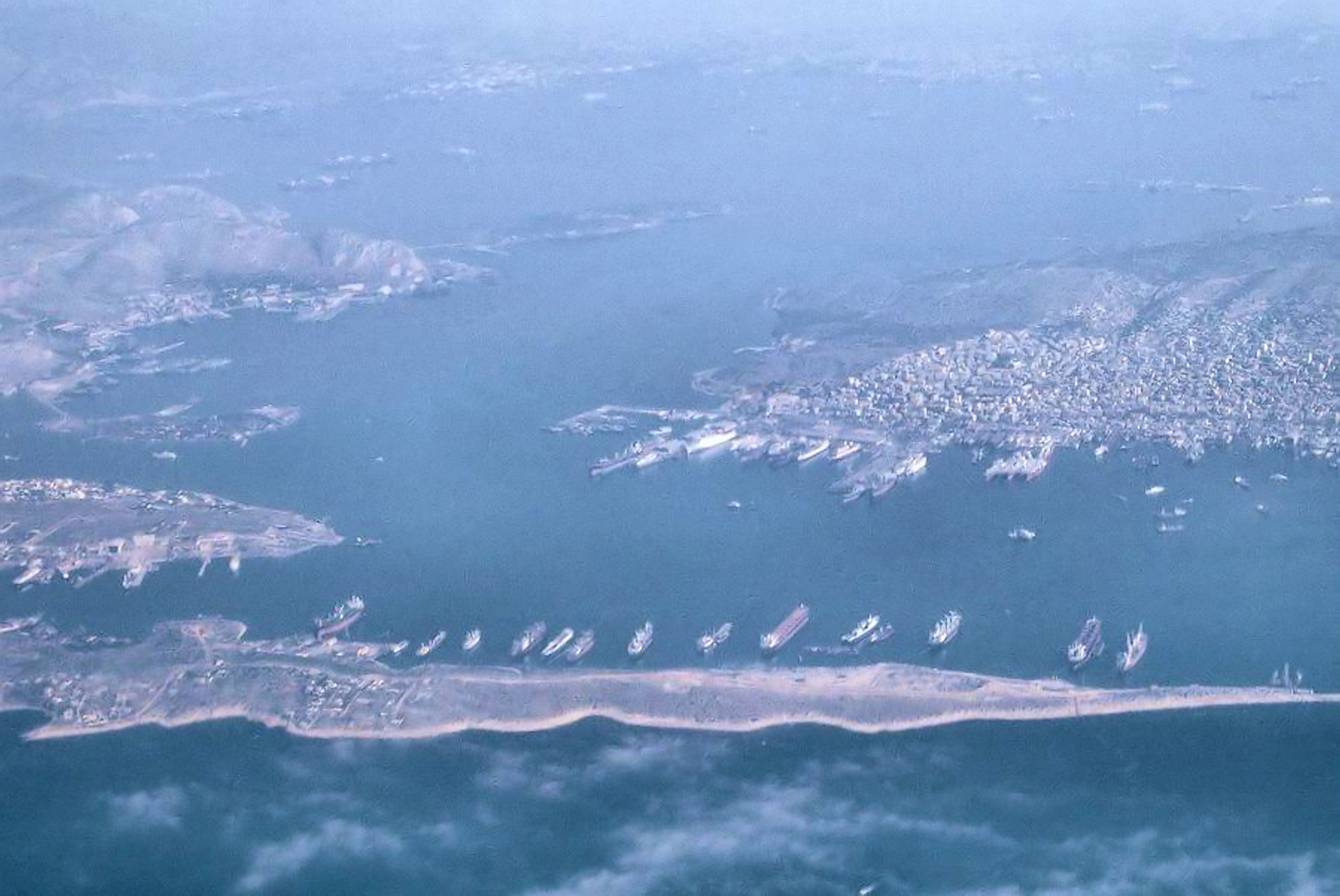
Ships survived after the city fell
The fleet had arrived at Salamis after a difficult retreat from the north. The defence of the pass at Thermopylae had failed, and the fleet withdrew from Artemisium after fighting off the coast of Euboea. Xerxes could advance into central Greece and Attica. His army occupied Athens and overcame the remaining defenders on the Acropolis.
Herodotus describes a city largely abandoned, but not completely empty. Some people remained because they lacked the means to leave; some understood an oracle about a protective wooden wall as referring to the barricade they could build around the sanctuary. Elsewhere in the account, naval resistance offers another interpretation of that promise. Leaving Athens was not simple. Some people could not afford to go, while others believed that staying offered their best hope.
For Athenians who had left their houses, the ships kept their community in the fight even after its territory was lost. For allies from the Peloponnese, the question could look different. A battle nearer the Isthmus would keep their navy alongside the land defence and nearer their homes. At Salamis, defeat might trap them on an island. Seen from their position, moving closer to home made sense. The victorious Athenian tradition had good reasons to favour the argument for staying.
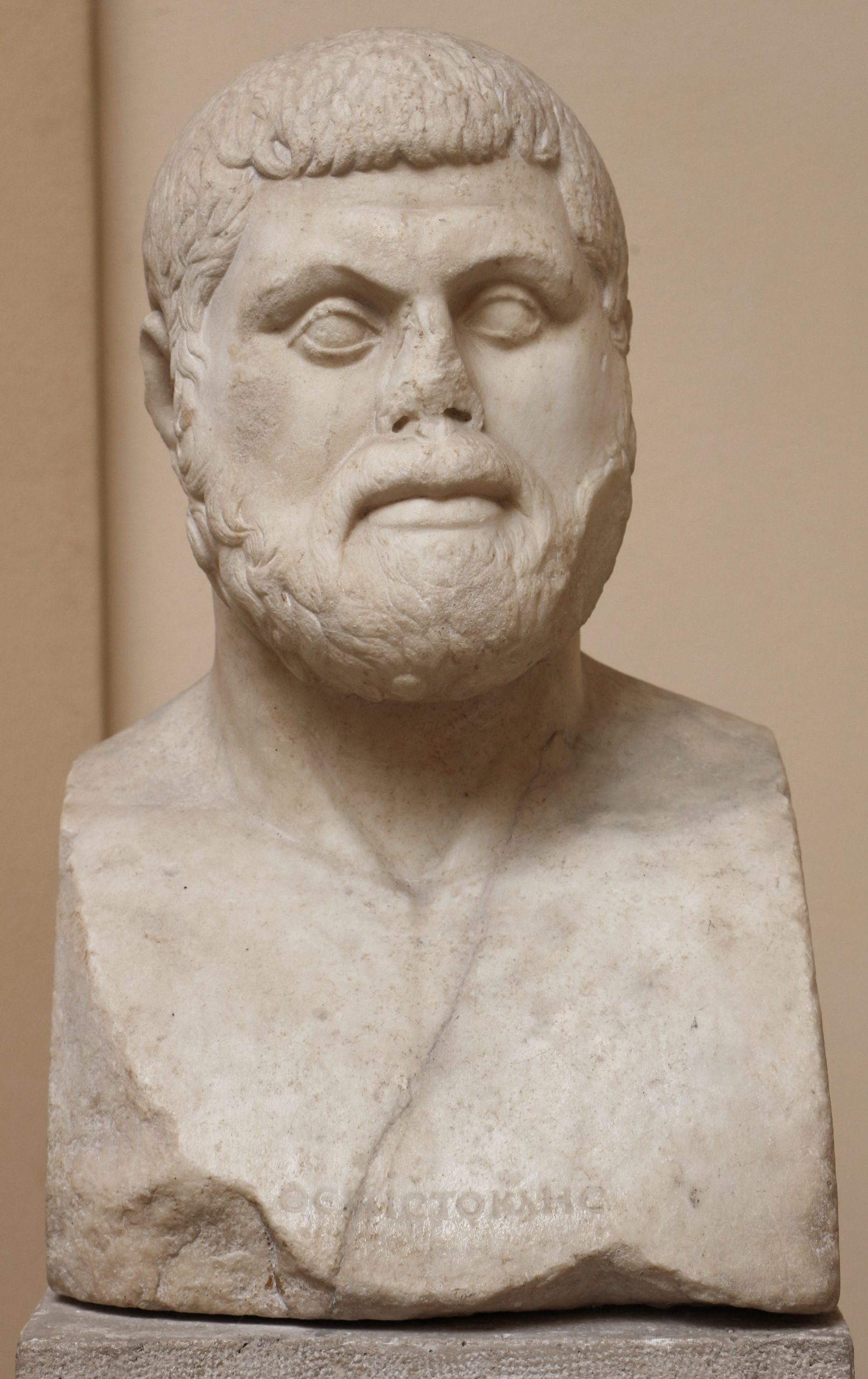
Herodotus makes Themistocles the forceful advocate for staying. His account combines a military argument about confined water with political pressure: the Athenians could take their ships and people elsewhere. The threat mattered because the alliance’s naval strength would shrink drastically without them. Themistocles could make that threat count because Athens had the ships and the crews. His position at the council table rested on all those people out on the water.
On the opposite side, the imperial navy also brought together different peoples. Phoenicians, Egyptians, Cypriots and Greeks from the eastern Aegean belonged to Xerxes’ forces. “Persian fleet” is a convenient name for this force, but its crews came from many different places. Histovia’s account of the workers and ration records at Persepolis offers a useful companion to this military history: the empire behind the invasion was a varied administrative world, not just the king and the army described by his opponents.
The people inside the warship
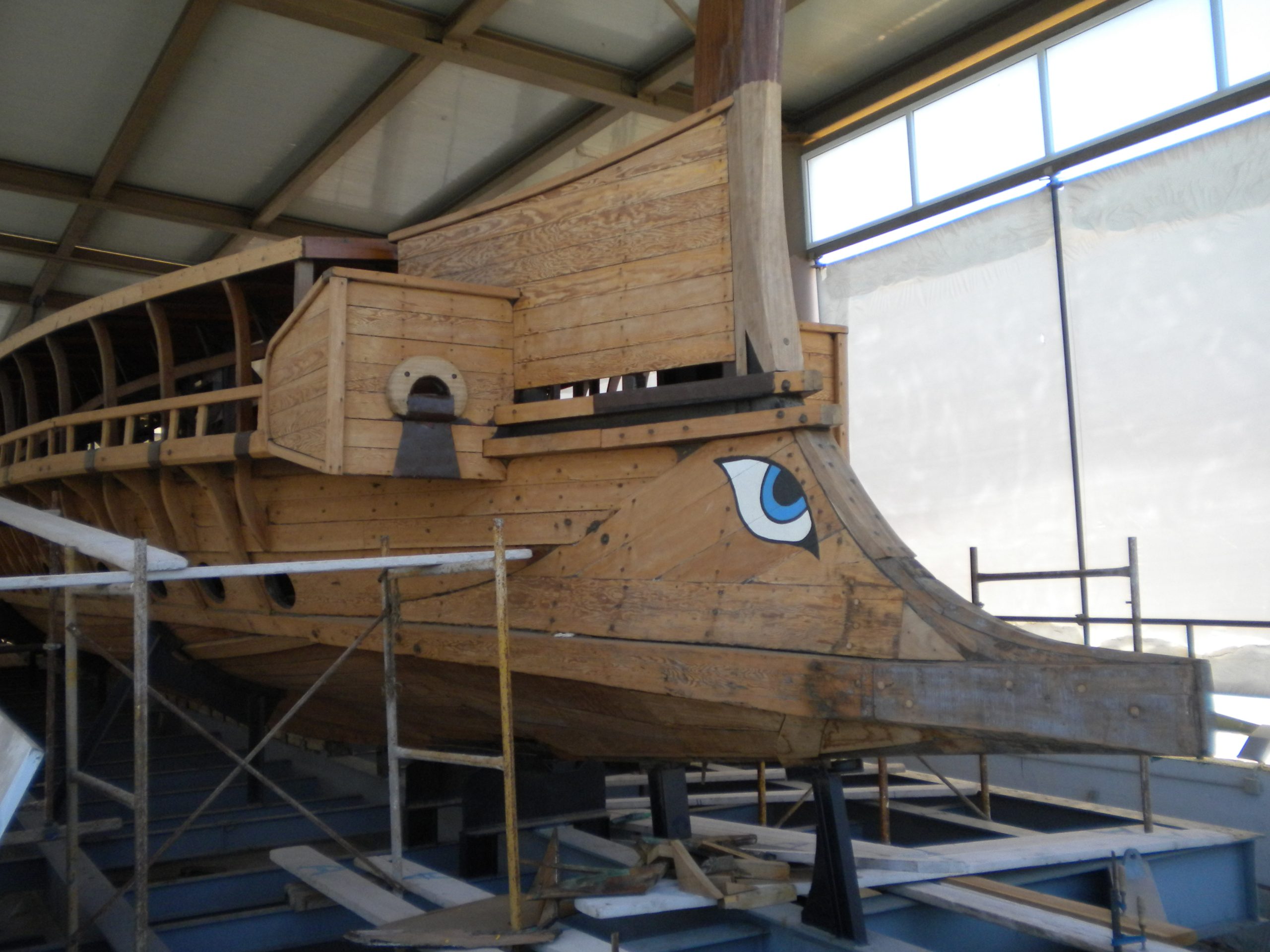
The principal fighting vessel was the trireme, propelled in battle by rowers arranged at three levels. A familiar reconstruction gives an Athenian trireme about 170 oarsmen, with sailors, officers and armed men bringing the complement towards 200. The Hellenic Navy’s description of the type sets out this arrangement. That gives a useful sense of the space and manpower involved, even though we do not have crew lists for each ship at Salamis.
Count the ships, and it is easy to forget the people inside them. A fleet of several hundred ships required tens of thousands of people to propel, steer, maintain and fight them. Turning a ship meant getting a large group of people to work together at just the right moment. Oars needed room to move, adjacent ships needed clearance, and a crew had to preserve useful motion while other vessels approached. A ship whose rowers lost their rhythm or whose oars were damaged could become vulnerable before its hull was destroyed.
The bronze-sheathed ram at the bow made the vessel itself a weapon. Hitting another hull was only part of the job. A crew also had to avoid being hit in return and pull its own ship clear. Armed men could fight across decks, but a naval battle was not simply a land engagement placed on floating platforms. The familiar picture of chained convicts at the oars is a poor guide here. Ancient crews had varied social backgrounds, and the people rowing for this coalition deserve more than a borrowed galley stereotype.
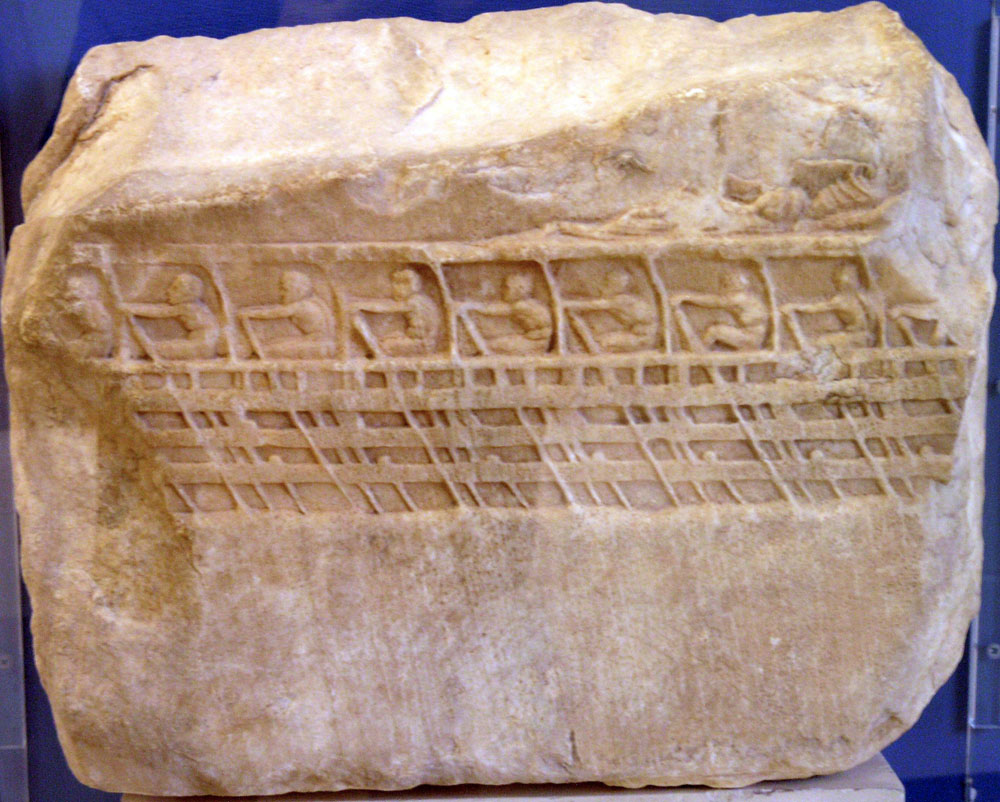
The surviving Lenormant relief in the Acropolis Museum shows rowers and a vessel’s overlapping oars. It dates to the end of the fifth century BCE, decades after Salamis. It helps scholars reconstruct trireme organisation but does not portray this particular battle. The modern Olympias similarly allows historians and rowers to investigate the practical problems of operating a reconstructed ship. It is an experiment informed by evidence, not an ancient survivor.
Look at these objects together and they begin to fill out the picture: the relief shows how a ship was represented, the reconstruction tests how it might work, and the strait explains the setting. The exact course of the battle is a separate question.
A message, a blockade and a difficult map
In Herodotus’ account, Themistocles attempted to settle the argument through the enemy. He sent Sicinnus, a member of his household whom the historian describes as an enslaved tutor, to tell the Persian commanders that the Greeks intended to escape. The message presented Themistocles as friendly to the king’s cause. Its practical invitation was to close the exits before the allied fleet could disperse.
It is a neat story, and there is a good reason to take it seriously. A version of a deceptive Greek message already appears in Aeschylus’ Persians, performed in 472 BCE, only eight years after the battle. Herodotus, writing several decades later, supplies the fuller version, including the messenger’s instructions and later rewards. Those extra details are harder to check.
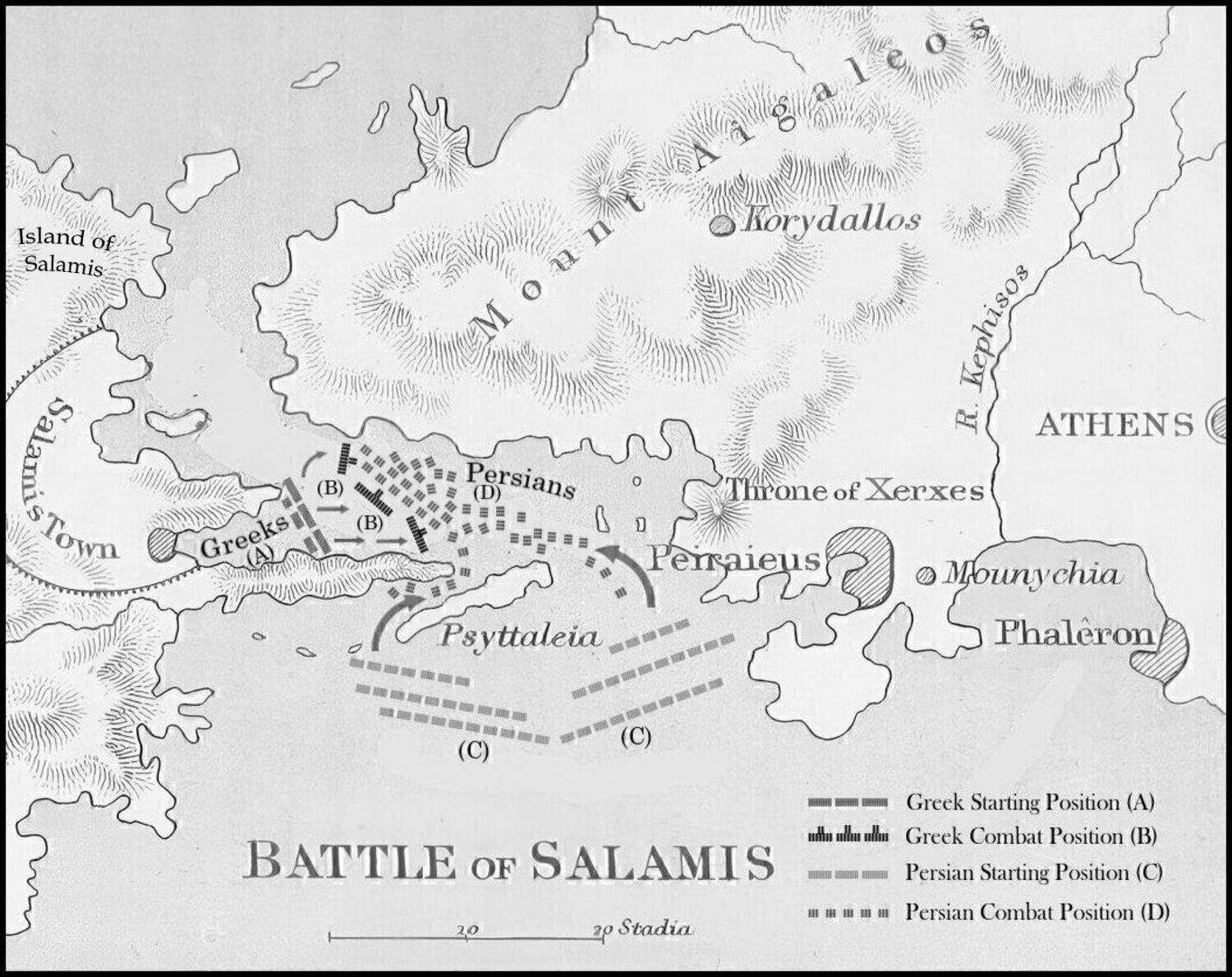
Herodotus reports movements during the night, a Persian detachment placed on the small island of Psyttaleia, and confirmation reaching the Greek commanders that their routes were blocked. In his telling, Aristides, an Athenian political rival of Themistocles, brings the news across the water. Whatever their domestic quarrels, the immediate situation now demanded cooperation. The choice to withdraw had become harder to exercise.
Try drawing those movements on a map, though, and things become less tidy. Ancient writers name shores and headlands without giving the continuous sequence a modern staff officer would require. Christopher Tuplin’s survey in Encyclopaedia Iranica explains competing reconstructions: they differ over whether the Persian fleet had already deployed inside the channel or initially blocked its approaches, and over where the principal engagement began.
The familiar arrows therefore represent an interpretation. The broad setting is firm: restricted waters between Salamis and the Attic mainland. Exact formations, distances and the progress of individual squadrons are much less secure. Even the conventional placement of the battle in September does not justify treating one proposed modern calendar date as beyond dispute.
We can still see the strategic advantage, even if we cannot follow every ship. Fighting in constricted water reduced the value of bringing additional ships into a space where they could not all manoeuvre effectively.
What the battle accounts actually show
Aeschylus presents the disaster through a messenger reporting to the Persian royal court. His narrative moves from an expected Greek flight to the sound and sight of an organised attack. Ships ram one another; oars break; the crowded imperial force loses freedom of movement. Wreckage and bodies fill the water. It is a powerful description written for a theatrical audience, not an official Persian dispatch.
Aeschylus gives the defeated side room to grieve. He also builds the drama around the gulf between the victory Xerxes expects and the disaster that follows. Its Persian speakers are characters created by a Greek poet. At the same time, we are close to the event: the play was performed for an audience that had lived through the invasion.
Herodotus offers a more fragmented series of episodes. He describes different claims about the ship that began the attack and admits that he cannot state with certainty what every contingent did. One celebrated story concerns Artemisia, ruler of Halicarnassus and an ally of Xerxes. Pursued by an Athenian vessel, she rammed and sank a ship on her own side. The pursuer, thinking her friendly or a deserter from the imperial fleet, broke off.
The historian himself leaves part of that story unresolved. He does not know whether Artemisia deliberately selected the particular allied vessel because of a quarrel or struck it because it obstructed her escape. Herodotus’ additional account of Xerxes misreading the action from shore makes a broader point about the difficulty of seeing who was fighting whom.
The Persian fleet suffered a major defeat. Men also died away from the principal ship-to-ship fighting: the force isolated on Psyttaleia was killed by Greek attackers. A wreck did not end the danger for the people aboard. Ancient accounts describe men struggling in the water and dying on shore, a grim counterpart to the familiar stories of commanders and clever decisions.
Reliable totals for ships lost and people killed are not available. Inflated enemy numbers make victory appear more extraordinary; modern estimates cannot turn literary figures into a census. We can be confident that the defeat was severe without pretending to have an exact tally.
The victory left another year of war
Salamis preserved the allied fleet and disrupted Xerxes’ campaign. The king withdrew from Greece with part of his forces, while Mardonius remained to continue the war. Persian power had suffered an important reverse, but it had not vanished from the mainland. The next year’s campaign, including the allied victory at Plataea and the fighting at Mycale, was necessary to secure the outcome of the invasion.
This makes Salamis comparable in one limited respect with Trafalgar: a naval victory could transform the possibilities of a wider war without deciding everything that followed. The two battles belong to very different worlds, but both reward a closer look at what happened next. What could the beaten side no longer do, and what work still fell to armies on land?
Later celebration often compresses Salamis into a contest between freedom and despotism. Freedom from Persian rule was a real stake for the resisting cities. But Greek identity did not place everyone on one side, and the victorious coalition was not a federation of identical democracies. Its members included different political systems; their societies also excluded and enslaved people. Those differences are part of the history too. A simple division into two opposing civilisations leaves too many of the people involved out of view.
The achievement at Salamis was striking enough on its own terms. Communities that distrusted one another kept enough of their naval power together to fight effectively after Athens had fallen. Themistocles’ advocacy mattered, but so did Eurybiades’ command, allied contributions, local knowledge and the collective labour that moved each ship. The strait offered an opportunity. A coalition had to remain intact long enough to use it.