
Reading Sanchi: The Stupas, Gateways and Donors on a Buddhist Hill
The Great Stupa catches the eye first. Stay with its paths, carved stories and small inscriptions, and a much larger community comes into view.
At Sanchi, the big shape is easy to remember: a rounded stone mound, an enclosure, and gateways crowded with carving. The smaller things take longer. A horse appears repeatedly along a stone beam. A short inscription names people who worked in ivory. A nearby shrine changes the architectural scale altogether. Those details make the hill much more rewarding than a photograph of a famous monument.
Sanchi lies in Madhya Pradesh, near Vidisha and northeast of Bhopal. Its buildings belong to many periods. The Buddhist centre began in the age of the Mauryan emperor Ashoka in the third century BCE and continued to develop well into the medieval centuries. UNESCO inscribed the Buddhist Monuments at Sanchi on the World Heritage List in 1989. The grand stupa is the best-known part of a landscape containing smaller stupas, pillars, temples and monasteries.
A useful visit starts by letting those dates come apart. Ashoka did not commission everything you can now see, and a monument’s dedication does not date every later addition. The site rewards the same patient attention to successive building campaigns that helps when reading the temples of Angkor.
Begin with the mound, then find its layers
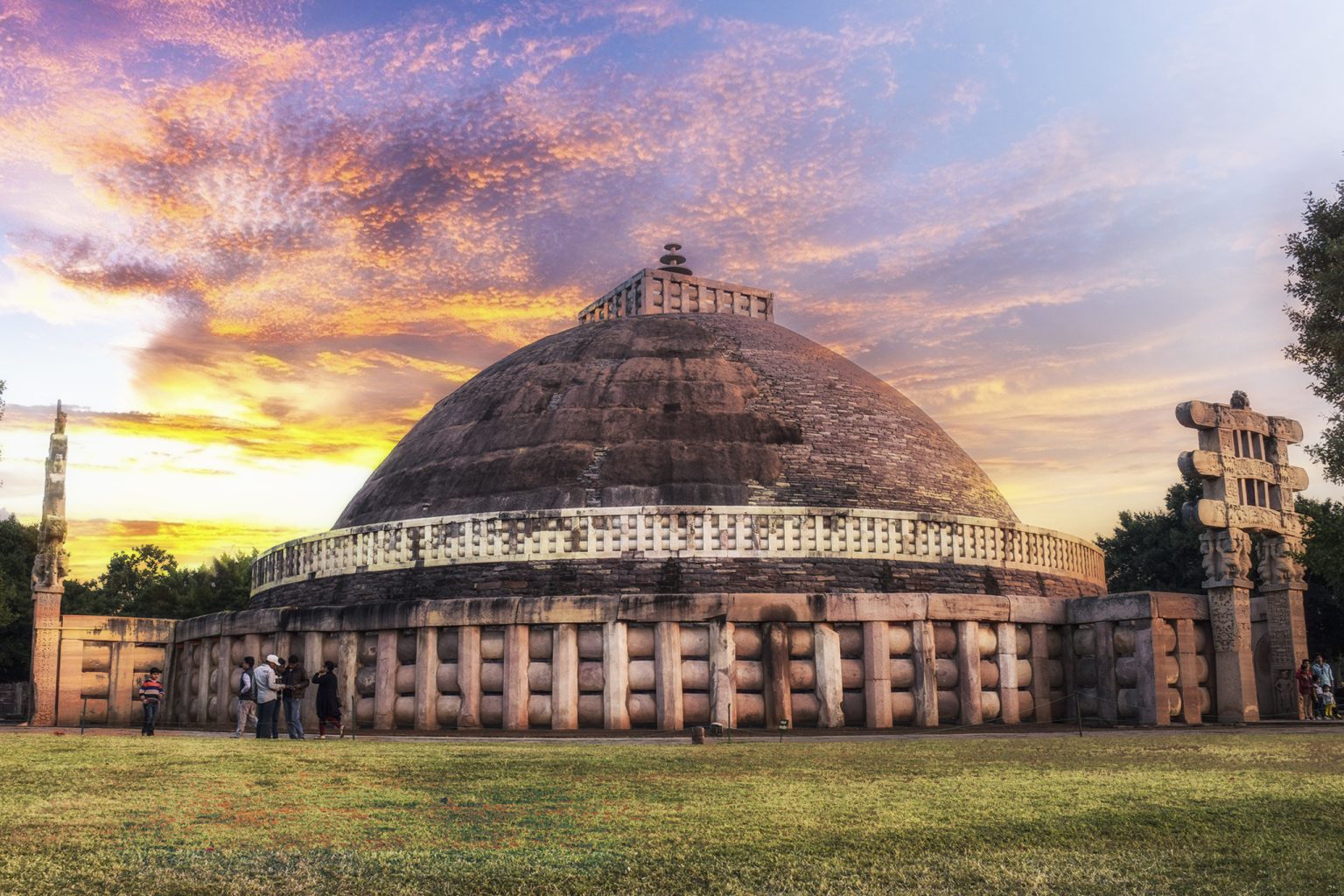
The Great Stupa, conventionally numbered Stupa 1, grew around an earlier brick structure. Later builders enlarged it and gave it its stone facing, surrounding railings and paths. The elaborately carved gateways belong to subsequent work around the first century BCE and first century CE. Different summaries date those additions somewhat differently, so a broad sequence is more reliable than assigning the whole complex to a single year.
The Archaeological Survey of India’s account identifies the enlargement with the Shunga period and the gateways with Satavahana patronage. Much later, Buddha images were added facing the four entrances. That sequence matters when you look at the sculpture: a seated Buddha beside the mound and an early gateway relief may stand close together while belonging to very different moments.
The stupa’s bulk is also a useful correction to modern expectations about sacred buildings. Its principal religious space is approached and circled. You do not understand it by looking for a large congregation hall inside the dome.
Follow the path before reading the pictures
Walkways run around the Great Stupa at ground level and on a raised terrace reached by stairs. In Buddhist circumambulation, or pradakshina, the devotee moves with the sacred object on the right. The architecture gives that practice a physical form. A railing defines the route; a gateway marks a passage; the curve brings the worshipper back around the mound.
John Marshall’s 1918 guide, especially pages 31–36, describes these paths, their stone paving and the relation between the earlier core and later additions. His book remains valuable for recorded observations, although its cultural hierarchies and some interpretations belong to colonial-era scholarship. It should be read alongside modern archaeology.
Look next at the railings. Posts, crossbars and coping stones preserve forms associated with timber construction even though they are made of stone. The curved mound and its carefully joined enclosure belong to different kinds of craft. Looking at the joints gives you a second way to see the building, beyond its overall silhouette.
A horse can move through a story without changing panels
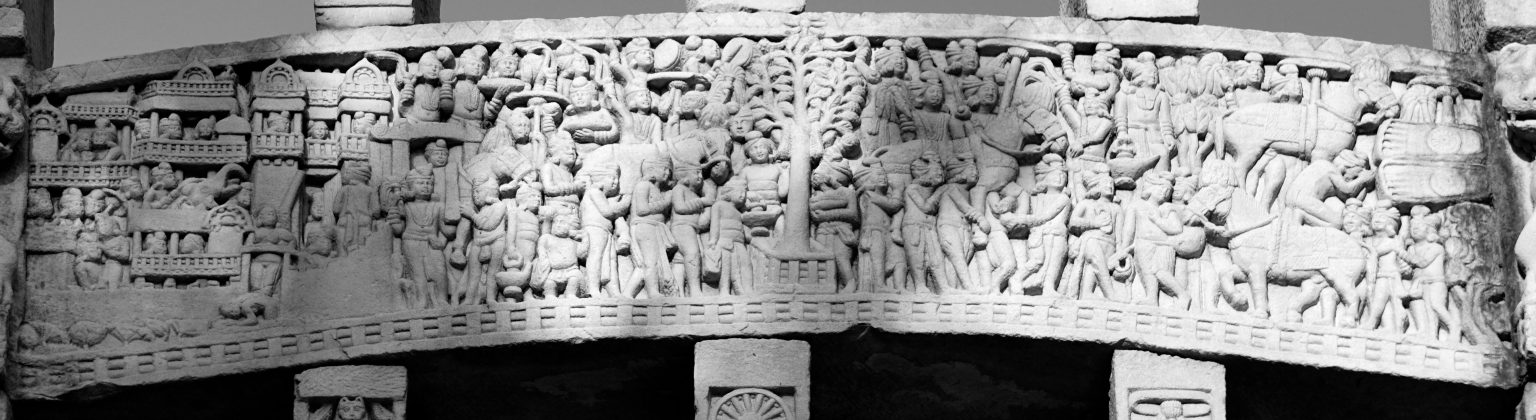
Each of the four gateways, or toranas, has uprights supporting horizontal beams covered with reliefs. They carry stories about the Buddha’s life, earlier births known as Jatakas, acts of worship, processions, animals and sacred places. Reading every scene on a first visit would be a sizeable undertaking. Choosing one and following it carefully is a better start.
On the east gateway, the Great Departure shows Siddhartha leaving Kapilavastu. The horse Kanthaka recurs along the composition. Attendants, an umbrella and the horse’s movement carry the story, while the future Buddha is not presented as an ordinary mounted human figure. Marshall describes the scene on pages 60–62 of his guide. The repeated horse indicates movement through time, rather than a stable full of identical animals.
This visual convention asks the viewer to participate. You follow the recurring forms and recognise what the honoured but unoccupied place signifies. Trees, thrones, footprints and stupas can similarly direct attention towards the Buddha or events associated with him. It is common to call this art “aniconic,” but the label is less helpful if it makes the pictures seem empty or incomplete.
They are full of people, actions and carefully organised attention. Nor does the absence of a human Buddha in a particular relief establish a universal prohibition covering all early Buddhist communities. Start with what this carving does. Then compare it with the much later Buddha images nearby. The hill preserves changing ways of making a sacred presence visible.
The small inscriptions bring other people into view
A monument associated with an emperor can easily become a story about an emperor alone. Sanchi’s inscriptions make that difficult. Short records appear on structural members, naming gifts and donors. A piece of railing can therefore be both a practical part of the enclosure and a surviving record of someone’s religious contribution.
These records generally use Prakrit language in Brahmi script. Their brevity is part of their value: a name, a place, a family relationship or a religious identity can survive where a full biography does not. Donors included laypeople as well as monks and nuns. Matthew D. Milligan’s account of donative epigraphy explains the relationship between material giving, religious merit and the maintenance of Buddhist institutions.
Women deserve particular attention. Their presence in the records shows participation in funding the religious landscape, rather than simply appearing as figures in someone else’s narrative. Milligan’s research on women’s economic power at Sanchi follows changes in female patronage across successive phases of construction. An inscription can register a woman’s own act of giving even when it identifies her through family or monastic relationships.
That evidence does not provide a complete social census. People who could sponsor durable stonework had a greater chance of leaving a legible trace than many others. Surviving donor names cannot tell us the experience of every labourer who quarried, carried or fitted the stones. They do, however, prevent a royal label from swallowing the entire community.
One especially revealing record on the south gateway associates carving with ivory workers from Vidisha. It identifies skilled makers and connects the hill to the nearby city. The work before you is stone, but the craftspeople’s recorded identity belongs to another material. That is a useful glimpse of skills and professional networks crossing the boundaries modern visitors might expect.
Keep the claim at its actual scale. The inscription does not sign every gateway, identify every mason or prove that every Sanchi relief came from the same workshop. It provides something more specific and valuable: an explicit connection between this work and a named group of craftspeople. For another way religious giving left a permanent record, compare the dedication of the Diamond Sutra of 868.

Stupa 3 changes the question from scale to memory
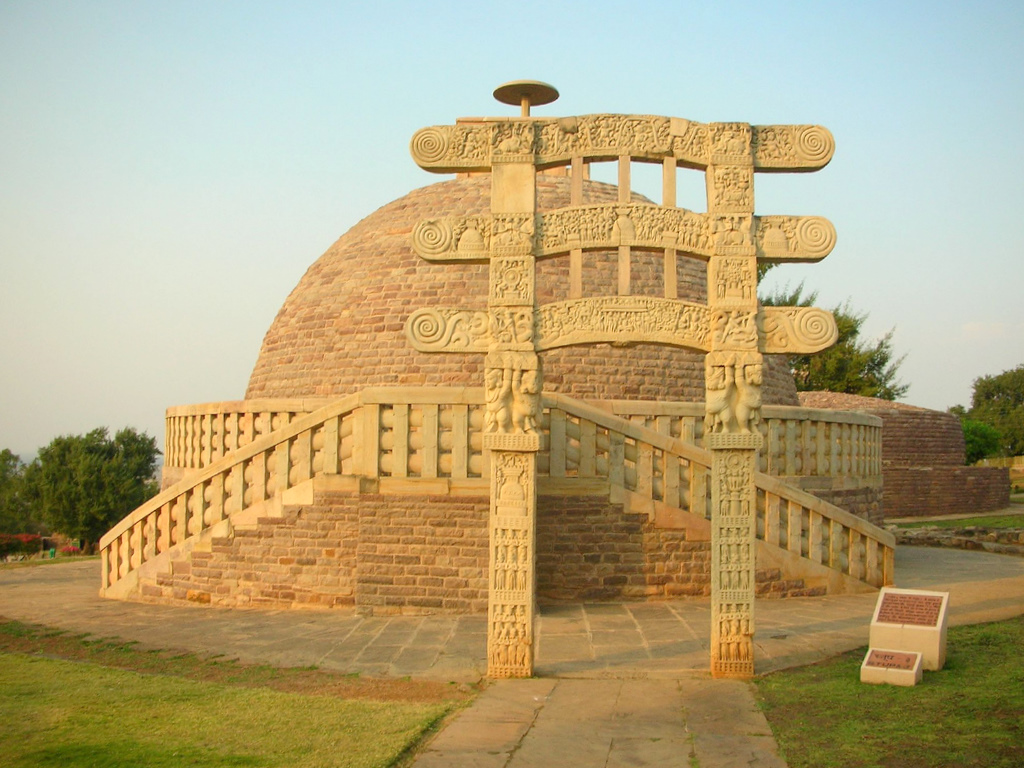
The Great Stupa can dominate a visit so completely that nearby monuments become background. Stupa 3 deserves a separate pause. Its smaller mound, single gateway and enclosure present a related architectural vocabulary at a different scale. The difference is a reminder that religious importance cannot simply be measured by diameter.
Nineteenth-century excavators reported finding inscribed relic containers associated with Sariputra and Mahamoggallana, two leading disciples of the Buddha, within Stupa 3. The find is described in Marshall’s guide, pages 80–82, and the continuing veneration of these disciples is recognised in UNESCO’s account of the site. The inscriptions supply the ancient attribution. They do not offer the kind of independent biological identification that a modern laboratory might attempt.
For the worshippers who established and maintained the monument, a relic linked a place to a revered person. The building protected that relationship and gave it a public setting. Relics could make an otherwise modest hill important without requiring the Buddha himself to have lived or taught there. Sanchi is not primarily a monument to a documented visit by the historical Buddha.
It also belonged to a wider sacred landscape. Other groups of stupas stood near Vidisha, including Satdhara, Sonari and Andher. Marshall opens his guide by situating Sanchi among those neighbouring sites. A map with only one pin leaves out the regional relationships through which religious communities, patrons and memories circulated.
The excavation history adds another layer. Opening a sealed deposit can produce knowledge while also disturbing an object of devotion. Relics and containers acquired new histories through excavation, collection and later religious claims. A visitor should resist treating the discovery as the moment when an object first became meaningful. It had already been protected, named and honoured for centuries.
That distinction changes how you look at an empty-looking mound. Much of the monument’s purpose concerns what could not ordinarily be seen. The visible architecture organised access to a presence understood to be inside it.
Give the quieter buildings some time
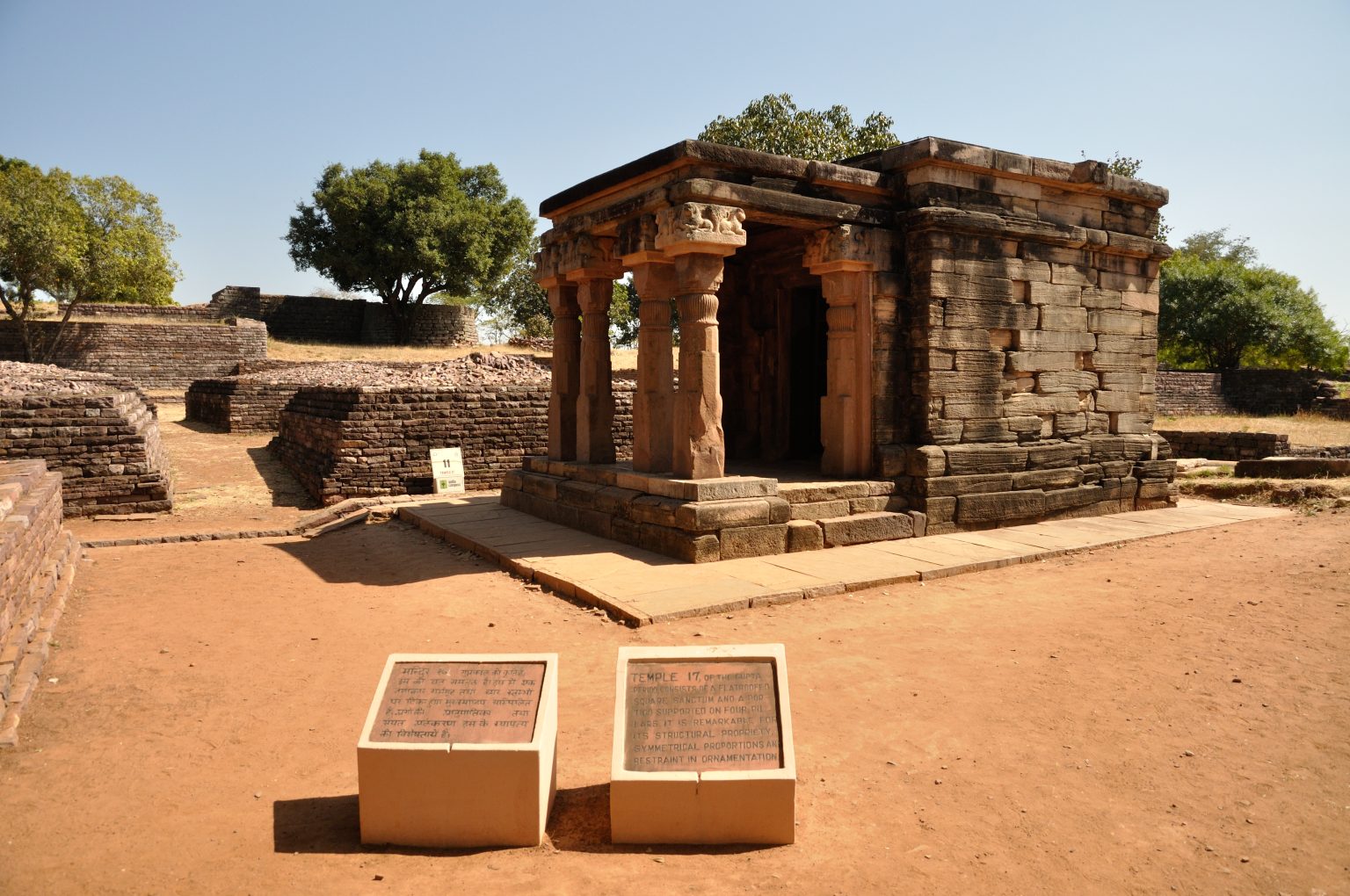
Temple 17 offers a change of pace. Usually dated to the early fifth century CE, it consists of a compact sanctuary with a pillared porch and a flat stone roof. Its relatively restrained surfaces can feel almost quiet after the crowded gateway reliefs. The comparison is useful precisely because both belong to Sanchi.
Notice how the porch frames the entrance and how the columns support the roof. Here the visitor can think about approaching a chamber, rather than moving around a solid mound. The monument belongs to a later architectural setting, centuries after the first stupa. The Australian National University’s visual-arts record identifies it as a surviving freestanding Buddhist building of the Gupta period.
It is tempting to arrange the monuments as a neat progression from simple to elaborate. The actual comparison is more interesting. The richly carved gateways precede this comparatively spare little temple. Changes in form reflect different uses, patrons and building choices; ornament is not a straightforward clock that measures artistic development.
Monastery remains broaden the picture further. Cells, courtyards and connecting spaces point towards communities that occupied and maintained the hill. Religious life required places to stay, routes between buildings and repeated work on the fabric of the site. A panorama centred entirely on the Great Stupa leaves those activities out of the frame.
Some later buildings also incorporated earlier material or stood over earlier foundations. A reused pillar does not automatically date the wall that contains it. Marshall’s descriptions of the temples record several such complications. If a group of ruins seems difficult to read, that may be because its builders were also dealing with an inherited landscape.
The hill we can read today was also conserved
Sanchi’s present appearance owes much to repair and conservation. Parts of the site had collapsed; early excavation damaged the Great Stupa; gateways were re-erected; drainage and masonry required attention. Marshall’s guide is unusually revealing because it describes conservation still underway, including work on the dome and the restoration of fallen architectural members.
His preface also acknowledges the ruler of Bhopal’s support for exploration and preservation. That is worth retaining in a history too often compressed into the name of a British archaeologist. Archaeological work depended on local authority, funding and labour as well as the interpretation of specialists.
UNESCO’s assessment explicitly recognises the early twentieth-century restoration of the principal stupas. This makes the site no less valuable. It means the modern visitor encounters ancient fabric through a history of intervention that should remain visible in the explanation.
For a visit, use the ASI’s current site information for access arrangements and recheck details before travelling. An interpretive route can be simple: understand the Great Stupa’s form, follow one gateway story, look for donor records, compare Stupa 3, then slow down at Temple 17 and the monastery remains. Follow local signs and staff guidance about permitted routes and access.
The aim is to leave with more than a list of buildings. Sanchi brings together royal sponsorship, many smaller gifts, skilled carving, devotion to relics and centuries of rebuilding. Once those relationships come into view, the famous dome becomes the beginning of the visit rather than its entire subject.